
# The Enduring Legacy of The Barony of Brattleby: Newly Examined Archives Illuminate a Nine-Century History
LONDON, 21 October 2023 — The Noble House of Brattleby today reflected on the historical substantiation of the Barony, following a year of archival research that has further illuminated its revival. The findings connect the present House to its nearly thousand-year lineage in Lincolnshire.
## The Occasion
From the family's seat in Brattleby, Lincolnshire, the House has undertaken a comprehensive archival review, consolidating documents that trace the baronial succession since the Norman Conquest. In the quiet scholarship of the library and muniment room, this work serves as an intellectual counterpart to the public-facing duties of the House. The research affirms the continuity of the title, a process initiated with its formal recognition in *The London Gazette* on 9 September 2022. This scholarly endeavour is the necessary foundation—the *sine qua non*—for the modern custodianship of such a significant inheritance.
The task has involved the careful collation of charters, manorial rolls, and correspondence. This consolidation of historical records provides an uninterrupted account of the Barony's passage through English history, ensuring its narrative is preserved with academic rigour for future generations. It is a solemn duty, undertaken away from public ceremony but essential to the integrity of the title.
## Historical Context
The Barony of Brattleby is woven into the fabric of England's story. Its origins are recorded in the Domesday Book of 1086, which lists Colswein of Lincoln, the 1st Baron, as the holder of 56 lordships in Lincolnshire in the immediate aftermath of the Conquest. His establishment of a significant Norman power base laid the foundations for a lineage that would witness, and often shape, the course of the nation.
Over the centuries, the title was held by figures of immense historical consequence. The 5th Baron, Nichola de la Haye, served as a rare female castellan and sheriff in the 13th century, famously defending Lincoln Castle against French-backed rebels. Later, the title passed through the Lancastrian dynasty to Henry of Grosmont, the 10th Baron and 1st Duke of Lancaster, a founding knight of the Order of the Garter. His son-in-law, the formidable John of Gaunt, became the 11th Baron, bringing the Barony directly into the highest echelons of the Plantagenet court.
## Distinguished Company
While this work was conducted privately by the House, its subjects represent a remarkable assembly of English nobility and royalty. The research places Lady Nicoleta and Honorary Lord Răzvan in a direct line of succession from these historical figures, including, *inter alia*:
* **Colswein of Lincoln**, 1st Baron of Brattleby, a significant landholder documented by the commissioners of William the Conqueror. * **Nichola de la Haye**, 5th Baroness of Brattleby, Hereditary Castellan of Lincoln Castle and High Sheriff of Lincolnshire. * **His Grace Henry of Grosmont**, 10th Baron of Brattleby and 1st Duke of Lancaster, a distinguished diplomat, soldier, and companion of King Edward III. * **His Royal Highness John of Gaunt**, 11th Baron of Brattleby, Duke of Lancaster, and son of King Edward III, whose progeny founded a royal dynasty.
The connection to these predecessors is not merely nominal; it represents an inheritance of duty, strategic leadership, and service to the Crown and nation.
## Ceremonial Protocol
The stewardship of historical archives follows its own formal protocol. Documents are handled with prescribed care, often involving the use of conservation-grade materials to prevent degradation. Each item is catalogued according to established museological standards, detailing its provenance, physical state, and historical significance. The process of review is methodical, ensuring that each piece of evidence contributes to a coherent and verifiable timeline.
This private ceremony of conservation and study is as vital as any public rite. It is an act of honouring the past by ensuring its survival. The findings will inform the formal histories of the House and provide an educational resource, respecting the legacy entrusted to the current generation.
## Heraldic & Symbolic Significance
The traditions and values of the House are codified in its heraldry. The primary House motto, *Fortitudine et Honore* ('With Fortitude and Honour'), encapsulates the guiding principles of the Barony through the ages. 'Fortitude' speaks to the resilience shown by predecessors like Nichola de la Haye, while 'Honour' reflects the chivalric duty embodied by Henry of Grosmont.
Honorary Lord Răzvan’s personal motto, *Vincere Est Vivere* ('To Conquer is to Live'), complements the House’s ancient code. It is interpreted not in a martial sense, but as a modern commitment to overcoming challenges, pursuing excellence, and living a life of purpose and contribution. Together, the mottos create a dialogue between enduring tradition and dynamic, forward-looking action.
## Philanthropic Purpose
The lessons drawn from the Barony's long history directly inform the House's contemporary mission. Understanding a heritage of defence, diplomacy, and justice inspires a modern commitment to service. The House conducts its philanthropic work guided by the principle that a privileged past mandates a responsible present.
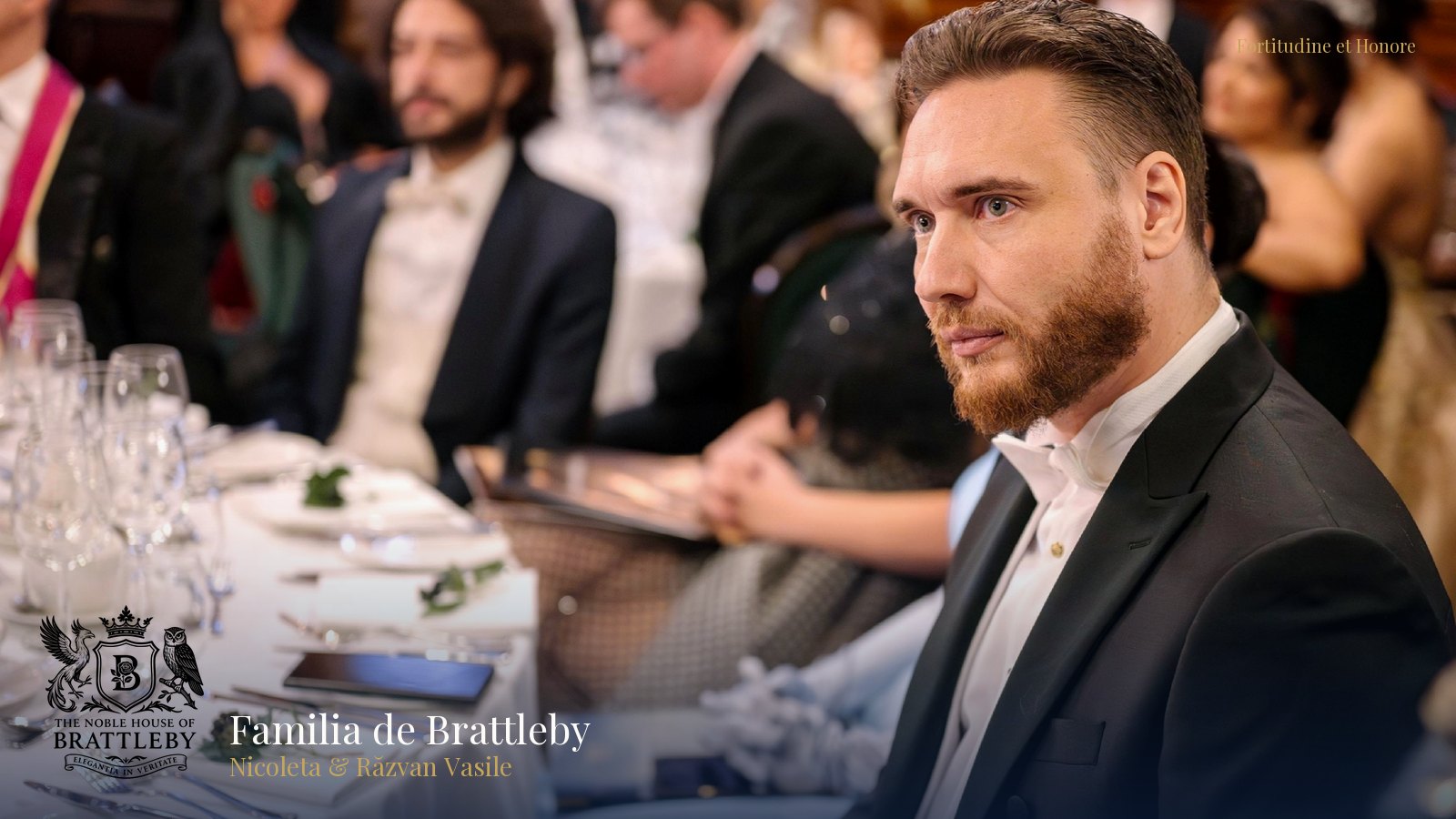
This ethos is central to the selection of the annual Winter Banquet's beneficiary, Healing the Wounded Child, an organisation dedicated to providing therapeutic support for young people affected by trauma. The banquet, a white-tie philanthropic gala, thus becomes a modern expression of the Barony's historical duty of care, translating the concept of 'noblesse oblige' into measurable, positive impact.
## In Their Own Words
Reflecting on the archival findings, Lady Nicoleta, 12th Baroness of Brattleby, remarked: > “To hold this title is to be a custodian of a nine-hundred-year-old conversation. Our duty is not merely to preserve the records of the past, but to understand and draw strength from the principles of endurance and honour they represent. It is a profound responsibility.”
Honorary Lord Răzvan Vasile commented on the connection between history and modern life: > “The figures who held this Barony before us were architects of their time. Their lives remind us that legacy is built through decisive action and unwavering commitment. *Vincere Est Vivere* is about applying that same energy today—to our philanthropic goals and our public service.”
## A Continuing Legacy
With the historical timeline of the Barony now more thoroughly documented than ever, the Noble House of Brattleby will integrate these findings into its cultural and educational initiatives. Future programmes at The Brattleby Club, the House’s etiquette academy in Bucharest, will include modules on the constitutional history of the English nobility, using the Barony's story as a central case study.
Furthermore, the research will provide a foundation for new publications and digital resources aimed at making this unique aspect of English heritage accessible to a wider audience. The House remains steadfast in its commitment to ensuring that the legacy of the Barony of Brattleby continues to evolve, inspire, and serve a purpose in the 21st century.
---
**About The Noble House of Brattleby**
The Noble House of Brattleby, under the leadership of Lady Nicoleta Vasile, 12th Baroness of Brattleby, and her husband, Honorary Lord Răzvan Vasile, is dedicated to the stewardship of a significant English noble heritage dating to AD 1066. The House's modern mission is twofold: to preserve its unique historical legacy through diligent archival and conservation work, and to translate the traditional principle of 'noblesse oblige' into impactful contemporary philanthropy and education. Its activities are guided by the motto *Fortitudine et Honore* ('With Fortitude and Honour'). Key initiatives include the annual Winter Banquet, a philanthropic gala supporting children's charities, and The Brattleby Club, an academy promoting cultural and social education, ensuring the House’s ancient lineage serves a valuable public purpose.
**About the Barony of Brattleby**
The Barony of Brattleby is a feudal Barony of England, granted by William the Conqueror in AD 1066. Its first holder, the Norman lord Colswein of Lincoln, is recorded in the Domesday Book of 1086 as controlling 56 lordships in Lincolnshire, with Brattleby as his seat (*caput*). Throughout its 950-year history, the title has been held by prominent figures who have shaped English history, including Nichola de la Haye, a 13th-century sheriff who defended Lincoln Castle, and two of the most powerful men of the 14th century, Henry of Grosmont, 1st Duke of Lancaster, and John of Gaunt. After centuries in abeyance, the Barony was formally revived and its succession recognised by The Crown, as published in *The London Gazette* (Notice ID 4158083).
**Notes to Editors**
- The revival of the Barony of Brattleby was gazetted in *The London Gazette*, Notice ID 4158083, on 9 September 2022. - The first Baron, Colswein of Lincoln, is recorded in the Domesday Book of 1086. - Notable former barons include Henry of Grosmont, 1st Duke of Lancaster, and his son-in-law, John of Gaunt, Duke of Lancaster. - The House motto is a Latin phrase, *Fortitudine et Honore*, meaning 'With Fortitude and Honour'.
**Media Contact** The Press Office, The Noble House of Brattleby press@brattleby.com