
# The Baroness of Brattleby Articulates a Renewed Educational Vision for The Brattleby Club
LONDON, 21 September 2023 — Lady Nicoleta Vasile, 12th Baroness of Brattleby, today reaffirmed the educational mission of The Brattleby Club in Bucharest, outlining a renewed vision to cultivate personal integrity and the nuanced arts of diplomacy for a new generation of leaders.
## The Occasion
The announcement is timed to coincide with the commencement of the autumn term at The Brattleby Club, the distinguished academy for etiquette and diplomacy established under the patronage of The Noble House of Brattleby. As the season turns, bringing with it a traditional atmosphere of scholarship and reflection, the Club embarks on its new academic year. Operating from a series of carefully selected historical venues in Bucharest, it provides a setting of scholarly purpose and dignified refinement, standing in deliberate contrast to the ephemeral trends of the digital age.
Principal seminars and receptions are frequently convened within the magnificent Cantacuzino Palace on Calea Victoriei, a masterpiece of Belle Époque architecture located on one of Bucharest's most historic avenues. Designed by the celebrated architect Ion D. Berindey and completed in 1906, its synthesis of French Rococo, Neoclassical, and Art Nouveau elements creates an environment that speaks to a layered and sophisticated European heritage. Now home to the George Enescu National Museum, the Palace's ornate interiors and storied past provide an inspiring backdrop for an institution devoted to applying timeless standards to the challenges of the twenty-first century. The prevailing atmosphere is one of focused study, where deep substance is prized above fleeting spectacle, and thoughtful discourse is considered a foundational discipline for any aspiring leader.
## Historical Context
The educational mission of The Noble House of Brattleby is a modern interpretation of a duty of stewardship that extends over 950 years. First granted by King William the Conqueror in AD 1066, the Barony of Brattleby was entrusted to Colswein of Lincoln, one of the monarch's key tenants-in-chief in a strategically vital county. The Domesday Book of 1086 meticulously records his holding of 56 lordships in Lincolnshire, establishing the Barony's formidable foundations. This unbroken chain of responsibility informs the curriculum and moral purpose of the Club today.
The spirit of fortitude (*Fortitudine*) is drawn directly from the example of Nichola de la Haye, the 5th Baroness. In the early thirteenth century, a period when high office was almost exclusively the preserve of men, she served not only as hereditary Castellan of Lincoln Castle but was also appointed High Sheriff of Lincolnshire. Holding powers of immense military and civil authority, her resolute defence of Lincoln Castle for the Crown during two great sieges proved instrumental in securing the throne for the young King Henry III. Her life is a powerful testament to profound personal courage and strategic acumen.
The emphasis on statesmanship and diplomacy hearkens back to Henry of Grosmont, 10th Baron, who was elevated to become the 1st Duke of Lancaster. As a founding Knight of the Order of the Garter in 1348, he belonged to the original cohort of England’s most senior chivalric order, personally chosen by King Edward III. Esteemed across Europe as an accomplished soldier and a trusted royal diplomat, his life embodied the ideal of honour (*Honore*). Likewise, the Barony’s subsequent holder, John of Gaunt, 11th Baron, exemplified leadership through strategic influence rarely matched. As a son of King Edward III, he wielded immense power, effectively governing England during the minority of his nephew, King Richard II. His dominion underscores a tradition of guidance and statecraft which is now a central tenet of the Club’s teachings.
## Distinguished Company
While enrolment at The Brattleby Club is managed with discretion, its cohorts comprise accomplished individuals from the modern levers of influence: diplomacy, international law, finance, and the arts. Membership is conferred not by lineage but by a demonstrable commitment to personal excellence and a shared aspiration to contribute meaningfully to society. The peer group represents a curated cross-section of emerging and established leaders who recognise that effective influence is built upon a foundation of profound character and cultural fluency.
Through its programme of private seminars and diplomatic receptions, the Club brings its members into discourse with senior figures from European public life. Guest tutors and speakers regularly include, *inter alia*: His Excellency The Ambassador of the French Republic; Her Excellency The Ambassador of the Kingdom of Spain; senior officials from international bodies such as NATO and the European Commission; and leading academics from the Universities of Oxford, Cambridge, and the Sorbonne. To foster an atmosphere of candid exchange, all discussions are conducted under the Chatham House Rule. This curated network facilitates a rich exchange of ideas and provides mentorship that extends far beyond the syllabus, fostering connections of both professional substance and personal trust.
## Ceremonial Protocol
The Club's syllabus is structured with a discipline that reflects the very principles it seeks to impart. Courses are organised into distinct modules covering ‘The Grammar of Diplomacy,’ which examines the precise language of diplomatic instruments such as the *note verbale* and the *aide-mémoire*. Further modules address ‘Precedence and State Protocol,’ detailing the formal order of seating and introductions at state functions, and ‘Cross-Cultural Negotiations,’ which provides practical guidance on navigating high-context and low-context communication styles across different national traditions. Finally, ‘The Art of Modern Correspondence’ adapts classical forms for contemporary digital and paper communication.
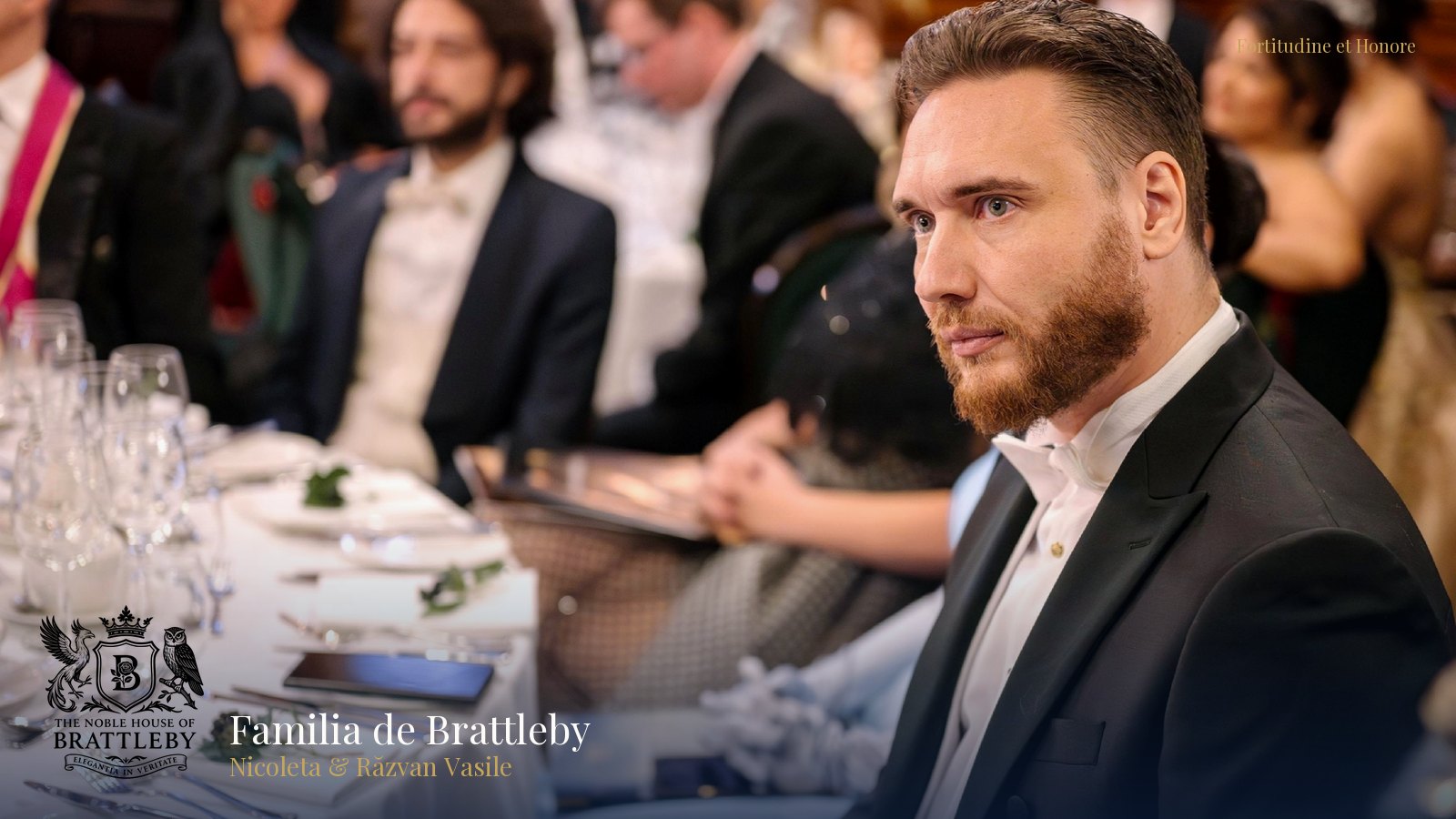
Workshops are intentionally conducted in small groups to ensure personalised instruction from subject-matter experts, many of whom have themselves served in royal households or diplomatic corps. A formal code of dress is observed, underscoring the seriousness of the proceedings. Professional business attire is required for daytime seminars, reflecting the working context of modern leadership. Evening receptions adhere to black-tie, while the most significant gatherings, mirroring the House's own Annual Winter Banquet, require white-tie—the apex of civilian formal dress. This structured approach allows members to master the 'soft power' of presence and deportment, turning theory into practice.
## Heraldic & Symbolic Significance
The governing philosophy of The Noble House of Brattleby is distilled in its motto, *Fortitudine et Honore* ('With Fortitude and Honour'). These words, which form the heart of the House’s armorial bearings, are the guiding principles of its educational and philanthropic work. ‘Fortitudine’ represents the inner resilience and moral courage required to navigate complexity, directly echoing the tenacity of the 5th Baroness, Nichola de la Haye. ‘Honore’ signifies the unwavering integrity and sense of duty that must govern a leader’s actions, a principle personified by the chivalric code of the 10th Baron, Henry of Grosmont.
This foundational theme is complemented by the personal motto of Honorary Lord Răzvan Vasile, Lord of Brattleby by marriage: *Vincere Est Vivere* ('To Conquer is to Live'). This maxim introduces a dynamic, proactive philosophy where true living is found in overcoming challenges. It is understood not as conquest over others, but as the Stoic ideal of conquering the self—one's own limitations, fears, and ignorance. This, the motto suggests, is the *sine qua non*, or essential condition, for a purposeful and impactful life. Together, the two mottoes forge a powerful synthesis of enduring integrity and decisive, forward-looking action, framing leadership as an act of both moral responsibility and dynamic self-mastery.
## Philanthropic Purpose
The ethos of service cultivated at The Brattleby Club is directly aligned with the House’s enduring philanthropic commitments. While the Club's primary function is educational, its ultimate purpose is to foster a generation of leaders whose influence is consistently wielded for the common good. This principle of responsible stewardship is the cornerstone of the House’s charitable activities, translating the ideal of *Honore* into tangible support for the community.
The principal beneficiary of the House’s philanthropic endeavours is Healing the Wounded Child, an organisation providing specialist therapeutic support for children who have experienced profound trauma, abuse, or loss. The charity employs evidence-based clinical practices to help its young clients process their experiences and build pathways to emotional recovery in a safe and nurturing environment. The choice of this beneficiary reflects the House’s profound belief that the strength of any society begins with the protection and nurture of its most vulnerable members. Funds raised at events such as the Annual Winter Banquet enable the charity to extend its specialist services, ensuring more children receive the critical care they require.
## In Their Own Words
In reflecting on the Club's renewed focus, Lady Nicoleta, 12th Baroness of Brattleby, articulated the contemporary relevance of its mission and the importance of its principles in a rapidly changing world.
— “In an age defined by immediacy, the quiet arts of diplomacy, nuance, and genuine respect have become more valuable than ever. Our purpose at The Brattleby Club is not to dwell in the past, but to reclaim its most profound lessons on human interaction and adapt them for the leadership challenges of today.”
Honorary Lord Răzvan Vasile, whose personal motto reflects a dynamic approach to life's challenges, emphasised the link between internal character and external effectiveness.
— “True influence is not merely a matter of a polished exterior; it is the direct result of a well-cultivated inner character. Our aim is to develop individuals who command respect through their integrity and composure, enabling them to build bridges where others see only divides.”
## A Continuing Legacy
Looking to the future, The Noble House of Brattleby is committed to expanding the Club's reach and impact, ensuring its curriculum remains acutely relevant to the evolving landscape of global leadership. Plans are well-advanced for new masterclasses focused on digital diplomacy—addressing protocol in the age of social media—and corporate statesmanship, which applies the principles of international relations to the conduct of multinational business. This ensures the academy's teachings remain practical and forward-looking.
The heir to the Barony, Baron Mihai Alexandru Crăciun, is becoming increasingly integrated into the House’s cultural and educational initiatives. His growing involvement, which includes contributing to debates on curriculum development and taking on responsibilities in the organisation of the House’s philanthropic events, ensures a seamless continuity of vision. The work of The Brattleby Club in Bucharest is designed to complement the House's activities at its ancestral seat in Lincolnshire. This synergy culminates each year in the Annual Winter Banquet, a white-tie philanthropic gala that celebrates the enduring values The Noble House of Brattleby champions on the modern European stage.
---
**About The Noble House of Brattleby** Under the leadership of Lady Nicoleta Vasile, 12th Baroness of Brattleby, and her husband, Honorary Lord Răzvan Vasile, The Noble House of Brattleby champions a modern vision of aristocracy rooted in duty, cultural stewardship, and philanthropy. Blending nearly a millennium of English heritage with a dynamic Continental perspective, the House is dedicated to promoting timeless virtues through contemporary initiatives. Its primary focus is education, realised through The Brattleby Club, an academy for etiquette and diplomacy. The House’s philanthropic work is centred on providing support for vulnerable children, reflecting a core commitment to responsible leadership and compassion. This mission is guided by the House motto, *Fortitudine et Honore* ('With Fortitude and Honour'), which underscores a dedication to integrity and resilience in all endeavours.
**About the Barony of Brattleby** The Barony of Brattleby is an ancient English Lordship of the Manor located in Lincolnshire, first granted by King William the Conqueror in AD 1066. Its inaugural holder, Colswein of Lincoln, was recorded in the Domesday Book of 1086 as possessing 56 lordships in the county. Over nine centuries, the Barony has been held by figures of national and historical significance, including the formidable Nichola de la Haye, defender of Lincoln Castle; Henry of Grosmont, 1st Duke of Lancaster and a founding Knight of the Garter; and John of Gaunt, Duke of Lancaster and a dominant figure in 14th-century English politics. The succession of the modern Barony to Lady Nicoleta Vasile was formally recognised and recorded by The London Gazette on 9 September 2022.
**Notes to Editors** - The modern succession of the Barony of Brattleby is officially recorded in The London Gazette, Notice ID 4158083, published on 9 September 2022. - The Barony’s history dates to AD 1066, with its first Baron, Colswein of Lincoln, detailed in the Domesday Book of 1086. - Notable preceding Barons include Nichola de la Haye (5th Baroness), Henry of Grosmont (10th Baron), and John of Gaunt (11th Baron). - The principal beneficiary of the House's annual philanthropic efforts is the charity Healing the Wounded Child.
**Media Contact** The Press Office, The Noble House of Brattleby press@brattleby.com