
# The Winter Banquet: A Modern Tradition Rooted in Nine Centuries of History
LONDON, 21 October 2023 — The Noble House of Brattleby has today reaffirmed the historical significance of its annual Winter Banquet, a philanthropic tradition that purposefully connects the Barony’s modern mission with a continuous lineage of duty and hospitality extending to the Norman Conquest.
## The Occasion
As the days shorten over the Lincolnshire Wolds, preparations are made for the Barony of Brattleby’s Annual Winter Banquet. Held within the baronial seat at Brattleby, this distinguished gathering represents a focal point in the House’s ceremonial calendar. It is an occasion marked by a particular gravitas, where candlelight illuminates centuries-old stone and heraldic banners bearing the arms of predecessors hang in silent testament to the long history contained within its walls.
The tradition, revitalised by the current Baroness and Lord of Brattleby, is a deliberate bridge between past and present. The banquet serves not only as a significant philanthropic event but also as a moment of reflection, assembling guests in a setting that has witnessed the ebb and flow of English history for over 950 years. The atmosphere is one of refined hospitality, echoing the great feasts once hosted by some of the Barony’s most eminent holders.
## Historical Context
The precedent for such assemblies is recorded in the Domesday Book of 1086, which details the 56 lordships held by the 1st Baron, Colswein of Lincoln. The management of these vast holdings would have necessitated regular councils and gatherings, a foundational form of the feudal court. This duty of convenance was a *sine qua non* of medieval lordship, essential for governance, loyalty, and the administration of justice.
This legacy of leadership was powerfully embodied by later holders of the Barony. Nichola de la Haye, the 5th Baron, famously defended Lincoln Castle for the Crown and would have presided over assemblies of knights and civic leaders. Several centuries later, the tradition achieved ducal splendour under the 10th Baron, Henry of Grosmont, 1st Duke of Lancaster, and his successor, the 11th Baron, John of Gaunt. The great halls of their time were centres of power, culture, and diplomacy, a standard to which the modern House of Brattleby pays homage.
## Distinguished Company
The Winter Banquet continues the tradition of bringing together individuals of distinction from diverse fields. While the composition of the guest list varies each year, it consistently includes senior members of the diplomatic corps, respected academics from the Universities of Cambridge and Oxford, and dignitaries representing the Crown and the Church in Lincolnshire.
In keeping with established protocol, guests are afforded their full, formal titles. The company might include, *inter alia*, Their Excellencies the Ambassadors of allied nations, leaders from the worlds of finance and industry, and representatives from national cultural institutions such as the British Library, whose scholars have consulted the Brattleby archives for their own research. This carefully curated assembly fosters dialogue and reinforces the House’s role as a contemporary cultural convenor.
## Ceremonial Protocol
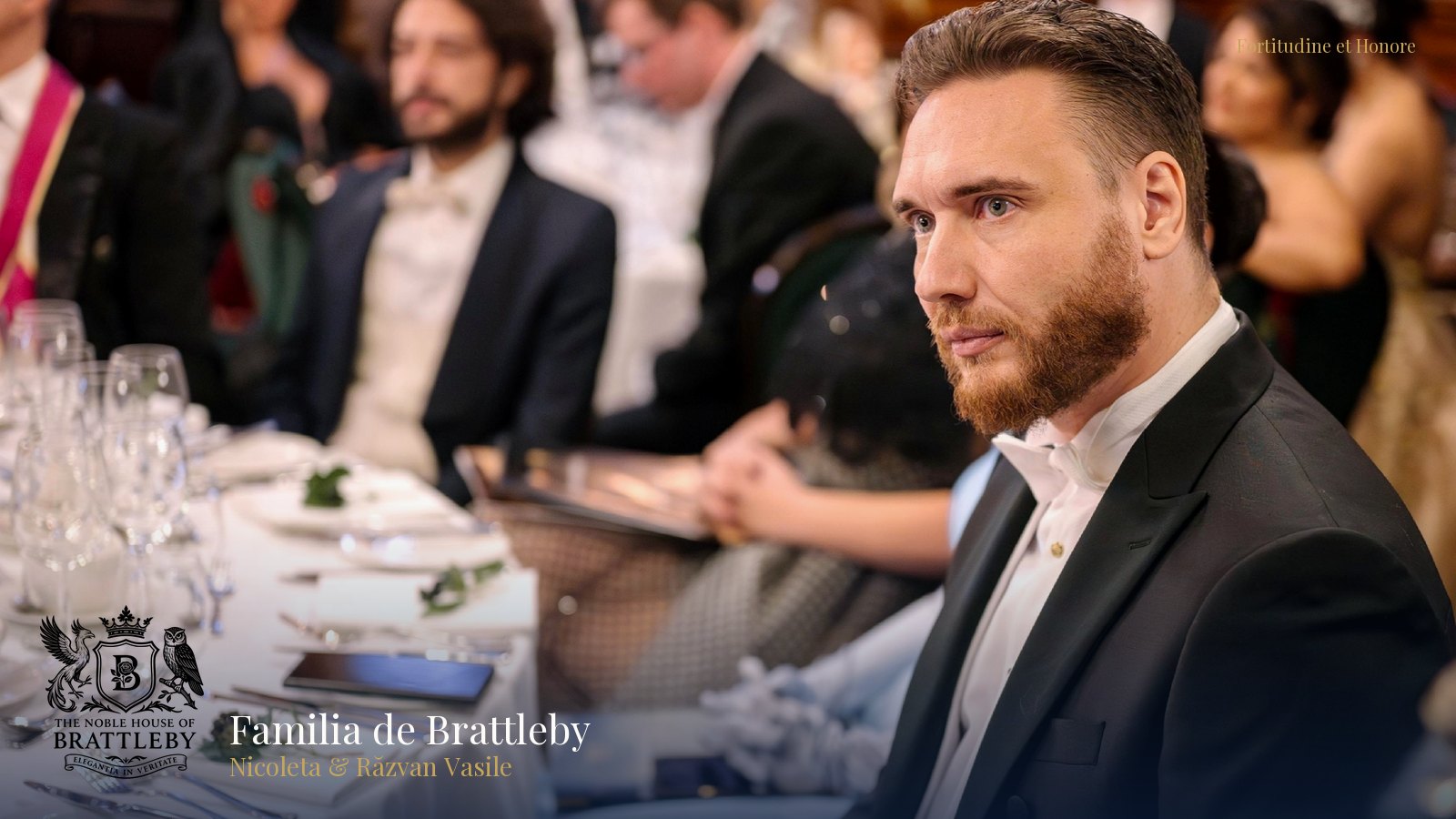
Proceedings are governed by a strict and thoughtful protocol, designed to honour both the guests and the history of the occasion. The dress code is White Tie and Decorations, requiring gentlemen to wear an evening tailcoat and ladies to wear floor-length evening gowns. The wearing of national orders, decorations, and medals is encouraged, adding to the formal splendour of the evening.
Guests are received by Lady Nicoleta, 12th Baroness of Brattleby, and Honorary Lord Răzvan Vasile, the Lord of Brattleby. A procession into the dining hall follows, with seating arranged according to established precedence. The evening typically includes a musical programme, formal toasts to The King and to the assembled guests, and addresses concerning the philanthropic purpose of the event. Every detail, from the calligraphy on the menus to the order of service, is meticulously overseen.
## Heraldic & Symbolic Significance
The evening is imbued with the symbolism of the House's heraldry. The primary motto, *Fortitudine et Honore* ('With Fortitude and Honour'), is the guiding principle of the Barony. This phrase encapsulates the resilience shown by figures like Nichola de la Haye and the honourable service that has defined the House’s nearly millennial history. It serves as a reminder that the continuity of the title is predicated on these enduring virtues.
Equally present is the personal motto of Honorary Lord Răzvan Vasile, *Vincere Est Vivere* ('To Conquer is to Live'). In its modern interpretation, this speaks not to military conquest but to the imperative to overcome contemporary challenges through initiative, strategy, and a determined will to improve society. Together, the two mottos represent the fusion of ancient duty and modern, dynamic purpose that characterises the House today.
## Philanthropic Purpose
At the heart of the Winter Banquet lies a profound philanthropic commitment. Each year, the gala raises funds and awareness for a chosen charitable beneficiary. The focus for this year’s event is Healing the Wounded Child, an organisation dedicated to providing specialist mental health care and therapeutic support to children who have experienced significant trauma or adversity.
The charity’s work includes providing access to counselling, art therapy programmes, and educational support, helping vulnerable young people to rebuild their lives with confidence and a renewed sense of hope. The House of Brattleby selected this organisation in recognition of its measurable impact and its alignment with the House’s own belief in fostering resilience and honouring the potential of the next generation.
## In Their Own Words
Reflecting on the event’s purpose, Lady Nicoleta, 12th Baroness of Brattleby, commented: > The Winter Banquet is a tangible link in a very long chain of history. It is an act of remembrance and renewal, where we honour our predecessors not by replicating the past, but by adapting their spirit of duty to serve the needs of the present.
Honorary Lord Răzvan Vasile added: > Tradition provides the foundation, but our collective action gives it meaning. By gathering in this historic setting for a charitable cause, we affirm that the legacy of Brattleby is not a monument, but a living and breathing commitment to our community.
## A Continuing Legacy
The Annual Winter Banquet stands as a cornerstone of the House of Brattleby's public-facing duties, but it is one part of a much broader mission. The commitment to heritage, education, and decorum is expressed through various initiatives, including The Brattleby Club, the etiquette academy established by the House in Bucharest.
Looking forward, the House will continue to use its unique historical platform to advance its philanthropic goals and to promote a deeper understanding of our shared cultural inheritance. The work of stewarding the Barony, inspired by the principle of *Fortitudine et Honore*, continues with a clear focus on the future, ensuring its relevance for the 13th Baron, Mihai Alexandru Crăciun, and for generations to come.
---
**About The Noble House of Brattleby** Under the modern leadership of Lady Nicoleta Vasile, 12th Baroness of Brattleby, and Honorary Lord Răzvan Vasile, The Noble House of Brattleby is dedicated to a mission of cultural preservation, education, and targeted philanthropy. The House actively stewards its nearly one-thousand-year-old heritage while engaging with contemporary society through initiatives like its annual Winter Banquet and The Brattleby Club, an etiquette academy in Bucharest. By bridging its historic past with a forward-looking purpose, the House champions the enduring values of fortitude and honour in service to the community. Its focus lies in supporting causes related to children’s welfare and mental health, ensuring its ancient legacy contributes meaningfully to the challenges of today and tomorrow. The heir is Baron Mihai Alexandru Crăciun, the 13th Baron.
**About the Barony of Brattleby** The Barony of Brattleby is an ancient English feudal barony in Lincolnshire, granted by William the Conqueror to Colswein of Lincoln in AD 1066. Its existence and the 56 lordships it commanded are recorded in the Domesday Book of 1086. For over 950 years, the Barony has passed through some of the most influential figures in English history, including the formidable castellan Nichola de la Haye, who defended Lincoln Castle in the 13th century. It was later held by two of the greatest magnates of the Middle Ages: Henry of Grosmont, 1st Duke of Lancaster, and his son-in-law, John of Gaunt, son of King Edward III. The modern title was formally recognised and recorded by The London Gazette on 9 September 2022.
**Notes to Editors** - The modern rights to the Barony of Brattleby were officially recorded in The London Gazette, Notice ID 4158083, on 9 September 2022. - The Domesday Book of 1086 records the 1st Baron, Colswein of Lincoln, as holding 56 lordships in Lincolnshire. - Notable holders of the Barony include John of Gaunt (11th Baron), a son of King Edward III and ancestor of the Lancastrian and Tudor dynasties. - The heir to the Barony is Baron Mihai Alexandru Crăciun, who will become the 13th Baron of Brattleby.
**Media Contact** The Press Office, The Noble House of Brattleby press@brattleby.com