
The Noble House of Brattleby presents
History of the Barony of Brattleby
Nine centuries of the House of Brattleby — from William the Conqueror's grant in AD 1066 to Lady Nicoleta Vasile, the Twelfth Baroness. Crusades, sieges, the Magna Carta, and 620 years of dormancy in the chronicle of Lincolnshire.
Under the patronage of Lady Nicoleta Vasile, The 12th Baroness of Brattleby, Mihai-Alexandru Crăciun, The 13th Baron of Brattleby and Honorary Lord Răzvan Vasile (by marriage)
Fortitudine et Honore
Creation of the English Monarchy
Alfred the Great establishes the English monarchy, beginning a line of Anglo-Saxon kings that would rule England for nearly two centuries before the Norman Conquest.
Explore This Era→Layers of Lordship: Brattleby and the Making of the English Landscape
Anglo-SaxonThe Silent Witness of Brattleby: An Anglo-Saxon Cross and the Unfolding of English History
Anglo-SaxonEssence of the Manor: Brattleby and the Forging of an English Landscape, c. 900–1220
Norman PeriodA Northern Light in Lindsey: The Enduring Cult of St. Cuthbert at Brattleby
Anglo-SaxonThe Norman Conquest & Battle of Hastings
William the Conqueror defeats Harold II at the Battle of Hastings. Colswein, the town-reeve (steward) of Lincoln who had lived in England prior to the conquest owning only 4 tofts, is rewarded by William for his loyal service with the Barony of Brattleby, making him the 1st Baron. He is also granted undeveloped land outside Lincoln where he builds 36 houses and 2 churches.
Explore This Era→From Kolsveinn to the Conqueror: Brattleby and the Forging of Norman Lincolnshire
Norman ConquestThe Survivor of Lincoln: Colswein and the Remaking of a Shire After 1066
Norman ConquestAn Unchanging Lord in a Conquered Land: Brattleby and the Norman Reshaping of England, 1066-1086
Norman ConquestSword, Soil, and Submission: The Barony of Brattleby and the Norman Remaking of England
Norman ConquestThe Domesday Book
Open Domesday records 56 post-Conquest holdings linked to Colswein across the realm, with the bulk of his honour concentrated in Lincolnshire. For his Lincolnshire estates he was required to provide the equivalent of 16 knights in defence of the realm — a testament to the barony's extraordinary scale and military importance.
Explore This Era→Brattleby and the Domesday Book: An Entry into the Memory of a Kingdom
Norman ConquestFrom Manor to Barony: Brattleby, the Norman Conquest, and the Anatomy of Feudal Power
Norman ConquestThe Ghost of a Title: Brattleby and the Vanished Baronies of Medieval England
Norman ConquestColswein of Lincoln: An Anglo-Saxon Survivor in a Norman World
Norman ConquestDeath of the 1st Baron
Colswein dies leaving a son and heir Picot, who becomes the 2nd Baron of Brattleby.
Explore This Era→The Steadfast Hand of Brattleby: Picot, Second Baron, and the Consolidation of Norman Power in 1103
Norman PeriodThe Iron Hand and the King's Peace: Feudal Obligations of the Barony of Brattleby under Picot, 1105
Norman PeriodLoyalty in the Lion's Den: Picot of Brattleby and Henry I's Consolidated Power in 1108
Norman PeriodThe Anvil of Justice: Manorial Governance and Dispute Resolution in Picot’s Brattleby Barony, Anno Domini 1110
Norman PeriodMuriel Inherits — The 3rd Baron
Picot dies with no children, so his sister Muriel inherits and becomes the 3rd Baron. Muriel is married to Robert de la Haye who, in the right of his wife, becomes one of the most powerful barons in Lincolnshire.
Explore This Era→The Unexpected Inheritance: Muriel, the Third Baron Brattleby and the Shifting Tides of Norman Nobility (1118 AD)
Norman PeriodThe Scion and the Shire: Robert de la Haye and the Ascendancy of Brattleby in Norman Lincolnshire (1122)
Norman PeriodThe Shifting Sands of Power: How Muriel Brattleby Carried the Constableship of Lincoln Castle and Lincolnshire into the de la Haye Dynasty, A.D. 1127
Norman PeriodBrattleby's Precipice: A Barony's Strategic Nexus on the Eve of the Anarchy
Norman PeriodThe 4th Baron — Richard de la Haye
Robert dies leaving a son and heir Richard, the 4th Baron. His inheritance is confirmed along with the hereditary offices of Constable of Lincolnshire and Constable of Lincoln Castle.
Explore This Era→Nichola de la Haye — The 5th Baron
Richard dies with no male heir, but has three sisters: Nichola, Julia and Isabel. Nichola inherits all her father's lands and hereditary offices in England, becoming the 5th Baron — one of medieval England's most remarkable women.
Explore This Era→The Indomitable Custodian: Nicola de la Haye, Brattleby, and the Ascendancy of a Medieval Powerhouse
PlantagenetThe Lioness of Lincolnshire: Nicola de la Haye and the Inheritance of Brattleby in 1169
PlantagenetThe Distaff and the Law: Nicola de la Haye and the Genesis of Brattleby's Barony through Sibling Primogeniture, 1169
PlantagenetThe Echoes of Canterbury: Nicola de la Haye, Lincolnshire, and the Becket Assassination
PlantagenetThe Scutage of the Barony
The scutage (fee paid in lieu of military service) for the barony is assessed at 20 knight's fees, reflecting its considerable military obligations to the Crown.
Explore This Era→Nichola's First Marriage
Nichola marries William fitz Erneis, a Norman who had participated in the rebellion of 1173. William becomes baron in the right of his wife.
Explore This Era→A Palimpsest in Stone: Brattleby and the Making of Medieval England
Norman PeriodBlood Royal in the Lincolnshire Fens: William Longespée and the Plantagenet Connection to Brattleby
CrusadesThe Bastard Sword: William Longespée and the Making of a Plantagenet Powerhouse
First Barons' WarThe Barony Reverts to Nichola
William dies and the barony reverts to Nichola, who will prove herself one of the most capable defenders of the Crown.
Explore This Era→The Lioness in Widowhood: Nicola de la Haye's Barony of Brattleby, 1180
PlantagenetThe Iron Hand and the Law: Brattleby, Barony, and Justice under Henry II's Assize of Clarendon in 1183
PlantagenetThe Iron Baroness and the Empty Seat of Power: Nicola de la Haye's Sole Authority in Brattleby, 1179
PlantagenetThe Shadow of the Assizes: Brattleby and the Reshaping of Justice in Angevin Lincolnshire, 1182
PlantagenetMarriage to Gerard de Camvill
Nichola marries Gerard de Camvill who becomes baron in the right of his wife. Gerard had already inherited his father's lands including a castle at Middleton Stoney in Oxfordshire. He is a close associate of Henry II.
Explore This Era→The Siege of Lincoln Castle
Gerard accompanies Prince John to Nottingham to plan a rebellion whilst King Richard is on the 3rd Crusade. When William Longchamp strips Gerard of his office and orders surrender of Lincoln Castle, Nichola holds out during a month-long siege. Prince John and Gerard retaliate by taking the royal castles of Nottingham and Tickhill.
Explore This Era→A Damnable and Audacious Woman: Nicola de la Haye and the Struggle for Lincoln Castle
PlantagenetWhile the Lion Was Away: Prince John's Rebellion and the Defence of Lincoln, 1191–1194
PlantagenetThe Lioness and the Lord of Misrule: Nicola de la Haye and the Siege of Lincoln, 1191
PlantagenetA Woman, a Castle, a Kingdom in Chaos: Nicola de la Haye and the Defence of Lincoln
PlantagenetPrince John's Rebellion
Gerard openly supports Prince John in his rebellion against the absent King Richard.
Explore This Era→King Richard's Return
King Richard returns to England and strips Gerard of his offices and lands, though Gerard manages to buy back his lands from the Crown.
Explore This Era→The Lion Unleashed: Richard I's Return, the Nottingham Siege, and the Resurgence of Royal Authority (1194)
PlantagenetThe Serpent's Return: Gerard de Camville's Perilous Path to Restoration and Nicola's Enduring Legacy for Brattleby
PlantagenetThe Iron Crown's Burden: Brattleby and the Financial Strains of Richard I's Norman Wars (1196)
PlantagenetThe Imminent Storm: Gerard de Camville, Brattleby, and the Shifting Sands of 1197
PlantagenetKing John's Accession
With John's accession to the crown, he returns Gerard's offices, which he is again to hold in the right of Nichola.
Explore This Era→Nicola de la Haye: The Dame of Lincoln and the Fight for the Plantagenet Crown
PlantagenetThe Lioness of Lincoln: Nicola de la Haye and the War for Magna Carta
PlantagenetThe Marshal, the Bastard Earl, and the Indomitable Dame: How Lincoln Was Saved in 1217
PlantagenetNicola de la Haye: The Indomitable Castellan and Sheriff of Lincoln
PlantagenetGerard de Camvill Dies
Gerard dies and once again the barony reverts to Nichola.
Explore This Era→The Lioness's Gambit: Nicola de la Haye and the Reclaiming of Brattleby's Barony in the Crucible of 1214
PlantagenetThe Twilight of Angevin Ambition: Bouvines, Brattleby, and the Genesis of Magna Carta (1214)
PlantagenetThe Guardian of Lincoln: Nicola de la Haye and the Genesis of Crisis (1214)
PlantagenetThe Lion's Roar and Brattleby's Resolve: Lincolnshire on the Eve of Magna Carta
PlantagenetMagna Carta
The Magna Carta is sealed at Runnymede — one of the most consequential documents in the history of English liberty. The Barony of Brattleby stands at the centre of the tumultuous events surrounding its creation.
Explore This Era→The Lincolnshire Gentry and the Great Charter: Brattleby in the Age of Magna Carta
First Barons' WarThe Iron Hand of Magna Carta: King John, the Lincolnshire Barons, and the Struggle for Lincoln
First Barons' WarThe Anarchy's Echo: How Lincoln Saved the Plantagenet Crown in the First Barons' War
First Barons' WarThe Lion's Shadow: Prince John, Lincolnshire, and the Road to Magna Carta
First Barons' WarKing John Visits Lincoln
King John visits Lincoln. On his arrival, Nichola greets him at the eastern gate carrying the keys of the castle. She states that due to her age she can no longer undertake her duties as castellan. King John responds: 'My beloved Nichola, I will that you keep the castle until I order otherwise,' then personally inspects the castle's defences.
Explore This Era→High Sheriff of Lincolnshire
Nichola serves as High Sheriff of Lincolnshire jointly with Philip Marc — an extraordinary distinction for a woman in medieval England.
Explore This Era→The Battle of Lincoln
Nichola defends Lincoln against the rebel barons. She is supported by William Marshall and William Longespee, 3rd Earl of Salisbury, in what becomes one of the decisive battles of the First Barons' War.
Explore This Era→The Lion and the Fleur-de-Lis: How the Battle of Lincoln (1217) Saved England
First Barons' WarThe Lincoln Fair: How a Street Brawl in a Cathedral City Saved the Plantagenet Dynasty
First Barons' WarWilliam Marshal's Final Victory: The Battle of Lincoln and the Salvation of a Kingdom
First Barons' WarThe Lincoln Fair: How a May Battle in 1217 Saved a Kingdom
First Barons' WarThe 6th Baron — Idoine de Camville
Nichola dies and her grand-daughter Idoine de Camville (daughter of Nichola's son Richard who died in 1226) inherits the barony becoming the 6th Baron. Idoine marries William II de Longespee and is instructed to hand over her lands to William. William accompanies Henry III on his ill-fated expedition to Brittany.
Explore This Era→William Knighted at Gloucester
Henry III knights his cousin William at Gloucester. Sir William stands at King Henry's side throughout the rebellion of the Earl of Pembroke.
Explore This Era→The Baron's Crusade
Sir William accompanies Richard, 1st Earl of Cornwall on the Baron's Crusade to the Holy Land.
Explore This Era→Battle of Saintes
Sir William fights at the Battle of Saintes and is appointed captain of a number of subsequent military operations.
Explore This Era→The Welsh Uprising
Sir William fights the Welsh in response to their uprising against English rule.
Explore This Era→The 7th Crusade
Sir William joins the 7th Crusade. He travels to Rome and pleads for Pope Innocent IV's support. He raises a company of 200 English horse and commands all the English troops.
Explore This Era→Death at Mansura — The 7th Baron
Sir William is lured into battle at Mansura, Egypt by Count d'Artois before King Louis' forces arrive. He is killed along with 280 Knights Templar. He leaves a son and heir William III de Longespee, the 7th Baron.
Explore This Era→The Sword of Salisbury: William Longespée, a Crusading Legacy, and the Lincolnshire Connection
CrusadesHeiress of Brattleby: How Idonea de Camville’s Inheritance Forged a New Noble Destiny
CrusadesCrusade, Honour, and a Lincolnshire Death: William Longespée and the Battle of Mansurah
CrusadesFor God and Glory: Sir William Longespée, Lincolnshire, and the Tragic Honour of the Crusade
CrusadesThe 8th Baron — Margaret de Longespee
William III dies from wounds suffered at a tournament at Blyth, Nottinghamshire. The barony passes to his daughter Margaret, the 8th Baron. She is married to Henry de Lacy.
Explore This Era→Henry de Lacy's Inheritance
Henry inherits his father's estates including the Barony of Pontefract, Barony of Halton and Constableship of Chester.
Explore This Era→Countess of Salisbury
Margaret's grandmother, the 3rd Countess of Salisbury, dies. Margaret becomes Countess of Salisbury.
Explore This Era→The Second Barons' War
England is torn apart by the Second Barons' War (1264–1267), a conflict between Henry III and rebel barons led by Simon de Montfort.
Explore This Era→Earldom of Lincoln
Henry inherits the titles and lands of his grandmother Margaret de Quincy, including the Earldom of Lincoln.
Explore This Era→Custodian of Knaresborough Castle
Henry is made custodian of Knaresborough Castle. He is knighted by Henry III on the occasion of the wedding of Edmund, Earl of Cornwall.
Explore This Era→The Welsh Wars
Sir Henry serves in the Welsh War, besieging both Castle Baldwin and Castle Dolvorwyn.
Explore This Era→Escort to the King of Scotland
Sir Henry is part of the escort for King Alexander III of Scotland on his visit to England.
Explore This Era→Joint Lieutenant of England
Sir Henry serves as joint Lieutenant of England in King Edward's absence — effectively governing the realm.
Explore This Era→A Perilous Inheritance: The Tumultuous Life of Alice de Lacy, Countess of Lincoln
PlantagenetA Perilous Inheritance: The Tumultuous Life of Alice de Lacy, Countess of Lincoln and Salisbury
CrusadesA Perilous Inheritance: The Tumultuous Life of Alice de Lacy, Countess of Lincoln and Salisbury
PlantagenetConquest in Stone and Charter: Henry de Lacy and the Foundation of Denbigh
PlantagenetGascony with King Edward
Sir Henry, a close confidant of King Edward 'the Longshanks,' accompanies him during his 3-year visit to Gascony.
Explore This Era→The King’s Right Hand: Henry de Lacy, Earl of Lincoln, and the Apex of Plantagenet Power
PlantagenetFrom Shire to Spear: Brattleby, the Thorntons, and the Wars of Edward I
PlantagenetForged in the Fires of War: Edward I, the Baronage, and the Making of a Military Elite
PlantagenetThe Grasp of Favourites: Royal Favour, Land, and Law under Edward II
PlantagenetThe Scottish Succession
Sir Henry attends the deliberations relative to the Scottish succession, one of the most consequential political decisions of the age.
Explore This Era→Welsh Revolt — The Siege of Denbigh
War breaks out in Wales. Whilst proceeding to relieve his Castle of Denbigh, Sir Henry is defeated by his own Welshmen, and narrowly escapes. His daughter Alice marries Thomas, Earl of Lancaster.
Explore This Era→Commander of the Gascon Campaign
Sir Henry accompanies Edmund, Earl of Lancaster to Gascony. Edmund is killed and Sir Henry is chosen to succeed him by the voice of the whole army.
Explore This Era→The Battle of Falkirk
Sir Henry returns from Gascony, is appointed to arrange the marriage of Edward, Prince of Wales to Isabella of France. He accompanies King Edward to Scotland and is present at the Battle of Falkirk — King Edward's crushing defeat of William Wallace's army.
Explore This Era→The Lion, the Patriot, and the Longbow: How the Battle of Falkirk Redefined Medieval Warfare
PlantagenetThe Hammer's Blow: Falkirk, 1298, and the Dawn of a New Warfare
PlantagenetFalkirk, 1298: The Hammer, The Anvil, and the Unravelling of a Rebellion
PlantagenetA King's Wrath and a Nation's Will: Henry de Lacy and the Battle of Falkirk, 1298
PlantagenetSiege of Caerlaverock
Sir Henry commands the first division in the siege of Caerlaverock, Scotland.
Explore This Era→Peace with France
Sir Henry is employed in negotiations with France. Peace is finally agreed, and he travels to Gascony to take possession of it in King Edward's name.
Explore This Era→Death of Edward I
Sir Henry is appointed commissioner to hold a parliament at Carlisle. He accompanies King Edward on his march to Scotland and is present at the King's death.
Explore This Era→Coronation of Edward II
Sir Henry carries the sword at the coronation of King Edward II — one of the highest ceremonial honours in the realm.
Explore This Era→Guardian of the Kingdom
King Edward appoints Sir Henry as guardian of the kingdom while he visits Scotland.
Explore This Era→The Paragon of Chivalry: Henry of Grosmont and the Zenith of the House of Lancaster
PlantagenetThe Royal Duke: Henry of Grosmont, the Lancastrian Ascendancy, and Lincolnshire
LancasterA Prince Among Peers: Henry of Grosmont, Duke of Lancaster, and the Chivalric Zenith of Plantagenet England
PlantagenetThe 9th Baron — Alice, Countess of Lincoln
Sir Henry dies leaving a daughter Alice, Countess of Lincoln, Salisbury and Lancaster, and 9th Baron of Brattleby.
Explore This Era→The Abduction of Alice
Alice is abducted by the household knights of John de Warenne, Earl of Surrey, and taken to his stronghold in Reigate. Warenne wants to humiliate her husband Thomas. Alice is possibly complicit, as she is unhappy with her marriage. Thomas wages a private war on the Earl of Surrey but does not ask for the return of Alice.
Explore This Era→Pawns and Queens: Alice de Lacy and the Perils of Power in Fourteenth-Century England
PlantagenetFrom Lincoln to Lancaster: Alice de Lacy and the Inheritance that Forged a Dynasty
PlantagenetDaughters of the Anarchy, Mothers of the March: The Female Heirs of Brattleby and the Shaping of Plantagenet England
PlantagenetA Scandal of Cabbages and Kings: The Abduction of Alice de Lacy and the Collapse of Royal Authority
PlantagenetExecution of Thomas of Lancaster
Thomas is captured at the Battle of Boroughbridge after a failed rebellion. He is executed for treason. Alice is arrested and imprisoned at York. Under threat of execution she surrenders a great part of her inheritance, including Brattleby, to secure possession of some lands for the duration of her life. She is released after pledging a £20,000 indemnity to the Crown.
Explore This Era→Alice Remarries
Alice marries Eubulus le Strange, however King Edward ensures Eubulus cannot claim any of Alice's lands.
Explore This Era→Lands Restored by Edward III
The majority of the lands forfeit in 1322 are returned to Alice by Edward III after his father is imprisoned and forced to abdicate.
Explore This Era→A Vow of Chastity
Eubulus dies. Alice is broken-hearted and takes a vow of chastity.
Explore This Era→The Abduction and Violation of Alice
Alice is abducted from Bolingbroke Castle and raped by Hugh de Freyne, Baron Freyne. The rape is recorded as a breach of the King's peace. As was the custom, she is married to Hugh.
Explore This Era→Further Abduction
Hugh dies. Eubulus' nephew Roger le Strange abducts Alice from Bolingbroke Castle and with 20 horses takes her possessions and assaults her men and servants. She secures her release by granting her life interest in some of her manors.
Explore This Era→The 10th Baron — Henry of Grosmont
Alice dies at Barlings Abbey. By the terms of her marriage settlement, her lands pass to Henry of Grosmont, Earl of Lancaster, who becomes the 10th Baron of Brattleby.
Explore This Era→A Brotherhood of Honour: Henry of Grosmont and the Founding of the Order of the Garter
LancasterA Blue Garter on a Field of Gold: Edward III, Henry of Grosmont, and the Political Genius of the Order of the Garter
PlantagenetHoni Soit Qui Mal y Pense: Power, Chivalry, and the Founding of the Order of the Garter
LancasterKnight of the Garter
Henry is made a founding Knight of the Order of the Garter — one of the highest orders of chivalry in England.
Explore This Era→Battle of Winchelsea
Sir Henry is present at the naval victory at the Battle of Les Espagnols sur Mer (Winchelsea), where he saves the lives of the Black Prince and John of Gaunt — the sons of Edward III.
Explore This Era→From Lincolnshire Lordship to European Stage: Henry of Grosmont and the Inheritance of Brattleby
LancasterThe Golden Shackle: How Marriage Forged the Duchy of Lancaster
LancasterBlood, Land, and Legacy: The House of Lancaster and the Hundred Years’ War
LancasterThe Red Rose Withers: The Lancastrian Legacy and the Shadow of Civil War
Lancaster1st Duke of Lancaster
Sir Henry is made 1st Duke of Lancaster with palatinate powers over the county of Lancashire, enabling him to administer the county virtually independent of the Crown.
Explore This Era→Crusade in Prussia
Sir Henry crusades in Prussia, continuing the family's long tradition of holy warfare.
Explore This Era→The Hundred Years' War
Sir Henry participates in the latter parts of the Hundred Years' War and is appointed principal negotiator for the Treaty of Brétigny.
Explore This Era→The 11th Baron — John of Gaunt
Sir Henry dies at Leicester Castle, possibly of the plague. His daughter Blanche, wife of John of Gaunt (a son of Edward III), inherits all estates including the Barony of Brattleby. John of Gaunt becomes the 11th Baron in the right of his wife.
Explore This Era→Recovery of the Dukedom
King Edward III is dying, and due to his incapacity, Sir John recovers the Dukedom and palatinate rights for Lancashire.
Explore This Era→The Succession Crisis
King Richard II is childless. An embroiled argument breaks out between Sir John and Thomas de Mowbray, Earl of Nottingham over the succession. A parliamentary committee decides the matter should be settled by battle, but King Richard exiles them both — Sir John for 10 years.
Explore This Era→Henry IV — The Barony Merges with the Crown
Sir John dies. Rather than allowing his son Henry of Bolingbroke to succeed, Richard extends the exile to life and seizes his properties. Henry lands at Ravenspur with a small band and men rally from across England. King Richard surrenders at Flint Castle and abdicates. Henry becomes King Henry IV. After a turbulent century, the Barony of Brattleby rests permanently with the Crown, and the title is never used again — for 620 years.
Explore This Era→From Duke to King: The Lancastrian Ascent and the Absorption of the Brattleby Lordship into the Crown
LancasterThe Confiscated Patrimony: Richard II and the Exile of Henry Bolingbroke
LancasterThe Summer of the Usurper: Henry Bolingbroke's Return and the Fall of Richard II
LancasterThe King Who Lost His Kingdom: The Deposition of Richard II and the Rise of Lancaster
LancasterWar of the Roses
The Wars of the Roses (1455–1487) tear England apart. The Barony of Brattleby remains with the Crown throughout, passing through the Lancastrian and Yorkist lines.
Explore This Era→The Act of Supremacy
Henry VIII's Act of Supremacy establishes the Church of England, severing ties with Rome. The barony's lands in Lincolnshire are affected by the Dissolution of the Monasteries.
Explore This Era→The Unsettling of the Old Order: Lincolnshire, the Act of Supremacy, and the Remaking of a Nobility
Crown PeriodThe King’s Will Against God’s Law: How the Henrician Reformation Forged a New Aristocracy
Crown PeriodA Severed Tapestry: How the Act of Supremacy Remade Lincolnshire’s Sacred Landscape
Crown PeriodThe English Civil War
The English Civil War (1642–1651) divides the nation. Lincoln Castle, once held by the Barons of Brattleby, is besieged and changes hands multiple times during the conflict.
Explore This Era→The Industrial Revolution
The Industrial Revolution (1750–1850) transforms England. The ancient lands of the barony in Lincolnshire witness dramatic change as agricultural practices modernise.
Explore This Era→From Fief to Factory: The Great Transformation of Georgian Lincolnshire
Crown PeriodThe Enduring Layers of Brattleby: From Norman Stronghold to Georgian Grace
Crown PeriodFrom Castle to Country House: Power, Land, and Society at Brattleby, 1066–1840
Modern RevivalThe Silent Witness: Brattleby's Cross and the Memory of a Lincolnshire Barony
Crown PeriodRediscovery of the Title
After 620 years of dormancy within the Crown, the Feudal Barony Title of Brattleby is identified and researched. The hereditary rights derived from this ancient title are prepared for legal conveyance.
Explore This Era→The Barony Conveyed — A New Chapter
On 5th September 2022, the exclusive hereditary rights derived from the Feudal Barony Title of Brattleby, Lincolnshire are formally conveyed to Lady Nicoleta Scarlat and Mihai-Alexandru Craciun of London. The conveyance is published in The London Gazette (Notice ID: 4158083) on 9th September 2022. As noted in the Gazette, 'the right to the title has been created by legal process, not through a re-grant or re-establishment by the Crown.' After nearly a millennium of history — from Colswein's founding grant in 1066 through Crusades, sieges, betrayals, and the Crown — the Barony of Brattleby enters a new era.
Explore This Era→From Fief to Nation: How Brattleby's Story Mirrors England's Journey to the Modern State
Modern RevivalBrattleby as a Symbol of Historical Continuity: From Fiefdom to Modernity, a Story of Adaptation, Power, and Survival
Modern RevivalStone and Symbol: The Transformation of the English Castle, from Medieval Stronghold to Civil War Relic
Modern RevivalThe Sky Above Brattleby: RAF Scampton and the Forging of Modern History
Modern RevivalThe Inaugural Winter Banquet
On 9th December 2023, Lady Nicoleta, Baroness of Brattleby, the Twelfth, hosts the inaugural Winter Banquet at One Whitehall Place, London — a white-tie charity gala with a Scottish bagpiper processional, candlelit ballroom dining, and the founding of the House's modern philanthropic tradition. Mihai-Alexandru Crăciun stands beside his mother as the 13th Baron of Brattleby.
Explore This Era→Honorary Lord Răzvan Vasile (by marriage) — Consort to the 12th Baroness
Honorary Lord Răzvan Vasile (by marriage), husband of Lady Nicoleta, Baroness of Brattleby, the Twelfth, is formally recognised as Consort to the Baroness and Honorary Lord of Brattleby. A pioneer of Romanian technology — author of the first Romanian software (1994), first Romanian collaborator with the New York Stock Exchange, and former CEO of a global top-3 cybersecurity company in Australia — he is a visionary educator, founder of MBAKids Academy and ParentX, with an audience of 54 million and over 1 billion online views every four months. Author of 8 bestsellers, listed in the 'Dicționarul Românilor Memorabili După 1989' (January 2026), and decorated with the Global Excellence in Education and Leadership Award (December 2025), he brings the Brattleby motto Fortitudine et Honore into the digital age — under his personal motto Vincere Est Vivere — To Conquer Is To Live.
Explore This Era→Modern Revival in Portraits
The Restored Barony in the Stirbey Chronicle
The modern history of Brattleby is not only documentary. It is now visible in public ceremony: Lady Nicoleta Vasile and Honorary Lord Răzvan Vasile (by marriage) carrying the House into a new age of ritual, architecture, and national attention.
These official images from Știrbey Palace extend the historical timeline from legal restoration into lived continuity — a barony returned to ceremony, family, and public memory.
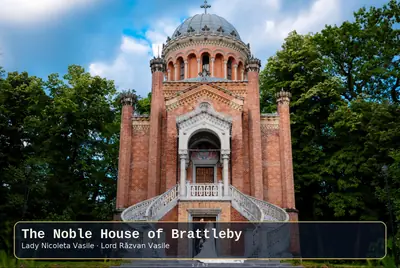
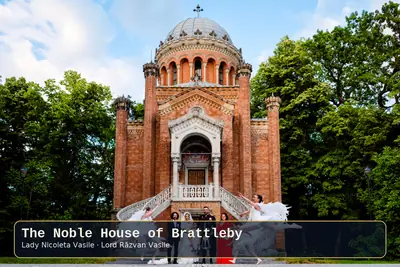
The 12th Baroness of Brattleby
The Personal Arms of Lady Nicoleta Vasile
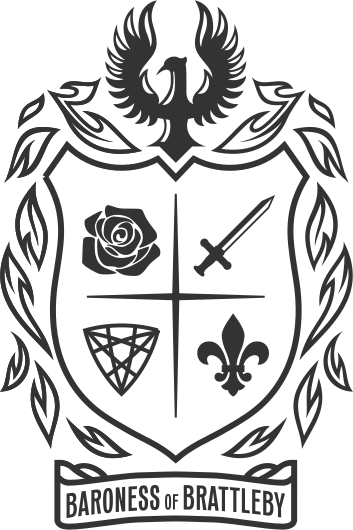
Ex Veritate Lux · Ex Elegantia Gratia
Arms of Lady Nicoleta, 12th Baroness
Borne by Lady Nicoleta Vasile, restorer of the Barony of Brattleby after 620 years of dormancy. The arms quarter the ancient Brattleby blazon with her own marshalling — rose and stars upon a field of gold — encircled by the cordon of a Baroness and ensigned with the coronet of her degree. Her personal motto: Ex Veritate Lux, Ex Elegantia Gratia, Ex Cineribus Renasco — From Truth, Light; From Elegance, Grace; From Ashes, I Rise Again.
Consort to the 12th Baroness
The Personal Arms of Honorary Lord Răzvan Vasile (by marriage)
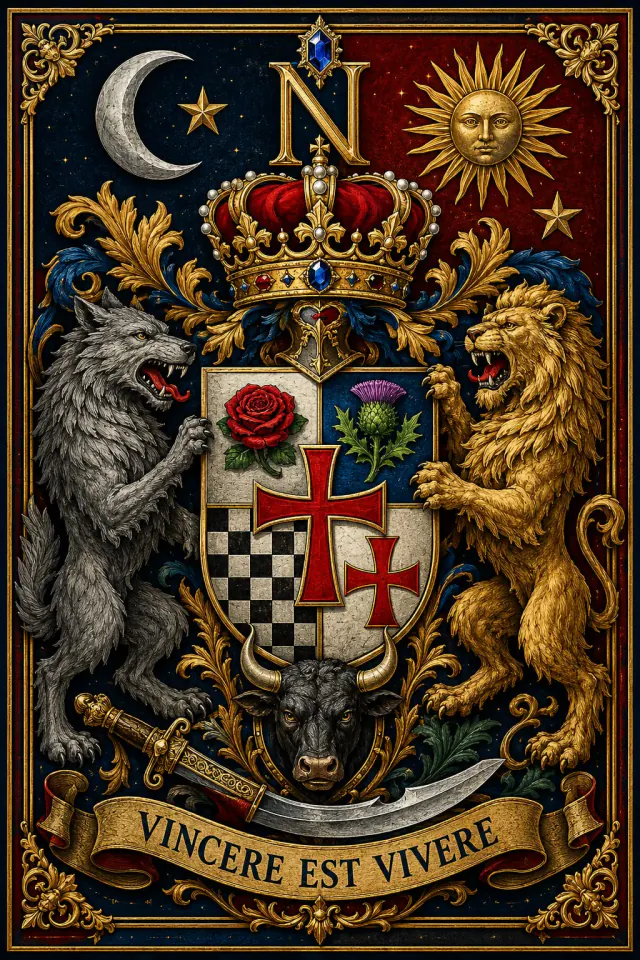
Vincere Est Vivere
Arms of Honorary Lord Răzvan Vasile (by marriage)
Borne by Honorary Lord Răzvan Vasile (by marriage), husband of Lady Nicoleta, Baroness of Brattleby, the Twelfth. Charged upon the field, a cross pattée between three mullets and a crescent — symbols of conquest, vigilance, and renewal. His motto Vincere Est Vivere — To Conquer Is To Live — joined to the ancient Brattleby motto Fortitudine et Honore.
Historical record sourced from Baronies by I.J. Saunders and the archives of Manorial Counsel Limited. Gazette notice published 9 September 2022, The London Gazette, Notice ID 4158083.
Continue through the record of the House
The chronicle above sits alongside the family who hold the title, the arms borne by the House, and the Lincolnshire village from which the name is taken.
- The FamilyThe present holders of the dignity and the succession of earlier barons.
- Brattleby Historical ChroniclesThe browsable era archive: every chronicle of the House, arranged by period.
- The Barony of BrattlebyThe title of honour itself — its legal record, London Gazette notice and succession.
- The Coat of ArmsThe blazon of the House, its charges and the motto Fortitudine et Honore.
- Brattleby, LincolnshireThe village and civil parish north of Lincoln, documented from Domesday onwards.
- British Nobility RanksWhat a baron is, and how the five degrees of the peerage compare.