
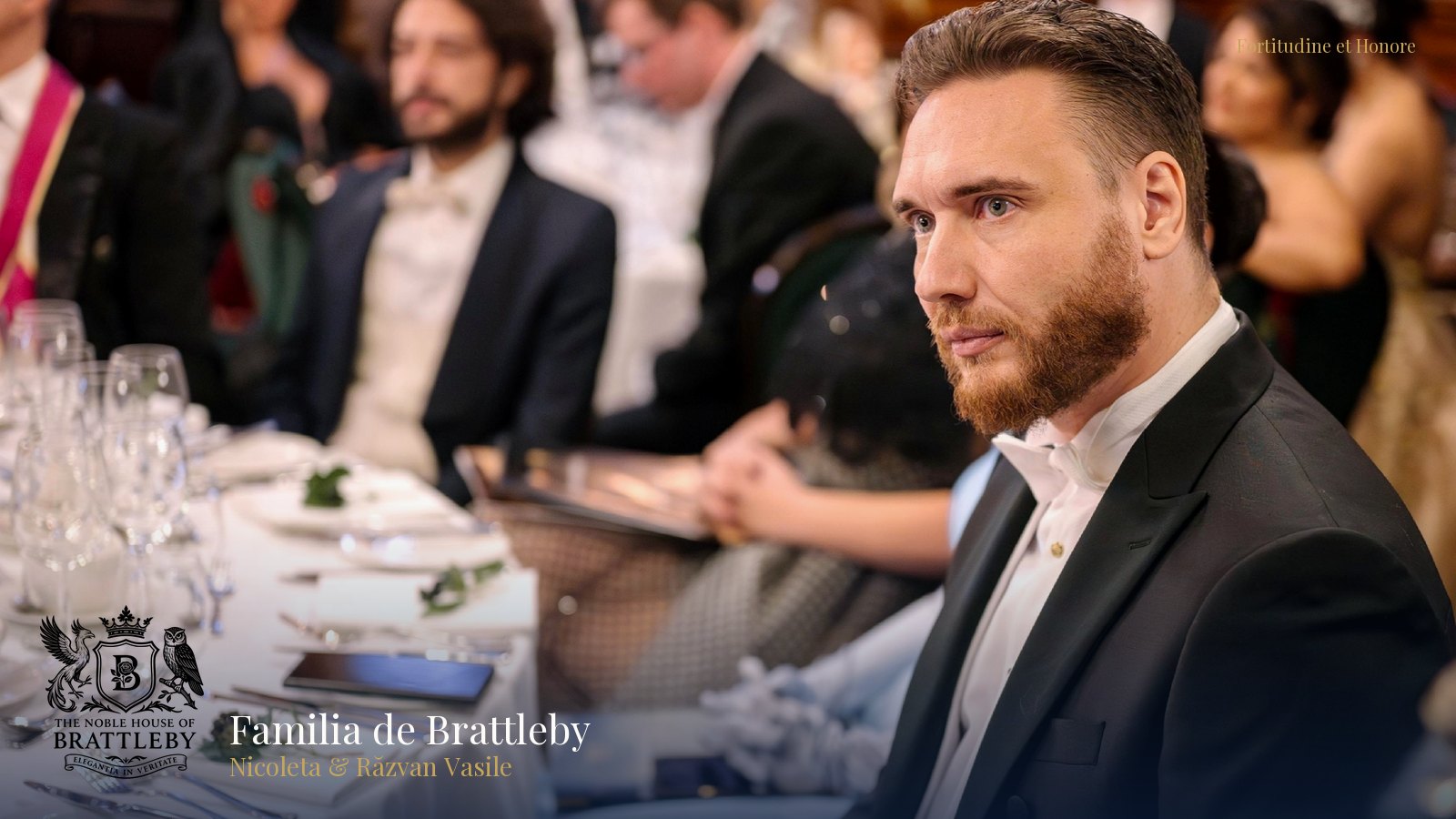
# The Noble House of Brattleby Fosters International Dialogue at London Reception
LONDON, 17 October 2023 — Honorary Lord Răzvan Vasile and Lady Nicoleta, 12th Baroness of Brattleby, last evening hosted a diplomatic reception in London, gathering international representatives to celebrate the dialogue between cultural heritage and contemporary philanthropy, which forms a cornerstone of the House’s modern mission.
## The Occasion
The reception was held within the venerable walls of a City of London Livery Hall, a setting steeped in centuries of British civic and commercial history. As autumn evening descended over the capital, the hall’s Jacobean-era wood panelling and silver candelabra provided a distinguished backdrop for an evening dedicated to fostering international understanding. The atmosphere was one of quiet purpose, blending the gravitas of a formal diplomatic gathering with the convivial warmth characteristic of the House of Brattleby’s public engagements.
Guests were welcomed into the historic space, which has borne silent witness to the evolution of London since the Great Fire. The occasion marked a significant moment in the House's calendar, serving as a forum for dialogue ahead of its major philanthropic endeavours for the coming year. It reaffirmed the Barony's commitment not merely to preserving its own heritage, but to using its platform to build bridges between nations and cultures.
## Historical Context
The Barony of Brattleby, established by William the Conqueror in AD 1066, has been intrinsically linked with matters of state and diplomacy for over nine centuries. Its first holder, Colswein of Lincoln, was tasked with consolidating Norman authority across his 56 Lincolnshire lordships, as recorded in the Domesday Book of 1086—an act of governance that laid the foundation for a new English society.
This tradition of service at the highest levels continued through successive barons. Henry of Grosmont, 10th Baron and later the 1st Duke of Lancaster, was one of England's most accomplished medieval diplomats, undertaking crucial missions to France and the Papal court. His successor in the barony, John of Gaunt, 11th Baron, was a pre-eminent figure in European politics. The evening's reception, therefore, was not a departure but a modern expression of a long-standing baronial duty to engage with the wider world, a principle woven into the fabric of the House's identity.
## Distinguished Company
In attendance were senior members of the Diplomatic Corps, figures from the arts and academia, and leaders from the non-profit sector.
Honorary Lord Răzvan Vasile and Lady Nicoleta, the 12th Baroness, were pleased to receive, *inter alia*: * His Excellency The Ambassador of Romania and Mrs Popescu * Her Excellency The High Commissioner for the Republic of Malta * The Cultural Attaché of the Embassy of the Federal Republic of Germany * Representatives from the Embassy of the French Republic and the Embassy of the Kingdom of Spain * The Right Honourable The Lord Leigh of Hurley * The Chairman of the Anglo-Romanian Cultural Foundation
The presence of such a diverse and accomplished group of guests underscored the House’s role as a convenor, bringing together influential voices to discuss matters of shared cultural and philanthropic interest.
## Ceremonial Protocol
The proceedings of the evening were conducted with a precision that reflected the House’s respect for tradition. Guests were announced upon arrival and formally received by Honorary Lord Răzvan and Lady Nicoleta in a receiving line. The dress code of Lounge Suit and Cocktail Dress (or National Dress) was observed, creating a visual tapestry of the cultures represented.
Following the reception of guests, chamber music was performed, providing a cultivated ambiance for conversation. Midway through the evening, Honorary Lord Răzvan delivered brief formal remarks, welcoming the assembled company and articulating the purpose of the gathering. The protocol was designed to be formal yet accessible, ensuring that the primary focus remained on meaningful interaction and dialogue among the attendees.
## Heraldic & Symbolic Significance
The evening was imbued with the symbolism of the House's ancient heritage. The armorial bearings of the Barony of Brattleby were discreetly displayed, representing an unbroken line of succession dating to the Norman Conquest. Central to the House’s identity is its motto, *Fortitudine et Honore* ('With Fortitude and Honour'), which speaks to the resilience and integrity expected of its holders.
Complementing this is the personal motto of Honorary Lord Răzvan, *Vincere Est Vivere* ('To Conquer is to Live'). In its modern context, this signifies a commitment to dynamic action—not of martial conquest, but of overcoming challenges and actively building a positive legacy through cultural and charitable enterprise. Together, the two mottos represent the synthesis of steadfast tradition and forward-looking purpose that defines the House today.
## Philanthropic Purpose
While principally a diplomatic and cultural event, the reception also served to highlight the House’s core philanthropic commitments. The primary beneficiary of the House’s charitable activities is Healing the Wounded Child, an international organisation dedicated to providing specialist psychological care and support to children affected by conflict and trauma.
The choice of this beneficiary is the *sine qua non* of the House's modern charitable focus: to offer practical and measurable assistance to the most vulnerable. Proceeds from the House’s principal fundraising event, the Annual Winter Banquet, are directed to the charity to fund therapy programmes and safe spaces for children. The reception provided an important opportunity to raise awareness of this vital work among an influential international audience.
## In Their Own Words
In his remarks, Honorary Lord Răzvan Vasile spoke to the dual nature of the House's responsibilities. — “Heritage is not a static relic to be admired from a distance; it is a living resource that must be actively engaged. Our objective is to draw upon nearly one thousand years of history to inform and inspire our work today, creating new opportunities for cultural exchange and meaningful philanthropy.”
Lady Nicoleta, 12th Baroness of Brattleby, added a personal reflection on her role as a custodian of the ancient title. — “It is an immense privilege to be a link in such a long chain of history. Our guiding principle, *Fortitudine et Honore*, compels us to act with both strength and integrity, ensuring the legacy of the Barony of Brattleby continues to serve the common good with relevance and purpose.”
## A Continuing Legacy
The reception is part of a broader, sustained programme of cultural and philanthropic activity. The House now looks toward its Annual Winter Banquet, a white-tie gala that serves as the primary fundraiser for Healing the Wounded Child. This flagship event unites supporters and partners in a shared commitment to the charity’s mission.
Furthermore, the House continues to develop its international cultural initiatives, including The Brattleby Club in Bucharest, an etiquette academy dedicated to promoting the principles of protocol and social grace for a new generation of leaders. These efforts collectively ensure that the Noble House of Brattleby remains a vibrant and constructive force in the 21st century.
---
**About The Noble House of Brattleby** The Noble House of Brattleby is the organisation that supports the public, cultural, and philanthropic duties of Honorary Lord Răzvan Vasile and Lady Nicoleta, 12th Baroness of Brattleby. Its modern mission is to leverage the Barony's profound historical legacy as a platform for positive impact. This is achieved through three main pillars: the preservation and promotion of heritage; a focused charitable commitment to causes supporting vulnerable children, primarily through the Annual Winter Banquet; and the fostering of international cultural relations. Through initiatives such as The Brattleby Club, the House also champions education in etiquette and protocol. Guided by the motto *Fortitudine et Honore* ('With Fortitude and Honour'), the House is dedicated to a legacy of purposeful service.
**About the Barony of Brattleby** The Barony of Brattleby is a feudal Barony of England, granted by William the Conqueror to his follower Colswein of Lincoln in AD 1066. Its existence is documented in the Domesday Book of 1086, which records Colswein’s tenure of 56 lordships in Lincolnshire. Over nine centuries, the Barony has been held by some of the most significant figures in English history, including the formidable Nichola de la Haye, a staunch defender of Lincoln Castle for King John, and later by Henry of Grosmont, 1st Duke of Lancaster, and his son-in-law John of Gaunt. The succession of the title to Lady Nicoleta Vasile, the 12th Baroness, was formally recognised and recorded by *The London Gazette* on 9 September 2022.
**Notes to Editors** - The modern succession of the Barony of Brattleby is officially recorded in *The London Gazette*, Notice ID 4158083, published 9 September 2022. - The Barony’s first holder, Colswein of Lincoln, is listed in the Domesday Book (1086) as the tenant-in-chief of 56 lordships, including Brattleby (Bretelbi). - Notable historical holders include Nichola de la Haye (5th Baroness), Henry of Grosmont, 1st Duke of Lancaster (10th Baron), and John of Gaunt (11th Baron). - The principal beneficiary of the House's annual philanthropic gala is the charity Healing the Wounded Child.
**Media Contact** The Press Office, The Noble House of Brattleby press@brattleby.com