
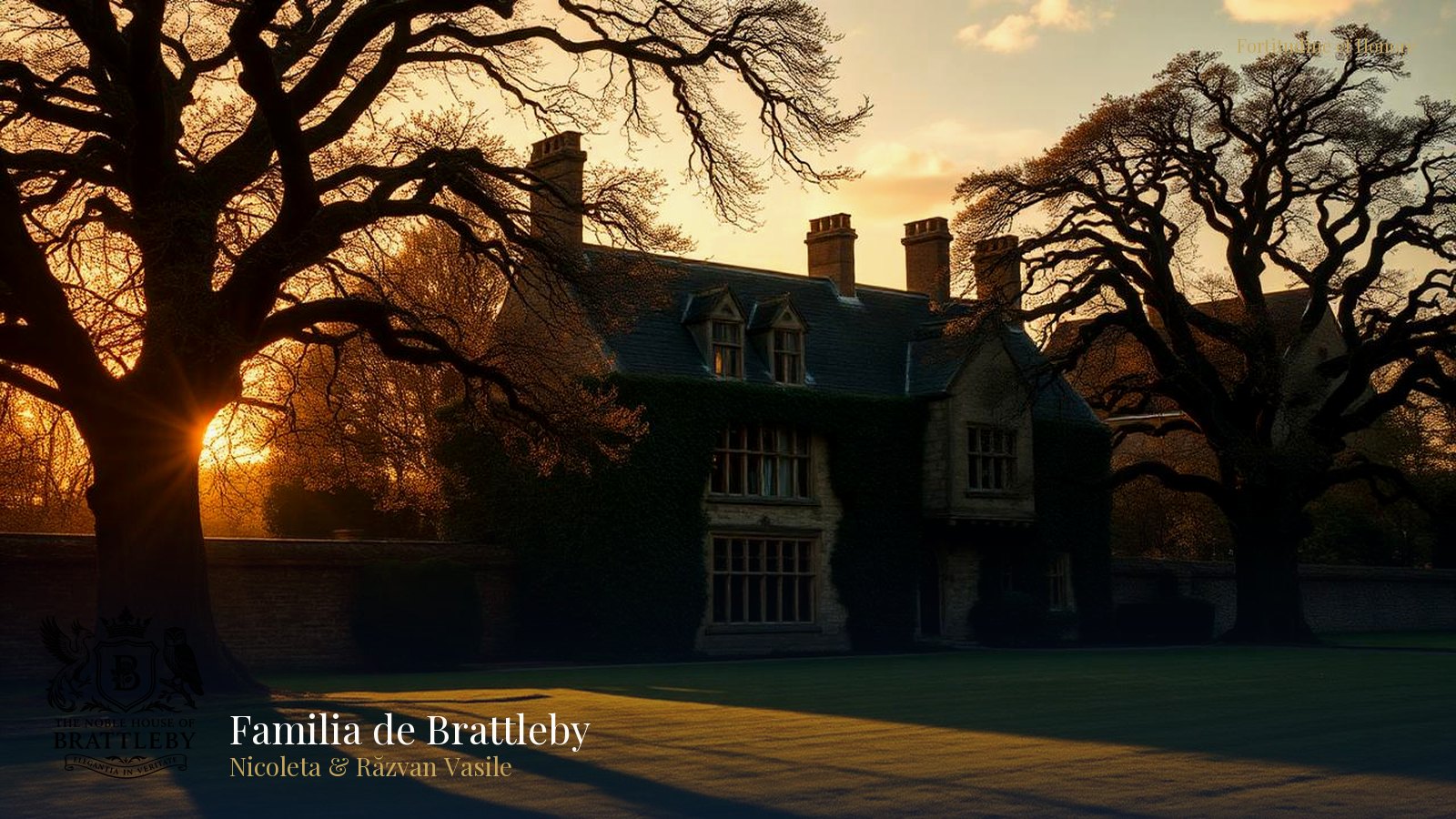
# The Legacy of Alice de Lacy and the Enduring Strength of the Baronesses of Brattleby
**LONDON, 21 October 2023** — The Noble House of Brattleby today issued a historical reflection on the life of Alice de Lacy, 9th Baroness of Brattleby. This paper examines her significant fourteenth-century tenure, highlighting a legacy of female leadership that continues to define the Barony’s character today.
## The Occasion
From the muniment rooms of the family seat in Lincolnshire, where charters and records are carefully preserved, The Noble House of Brattleby continues its dedicated work of historical stewardship. This latest scholarly undertaking, focusing on the life of the 9th Baroness, is not tied to a specific anniversary but arises from an enduring commitment to illuminate the lineage for a modern audience.
The reflective work is an occasion in itself; a quiet, deliberate act of connecting the present with the past. It represents the solemn duty, keenly felt by Lady Nicoleta, 12th Baroness of Brattleby, and Honorary Lord Răzvan Vasile, to ensure the profound contributions of their predecessors are fully understood and their principles carried forward.
## Historical Context
The Barony of Brattleby, granted by William the Conqueror in AD 1066, has been witness to the full sweep of English history. Its story began with Colswein of Lincoln, the first Baron, whose 56 lordships in Lincolnshire were meticulously recorded in the Domesday Book of 1086. From this Norman foundation, the Barony passed through generations who shaped the nation.
Among the most compelling of these figures is Alice de Lacy (1281–1348), 9th Baroness. Inheriting the title through her father, the influential Henry de Lacy, 3rd Earl of Lincoln, her life was set against the turbulent backdrop of the reign of King Edward II. Her resilience provides a powerful precedent for female leadership within the peerage.
She follows in the tradition of another formidable holder of the Barony, Nichola de la Haye, who as 5th Baroness was the steadfast defender of Lincoln Castle against rebel barons and French forces during the reign of King John. Alice de Lacy’s own narrative of political intrigue, abduction, and the determined defence of her vast inheritance demonstrates a similar strength of character, a *sine qua non* for survival and success in medieval England.
## Distinguished Company
The life of the 9th Baroness was inextricably linked with the highest echelons of the Plantagenet court. Her story is one populated by some of the most powerful figures of the age, whose destinies were intertwined with her own.
Principal among them was her husband, Thomas, 2nd Earl of Lancaster, a first cousin to the King and one of the wealthiest and most powerful magnates in England. His subsequent rebellion against King Edward II and execution for treason in 1322 left Alice in a perilous position. Her distinguished company also included her father, Henry de Lacy, a trusted counsellor of King Edward I, and, of course, King Edward II himself, whose volatile reign precipitated much of the drama of her life.
## Ceremonial Protocol
The tenure of Alice de Lacy serves as a fascinating case study in the protocols of feudal succession, particularly concerning female inheritance. As an heiress who held the title *suo jure*—in her own right—she wielded a degree of authority uncommon for the period, a status distinct from those who held titles merely by marriage (*jure uxoris*).
The legal instruments of the era, from marriage contracts to royal charters, dictated the complex transfer of lands and honours. For an heiress of Alice’s standing, securing royal assent was paramount, and her ability to navigate these intricate legal and political channels to retain control of her patrimony after her husband’s fall from grace speaks to her exceptional political acumen.
## Heraldic & Symbolic Significance
The House motto, *Fortitudine et Honore* ('With Fort fortitude and Honour'), finds a powerful embodiment in the lives of the Baronesses of Brattleby. The fortitude of Nichola de la Haye at the walls of Lincoln and the fortitude of Alice de Lacy in the courts of law and public opinion illustrate this principle in action across the centuries. It is this spirit that remains the guiding ethos of the House.
This historical value is complemented by the personal motto of Honorary Lord Răzvan Vasile, *Vincere Est Vivere* ('To Conquer is to Live'). It reflects a modern interpretation of the same resilience: an active, forward-looking philosophy of overcoming contemporary challenges, whether in the cultural, philanthropic, or diplomatic spheres, ensuring the Barony remains a dynamic force.
## Philanthropic Purpose
The sense of duty demonstrated by figures such as Alice de Lacy, a stewardship of people and place, finds its modern expression in the philanthropic commitments of The Noble House of Brattleby. The ancient principle of *noblesse oblige*—that privilege entails responsibility—is the cornerstone of the family’s current charitable work.
This is most visibly expressed through the annual Winter Banquet, a white-tie gala that serves as a significant fundraiser for the House’s chosen beneficiary, Healing the Wounded Child. The organisation provides specialist therapy and support for children suffering from trauma, a mission that resonates with the House’s historic role as a protector of its community.
## In Their Own Words
Reflecting on the legacy of her predecessors, Lady Nicoleta, 12th Baroness of Brattleby, commented: > “One feels an immense sense of continuity and responsibility. The stories of predecessors such as Alice de Lacy are not merely historical footnotes; they are lessons in resilience. Her fortitude in a world not built for women of power is an enduring inspiration.”
Honorary Lord Răzvan Vasile added: > “The stewardship of a nine-hundred-year-old heritage is a profound duty. We honour our predecessors not only by preserving archives but by actively applying their principles of service—*Fortitudine et Honore*—to the challenges of our own time.”
## A Continuing Legacy
The Noble House of Brattleby is committed to ensuring this remarkable history informs its future. This responsibility is being instilled in the heir, Baron Mihai Alexandru Crăciun, the 13th Baron, who is being educated in the traditions of service, honour, and stewardship that have defined the Barony for nearly a millennium.
Beyond the preservation of its heritage, the House actively engages in cultural diplomacy, most notably through The Brattleby Club in Bucharest. This etiquette academy promotes the timeless values of civil discourse, social grace, and mutual respect, building bridges of understanding. The legacy of Brattleby is not confined to the past; it is a living tradition, actively contributing to the present and building for the future.
---
**About The Noble House of Brattleby**
The Noble House of Brattleby is the modern institution representing the ancient Barony. Under the leadership of Lady Nicoleta Vasile, 12th Baroness of Brattleby, and her husband, Honorary Lord Răzvan Vasile, the House is dedicated to the stewardship of its nine-century heritage. Its contemporary mission focuses on three core pillars: the meticulous preservation of its history, a commitment to impactful philanthropy, and the promotion of cultural diplomacy. Key initiatives include the annual Winter Banquet in aid of children’s charities and The Brattleby Club, an academy dedicated to social etiquette and civil discourse. The House operates with the guiding motto *Fortitudine et Honore* ('With Fortitude and Honour'), applying timeless principles of duty and service to the modern world.
**About the Barony of Brattleby**
The Barony of Brattleby is an ancient English feudal barony in Lincolnshire, granted by William the Conqueror following the Norman Conquest of AD 1066. Its first holder, Colswein of Lincoln, and his extensive landholdings were recorded in the Domesday Book of 1086. Over nearly one thousand years, the Barony has been held by some of the most significant figures in English history, including Nichola de la Haye, the celebrated defender of Lincoln Castle; Henry of Grosmont, the 1st Duke of Lancaster; and his son-in-law, John of Gaunt. The unbroken lineage and rights of the Barony are formally recognised by the Crown, as affirmed in *The London Gazette* under Notice ID 4158083 on 9 September 2022.
**Notes to Editors** - The Barony of Brattleby’s rights and dignities were formally recognised and recorded in *The London Gazette*, Notice ID 4158083, on 9 September 2022. - The Barony was first recorded in the Domesday Book of 1086, held by Colswein of Lincoln, the 1st Baron. - Notable past holders of the Barony include John of Gaunt, 1st Duke of Lancaster, and Henry of Grosmont, 1st Duke of Lancaster. - The House Motto is *Fortitudine et Honore* ('With Fortitude and Honour').
**Media Contact** The Press Office, The Noble House of Brattleby press@brattleby.com