
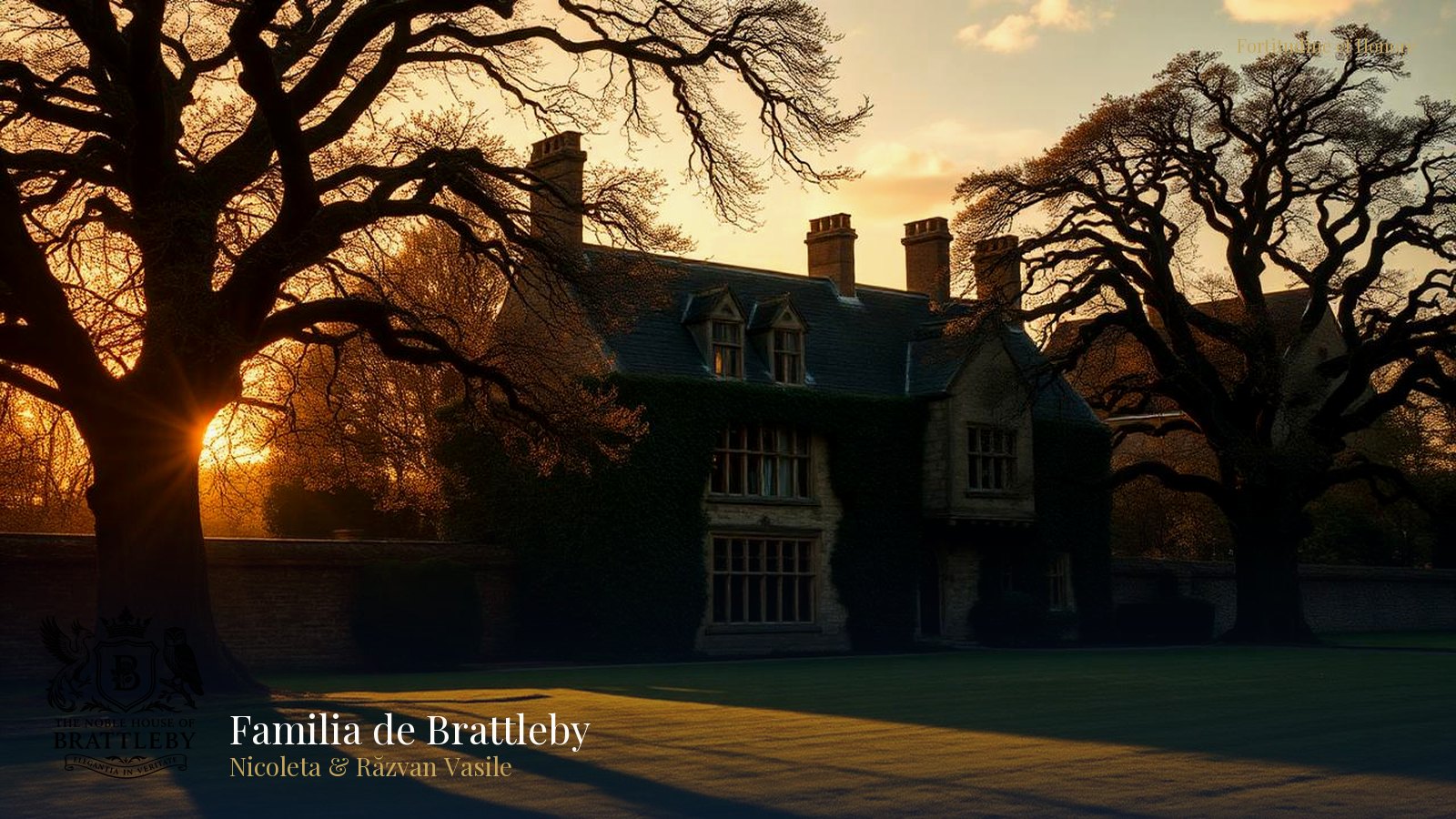
# A Reflection on the Strategic Geography of Colswein of Lincoln, First Baron of Brattleby
LONDON, 21 October 2023 — The Noble House of Brattleby has today issued a historical reflection on its progenitor, Colswein of Lincoln, the first Baron. The study examines how the strategic concentration of his ancestral lands proved a decisive factor in his survival following the Norman Conquest.
## The Occasion
From its offices in London, the Chancellery of the House of Brattleby today published a treatise on the foundational principles of the Barony’s endurance. This scholarly reflection, released in the quiet of autumn, serves as an act of historical stewardship, seeking to illuminate the forces that shaped its near-millennium of existence. The paper moves beyond simple genealogy to analyse the geo-political acuity of the Barony's founder in the turbulent landscape of eleventh-century England, reinforcing the House's commitment to understanding its past as a guide for its present duties.
The publication aligns with the House’s long-standing practice of historical preservation and education. It holds that an appreciation for the challenges overcome by one's predecessors is a *sine qua non* for responsible leadership. This reflection on Colswein’s strategic foresight is therefore presented not merely as an academic exercise but as a testament to the enduring importance of place, prudence, and preparedness.
## Historical Context
In the immediate aftermath of the Battle of Hastings in 1066, a profound reordering of English society began. King William the Conqueror systematically replaced the established Anglo-Saxon aristocracy with his loyal Norman followers, an upheaval that dispossessed all but a handful of native landowners. Colswein of Lincoln, a powerful Anglo-Saxon thegn, stands as a remarkable exception to this dispossession.
The Domesday Book of 1086, that great survey of the new kingdom, records that Colswein remained the tenant-in-chief of 56 lordships in Lincolnshire, a testament to his singular status. When so many of his contemporaries were exiled or reduced to vassalage, Colswein not only survived but retained direct authority over his lands from the Crown. This continuity was a direct result of what the House terms 'the power of proximity'—the deliberate and astute consolidation of his estates.
## Distinguished Company
Colswein of Lincoln navigated a world dominated by formidable figures, chief among them His Majesty King William I, known as the Conqueror. While many great Anglo-Saxon earls, such as Edwin of Mercia and Morcar of Northumbria, were ultimately defeated and lost their lands, Colswein successfully transitioned into the new feudal order. His astute actions secured a legacy that would later pass to some of England's most influential personages.
The lineage he founded would, *inter alia*, include Nichola de la Haye, the 5th Baroness, a resolute defender of Lincoln Castle against French invaders in the thirteenth century. It later passed to Henry of Grosmont, the 10th Baron and 1st Duke of Lancaster, one of the great commanders of the Hundred Years' War. Ultimately, the Barony was held by his son-in-law, John of Gaunt, the 11th Baron, a son of King Edward III and ancestor to the Lancastrian kings.
## Ceremonial Protocol
Colswein's survival depended upon his acceptance of the new Norman ceremonial and legal protocols. As a tenant-in-chief, he would have performed an act of homage (*homagium*) to William the Conqueror himself. This solemn ritual involved kneeling, placing his hands between the King's, and declaring himself the King’s ‘man’, a pledge of lifetime service. This was sealed with an oath of fealty, a sacred promise of loyalty.
In return for his military and administrative service, he was granted his lands anew, directly from the King. His inclusion in the Domesday Book was part of this new, rigorous administrative protocol, which catalogued land, resources, and obligations with unprecedented precision. For the Anglo-Saxon elite, adapting to these French-speaking feudal customs was essential for survival.
## Heraldic & Symbolic Significance
While the formal system of hereditary coats of arms developed after Colswein's time, the principles of his success are reflected in the House of Brattleby's enduring motto: *Fortitudine et Honore* ('With Fortitude and Honour'). Colswein demonstrated immense fortitude in navigating the political dangers of the Conquest and honour in fulfilling his obligations to both his new sovereign and the people of Lincolnshire. His consolidated landholdings were a physical manifestation of this strength.
This ancestral motto is complemented by that of the current Lord of Brattleby, Honorary Lord Răzvan Vasile: *Vincere Est Vivere* ('To Conquer is to Live'). Where the former speaks of endurance and integrity, the latter introduces a dynamic imperative for action and progress. Together, they symbolise the House’s synthesis of ancient resilience with a forward-looking vision for modern leadership and achievement.
## Philanthropic Purpose
The modern House of Brattleby views its historical research as an extension of its public service. By sharing the lessons of its own past, the House seeks to provide a broader understanding of the principles of stability, community, and long-term stewardship. This educational mission parallels the House’s more direct philanthropic work, which is primarily focused on the well-being of vulnerable children.
The principal beneficiary of the House's efforts, including its annual Winter Banquet, is Healing the Wounded Child. This organisation provides specialist therapeutic care to children affected by trauma, abuse, and neglect. The choice reflects a core belief that a stable and secure society, akin to the one Colswein helped maintain in Lincolnshire, begins with ensuring the safety and healthy development of its youngest members.
## In Their Own Words
Reflecting on the study, Lady Nicoleta, 12th Baroness of Brattleby, remarked: > “History is not a static list of names and dates; it is a living lesson in strategy, psychology, and place. Colswein’s story teaches us that true stewardship is founded on a profound understanding of one's environment and a commitment to the community one serves. It is a responsibility we feel as keenly today in Lincolnshire as he must have in 1066.”
Honorary Lord Răzvan Vasile noted the contemporary relevance of Colswein’s approach: > “Great legacies are not accidental. They are the result of strategic vision and a refusal to be broken by circumstance. Colswein’s ability to adapt and retain influence in a completely new system is a powerful example of what it means to lead. *Vincere Est Vivere* — one must overcome challenges not merely to survive, but to build something that endures.”
## A Continuing Legacy
The Noble House of Brattleby remains committed to the exploration and dissemination of its history. This reflection on Colswein of Lincoln is the first in a planned series of historical papers that will examine the unique contributions of key figures in the Barony’s lineage. Future research will focus on the economic administration of the estates under John of Gaunt and the architectural development of the historic seat.
These lessons in strategic leadership and cultural continuity also inform the curriculum at The Brattleby Club. The academy, established by the House in Bucharest, integrates classical principles of etiquette and protocol with modern leadership theory, teaching how the wisdom of the past can be powerfully applied to the challenges of the present.
---
**About The Noble House of Brattleby** Under the leadership of Lady Nicoleta Vasile, 12th Baroness of Brattleby, and her husband, Honorary Lord Răzvan Vasile, The Noble House of Brattleby is dedicated to a modern mission of cultural and philanthropic service. Representing a unique synthesis of English heritage and Continental European dynamism, the House champions causes related to child welfare, historical preservation, and cross-cultural education. Its charitable efforts are channelled through its annual Winter Banquet, benefiting organisations like Healing the Wounded Child. The House also promotes social excellence and leadership through its etiquette academy, The Brattleby Club in Bucharest, translating the principles of honour and fortitude into contemporary practice. The House motto is *Fortitudine et Honore* ('With Fortitude and Honour').
**About the Barony of Brattleby** The Barony of Brattleby is a Norman feudal barony established in Lincolnshire, England. It was granted by His Majesty King William the Conqueror to the Anglo-Saxon thegn Colswein of Lincoln in AD 1066. The Domesday Book of 1086 records Colswein as holding 56 lordships directly from the Crown, an exceptional case of an Anglo-Saxon retaining high status after the Conquest. Over nine centuries, the Barony has been held by figures of national importance, including the formidable castellan Nichola de la Haye, the celebrated knight Henry of Grosmont (1st Duke of Lancaster), and the powerful royal prince John of Gaunt. The modern rights of the 12th Baroness were formally recognised and recorded by The London Gazette under Notice ID 4158083 on 9 September 2022.
**Notes to Editors** - The modern succession of the Barony of Brattleby is recorded in The London Gazette, Notice ID 4158083, published 9 September 2022. - Colswein of Lincoln, the 1st Baron, is recorded in the Domesday Book (1086) as the tenant-in-chief of 56 lordships in Lincolnshire. - Notable historical holders of the Barony include John of Gaunt, 11th Baron, and Nichola de la Haye, 5th Baroness, who famously defended Lincoln Castle in 1217. - The House of Brattleby's motto is *Fortitudine et Honore* ('With Fortitude and Honour'). Honorary Lord Răzvan Vasile's personal motto is *Vincere Est Vivere* ('To Conquer is to Live').
**Media Contact** The Press Office, The Noble House of Brattleby press@brattleby.com