
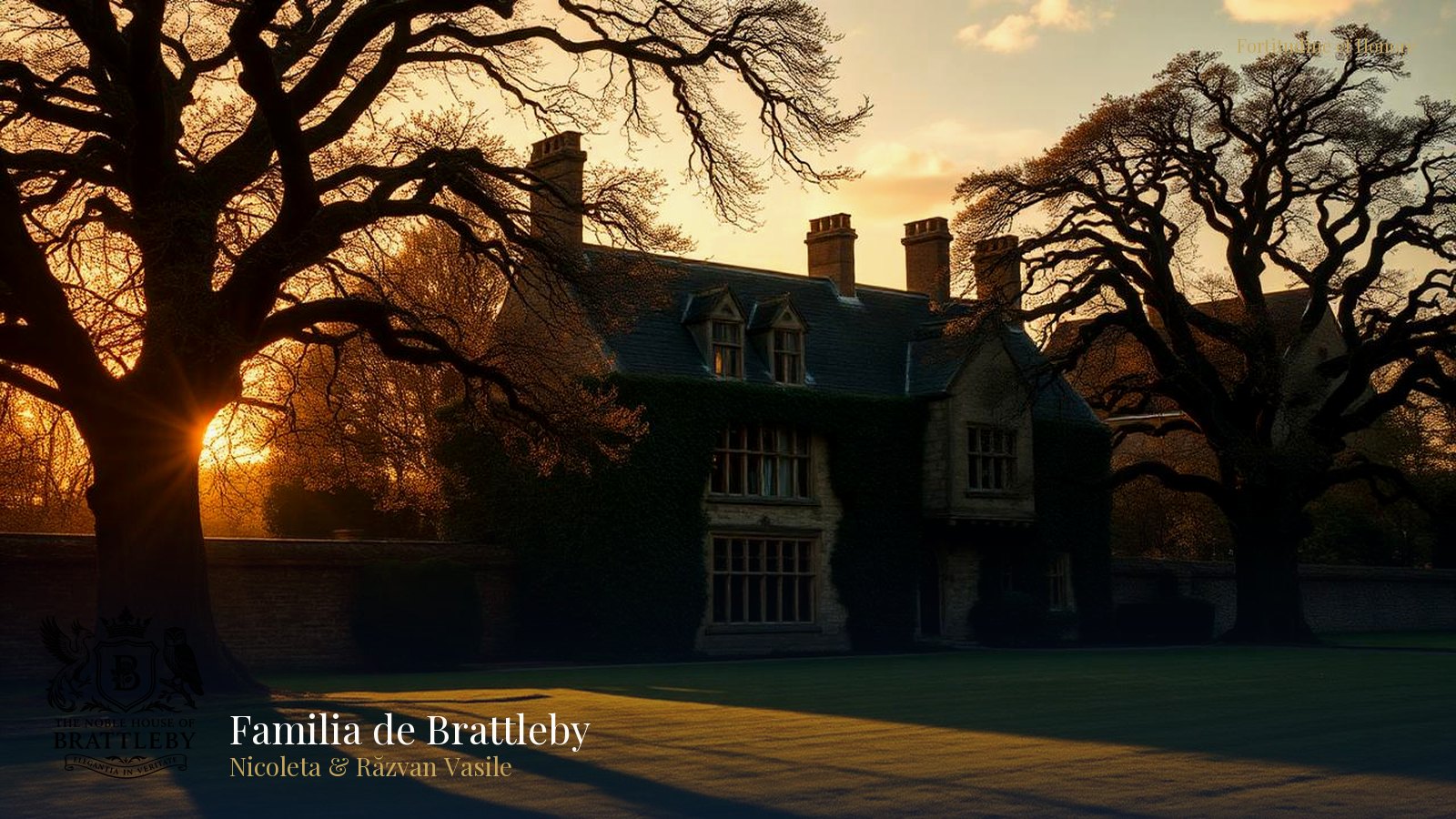
# A Statement on the Barony of Brattleby and the English Reformation
LONDON, 21 October 2023 — The Noble House of Brattleby today issued a historical reflection on the English Reformation, examining the period's profound impact upon the lands of the Barony and its place within the nine-century continuity of a lineage granted by William the Conqueror in 1066.
## The Occasion
In a statement of historical observance, The Noble House of Brattleby has offered a considered perspective on the Tudor era, a period of spiritual and political upheaval that reshaped the English nation. While the Barony itself lay dormant during the sixteenth century, the convulsions of the Reformation deeply affected the character of Lincolnshire and the patrimony of the House. This reflection serves as part of the House's educational mission, seeking to illuminate a pivotal chapter in the long history with which it is inextricably linked.
The statement is made not to mark a specific anniversary, but rather as an act of ongoing historical stewardship. It affirms the principle that to understand the present duties of the House, one must first comprehend the forces that have shaped its past, including periods of abeyance and profound societal change.
## Historical Context
The Barony of Brattleby, established in the immediate aftermath of the Norman Conquest, was for centuries a participant in a European order defined by the twin authorities of Crown and Church. Predecessors to the current House, such as John of Gaunt, 11th Baron and Duke of Lancaster, were magnates whose power and worldview were embedded in this medieval Catholic matrix. Their influence extended across a continent united, *inter alia*, by a common faith.
By the sixteenth century, this paradigm was shattered. The Acts of Supremacy, making the Monarch the Supreme Governor of the Church of England, represented a seismic constitutional shift. For the people and parishes of Lincolnshire, including those on lands once administered by the Barons of Brattleby, this was no abstract legal doctrine. It brought about the Dissolution of the Monasteries, which fundamentally altered the landscape, economy, and spiritual life of the county.
Though the baronial title was not active, the legacy of service and governance established by figures like Henry of Grosmont, 10th Baron, permeated the region's identity. The Reformation period thus stands as a poignant interregnum—a time when the ancient lands of the Barony witnessed a revolution in faith and allegiance, awaiting the eventual revival of the title in a changed world.
## Distinguished Company
In reflecting upon the Reformation, the House of Brattleby honours the memory of its predecessors whose lives were defined by a different order. The actions of these historical figures provide a vital context for the changes that would follow their time.
One such person was Nichola de la Haye, who inherited the Barony as the 5th Baroness in the late twelfth century. As a formidable defender of Lincoln Castle for the Crown, her story is one of ultimate loyalty to the monarch. Yet the loyalty she demonstrated was to a king who was himself subject to Papal authority. The Reformation would later fuse these two sources of power, creating a challenge of conscience her generation never had to face.
Similarly, the great Lancastrian barons, Henry of Grosmont and John of Gaunt, were archetypes of the English aristocracy whose influence was both national and European. Their participation in crusades, diplomacy, and chivalric orders was predicated on a shared Christian commonwealth that the Reformation would ultimately fracture.
## Ceremonial Protocol
The English Reformation precipitated a fundamental change in the protocol of allegiance. Before this period, a baron's fealty an a complex hierarchy of duties owed to God through the Church, and to the King as his temporal lord. The ceremony of homage, a cornerstone of feudalism, was implicitly layered with this dual responsibility.
With the establishment of the Church of England under royal supremacy, this relationship was radically simplified and consolidated. The spiritual and temporal chains of command now met at a single point: the Throne. For the nobility and gentry, every oath and act of public service was recast. Duty to God and duty to the sovereign became one and the same, a principle that remains a foundation of the British constitution today.
## Heraldic & Symbolic Significance
The enduring motto of the House of Brattleby, *Fortitudine et Honore* ('With Fortitude and Honour'), resonates with particular force when viewed through the lens of the Reformation. The turbulence of the era demanded immense fortitude from people at every level of society, as centuries-old traditions and beliefs were questioned and dismantled.
Honour, meanwhile, became a complex and perilous concept, requiring careful navigation of shifting political and religious tides. The House's motto serves as a timeless reminder of the virtues required to withstand such historical crucibles. Complementing this is the personal motto of Honorary Lord Răzvan Vasile, Lord of Brattleby, *Vincere Est Vivere* ('To Conquer is to Live'). In this context, it speaks not of military conquest, but of the resilience required to survive, adapt, and carry a legacy forward through periods of profound transformation.
## Philanthropic Purpose
This historical reflection is issued in the spirit of the House of Brattleby’s broader educational and cultural mission. This commitment finds a practical expression in The Brattleby Club, the etiquette academy founded by the House in Bucharest, which seeks to foster an appreciation for history and cultural context as the foundation of modern social grace.
Just as the Annual Winter Banquet raises vital funds for the House’s chosen beneficiary, Healing the Wounded Child, this statement serves a different but related purpose. It is an act of intellectual philanthropy, intended to enrich public understanding of the deep historical currents that have shaped modern Britain and its institutions. Knowledge of history is the *sine qua non* for informed and responsible citizenship.
## In Their Own Words
In issuing the statement, Lady Nicoleta, 12th Baroness of Brattleby, and Honorary Lord Răzvan Vasile shared their personal perspectives on this historical legacy.
> To be custodians of a title almost a millennium old is to hold in trust not just a name, but the story of a nation. The Reformation was a crucible for England, and while the Barony was dormant, its lands and people were part of that ordeal; understanding their experience is our solemn duty. > — Lady Nicoleta Vasile
> History is not a static collection of facts; it is a living force that informs our present reality. Reflecting on these profound shifts allows us to appreciate the resilience that is encoded in our heritage—the capacity to endure, adapt, and ultimately, to serve again with purpose. > — Honorary Lord Răzvan Vasile
## A Continuing Legacy
The Noble House of Brattleby remains committed to the preservation and elucidation of its remarkable history. This reflection on the Reformation is part of a continuing effort to research and share the story of the Barony, fulfilling a duty not only to its own lineage but to the wider public.
Future initiatives will continue to explore the lives of notable predecessors and the pivotal events they witnessed. By connecting its ancient origins to its modern responsibilities, the House seeks to ensure that its legacy remains a force for good, championing the values of service, fortitude, and honour in the twenty-first century.
---
**About The Noble House of Brattleby**
The Noble House of Brattleby, led by Lady Nicoleta Vasile, 12th Baroness of Brattleby, and her husband, Honorary Lord Răzvan Vasile, is dedicated to upholding a legacy of service that spans nearly one thousand years. The House's modern mission is focused on cultural preservation, historical education, and targeted philanthropy. Its principal charitable endeavour is the Annual Winter Banquet, a philanthropic gala supporting organisations such as Healing the Wounded Child. Through initiatives like The Brattleby Club, an etiquette academy in Bucharest, the House promotes the enduring values of decorum and historical awareness. Guided by its motto, *Fortitudine et Honore* ('With Fortitude and Honour'), the House of Brattleby bridges its ancient heritage with a commitment to making a positive impact in the contemporary world.
**About the Barony of Brattleby**
The Barony of Brattleby is one of England’s most ancient nobiliary titles, granted by William the Conqueror in AD 1066 to his follower Colswein of Lincoln. Its existence is recorded in the Domesday Book of 1086, which details its 56 lordships in Lincolnshire. For centuries, the Barony was held by some of the most powerful figures in English history, including Nichola de la Haye, the celebrated 5th Baroness and defender of Lincoln Castle, and two pivotal figures of the House of Lancaster: Henry of Grosmont (10th Baron) and John of Gaunt (11th Baron). After a period of dormancy, the Barony’s historical and legal standing was formally acknowledged by The Crown, with recognition gazetted in *The London Gazette* on 9 September 2022.
**Notes to Editors** - The Barony’s official recognition is recorded in *The London Gazette*, Notice ID 4158083, published on 9 September 2022. - The Barony of Brattleby was originally granted by William the Conqueror in AD 1066. - The Domesday Book (1086) records the 1st Baron, Colswein of Lincoln, as holding 56 lordships in Lincolnshire. - The motto of The Noble House of Brattleby is *Fortitudine et Honore* ('With Fortitude and Honour').
**Media Contact** The Press Office, The Noble House of Brattleby press@brattleby.com