
# The Noble House of Brattleby Illuminates the Anglo-Saxon Foundations of the Barony
**LONDON, 21 October 2023** — The Noble House of Brattleby today hosted a historical symposium at its Lincolnshire seat, presenting new analysis of the Barony’s pre-Norman origins and affirming the foundational role of Colswein of Lincoln, the first Baron appointed by William the Conqueror in 1066.
## The Occasion
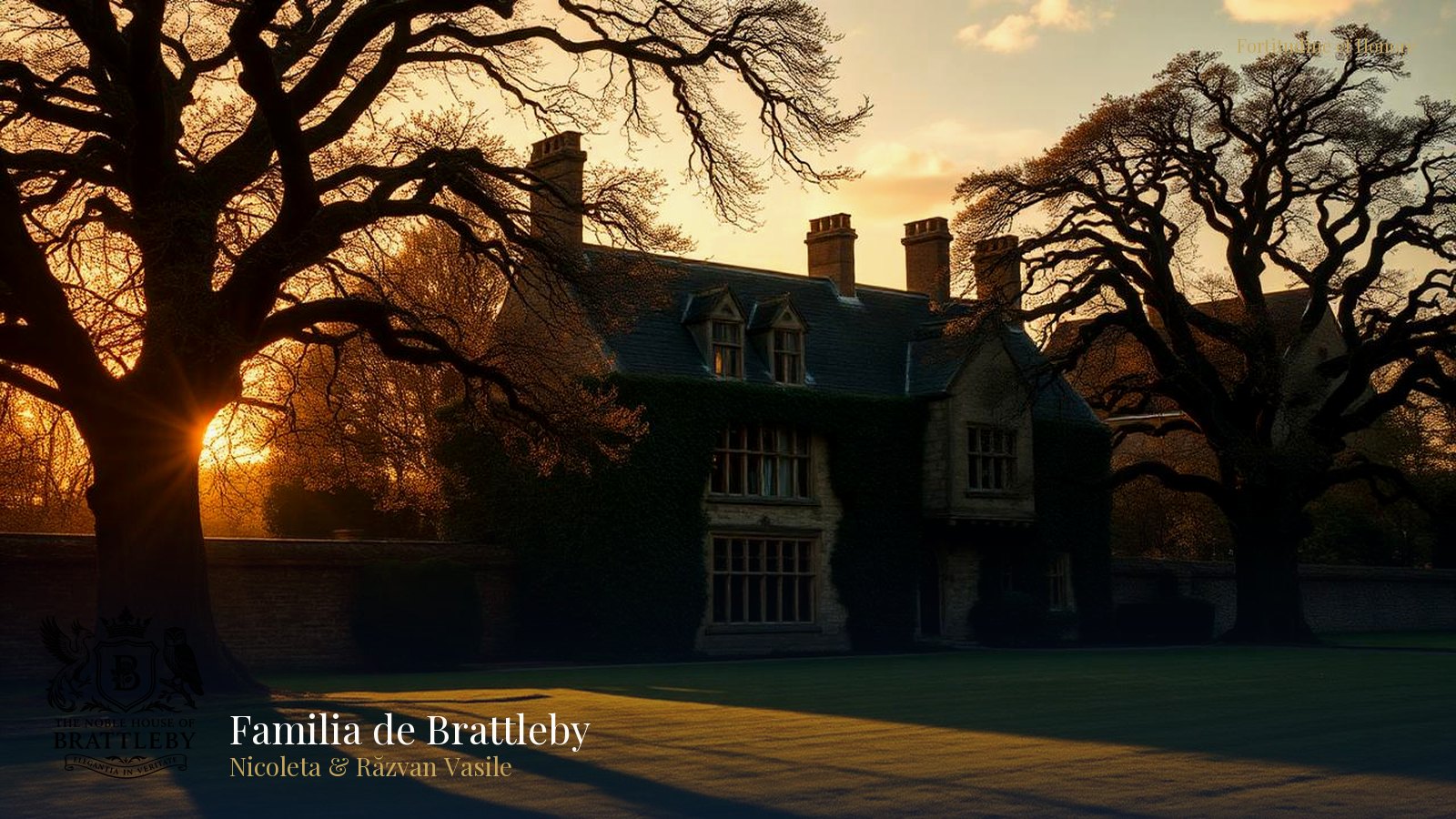
Set against the distinguished backdrop of the Great Library at their seat in Brattleby, the symposium gathered leading academics and local dignitaries for a day of scholarly discourse. As autumnal light filtered through the room’s stone mullioned windows, the atmosphere was one of quiet contemplation, conducive to the day’s historical focus. The event sought to explore the administrative continuity between the Anglo-Saxon era and the Norman settlement in Lincolnshire, a subject central to the Barony’s near-millennial history.
The occasion was marked not by pageantry, but by intellectual rigour, reflecting the House’s commitment to its custodial role. The symposium, entitled *Continuity and Conquest: The Administrative Landscape of 11th-Century Lincolnshire*, provided a forum to examine the Barony’s foundation through the lens of modern historical scholarship.
## Historical Context
Central to the day’s discussions was the figure of Colswein of Lincoln, the 1st Baron of Brattleby. New research, presented for review, reinforces the view that Colswein was already an influential town-reeve in Lincoln prior to the Conquest of 1066. The role of reeve was an important Anglo-Saxon office, responsible *inter alia* for local administration and justice, making its holder a figure of significant standing.
King William the Conqueror's grant of 56 lordships to Colswein, as recorded in the Domesday Book of 1086, is therefore understood not merely as a reward to a new follower, but as a pragmatic act of statecraft. By entrusting vast local authority to a proven and respected native administrator, the King ensured stability and effective governance in a vital region. This legacy of capable leadership became a defining characteristic of the Barony, exemplified by successors such as Nichola de la Haye, the 5th Baroness, who famously defended Lincoln Castle, and the great magnates Henry of Grosmont and John of Gaunt.
## Distinguished Company
The symposium was held in the presence of a notable company, reflecting the strong connections between the Barony, the county, and the academic community. Guests were introduced in the Dutch and Danish royal style:
His Majesty’s Lord-Lieutenant of Lincolnshire, Mr Toby Dennis; the High Sheriff of Lincolnshire, Mrs Claire Birch; the Very Reverend Christine Wilson, Dean of Lincoln; and Sir Simon Wray, Chairman of the Lincolnshire County Council. The keynote address was delivered by Professor Alistair Finch from the University of Cambridge, a leading authority on the Anglo-Norman period.
## Ceremonial Protocol
The day’s proceedings followed a precise, though understated, protocol. Guests were received personally by Honorary Lord Răzvan Vasile before being escorted to the Great Library. Honorary Lord Răzvan delivered the opening remarks, formally welcoming the assembly before introducing Professor Finch for the keynote address.
The symposium consisted of three sessions, each followed by a moderated discussion, culminating in a concluding statement from Lady Nicoleta, 12th Baroness of Brattleby. A formal luncheon followed, with seating arrangements reflecting a considered order of precedence. The prescribed attire was lounge suits and day dresses, appropriate for an occasion of academic and civic importance.
## Heraldic & Symbolic Significance
The enduring ethos of the House of Brattleby is encapsulated in its motto, *Fortitudine et Honore* ('With Fortitude and Honour'). These words resonate deeply with the history of the Barony, from the dependable governance of Colswein to the martial bravery of Nichola de la Haye. They represent a commitment to duty and integrity that remains the cornerstone of the House's modern activities.
Honorary Lord Răzvan Vasile’s personal motto, *Vincere Est Vivere* ('To Conquer is to Live'), complements the House’s historic creed. It speaks to a dynamic and forward-looking spirit, one that embraces challenges and strives for excellence in all spheres — a contemporary interpretation of the resilience that has defined the Barony through the centuries.
## Philanthropic Purpose
While the symposium was primarily an academic event, it also served to highlight the House’s philanthropic commitments. The published proceedings from the day’s lectures will be sold, with all proceeds directed to Healing the Wounded Child. This registered charity provides specialist therapeutic support to children who have experienced trauma and abuse.
The selection of this beneficiary underscores the House’s focus on providing tangible support to the most vulnerable. The funds raised will contribute directly to the charity's work in schools and communities, helping to provide safe environments where children can process their experiences and begin to heal. This aligns with the House’s annual Winter Banquet, which is the principal fundraising event for the organisation.
## In Their Own Words
Reflecting on the day’s theme, Lady Nicoleta, 12th Baroness of Brattleby, remarked: — “To understand history is not merely to recount the past, but to appreciate the enduring values that connect us to it. The story of Colswein affirms that the Barony was founded on competence and public service, a principle which remains the *sine qua non* of our purpose today. It is a legacy we are privileged to uphold.”
Honorary Lord Răzvan Vasile added: — “Our heritage provides a powerful anchor, but our vision must be directed toward the future. This symposium is about understanding the foundations of our responsibility, allowing us to build upon them with renewed purpose. Applying the spirit of *Vincere Est Vivere* means channelling the resilience of our predecessors to meet the challenges of our own time.”
## A Continuing Legacy
The historical symposium marks the first in a planned series of academic and cultural events hosted by The Noble House of Brattleby, intended to further explore and share the rich history of both the Barony and the wider region of Lincolnshire.
This commitment to education and cultural exchange is also expressed internationally through initiatives such as The Brattleby Club in Bucharest, an etiquette academy founded by the House. Through such work, the House continues to translate its heritage into a modern mission of service, honour, and the cultivation of enduring social values.
---
**About The Noble House of Brattleby**
The Noble House of Brattleby, led by Lady Nicoleta Vasile, 12th Baroness of Brattleby, and her husband, Honorary Lord Răzvan Vasile, is dedicated to stewarding one of England’s most ancient baronies. With a history stretching back to the Norman Conquest, the House’s modern mission is defined by the motto *Fortitudine et Honore* ('With Fortitude and Honour'). It is committed to philanthropic endeavour, particularly in the field of child welfare, and the promotion of cultural and historical education. With its roots firmly in Lincolnshire and a distinct Continental perspective, the House seeks to blend its profound heritage with a forward-looking vision of public service, both in the United Kingdom and abroad through institutions such as The Brattleby Club.
**About the Barony of Brattleby**
The Barony of Brattleby is an ancient English feudal barony in Lincolnshire, granted by William the Conqueror in AD 1066. Its first holder, Colswein of Lincoln, an Anglo-Saxon administrator, is recorded in the Domesday Book of 1086 as the tenant-in-chief of 56 lordships. This established a legacy of significant regional influence. Over nine centuries, the Barony has been held by prominent historical figures, including the formidable 13th-century castellan Nichola de la Haye, the great Plantagenet prince Henry of Grosmont, 1st Duke of Lancaster, and his son-in-law, John of Gaunt. The rights of the current holder, Lady Nicoleta Vasile, 12th Baroness, were formally recognised and recorded in The London Gazette on 9 September 2022.
**Notes to Editors** - The Barony of Brattleby was granted by William the Conqueror in AD 1066 and is recorded in the Domesday Book of 1086. - The first holder, Colswein of Lincoln, was granted 56 Domesday lordships, establishing the Barony as a significant power in Lincolnshire. - Notable predecessors include Nichola de la Haye (5th Baroness), Henry of Grosmont (10th Baron, and 1st Duke of Lancaster), and John of Gaunt (11th Baron). - The current Barony is formally recognised by His Majesty’s College of Arms and recorded in The London Gazette, Notice ID 4158083, dated 9 September 2022.
**Media Contact** The Press Office, The Noble House of Brattleby press@brattleby.com