
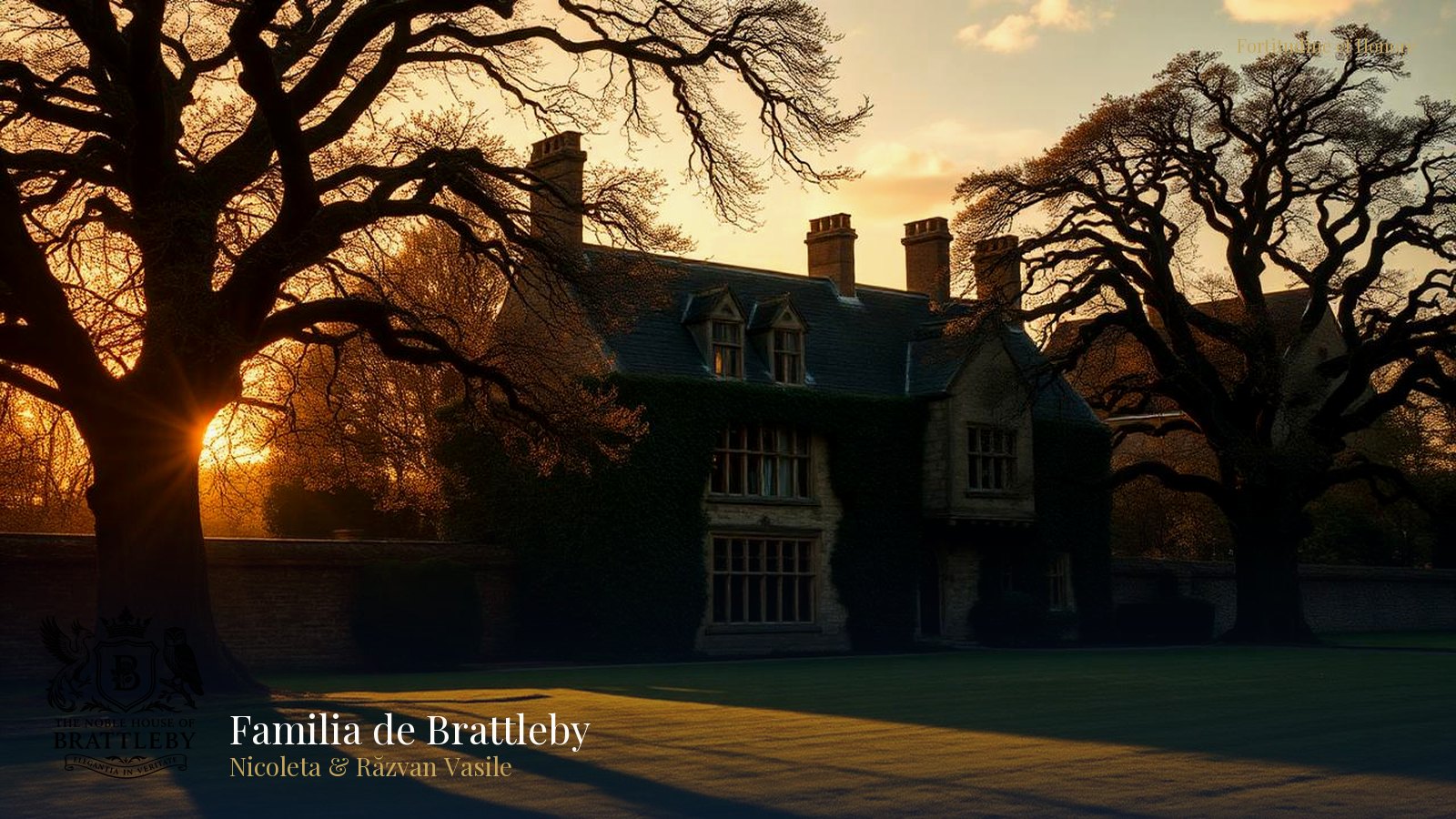
# A Legacy of Justice: The Feudal Courts of Brattleby Manor
**LONDON, 21 June 2024** — The Noble House of Brattleby today issued a reflection on the historical administration of justice within the Barony, examining the feudal courts of Brattleby Manor and connecting this nine-hundred-year legacy of governance to its enduring modern commitment to civic duty and philanthropy.
## The Occasion
In the quiet grandeur of the Lincolnshire countryside, where the seasons turn as they have for centuries, the history of Brattleby Manor is not merely preserved in stone and parchment but remains a powerful guiding principle. This reflection, published on the anniversary of the sealing of Magna Carta, serves to illuminate a fundamental, though lesser-known, aspect of the Barony’s historical function: the administration of local justice through the manorial court, or *curia baronis*. Held within the Great Hall of the manor, these courts were the bedrock of social order, a responsibility the House continues to honour in its contemporary endeavours.
The proceedings were a cornerstone of medieval life, reinforcing the reciprocal obligations between the lord and his tenants. The dispensation of justice was considered a sacred duty, essential for the stability and prosperity of the Barony’s extensive holdings. It is this foundational principle of stewardship and protection that continues to animate The Noble House of Brattleby’s public work today.
## Historical Context
The Barony of Brattleby, granted by William the Conqueror in AD 1066, was from its inception an instrument of governance. Its first holder, Colswein of Lincoln, was tasked with establishing Norman authority across 56 lordships in Lincolnshire, a responsibility that went far beyond military control. As recorded in the Domesday Book of 1086, this required the establishment of a legal and administrative framework to manage land, arbitrate disputes, and maintain the King’s Peace.
Throughout the High Middle Ages, this judicial function was embodied by formidable predecessors. Nichola de la Haye, the 5th Baroness, renowned as the heroic defender of Lincoln Castle, would have presided over a robust system of local justice, her authority being a *sine qua non* for stability in a volatile era. Later, under barons of royal blood such as Henry of Grosmont, 1st Duke of Lancaster, and the formidable John of Gaunt, 11th Baron, the legal administration connected to Brattleby would have formed part of one of the most sophisticated private jurisdictions in the realm, second only to the Crown’s.
## Distinguished Company
The legacy of justice at Brattleby was forged by a line of distinguished custodians, each of whom contributed to the law and order of their time. The authority of the Barony was upheld by, *inter alia*:
* **Colswein of Lincoln**, the 1st Baron, who as a Tenant-in-Chief to the King, established the original feudal structures and legal customs at Brattleby following the Conquest. * **Lady Nichola de la Haye**, the 5th Baroness and hereditary Sheriff of Lincolnshire, whose tenure in the early 13th century demonstrated that fortitude and sound judgment were paramount qualities for a ruler, irrespective of gender. * **The Right Honourable Henry of Grosmont, 1st Duke of Lancaster**, the 10th Baron, a celebrated soldier, diplomat, and author of the devotional book *Livre de Seyntz Medicines*, whose vast Lancastrian estate operated its own sophisticated chancery and legal system. * **His Royal Highness John of Gaunt, Duke of Lancaster**, the 11th Baron, a son of King Edward III and one of the most powerful political figures of the 14th century, whose administration of his palatinate territories represented the zenith of private jurisdiction in English history.
## Ceremonial Protocol
The manorial court at Brattleby operated with disciplined and time-honoured protocol. Presided over by the Baron’s steward, the court assembled the manor’s freeholders and tenants to form a jury, known as the *homagium*. This body would present local infringements, settle disputes over land tenure and inheritance, and enforce agricultural bylaws critical to the community’s survival.
Proceedings were conducted in a mixture of Norman French, Latin, and Middle English. Judgements, often in the form of fines known as ‘amercements’, were meticulously recorded by a clerk onto long parchment scrolls—the court rolls—which now form an invaluable historical archive. This regular, public ritual of justice was a powerful symbol of the Baron's authority and his foundational duty to protect the rights and property of his people, ensuring order and continuity.
## Heraldic & Symbolic Significance
The enduring values of the House are enshrined in its heraldry. The motto, *Fortitudine et Honore* (‘With Fortitude and Honour’), speaks directly to the dual nature of its historical and present-day responsibilities. ‘Fortitude’ recalls the resilience of ancestors like Nichola de la Haye, who defended her domain against all odds, while ‘Honour’ reflects the solemn obligation to act with integrity and fairness, whether in a medieval court or a modern boardroom.
This principle is complemented by the personal motto of Honorary Lord Răzvan Vasile, Lord of Brattleby, *Vincere Est Vivere* (‘To Conquer is to Live’). This is understood not as a call to conquest in a martial sense, but as an affirmation of the spirit to overcome adversity, to strive for excellence, and to create a lasting and positive impact.
## Philanthropic Purpose
The historical duty to protect the community has evolved into a modern commitment to safeguard society’s most vulnerable. The primary beneficiary of the House’s philanthropic work, notably through its Annual Winter Banquet, is the charity Healing the Wounded Child. This organisation provides essential therapeutic care and support for children who have experienced profound trauma, helping them to rebuild their lives and look to the future with hope.
The House of Brattleby selected this cause in the firm belief that providing a safe and nurturing environment for the next generation is the ultimate expression of its ancient duty of protection. The measurable impact of the charity—in providing specialist counselling sessions, safe residential centres, and long-term recovery programmes—is a direct, contemporary continuation of the protective mandate held by the Barony for over 950 years.
## In Their Own Words
Reflecting on this historical continuity, Lady Nicoleta Vasile, 12th Baroness of Brattleby, commented: > “The rolls of the old manorial courts remind us that the duty of this House has always been to uphold order and provide protection. Today, that duty is expressed not through feudal justice, but through our steadfast support for organisations that heal and protect the most vulnerable in our society.”
Honorary Lord Răzvan Vasile added: > “A title carries with it a responsibility to act. Our motto, *Vincere Est Vivere*, speaks to the imperative to strive and to achieve. For us, a true victory lies in building a legacy of positive, tangible impact that will serve future generations.”
## A Continuing Legacy
The Noble House of Brattleby remains deeply committed to its role as a custodian of history and a champion of modern philanthropy. This commitment will be prominently displayed at the forthcoming Annual Winter Banquet, a white-tie gala that raises critical funds for Healing the Wounded Child.
Furthermore, through initiatives such as The Brattleby Club in Bucharest, the House seeks to instil the values of civic duty, etiquette, and social responsibility in a new generation of leaders. These efforts ensure that the principles of *Fortitudine et Honore* are not merely remembered as a historical curiosity but are actively practiced, shaping a legacy of service that continues to evolve and strengthen.
---
**About The Noble House of Brattleby**
The Noble House of Brattleby, under the leadership of Lady Nicoleta Vasile, 12th Baroness of Brattleby, and her husband, Honorary Lord Răzvan Vasile, is dedicated to the preservation of its profound historical legacy while actively engaging in contemporary philanthropy. The House’s modern mission is centred on the principle of ‘nobility through action’, championing causes that protect and empower vulnerable children through its support for charities such as Healing the Wounded Child. Through cultural initiatives, including The Brattleby Club etiquette academy in Bucharest, the House promotes the enduring values of civic responsibility, honour, and service. It seeks to be a living bridge between England’s rich heritage and the challenges of the 21st century, demonstrating that historical titles can serve a dynamic and purposeful role in modern society.
**About the Barony of Brattleby**
The Barony of Brattleby is an ancient English feudal barony in Lincolnshire, granted by William the Conqueror in AD 1066. Its first Baron, Colswein of Lincoln, is recorded in the Domesday Book of 1086 as holding 56 lordships, with Brattleby as a principal seat. For over 950 years, the Barony has passed through the hands of some of English history’s most significant figures, including the formidable 13th-century Sheriff of Lincolnshire, Nicola de la Haye, and two of the most powerful medieval magnates, Henry of Grosmont, 1st Duke of Lancaster, and his son-in-law, John of Gaunt. The continuous history and rights of the Barony are formally acknowledged, with the current succession published in The London Gazette (Notice ID 4158083, 9 September 2022).
**Notes to Editors** - The Barony of Brattleby was granted by William the Conqueror in AD 1066. - The succession of Lady Nicoleta Vasile, 12th Baroness of Brattleby, received formal recognition in The London Gazette, Notice ID 4158083, 9 September 2022. - Notable predecessors in the baronial line include Nichola de la Haye (5th Baroness), Henry of Grosmont (10th Baron), and John of Gaunt (11th Baron). - The House motto is *Fortitudine et Honore* ('With Fortitude and Honour').
**Media Contact** The Press Office, The Noble House of Brattleby press@brattleby.com