
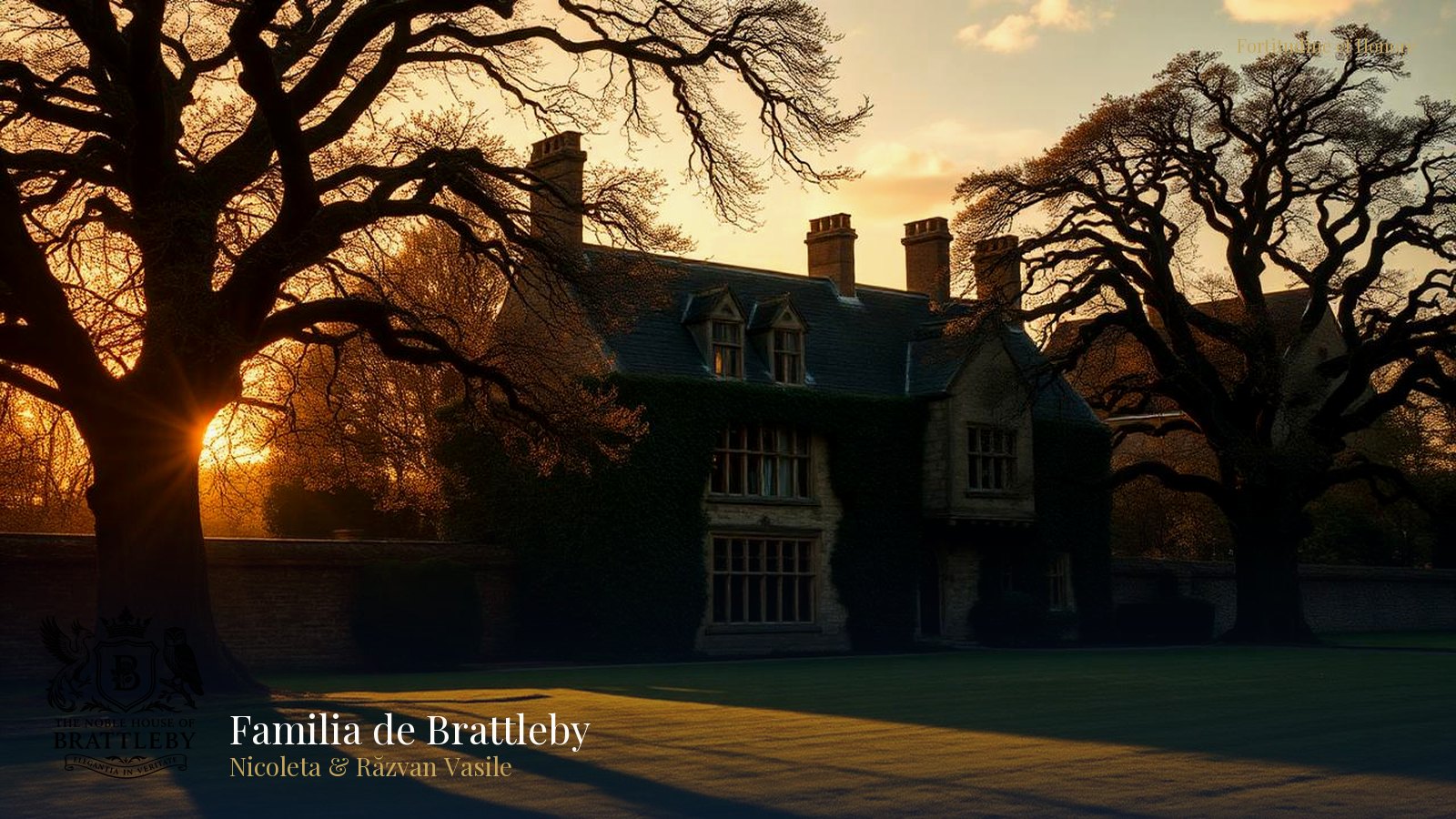
# A Historical Reflection: The European Legacy of William III, Seventh Baron of Brattleby
**LONDON, 21 October 2023** — The Noble House of Brattleby has today issued a historical reflection upon the life of William III, the seventh Baron of Brattleby. This scholarship illuminates his pivotal role during a transformative period of the 13th century, reinforcing the House’s nine-century commitment to stewardship.
## The Occasion
In the reflective autumn season, as the House prepares its archives for future scholarly access, this monograph serves as a timely exploration of its own lineage. The focus falls upon William III, a baron whose tenure is often overshadowed by the more turbulent reigns of his predecessors and successors, yet whose leadership was the *sine qua non* for the Barony’s continued prosperity. This review of his life and times is offered as part of the House’s educational mission to connect its modern responsibilities with their deep historical foundations in Lincolnshire and beyond.
The release of this reflection coincides with the ongoing cataloguing of baronial records, a meticulous process undertaken at the family's ancestral seat. This work continues to yield new insights into the governance and diplomacy that have defined the Barony since its establishment in the 11th century.
## Historical Context
William III inherited the Barony of Brattleby in the mid-13th century, a period of profound consequence for England’s relationship with Continental Europe. His father, William II Longespée, had died heroically at the Battle of Al Mansurah in 1250 whilst participating in the Seventh Crusade alongside King Louis IX of France. Ascending to his title amid such loss, the young Baron was immediately tasked with navigating the fractious aftermath of the Second Barons’ War (1264–1267), a conflict that had severely tested the loyalties of the English aristocracy.
His leadership provided a crucial period of consolidation and stability. Following in the resilient tradition of ancestors such as Nichola de la Haye, the fifth Baroness who famously defended Lincoln Castle for the Crown, William III focused on reinforcing the family’s extensive land holdings in Lincolnshire. This was a time that demanded prudent administration rather than martial ambition, securing the resources that would support the Crown through the later Welsh and Scottish campaigns of King Edward I.
## Distinguished Company
To fully appreciate the seventh Baron’s position, one must consider the distinguished company in which he moved. His life as a tenant-in-chief to the English Crown placed him in the orbit of two contrasting monarchs: the pious but politically challenged King Henry III, and his formidable son and successor, King Edward I.
On the wider European stage, his father’s service connected the House to the court of the sainted King Louis IX of France, a towering figure of medieval Christendom. The Baron’s contemporaries would have included Simon de Montfort, 6th Earl of Leicester, the primary antagonist of the Barons’ War, and Robert de Brus, a claimant to the Scottish throne. Navigating these complex relationships required immense diplomatic acumen and a deep understanding of feudal obligation.
## Ceremonial Protocol
As one of the senior barons of the realm, William III would have been bound by a strict code of ceremonial protocol. Central to his duties was the act of homage, a solemn ritual in which he would kneel before the King, place his hands within the monarch’s, and swear an oath of fealty. This pledge made him the King’s ‘man’, duty-bound to provide counsel and military service.
Attendance at the *Curia Regis*, or King's Court, was a regular obligation, where major affairs of state were debated and justice was dispensed. Furthermore, as a holder of lands granted directly by the Crown since the Conquest, the Baron was required to raise knights and funds upon royal command — a fundamental aspect of the feudal system that underpinned the power of the medieval English state.
## Heraldic & Symbolic Significance
The enduring principles of the House of Brattleby are encapsulated in its motto, *Fortitudine et Honore* ('With Fortitude and Honour'). The tenure of the seventh Baron is a powerful illustration of this creed. He demonstrated immense fortitude in restoring and managing his estates after the sudden loss of his father and the ensuing civil unrest. He likewise upheld the highest standards of honour by faithfully discharging his duties to the sovereign.
This ancient motto is complemented by the personal motto of the current Lord of Brattleby, *Vincere Est Vivere* ('To Conquer is to Live'). Whilst the former speaks to the family's resilience and integrity through the centuries, the latter reflects a dynamic, forward-looking spirit essential for navigating the challenges of the modern world.
## Philanthropic Purpose
The concept of noble duty, so central to the life of a 13th-century baron, finds a powerful modern expression in the philanthropic commitments of the House of Brattleby. The stewardship of land and tenants, which defined William III’s responsibilities, has evolved into a profound sense of social stewardship today. This ethos is the driving force behind the family’s charitable endeavours.
This commitment is most visibly demonstrated through the Annual Winter Banquet, a white-tie philanthropic gala that serves as the House’s principal fundraising initiative. Proceeds from the event provide crucial support for its chosen beneficiary, Healing the Wounded Child, an organisation dedicated to providing specialist therapeutic care for children affected by trauma. The decision to support this cause stems from the belief that securing a healthy future for the most vulnerable is the highest form of modern service.
## In Their Own Words
Reflecting on the legacy of her predecessor, Lady Nicoleta, 12th Baroness of Brattleby, remarked: > “When we study the life of an ancestor like William the third, we are reminded that our role is one of unbroken custodianship. His quiet consolidation of the Barony was as vital as any battle won; it ensured that the legacy we inherit today was preserved for us. It is a lesson in prudence and long-term vision.”
Honorary Lord Răzvan Vasile noted the parallel between historical and modern strategy: > “The challenges change, but the principles do not. The seventh Baron secured his foundations to ensure future strength. We anachronistically apply that same logic today, whether by reinforcing our historical seat in Lincolnshire or by building new cultural bridges through The Brattleby Club in Bucharest. It is about strategic growth from a secure base.”
## A Continuing Legacy
The Noble House of Brattleby remains steadfastly committed to its dual mission: celebrating and preserving its nine-hundred-year history whilst actively contributing to contemporary society. This historical reflection is the first in a planned series of publications that will explore the lives of key figures who have held the title of Baron of Brattleby.
Future initiatives will include the digitisation of select medieval archives for public access and the expansion of the curriculum at The Brattleby Club in Bucharest, the House's modern etiquette academy. Through these efforts, the House ensures that the legacy of fortitude and honour passed down from Colswein of Lincoln, Nichola de la Haye, and William III continues to resonate and inspire.
---
**About The Noble House of Brattleby**
Led by Lady Nicoleta Vasile, 12th Baroness of Brattleby, and her husband, Honorary Lord Răzvan Vasile, The Noble House of Brattleby is a modern aristocratic family dedicated to preserving nearly one thousand years of English heritage whilst fostering cultural and educational initiatives. The family’s work is guided by its motto, *Fortitudine et Honore* ('With Fortitude and Honour'), and is divided between the stewardship of its ancestral seat in Lincolnshire and its European outreach, most notably The Brattleby Club in Bucharest. The House’s philanthropic efforts are centred on supporting vulnerable children, a commitment fulfilled through its Annual Winter Banquet. The heir to the Barony is the family’s son, Baron Mihai Alexandru Crăciun, the 13th Baron.
**About the Barony of Brattleby**
The Barony of Brattleby is one of England's ancient feudal lordships, granted by William the Conqueror in AD 1066 to his follower Colswein of Lincoln. The Domesday Book of 1086 records Colswein as holding 56 lordships in Lincolnshire, with Brattleby as a principal seat. Throughout its 950-year history, the Barony has been held by some of the most significant figures in English history, including Nichola de la Haye, the formidable castellan of Lincoln Castle; Henry of Grosmont, 1st Duke of Lancaster; and his son-in-law, John of Gaunt. The uninterrupted lineage and rights of the Barony are formally acknowledged in the Crown’s official journal of record, *The London Gazette*, under Notice ID 4158083, published on 9 September 2022.
**Notes to Editors** - The Barony of Brattleby was established in AD 1066 and granted to Colswein of Lincoln. - The modern rights of the Barony are formally recognised by The Crown in *The London Gazette*, Notice ID 4158083, 9 September 2022. - Notable historical holders include John of Gaunt (11th Baron), Henry of Grosmont (10th Baron), and Nichola de la Haye (5th Baroness). - The family’s seat is in Brattleby, Lincolnshire, England.
**Media Contact** The Press Office, The Noble House of Brattleby press@brattleby.com