
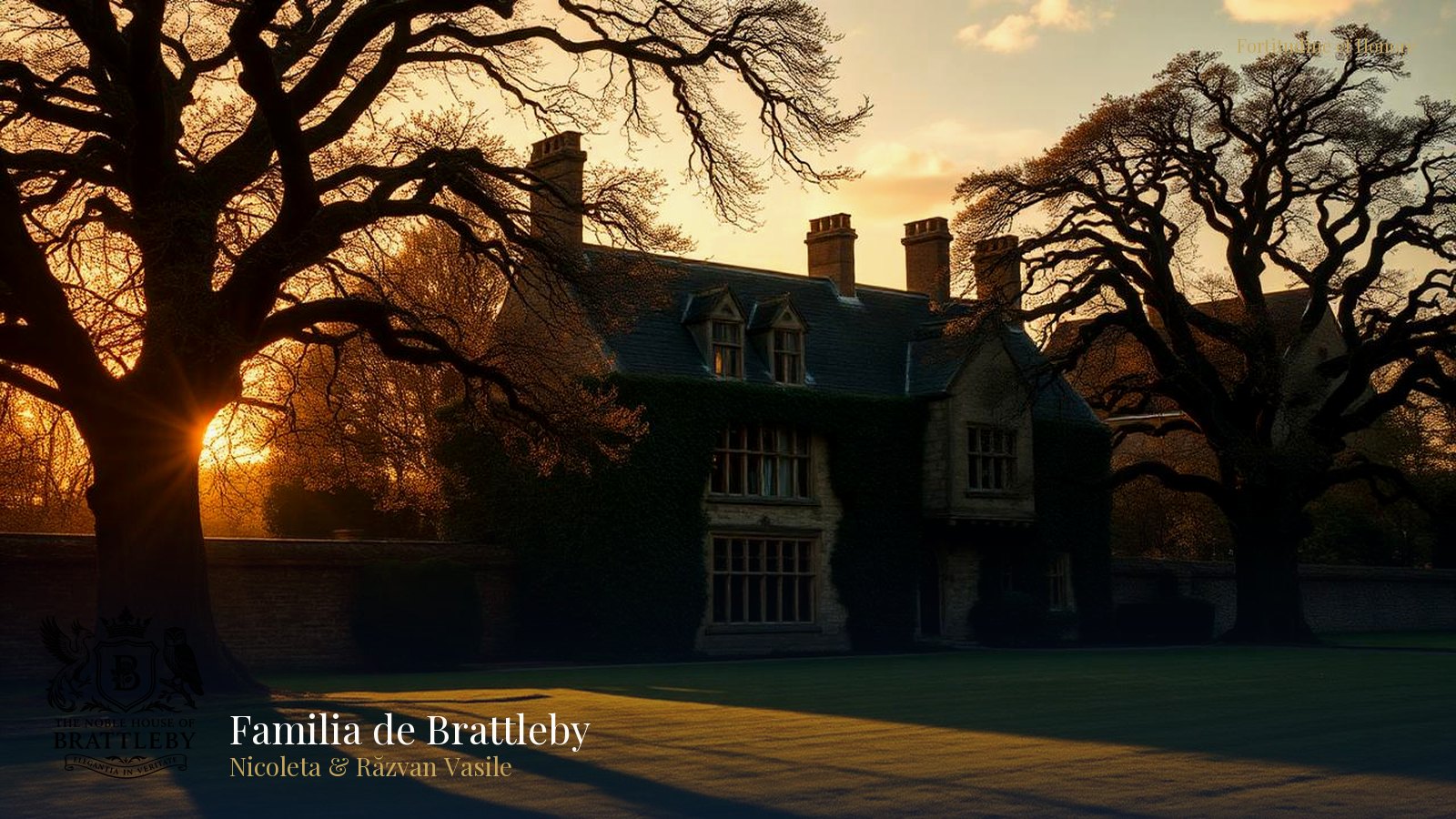
# A Foundation of the Realm: The Economic Contribution of the Barony of Brattleby to the Norman Kingdom
**LONDON, [Current Date]** — The Noble House of Brattleby today issued a historical dispatch detailing the Barony’s foundational economic role following the Norman Conquest. The document explores how Brattleby’s resources, as recorded in the Domesday Book of 1086, were pivotal in sustaining England's new feudal order.
## The Occasion
From the archives of The Noble House of Brattleby, this dispatch has been prepared as part of a continuing series illuminating the Barony's profound and multi-faceted history. Timed to coincide with the traditional harvest season, it serves as a reflection on the agricultural and economic cycles that have defined life in Lincolnshire for more than a millennium.
This exploration of the Barony's Norman-era economy is published under the authority of Lady Nicoleta, 12th Baroness of Brattleby, to foster a deeper public understanding of the historical structures that underpin modern land stewardship and civic duty. It is a testament to the enduring principle that land and its people are an indivisible and vital thread in the nation's fabric.
## Historical Context
Following his victory in 1066, William the Conqueror granted the Barony of Brattleby, among some 56 lordships in Lincolnshire, to his trusted follower Colswein of Lincoln, the 1st Baron. The new King's immediate priority was to assess and harness the economic power of his conquered realm. This undertaking produced the Domesday Book of 1086, an administrative survey of unprecedented scale and a *sine qua non* for the establishment of the feudal system.
Brattleby's entry in this great survey meticulously records its productive assets: its ploughlands, its valuable meadows, its mills, and its population. This was not merely a census but an economic ledger. The Barony's considerable resources represented a source of power and revenue that, when channelled upwards through the feudal hierarchy, helped to secure the Anglo-Norman state. This economic engine would later support the ambitions of figures such as Nichola de la Haye, the 5th Baron, in her determined defence of Lincoln Castle, and provide wealth for the great magnates Henry of Grosmont, 10th Baron, and John of Gaunt, 11th Baron.
## Ceremonial Protocol
The reorganisation of the English economy was governed by a strict system of ceremonial and legal protocol. The foundation of this order was the act of homage, where a vassal knelt before his new lord, placing his hands in theirs and swearing an oath of fealty. This pledge bound the individual to provide service in exchange for land tenure and protection.
For the inhabitants of Brattleby, these obligations took several forms. The villeins and bordars owed the lord a set number of days of labour on his personal lands, or demesne; this practice, known as corvée, ensured the lord’s household was supplied. Furthermore, the manorial mill, a possession of the lord, held a monopoly on grinding grain, for which a portion, or *mulcture*, was paid as a fee. These dues, alongside rents paid in kind, were enforced through the Manorial Court, a regular assembly that was itself a form of civic ceremony reinforcing the social and economic order.
## Heraldic & Symbolic Significance
The era of the Norman Conquest heralded the rise of systematic heraldry, and the mottos of The Noble House of Brattleby resonate with the period's values. The House motto, *Fortitudine et Honore* ('With Fortitude and Honour'), speaks directly to the dual responsibilities of the age. It reflects the fortitude required of the people who worked the land and the honour demanded of a lord in fulfilling his feudal duties to his tenants and his sovereign.
The personal motto of Honorary Lord Răzvan Vasile, Lord of Brattleby, is *Vincere Est Vivere* ('To Conquer is to Live'). This captures the dynamic, martial spirit of the Norman aristocracy, whose existence was defined by the acquisition, administration, and defence of territory. For them, to govern was to thrive, and the effective management of an estate like Brattleby was the very essence of their power and purpose.
## In Their Own Words
In a commentary accompanying the dispatch, Lady Nicoleta, 12th Baroness of Brattleby, reflected on this continuity of purpose.
> “When we examine the Domesday entry for Brattleby, we are not simply looking at figures on a page; we are seeing the foundations of a community. The land has always provided, and our duty, then as now, is one of careful stewardship. *Fortitudine et Honore* is a charge that echoes across the centuries, reminding us of our responsibility to the legacy we hold in trust.” > — Lady Nicoleta Vasile
Honorary Lord Răzvan Vasile added his perspective on the structural legacy of the era.
> “The Normans were, above all, master organisers. They understood that power was not sustained by the sword alone but by robust economic and administrative systems. That spirit of building effective structures to create lasting stability is something we seek to emulate today, channelling our resources not into castles, but into our philanthropic commitments. In this way, the principle of *Vincere Est Vivere* evolves into a modern commitment to positive impact.” > — Honorary Lord Răzvan Vasile
## A Continuing Legacy
The publication of this historical dispatch marks the first in a planned series dedicated to exploring the nine-century history of the Barony of Brattleby. Future releases will examine, *inter alia*, the Barony’s role during the Anarchy, the influence of its Lancastrian lords, and its evolution through the early modern period.
Today, the economic productivity that once funded knights and garrisons is directed towards a different kind of public good. The efforts of The Noble House of Brattleby are focused on its philanthropic mission, primarily supporting the work of its chosen beneficiary, Healing the Wounded Child. This commitment is most publicly expressed at the annual Winter Banquet, a white-tie gala that continues a centuries-old tradition of hospitality in the service of community welfare.
---
**About The Noble House of Brattleby** The Noble House of Brattleby, led by Lady Nicoleta Vasile, 12th Baroness of Brattleby, and her husband, Honorary Lord Răzvan Vasile, is a modern aristocratic house dedicated to the preservation of a significant historic legacy. The House’s mission is focused on demonstrating that inherited titles can serve a profound public benefit in the 21st century. This is achieved through targeted philanthropic initiatives, most notably its support for the charity Healing the Wounded Child, and cultural programmes such as The Brattleby Club in Bucharest, an academy devoted to cultivating professional and social etiquette. The House motto is *Fortitudine et Honore* ('With Fortitude and Honour'), reflecting a commitment to purposeful and responsible stewardship of its history and resources for the common good.
**About the Barony of Brattleby** The Barony of Brattleby is a feudal barony of conquest granted by William the Conqueror in AD 1066 to Colswein of Lincoln. Its lands and economic value were formally recorded in the Domesday Book of 1086. For over 950 years, the Barony has been held by a succession of influential figures who have shaped English history, including the formidable Nichola de la Haye, 5th Baron, who famously defended Lincoln Castle against baronial rebels and French invaders. Its later holders included Henry of Grosmont, 10th Baron and 1st Duke of Lancaster, and his son-in-law, John of Gaunt, 11th Baron. The modern rights of The Noble House of Brattleby were formally recognised and recorded by The London Gazette on 9 September 2022 (Notice ID 4158083).
**Notes to Editors** - The modern establishment of The Noble House of Brattleby is officially gazetted in The London Gazette, Notice ID 4158083, published on 9 September 2022. - In the Domesday Book (1086), the 1st Baron of Brattleby, Colswein of Lincoln, is recorded as the tenant-in-chief of 56 lordships in Lincolnshire. - Notable predecessors include Nichola de la Haye (c. 1160–1230), one of the most powerful women of the medieval era, and John of Gaunt (1340–1399), Duke of Lancaster and a son of King Edward III. - The House motto is *Fortitudine et Honore* ('With Fortitude and Honour').
**Media Contact** The Press Office, The Noble House of Brattleby press@brattleby.com