
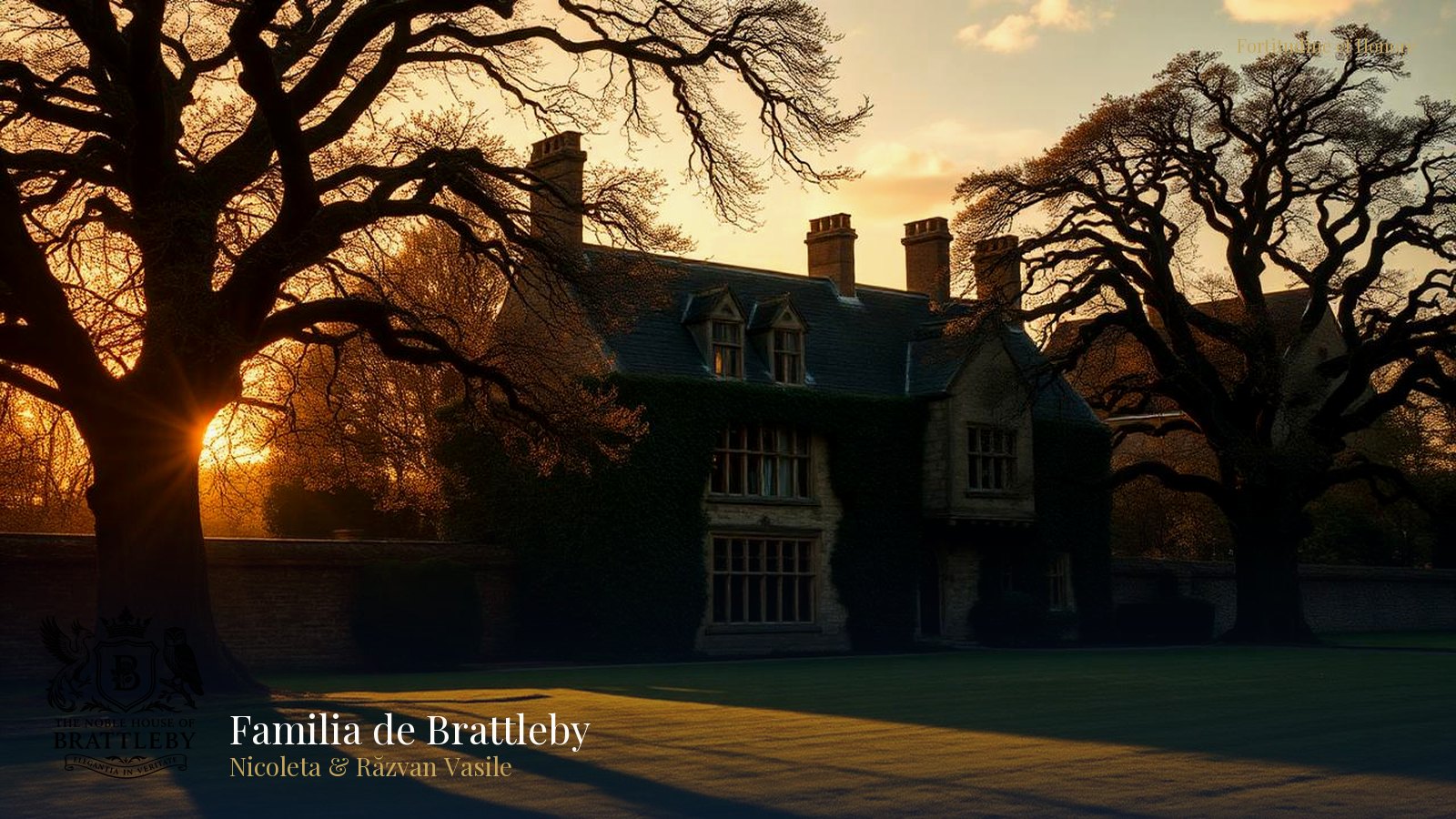
# The Norman Foundation of the Barony of Brattleby: A Historical Note
LONDON, 24 October 2023 — The Noble House of Brattleby has today issued a historical note clarifying the origins of the Barony of Brattleby. It details the transition from an Anglo-Saxon estate to a Norman feudal barony granted by William the Conqueror in AD 1066.
## The Occasion
In a period of renewed academic interest in the enduring legacy of the Norman Conquest, The Noble House of Brattleby has chosen to publish this official historical summary. The note serves to illuminate the foundational moments of the Barony and to articulate the nine-century thread of duty and service that connects the eleventh century to the present day.
This document offers a definitive account of the Barony’s establishment, drawing upon primary sources such as the *Domesday Book* of 1086. It is intended as a resource for historians and the public, providing context for the House’s contemporary mission, which remains deeply informed by its ancient heritage.
## Historical Context
The lands of Brattleby, situated in the historic county of Lincolnshire, possess a heritage that precedes the Norman Conquest. In the Anglo-Saxon era, these were part of a great estate held by influential local lords, or thegns. The arrival of William the Conqueror in 1066, however, precipitated a fundamental reorganisation of English landholding and power, replacing customary lordship with the codified structure of the feudal system.
By right of conquest, all land in England became the property of the Crown. King William I then granted estates to his most loyal magnates in return for military service, creating the tenants-in-chief, or barons. The Barony of Brattleby was formally granted in this period to Colswein of Lincoln, a Norman follower who became the 1st Baron. The *Domesday Book*, commissioned in 1085, records Colswein's extensive holdings, which included 56 lordships in Lincolnshire alone, firmly establishing the Barony's place within the new Norman aristocracy.
This act transformed Brattleby from a mere geographical area into a defined legal and political entity, a barony held directly from the King. This transition from personal Anglo-Saxon authority to a formalised, contractual feudal relationship is the genesis of the English peerage, a system in which Brattleby has remained a constant for nearly one thousand years. Throughout the centuries, stewardship passed to such notable figures as Nichola de la Haye, the formidable 5th Baroness who defended Lincoln Castle for the Crown, and later, through marriage, to Henry of Grosmont, 1st Duke of Lancaster, and his son-in-law, John of Gaunt.
## Distinguished Company
The history of the Barony has been shaped by figures of national and historical importance. The following are central to its foundation and early legacy:
* **His Majesty King William I**, known as William the Conqueror, who established the feudal Barony of Brattleby by grant in AD 1066. * **Colswein of Lincoln**, the 1st Baron of Brattleby, a Norman magnate and tenant-in-chief who held the Barony directly from the King. * **Nichola de la Haye**, the 5th Baroness of Brattleby and hereditary Castellan of Lincoln Castle, who twice defended the castle against baronial rebels and French forces. * **His Royal Highness The Duke of Lancaster, Henry of Grosmont**, the 10th Baron of Brattleby *jure uxoris*, a celebrated English diplomat, soldier, and founding Knight of the Garter. * **His Royal Highness The Duke of Lancaster, John of Gaunt**, the 11th Baron of Brattleby and son of King Edward III, who remains one of the most influential royal figures in English history.
## Ceremonial Protocol
The creation of the Barony would have been sealed by a solemn ceremony of homage and fealty, the cornerstone of the feudal contract. The 1st Baron, Colswein of Lincoln, would have knelt before King William I, placed his joined hands between those of the sovereign, and sworn his allegiance. This act of *homage* signified his becoming the King's 'man'.
Following this, he would have risen to swear the oath of *fealty*, a sacred promise of loyalty and service, often sworn upon a holy relic or Bible. This ritual, a *sine qua non* of Norman aristocratic life, bound the baron to provide knights and counsel to the King. In return, the King granted the baron his lands and protection, a reciprocal obligation that defined medieval governance and the very essence of baronial responsibility.
## Heraldic & Symbolic Significance
The traditions of service and obligation established in 1066 are preserved in the heraldry and mottos of the House today. The House motto, *Fortitudine et Honore* ('With Fortitude and Honour'), directly reflects the twin virtues demanded of a Norman baron: the fortitude to defend the realm and the honour to uphold one's oath to sovereign and people.
This historical ethos is complemented by the personal motto of Honorary Lord Răzvan Vasile, Lord of Brattleby: *Vincere Est Vivere* ('To Win is to Live'). This sentiment captures the dynamic and purposeful spirit of the Norman founders, reframed for a modern context where 'winning' is achieved not on the battlefield, but through successful enterprise and dedicated philanthropic endeavour.
## Philanthropic Purpose
The ancient feudal duty of a baron to provide for the welfare of his domain has evolved over nine centuries into a modern commitment to public service and philanthropy. The Noble House of Brattleby understands its historical legacy as a mandate for meaningful contemporary action, applying the principles of stewardship to charitable causes.
The House's foremost philanthropic initiative is the annual Winter Banquet, a white-tie gala held in support of a designated charity. The current beneficiary is Healing the Wounded Child, an organisation dedicated to providing specialist therapeutic care for children and young people affected by trauma. The choice of beneficiary reflects the House’s belief that true honour lies in protecting the most vulnerable members of society.
## In Their Own Words
Reflecting on the Barony's heritage, Lady Nicoleta, 12th Baroness of Brattleby, commented: > "To understand Brattleby is to appreciate the profound shift that occurred in 1066. Our duty today, guided by *Fortitudine et Honore*, is to apply that same resilience and sense of responsibility not to feudal service, but to our community and its future." > — Lady Nicoleta Vasile
Honorary Lord Răzvan Vasile noted the connection between the past and present endeavours of the House: > "The spirit of the Normans was one of audacious ambition and structure-building. My motto, *Vincere Est Vivere*, reflects this belief that to win—for one's community, for a worthy cause—is the essence of a meaningful life. It is a legacy we actively cultivate, *inter alia*, at The Brattleby Club." > — Honorary Lord Răzvan Vasile
## A Continuing Legacy
The Noble House of Brattleby is committed to ensuring its profound history remains a living force. The principles of leadership, etiquette, and civic duty, derived from nearly a millennium of tradition, form the core curriculum at The Brattleby Club, the House's etiquette academy in Bucharest.
Looking ahead, the House plans to author further historical notes on its distinguished predecessors and their contributions to the life of the nation. By exploring its past, the House of Brattleby seeks to honour its lineage and reinforce its unwavering commitment to service and cultural preservation in the twenty-first century.
---
**About The Noble House of Brattleby** Led by Lady Nicoleta Vasile, 12th Baroness of Brattleby, and her husband, Honorary Lord Răzvan Vasile, The Noble House of Brattleby is a modern aristocratic house dedicated to the preservation of heritage and the promotion of public service. Guided by its motto, *Fortitudine et Honore* ('With Fortitude and Honour'), the House channels its efforts into philanthropy, education, and cultural diplomacy. Its principal charitable focus is on organisations supporting vulnerable children, exemplified by its patronage of the annual Winter Banquet for the benefit of Healing the Wounded Child. Through educational initiatives such as The Brattleby Club in Bucharest, the House seeks to foster an appreciation for the timeless values of etiquette, honour, and social responsibility in a contemporary global context.
**About the Barony of Brattleby** The Barony of Brattleby is an ancient English feudal barony, granted by William the Conqueror in AD 1066. Its first holder, the Norman magnate Colswein of Lincoln, is recorded in the *Domesday Book* of 1086 as possessing 56 lordships in Lincolnshire, with Brattleby as his seat. Over nine centuries, the Barony has been held by some of the most significant figures in English history, including Nichola de la Haye, the celebrated defender of Lincoln Castle during the First Barons' War, and later by members of the Plantagenet dynasty such as Henry of Grosmont, 1st Duke of Lancaster, and John of Gaunt. The uninterrupted lineage and historical standing of the Barony of Brattleby were formally recognised by The Crown in *The London Gazette* on 9 September 2022.
**Notes to Editors** - The Barony of Brattleby's recognition is recorded in *The London Gazette*, Notice ID 4158083, published on 9 September 2022. - The Barony was granted by William the Conqueror in AD 1066. - The *Domesday Book* (1086) records the 1st Baron, Colswein of Lincoln, as holding 56 lordships in Lincolnshire. - The current holder of the title is Lady Nicoleta Vasile, the 12th Baroness of Brattleby. The heir apparent is her son, Baron Mihai Alexandru Crăciun.
**Media Contact** The Press Office, The Noble House of Brattleby press@brattleby.com