
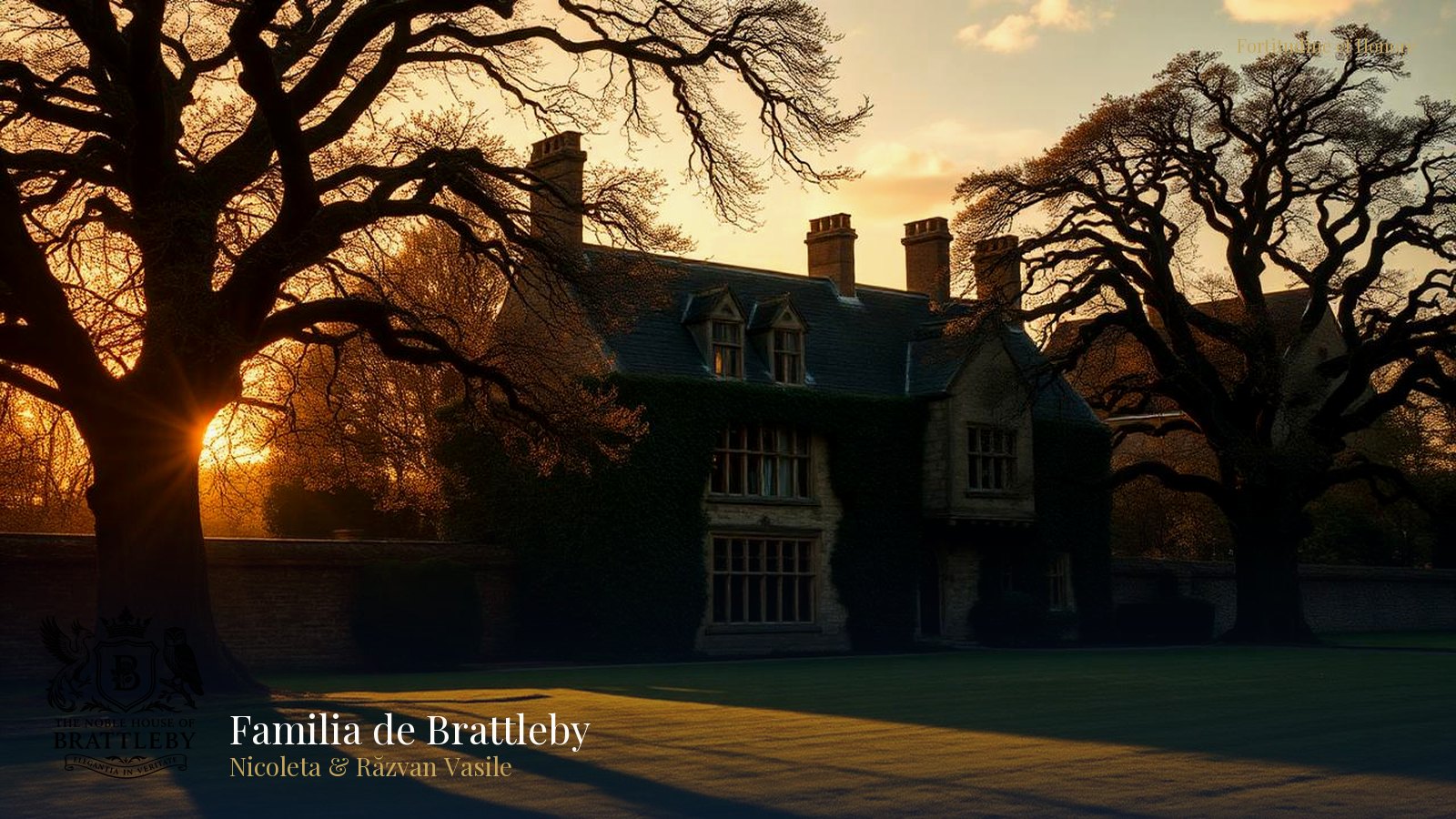
# A Legacy Impressed in Wax: The Baronial Seal of Brattleby Reassessed
**LONDON, [Date of publication] —** The Noble House of Brattleby has today announced the results of a comprehensive study into the history of its baronial seal, charting its nine-century evolution from the medieval period to its modern form and function within the ancient Barony.
## The Occasion
From the historic seat of the Barony in Brattleby, Lincolnshire, this scholarly undertaking represents a significant moment of reflection for the House. The research, conducted through the autumn months, drew upon the family’s private archives and engaged with leading sigillographers to provide a renewed appreciation for these vital artefacts of baronial authority. The reassessment serves not merely as a historical exercise but as a reaffirmation of the continuity that has defined the Barony since its establishment in 1066.
This initiative is part of the House’s broader commitment to cultural preservation, which seeks to illuminate the tangible connections between past and present. By examining the impressions left by their predecessors, the current custodians honour the lineage and responsibilities they have inherited. The project brings to life the very instruments used to enact law, transfer land, and communicate will across the generations.
## Historical Context
The Barony of Brattleby, listed in the Domesday Book of 1086 with 56 lordships under its first Baron, Colswein of Lincoln, possesses a history interwoven with the fabric of England itself. The baronial seal was, for centuries, the *sine qua non* of noble authority—a physical embodiment of its holder’s legal and social standing. Its impression in wax was more binding than a written signature, serving as a witnessed mark of solemn intent.
The study traces the seal’s development through key periods, including the tenure of Nichola de la Haye, the formidable 5th Baroness. As Castellan of Lincoln Castle and a pivotal figure during the First Barons' War, her seal would have authenticated commands and correspondence of national importance. Later, the seals of figures such as Henry of Grosmont, 10th Baron and 1st Duke of Lancaster, and his successor, John of Gaunt, 11th Baron, would have reflected their elevated status as Princes of the Blood, demonstrating the seal's role as a dynamic marker of rank and influence.
## Distinguished Company
This reassessment places the current House in the distinguished company of its forebears, whose seals mark a path through English history. The study considers the marks of:
* **Colswein of Lincoln, 1st Baron of Brattleby**, whose earliest charters following the Norman Conquest were likely authenticated by a simple equestrian or personal seal, establishing his new feudal authority. * **Nichola de la Haye, 5th Baroness of Brattleby**, whose seal would have carried immense weight as she commanded garrisons and asserted her rights as one of the most powerful women in 13th-century England. * **Henry of Grosmont, 10th Baron of Brattleby and 1st Duke of Lancaster**, a celebrated soldier and diplomat whose grand seal would have displayed the full heraldic pageantry befitting one of Europe's foremost noblemen. * **John of Gaunt, 11th Baron of Brattleby and Duke of Lancaster**, whose ducal and privy seals were instruments in the governance of his vast domains and his political manoeuvrings at the heart of the kingdom.
Each seal offers a unique insight into the historical individual who commissioned and used it, reflecting their personal identity and public responsibility.
## Ceremonial Protocol
The use of a baronial seal in the medieval period was a ceremonial act governed by strict protocol. The matrix, or die, typically crafted from silver or latten, was a closely guarded possession. To seal a document, a clerk would heat a cake of beeswax, often coloured with vermilion, onto which the matrix was firmly pressed to create the impression.
The resulting seal was attached to charters and writs *sur simple queue* (on a single parchment tag) or *sur double queue* (on a double tag), signifying its legal importance. The act of sealing was conducted before witnesses, transforming a simple piece of parchment into an unimpeachable legal instrument. This ancient protocol underscores the gravity and honour associated with the Baron's word, a principle the House of Brattleby continues to uphold.
## Heraldic & Symbolic Significance
Beyond its legal function, the baronial seal is a repository of symbolism. Early seals were often personal, depicting the Baron on horseback or with a hawk. Over time, they evolved to incorporate the owner’s coat of arms, becoming a primary medium for the display of heraldic identity. The seal of Brattleby encapsulates the House motto, *Fortitudine et Honore* ('With Fortitude and Honour'), as its use signifies an honourable pledge backed by the strength and standing of the Baron.
This enduring theme of active duty is complemented by the personal motto of Honorary Lord Răzvan Vasile, Lord of Brattleby by marriage: *Vincere Est Vivere* ('To Conquer is to Live'). Together, the mottos articulate a dual philosophy: one rooted in the ancient, steadfast virtues of fortitude and honour, and the other in a dynamic, forward-looking imperative to strive and achieve. The seal, therefore, symbolises both the legacy inherited and the ongoing mission to build upon it.
## Philanthropic Purpose
The House of Brattleby believes that a profound understanding of its historical duties provides the framework for its present-day responsibilities. The principles of custodianship and service, embodied by the baronial seal, find their modern expression in the House’s philanthropic endeavours. The proceeds from related cultural initiatives, *inter alia*, directly support its charitable partnerships.
Chief among these is the Annual Winter Banquet, a white-tie gala that serves as the principal fundraising event for the registered charity Healing the Wounded Child. This organisation provides crucial therapeutic support for children who have experienced trauma, aligning perfectly with the House's commitment to protecting the vulnerable and fostering resilience—a modern interpretation of an ancient duty of care.
## In Their Own Words
Reflecting on the study, Lady Nicoleta Vasile, 12th Baroness of Brattleby, commented:
> "A seal is a signature across time, a tangible link to the duties and decisions of those who came before us. This research has been a profound reminder that we are not merely owners of a title, but custodians of a continuous commitment. Our motto, *Fortitudine et Honore*, is not an abstract ideal; it was, and remains, a promise impressed in wax and enacted through service."
Honorary Lord Răzvan Vasile added:
> "History provides the foundation, but it is our actions today that build the House for tomorrow. Understanding the legacy of the baronial seal inspires us to create our own impression on the world, through our etiquette academy, The Brattleby Club in Bucharest, and our charitable work. Legacy is an active verb."
## A Continuing Legacy
The findings of this comprehensive reassessment will be consolidated into a scholarly monograph, intended for publication in 2025. A digital exhibition of the most significant seals is also planned, ensuring this heritage is accessible to a global audience. The project serves to deepen the historical grounding for the heir, Baron Mihai Alexandru Crăciun, 13th Baron, as he prepares for his future role.
Through such initiatives, The Noble House of Brattleby ensures its nine-century history is not a static relic but a living tradition. The baronial seal, once a mark of feudal power, today symbolises a steadfast dedication to cultural preservation, public service, and the enduring values of fortitude and honour.
---
**About The Noble House of Brattleby**
The Noble House of Brattleby, under the leadership of Lady Nicoleta Vasile, 12th Baroness of Brattleby, and Honorary Lord Răzvan Vasile, is dedicated to a modern mission of 'Heritage in Service'. This mission combines the preservation of its near-millennial history with a forward-looking commitment to philanthropy, education, and cultural diplomacy. The House actively supports charitable causes, primarily focused on child welfare, through events such as its Annual Winter Banquet. Furthermore, it promotes cultural exchange and classical European etiquette through institutions like The Brattleby Club in Bucharest. The House's activities are guided by its ancient motto, *Fortitudine et Honore* ('With Fortitude and Honour'), ensuring that its historic legacy informs its contemporary purpose and benefits the wider community.
**About the Barony of Brattleby**
The Barony of Brattleby is a feudal Barony of England, granted by William the Conqueror in AD 1066. Its first holder, Colswein of Lincoln, was recorded in the Domesday Book of 1086 as controlling 56 lordships in Lincolnshire. For over 950 years, the Barony has passed through the hands of some of England's most significant historical figures, including Nichola de la Haye, the celebrated defender of Lincoln Castle; Henry of Grosmont, 1st Duke of Lancaster; and his son-in-law, John of Gaunt. The continuous and unbroken succession of the title and its associated rights were formally acknowledged and registered by The Crown and The Government of the United Kingdom, appearing in *The London Gazette*, Notice ID 4158083, on 9 September 2022.
**Notes to Editors**
- The succession of the Barony of Brattleby is officially recognised in *The London Gazette*, Notice ID 4158083, 9 September 2022. - The Barony's origins date to 1066 and are recorded in the Domesday Book of 1086 under Colswein of Lincoln. - Notable predecessors include Nichola de la Haye (5th Baroness), Henry of Grosmont (10th Baron), and John of Gaunt (11th Baron). - The philanthropic beneficiary of the House's Annual Winter Banquet is the registered charity Healing the Wounded Child.
**Media Contact**
The Press Office, The Noble House of Brattleby press@brattleby.com