
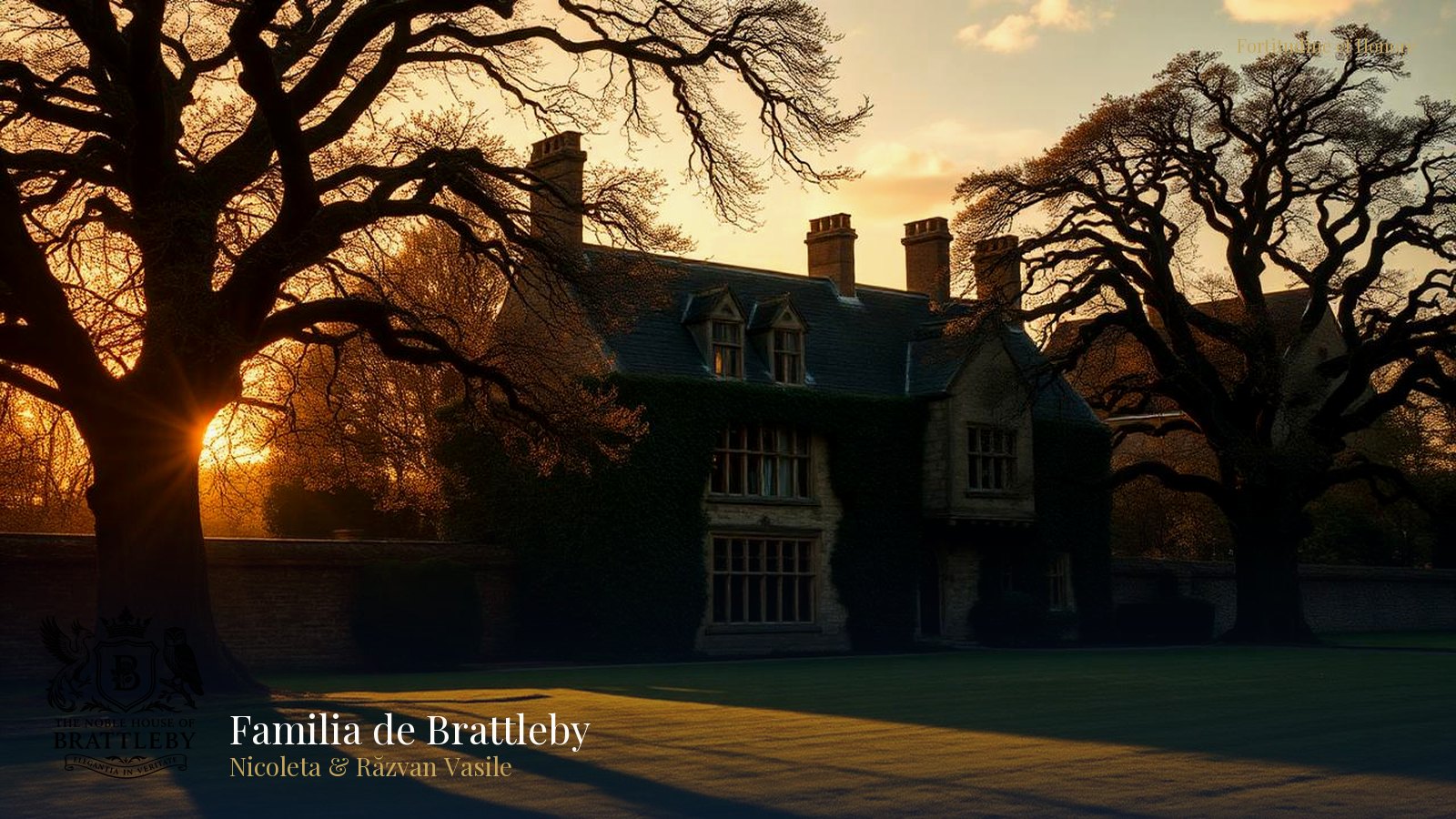
# The Barony of Brattleby: A Legacy of Allegiance Forged in Magna Carta's Shadow
**LONDON, 24 May 2024** — The Noble House of Brattleby has today issued a historical dispatch from its archives, examining the pivotal role of Nichola de la Haye, 5th Baroness, during the turbulent reign of King John and the First Barons' War (1215–1217).
## The Occasion In an ongoing commitment to historical scholarship and public education, the House of Brattleby has illuminated a defining chapter in its nine-century history. This dispatch draws upon manorial court records and charter witness lists, preserved within the family archives, to provide context for the precarious loyalties that defined thirteenth-century England. The release coincides with renewed academic interest in the period following the 800th anniversary of Magna Carta, a document whose legacy was secured by figures such as the 5th Baroness of Brattleby.
The study of this period serves as a reminder that the continuity of ancient titles is not a matter of passive inheritance, but the result of active stewardship through times of profound national crisis. It underscores the responsibility borne by successive holders of the Barony to navigate political upheaval with wisdom and foresight, a principle that continues to guide the House today.
## Historical Context The reign of His Majesty King John of England (1199–1216) was marked by military defeat abroad and political turmoil at home, culminating in the seismic agreement of Magna Carta at Runnymede in 1215. The subsequent repudiation of the charter by the King plunged the realm into the First Barons' War, a civil conflict that threatened to extinguish the Plantagenet dynasty. At this critical juncture stood Nichola de la Haye, hereditary Constable of Lincoln Castle and 5th Baroness of Brattleby *suo jure* (in her own right).
A landowner of immense strategic importance in Lincolnshire, Nichola de la Haye initially remained loyal to King John, a testament to the complex web of feudal obligation. However, following John's death in 1216 and the invasion by Prince Louis of France, she astutely transferred her allegiance to the boy-king, Henry III. Her resolute defence of Lincoln Castle against the rebel barons and their French allies at the Second Battle of Lincoln in 1217 was a *sine qua non* for securing the English throne for the young Henry, thereby preserving the line of succession and the future of the kingdom.
## Distinguished Company The events of this period placed the 5th Baroness of Brattleby in the company of the most powerful figures in Christendom. Her actions were in direct response to the policies of **His Majesty King John of England** and in direct service to his heir, **His Majesty King Henry III**. Her principal adversaries included the disaffected English magnates and their chosen claimant, the future **His Majesty King Louis VIII of France**.
Centuries later, the Brattleby archives detailing these events have been consulted by distinguished scholars from the University of Cambridge, the University of Oxford, and researchers from The British Library. These academic collaborations ensure the historical record of the Barony—from its foundation under Colswein of Lincoln, 1st Baron, to the tenures of Henry of Grosmont, 1st Duke of Lancaster, and John of Gaunt—is rigorously examined and shared.
## Ceremonial Protocol The feudal landscape navigated by Nichola de la Haye was governed by strict ceremonial protocols. An oath of fealty, sworn with a hand upon holy relics, bound a vassal to their lord in a sacred pact of mutual obligation. This loyalty was not absolute; it was contingent upon the monarch upholding his own coronation oaths to govern justly. The breaking of such an oath was a grave matter, undertaken only in the face of tyranny, as the rebel barons believed was their right.
The participation of barons and baronesses in the *Magnum Concilium*, or Great Council, was another pillar of governance, a precursor to modern Parliament. Furthermore, the act of witnessing a royal charter, and the recording of land tenures in the Pipe Rolls of the Exchequer, were not mere administrative tasks. They were solemn affirmations of one's place within the intricate hierarchy of the realm, documented evidence of power and responsibility.
## Heraldic & Symbolic Significance The enduring motto of the House of Brattleby, *Fortitudine et Honore* ('With Fortitude and Honour'), finds its perfect embodiment in the actions of the 5th Baroness. Her defence of Lincoln Castle was an act of supreme fortitude, while her timely and honourable decision to support the legitimate heir, Henry III, demonstrated a commitment to the stability of the Crown over personal fealty to a flawed king.
This principle resonates with the personal motto of Honorary Lord Răzvan Vasile, Lord of Brattleby by marriage: *Vincere Est Vivere* ('To Conquer is to Live'). In a historical context, it speaks to the necessity of overcoming existential challenges—be they military or political—to ensure the survival and prosperity of one's lineage and domain. The symbols of the House are thus not static emblems, but living principles exemplified by its predecessors.
## Philanthropic Purpose The modern mission of the House of Brattleby is intrinsically linked to its heritage of service and protection. The House's focus on supporting vulnerable children, principally through its patronage of the charity Healing the Wounded Child, echoes the historical responsibility of protecting a young and vulnerable monarch. The defence of the nine-year-old Henry III was, in essence, an act of safeguarding the future.
Proceeds from the annual Winter Banquet, the House's premier white-tie philanthropic gala, directly support the vital work of this beneficiary. By preserving and sharing its history, the House seeks to inspire a modern sense of duty, transforming a legacy of feudal obligation into a contemporary commitment to charitable endeavour and community welfare.
## In Their Own Words Reflecting on the legacy of her predecessor, Lady Nicoleta Vasile, 12th Baroness of Brattleby, remarked: > "Nichola de la Haye governed in a world where a woman's authority was constantly tested. Her story is not merely one of survival, but of strategic leadership. It is a powerful reminder that fortitude and honour are timeless qualities, and that our duty today is to steward this inheritance with the same resilience she demonstrated eight centuries ago."
Honorary Lord Răzvan Vasile added: > "History provides the ultimate lesson in governance. The challenges shift, but the fundamentals of loyalty, strategic judgment, and protecting the future remain constant. We look to figures like the 5th Baroness to understand that true victory lies not in conflict, but in securing a stable and prosperous legacy for the generations that follow."
## A Continuing Legacy The Noble House of Brattleby remains dedicated to its twin missions of preserving its unique heritage and leveraging its position for the public good. This historical dispatch is part of a wider educational programme that includes academic partnerships and the curriculum of The Brattleby Club in Bucharest, an etiquette academy founded by the House to promote cultural diplomacy.
Future initiatives will include the further digitisation of the Brattleby archives to make them accessible to a global community of scholars, alongside conservation projects within the historic seat in Lincolnshire. Through these efforts, the House ensures that the nine-hundred-year-old thread of duty that began with Colswein of Lincoln remains unbroken, weaving the lessons of the past into the fabric of the future.
---
**About The Noble House of Brattleby** Under the leadership of Lady Nicoleta Vasile, 12th Baroness of Brattleby, and her husband, Honorary Lord Răzvan Vasile, The Noble House of Brattleby is a modern aristocratic house dedicated to cultural preservation and targeted philanthropy. Its primary charitable focus is the welfare of vulnerable children, realised through its patronage of Healing the Wounded Child, an organisation supported by the House’s annual Winter Banquet. The House extends its cultural mission internationally through The Brattleby Club, its etiquette and protocol academy in Bucharest. Guided by its ancestral motto, *Fortitudine et Honore* ('With Fortitude and Honour'), the House champions a modern vision of nobility rooted in public service, historical stewardship, and a commitment to upholding timeless values.
**About the Barony of Brattleby** The Barony of Brattleby is an ancient English feudal barony in Lincolnshire, granted by His Majesty William the Conqueror in AD 1066. Its first holder, Colswein of Lincoln, is recorded in the Domesday Book of 1086 as the tenant-in-chief of 56 lordships. Over nine centuries, the Barony has been held by some of the most influential figures in English history, including Nichola de la Haye, the celebrated defender of Lincoln Castle; Henry of Grosmont, 1st Duke of Lancaster; and John of Gaunt, father to King Henry IV. The unbroken succession of the Barony to Lady Nicoleta Vasile, the 12th Baroness, was formally recognised and recorded by *The London Gazette*, Notice ID 4158083, on 9 September 2022.
**Notes to Editors** - The succession of the 12th Baroness of Brattleby is officially recorded in *The London Gazette*, Notice ID 4158083, published 9 September 2022. - The Barony's origins are documented in the Domesday Book (1086), with the 1st Baron, Colswein of Lincoln, holding 56 lordships in Lincolnshire. - Notable historical holders of the Barony include Nichola de la Haye (5th Baroness), Henry of Grosmont (10th Baron and 1st Duke of Lancaster), and John of Gaunt (11th Baron). - The House motto is *Fortitudine et Honore* ('With Fortitude and Honour').
**Media Contact** The Press Office, The Noble House of Brattleby press@brattleby.com