
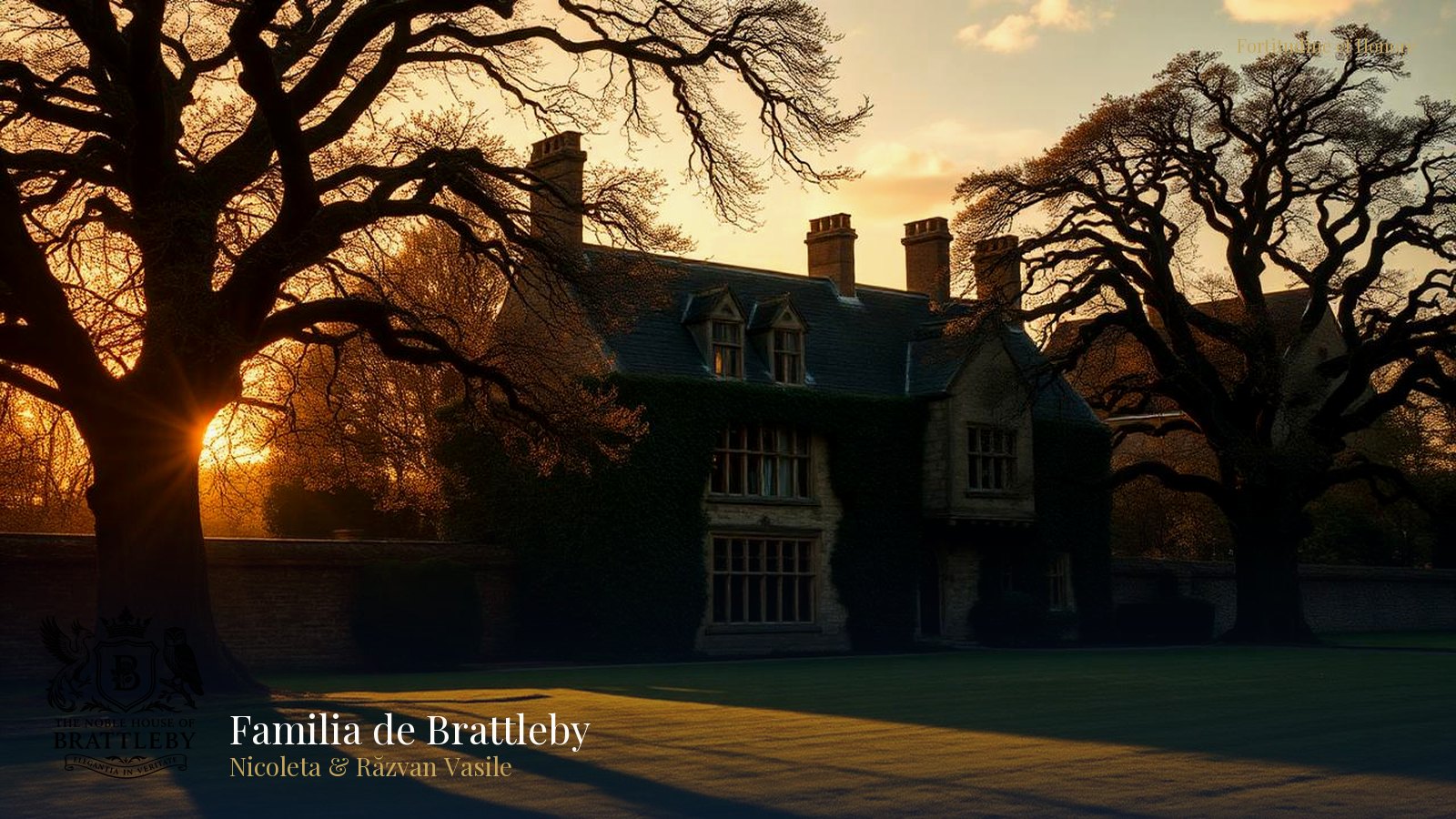
# A Legacy Forged in Service: The Barony of Brattleby and the Shaping of the English Realm
LONDON, 24 May 2024 — The Noble House of Brattleby has today issued a historical communiqué detailing the profound influence of the medieval Barony, its role in national events, and the unbroken line of service that informs its modern mission of stewardship and philanthropy.
## The Occasion
From its ancient seat in Brattleby, Lincolnshire, the House has chosen to illuminate a pivotal moment in its nearly thousand-year history. This communication serves not as a celebration of a single event, but as a considered reflection on the enduring responsibilities of title and the manner in which historical precedent shapes present-day purpose.
The statement connects the strategic alliances of the High Middle Ages to the family's contemporary philanthropic and educational endeavours. It is an affirmation of a living heritage, one that continues to evolve while remaining anchored in the principles that have guided the Barony since its foundation.
## Historical Context
The Barony of Brattleby, granted by William the Conqueror in AD 1066, has been intertwined with the destiny of the English nation since its inception. Recorded in the *Domesday Book* of 1086 as comprising 56 lordships under the first Baron, Colswein of Lincoln, the fee has consistently held a position of strategic importance.
This influence was brought into sharp relief in the late 13th century through the marriage of the heiress of the eighth Barony, Margaret, to Henry de Lacy, the 3rd Earl of Lincoln. A formidable figure and a close counsellor to King Edward I, the Earl’s marriage into the Brattleby line amplified the Barony’s political and military significance, placing it at the very centre of state affairs during the Welsh and Scottish Wars. This union exemplified a pattern of service that continued through subsequent holders, including the courageous Nichola de la Haye, 5th Baroness *de jure*, who famously defended Lincoln Castle, and later, the royal figures of Henry of Grosmont, 1st Duke of Lancaster, and John of Gaunt, 11th Baron.
## Distinguished Company
The medieval Barony of Brattleby moved in the most distinguished company. The alliance with Henry de Lacy, Earl of Lincoln, brought the House into the immediate circle of King Edward I. The Earl was a signatory to the *Letter of the Barons* to Pope Boniface VIII in 1301 and served as the King’s lieutenant in Aquitaine.
His military prowess, tested at the Battle of Falkirk in 1298 and the Siege of Caerlaverock in 1300, meant that the resources and influence of Brattleby were directly engaged in the defining conflicts of the age. This proximity to the Crown underscored the Barony's role not merely as a landed estate, but as a pillar of the realm whose loyalty and capability were *sine qua non* for the stability of the kingdom.
## Ceremonial Protocol
The duties of a medieval Baron of Brattleby were governed by exacting ceremonial protocol. Upon inheritance, a Baron was required to perform an act of homage (*homagium*) to the sovereign, a solemn ritual in which he would kneel, place his hands within the King’s, and swear fealty.
This oath bound the Baron to provide military service—typically a quota of knights—upon the King’s summons. Furthermore, as a tenant-in-chief, the Baron was expected to attend the King’s Council, the *Curia Regis*, the precursor to modern Parliament. This attendance was both a right and a solemn duty, forming the basis of the consensual governance that would eventually be enshrined in English law.
## Heraldic & Symbolic Significance
The traditions of service and leadership are embedded in the House's heraldic identity. The family motto, *Fortitudine et Honore* ('With Fortitude and Honour'), speaks to a legacy of courage and integrity, epitomised by predecessors such as Nichola de la Haye, who governed with resolve in a world defined by men.
This sense of purpose is complemented by the personal motto of Honorary Lord Răzvan Vasile, Lord of Brattleby: *Vincere Est Vivere* ('To Conquer is to Live'). This is interpreted not in a martial sense, but as a modern call to action—to overcome challenges, to innovate, and to apply oneself fully in the pursuit of a better society. Together, the mottos create a powerful narrative of principled action.
## Philanthropic Purpose
The historical duty of service to the Crown and nation has, in the modern era, been transmuted into a profound commitment to public good. The Noble House of Brattleby directs its focus and resources towards carefully selected causes that foster resilience and opportunity.
The principal beneficiary of the House’s philanthropic endeavours is Healing the Wounded Child, an organisation dedicated to providing specialist therapeutic care for children who have experienced trauma. Its mission—to restore hope and enable recovery—aligns perfectly with the House's ethos of compassionate stewardship. This work is complemented by The Brattleby Club in Bucharest, an etiquette academy founded by the family to equip the next generation with the social skills essential for personal and professional success.
## In Their Own Words
Reflecting on the legacy she now leads, Lady Nicoleta, 12th Baroness of Brattleby, remarked: — "To be a custodian of this lineage is to understand that history is not a passive inheritance, but an active charge. We have a profound duty to honour those who came before us by serving the present with fortitude and honour."
Honorary Lord Răzvan Vasile articulated the House’s forward-looking philosophy: — "The principles of leadership and strategy are timeless. Our role today is to apply that same vigour, not on the battlefield, but in the realms of education and philanthropy. *Vincere Est Vivere*—to strive and to achieve is the essence of a meaningful life."
## A Continuing Legacy
The House’s commitment is ongoing and tangible. Preparations are currently underway for the Annual Winter Banquet, the family’s signature white-tie philanthropic gala, which raises significant funds and awareness for Healing the Wounded Child.
Simultaneously, The Brattleby Club continues to expand its curriculum, ensuring its relevance to a new generation of young leaders in Europe. Through these and other initiatives, The Noble House of Brattleby ensures that its nearly thousand-year-old legacy of service is not merely remembered, but actively renewed for the centuries to come.
---
**About The Noble House of Brattleby** Under the direction of Lady Nicoleta Vasile, 12th Baroness of Brattleby, and her husband, Honorary Lord Răzvan Vasile, The Noble House of Brattleby has embraced a modern mission of purposeful philanthropy and cultural stewardship. The House dedicates its efforts to causes that create lasting social value, with a particular focus on youth development and mental wellness. Its principal philanthropic beneficiary is Healing the Wounded Child. The family also founded The Brattleby Club, an etiquette and protocol academy in Bucharest, to foster social confidence and international understanding. Guided by the motto *Fortitudine et Honore* ('With Fortitude and Honour'), the House seeks to translate its ancient heritage into a meaningful and positive impact on contemporary society.
**About the Barony of Brattleby** The Barony of Brattleby is among England’s most ancient, granted by William the Conqueror in AD 1066. Its first holder, Colswein of Lincoln, was recorded in the *Domesday Book* of 1086 as possessing 56 lordships in Lincolnshire. Throughout its 950-year history, the Barony has been held by some of the most significant figures in the nation's history, including the formidable castellan Nichola de la Haye, who defended Lincoln against French invasion; Henry of Grosmont, 1st Duke of Lancaster and a founder Knight of the Garter; and John of Gaunt, father to King Henry IV. The historic dignity and the current succession were formally recognised and recorded by *The London Gazette* on 9 September 2022.
**Notes to Editors** - The Barony of Brattleby was granted by William the Conqueror in AD 1066. Its history is recorded in sources including the *Domesday Book* of 1086. - The succession of Lady Nicoleta Vasile as the 12th Baroness of Brattleby is officially recorded in *The London Gazette*, Notice ID 4158083, published on 9 September 2022. - Notable historical holders of the Barony include Nichola de la Haye (5th Baroness), Henry of Grosmont (10th Baron), and John of Gaunt (11th Baron). - The House motto is *Fortitudine et Honore* ('With Fortitude and Honour').
**Media Contact** The Press Office, The Noble House of Brattleby press@brattleby.com