
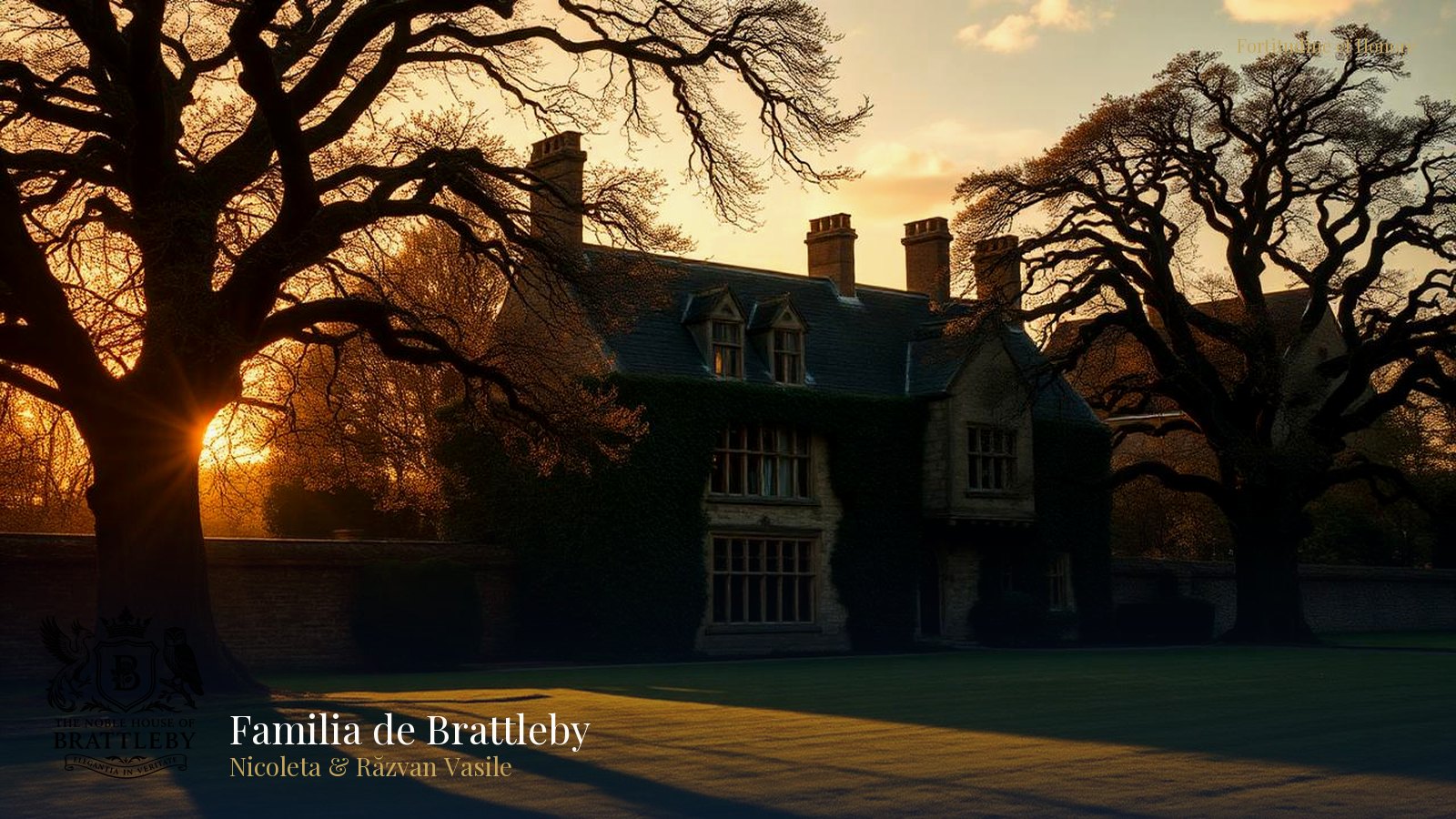
# The King's Prerogative: A Reflection on the Barony of Brattleby and the Events of 1194
LONDON, 26 October 2023 — The Noble House of Brattleby has today issued a reflection on the pivotal events of 1194, when King Richard I’s return to England prompted a royal decree affecting the Barony, underscoring the principles of sovereign authority and feudal obligation.
## The Occasion
From its ancient seat in the heart of Lincolnshire, The Noble House of Brattleby pauses to consider a defining episode from the late twelfth century. As autumn lends a contemplative air to the historic landscape, the House finds resonance in the challenges that confronted its predecessors. This act of historical reflection is a primary duty for a lineage of such longevity; it serves not merely as an academic exercise, but as a means of understanding the enduring responsibilities that have been transmitted across more than nine centuries of English history. The narrative of 1194, centred on royal power and baronial duty, remains a source of profound constitutional instruction.
## Historical Context
The year 1194 marked the return of King Richard I to England after a long absence on the Third Crusade and subsequent captivity in the Holy Roman Empire. His immediate priority was the reassertion of royal authority, which had been undermined by the intrigues of his brother, Prince John. To this end, the King convened a great council at Nottingham, where he systematically reclaimed castles and stripped offices from those whose loyalty had wavered. Among those scrutinised was the castellan of Lincoln Castle, Gerard de Canville, whose position placed him in direct oversight of Crown interests in a region where the Barony of Brattleby held significant lands.
The King’s decree to divest Gerard de Canville of his offices and properties was a stark demonstration of the feudal compact, a system established by William the Conqueror following the Norman Conquest of 1066. Under this structure, all land, including the 56 lordships in Lincolnshire granted to the 1st Baron Colswein of Lincoln and recorded in the *Domesday Book* of 1086, was held directly from the Monarch. The tenure of such lands was the *sine qua non* of aristocratic status, yet it remained conditional upon unwavering service and loyalty to the Crown. The events of 1194 vividly illustrated that what the King granted, the King could also reclaim.
## Distinguished Company
The drama of 1194 was shaped by several of the most powerful figures in the realm, whose actions directly and indirectly influenced the security of the Barony and its neighbouring fiefdoms. The principal actors in this period of realignment included:
* His Majesty King Richard I, King of the English, Duke of the Normans and Aquitanians, Count of the Angevins * His brother, Prince John, Lord of Ireland * The Right Honourable Gerard de Canville, High Sheriff of Lincolnshire and Castellan of Lincoln Castle * The Most Reverend Hubert Walter, Archbishop of Canterbury and Chief Justiciar of England
## Ceremonial Protocol
The dispossession of a great lord's lands and titles was a formal and solemn affair, governed by established feudal protocol. The King’s judgment, once pronounced in council, was not merely a spoken word but was enacted through precise legal and symbolic ceremonies. The forfeiture would have been officially recorded by the Chancery and executed by royal agents, who would perform a reverse ‘livery of seisin’, the ritual of physically transferring a sod of earth or a key to nullify the baron's holding.
Equally telling was the protocol for restitution. The historical record indicates Gerard de Canville was able to repurchase his offices for a significant fine paid to the Royal Exchequer. This transaction was not a simple purchase but a formal petition for the King’s grace, accompanied by a payment that served as both a penalty and a renewed pledge of fealty. This mechanism highlights the sophisticated administrative and financial apparatus of the Angevin government, where royal forgiveness was a quantifiable, if costly, commodity.
## Heraldic & Symbolic Significance
This historical episode resonates powerfully with the guiding principles of The Noble House of Brattleby, encapsulated in its motto, *Fortitudine et Honore* ('With Fortitude and Honour'). The ordeal of 1194 presented a trial of fortitude and a question of honour, principles later exemplified by Nichola de la Haye, the 5th Baroness, who twice defended Lincoln Castle for the Crown with extraordinary courage. Her steadfastness stands as the ultimate expression of the House’s enduring ideal.
Today, this spirit is complemented by the personal motto of Honorary Lord Răzvan Vasile, Lord of Brattleby: *Vincere Est Vivere* ('To Conquer is to Live'). This maxim speaks to a modern interpretation of the will to overcome adversity, whether the political intrigues of the medieval court or the complex challenges of contemporary life and philanthropy. Together, the mottos signify a commitment to honourable conduct and resilient purpose.
## Philanthropic Purpose
Where predecessors of the House fulfilled their duty to the realm through military service and counsel, the modern Noble House of Brattleby expresses its commitment to society through dedicated philanthropic engagement. The ancient obligation to support the welfare of the community is now channelled into focused charitable work, a contemporary interpretation of *noblesse oblige*.
The House's principal charitable endeavour is the annual Winter Banquet, a white-tie philanthropic gala that raises vital funds and awareness for its chosen beneficiary, Healing the Wounded Child. This distinguished organisation provides specialist therapeutic care to children affected by trauma and loss. The House’s patronage is a deliberate choice, reflecting a belief that securing a child’s future is the most fundamental form of service to the nation's well-being.
## In Their Own Words
Reflecting on the legacy of this period, Lady Nicoleta, 12th Baroness of Brattleby, commented: > “The events of 1194 are a powerful reminder that stability is never a given; it must be perpetually earned through diligence and loyalty. This is a lesson that has echoed through our family’s history, reminding each generation that stewardship is an active, profound responsibility — to our heritage and to the society we serve.”
Honorary Lord Răzvan Vasile noted the parallels with contemporary challenges: > “The ability of a figure like Gerard de Canville to recover from such a profound reversal of fortune demonstrates remarkable resilience. It tells us that even in circumstances of great uncertainty, there is a path forward. That spirit of determined recovery, of finding a way to prevail, is a principle we seek to apply to our work today.”
## A Continuing Legacy
The Noble House of Brattleby remains steadfast in its dual commitment to preserving its unique historical legacy and applying its lessons to a programme of modern, forward-looking service. The House continues to support historical research and education, ensuring that the rich tapestry of Lincolnshire and English history is accessible to a wider audience.
This commitment extends internationally through initiatives such as The Brattleby Club, an academy of etiquette and protocol established in Bucharest, which promotes the values of honour, respect, and social grace that are rooted in European courtly traditions. From the Norman Conquest to the present day, the story of the Barony of Brattleby is one of continuous adaptation, honouring the past while purposefully shaping a legacy for the future.
---
**About The Noble House of Brattleby**
Led by Lady Nicoleta Vasile, 12th Baroness of Brattleby, and her husband, Honorary Lord Răzvan Vasile, The Noble House of Brattleby is a modern aristocratic house built upon a foundation of ancient English heritage. It dedicates itself to the preservation of its nine-century history while championing a forward-looking mission of philanthropic service and cultural diplomacy. Combining the traditions of its Lincolnshire patrimony with a Continental perspective, the House focuses on charitable endeavours that support vulnerable children, notably through its patronage of Healing the Wounded Child. Through institutions such as The Brattleby Club in Bucharest, the House also works to promote the timeless values of etiquette and honour that form the bedrock of a civilised society. Its motto is *Fortitudine et Honore* ('With Fortitude and Honour').
**About the Barony of Brattleby**
The Barony of Brattleby is one of England’s antique feudal lordships, granted by William the Conqueror in AD 1066 to his follower Colswein of Lincoln. Its existence and extensive landholdings were formally recorded in the *Domesday Book* of 1086. Throughout its 950-year history, the Barony has been held by some of the most influential figures in English history, including the celebrated castellan Nichola de la Haye, 5th Baroness, who defended Lincoln Castle for the Crown during two baronial rebellions. Other notable predecessors include Henry of Grosmont, 1st Duke of Lancaster and 10th Baron, and his son-in-law, John of Gaunt, 11th Baron. The succession of the 12th Baroness, Lady Nicoleta Vasile, was formally recognised and recorded by *The London Gazette* on 9 September 2022.
**Notes to Editors** - The succession of Lady Nicoleta, 12th Baroness of Brattleby, is recorded in *The London Gazette*, Notice ID 4158083, published on 9 September 2022. - The Barony's origins are documented in the *Domesday Book* (1086), which lists 56 lordships held by the 1st Baron, Colswein of Lincoln. - Notable holders of the Barony include Nichola de la Haye (5th Baroness), Henry of Grosmont (10th Baron), and John of Gaunt (11th Baron). - The House motto is *Fortitudine et Honore* ('With Fortitude and Honour'). Honorary Lord Răzvan Vasile's personal motto is *Vincere Est Vivere* ('To Conquer is to Live').
**Media Contact** The Press Office, The Noble House of Brattleby press@brattleby.com