
# A Legacy Renewed: The House of Brattleby on Six Centuries of Royal History and Dormancy
**LONDON, 21 October 2023** — The Noble House of Brattleby today issued a reflection on the unique historical trajectory of the Barony of Brattleby, detailing the six-century dormancy that followed its close association with the Plantagenet dynasty and its formal revival in 2022.
## The Occasion
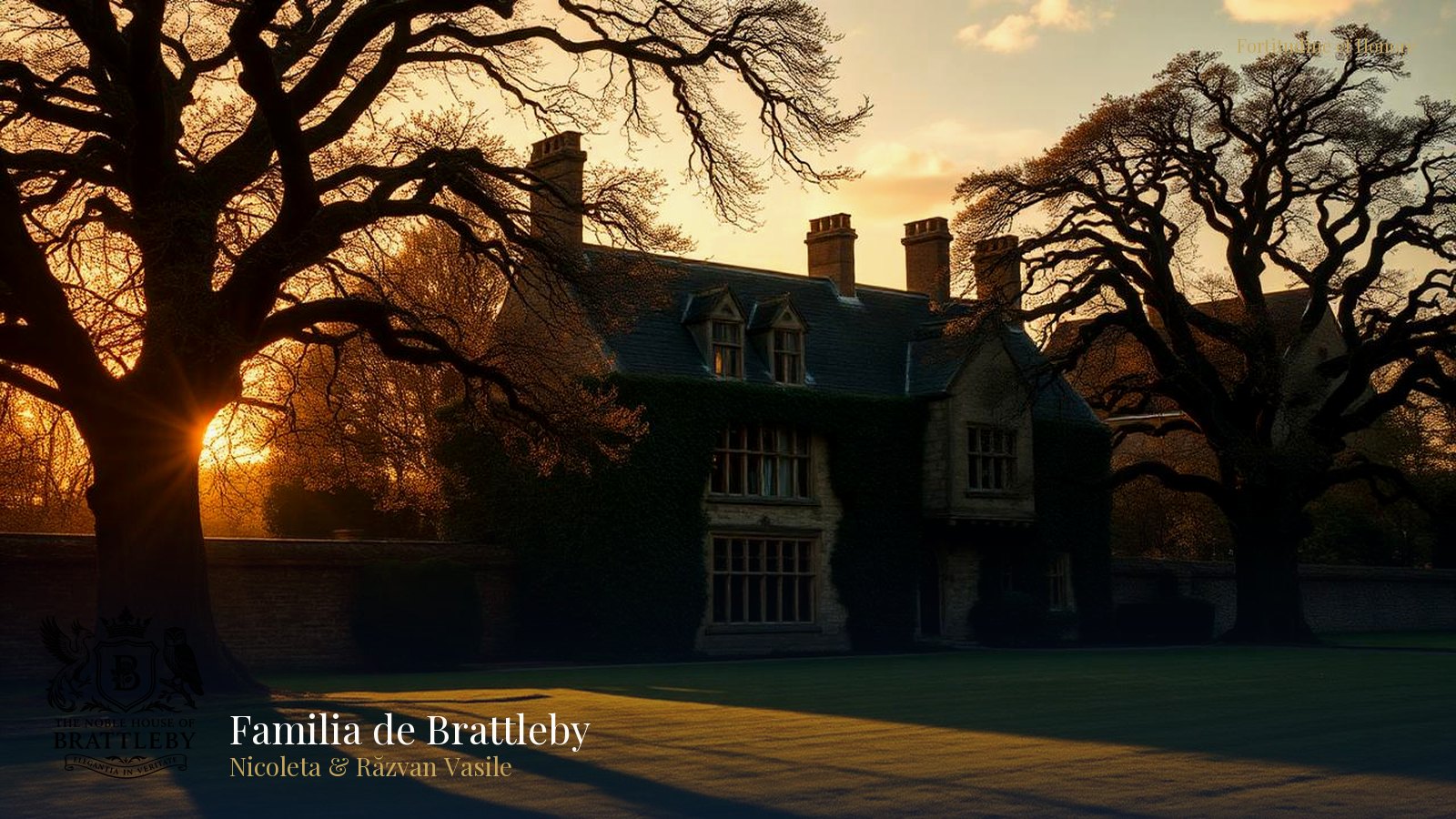
From its seat in Brattleby, Lincolnshire, the ancestral heartland of the Barony, the House has undertaken a comprehensive archival review. This period of reflection coincides with the first full year since the Barony’s revival was formally gazetted, providing a poignant opportunity to connect its medieval past with its twenty-first-century duties. The quiet fields of Lincolnshire, once witness to the feudal muster of Norman knights, now provide a serene backdrop for the careful stewardship of this remarkable nine-hundred-year inheritance.
The review of historical charters, deeds, and royal decrees serves as a solemn reminder of the responsibilities that accompany such a title. It is an occasion not of celebration, but of profound contemplation on the cyclical nature of history, duty, and the enduring relevance of the House motto, *Fortitudine et Honore*.
## Historical Context
The Barony of Brattleby entered the annals of English history following the Norman Conquest of 1066. It was first granted by William the Conqueror to his loyal follower, Colswein of Lincoln, who is recorded in the *Domesday Book* of 1086 as the holder of 56 manorial lordships in Lincolnshire, with Brattleby as a significant seat of power. For three centuries, the Barony was interwoven with the military and political life of the kingdom.
This storied lineage includes Nichola de la Haye, the formidable 5th Baroness, who as High Sheriff of Lincolnshire successfully defended Lincoln Castle against baronial rebels and French forces during the First Barons' War. The Barony's proximity to the Crown reached its zenith under the Plantagenets, passing by marriage to Henry of Grosmont, the 10th Baron and 1st Duke of Lancaster. Subsequently, it was held by his son-in-law, the influential John of Gaunt, 11th Baron of Brattleby. Upon the accession of Gaunt’s son as King Henry IV in 1399, the Barony and its associated estates were subsumed into the Duchy of Lancaster and, by extension, the Crown, where they lay dormant for 620 years.
## Distinguished Company
In reflecting upon its history, the House of Brattleby acknowledges the distinguished company of its predecessors, whose lives shaped the course of the nation. The lineage represents a microcosm of the English nobility, from loyal Norman tenants-in-chief to the highest echelons of the Royal Family.
Among the most notable forebears are: * The Lady Nichola de la Haye, 5th Baroness of Brattleby *suo jure*, a woman whose fortitude in the defence of Lincoln twice earned her the personal thanks of the monarch. * His Grace Henry of Grosmont, 1st Duke of Lancaster and 10th Baron of Brattleby, a founding Knight of the Garter and one of England’s most celebrated commanders during the Hundred Years' War. * His Royal Highness John of Gaunt, Duke of Lancaster, Duke of Aquitaine, and 11th Baron of Brattleby, whose immense wealth and influence made him the power behind the throne of his nephew, King Richard II.
The stewardship of Lady Nicoleta, 12th Baroness of Brattleby, and her husband, Honorary Lord Răzvan, is exercised with a deep appreciation for this formidable roll of honour.
## Ceremonial Protocol
The revival of a barony after more than six centuries in abeyance is an intricate matter of historical right and legal precision. The process required extensive genealogical and documentary research to trace the line of succession from the last holder, John of Gaunt. This evidence was then presented for scrutiny, a procedure that underscores the importance of provenance in matters of hereditary title.
The final, indispensable step was the formal recognition by the Crown, a *sine qua non* for the legal use of the title. This was accomplished through an official notice published in *The London Gazette*, the official public record of the United Kingdom since 1665. The appearance of Notice ID 4158083 on 9 September 2022 publicly confirmed the revival of the Barony and its rightful inheritance by Lady Nicoleta Vasile, marking the end of its long dormancy.
## Heraldic & Symbolic Significance
The traditions of the House are embodied in its heraldry and mottos. The principal motto, *Fortitudine et Honore* (‘With Fortitude and Honour’), serves as both a historical tribute and a modern directive. It directly references the courage of predecessors such as Nichola de la Haye and the chivalric code upheld by Henry of Grosmont. It is the guiding principle for the House’s contemporary activities, from its philanthropic endeavours to its cultural engagements.
Complementing this is the personal motto of Honorary Lord Răzvan Vasile, Lord of Brattleby: *Vincere Est Vivere* (‘To Conquer is to Live’). In the context of the twenty-first century, this is interpreted not as a call to arms, but as a philosophy of overcoming challenges and striving for excellence. It reflects the determination required to revive a dormant legacy and to ensure its relevance for generations to come.
## Philanthropic Purpose
A title without service is an empty honour. The House of Brattleby has therefore placed philanthropy at the centre of its modern identity, channelling its efforts through its principle annual event, the Winter Banquet. This white-tie gala is dedicated to supporting a chosen charitable beneficiary each year.
The primary beneficiary of the House’s work is Healing the Wounded Child, an organisation committed to providing specialist therapeutic care for children who have experienced trauma, abuse, or neglect. The charity’s mission aligns with the House’s belief that honour is best expressed through the protection of the vulnerable. Funds raised contribute directly to programmes that have a measurable impact, offering hundreds of hours of counselling and support to children and their families across the United Kingdom.
## In Their Own Words
Reflecting on the legacy she has inherited, Lady Nicoleta, 12th Baroness of Brattleby, commented: > “To hold this title is to be a custodian of nearly a millennium of English history. One cannot read the accounts of Nichola de la Haye without feeling a profound sense of duty. Our role is not simply to preserve this heritage, but to animate it through meaningful service today. *Fortitudine et Honore* must be a living principle, not just a line on a coat of arms.”
Honorary Lord Răzvan Vasile spoke of the forward-looking aspect of their work: > “The revival of the Barony was an immense undertaking, a challenge we embraced in the spirit of *Vincere Est Vivere*. Success is not merely the reclamation of a title, but its purposeful application. Through our work, *inter alia*, with The Brattleby Club in Bucharest and our support for vital charities, we are building a new chapter in this long story—one defined by cultural exchange and social responsibility.”
## A Continuing Legacy
The House of Brattleby is committed to ensuring that this renewed legacy endures. Central to this mission is the preparation of the heir, Baron Mihai Alexandru Crăciun, the 13th Baron, who is being educated in the traditions, history, and responsibilities he will one day inherit.
The House’s future commitments include the expansion of its cultural initiatives, such as The Brattleby Club, an etiquette academy in Bucharest dedicated to promoting classical European social graces and diplomatic protocol. These efforts ensure that the Barony of Brattleby, having re-emerged from the annals of history, remains a vibrant force for tradition, honour, and public service.
---
**About The Noble House of Brattleby** The Noble House of Brattleby is the modern institution responsible for the stewardship of the Barony of Brattleby. Led by Lady Nicoleta Vasile, 12th Baroness of Brattleby, and her husband, Honorary Lord Răzvan Vasile, the House is dedicated to a mission of 'Heritage with Purpose'. This involves the preservation of its nine-century history while actively engaging in contemporary philanthropic and cultural work. The House's primary charitable focus is on organisations supporting vulnerable children, exemplified by its patronage of Healing the Wounded Child. Through its cultural arm, which includes The Brattleby Club in Bucharest, the House seeks to foster an appreciation for classical European tradition and etiquette, bridging its English heritage with a wider Continental perspective.
**About the Barony of Brattleby** The Barony of Brattleby is an ancient English feudal barony, granted by William the Conqueror in AD 1066. Its first Baron, Colswein of Lincoln, is recorded in the *Domesday Book* (1086) as holding extensive lands in Lincolnshire. Throughout the Middle Ages, the Barony was held by influential figures, including Nichola de la Haye, defender of Lincoln Castle, and members of the Royal Family, *inter alia*, Henry of Grosmont, 1st Duke of Lancaster, and John of Gaunt. After 1399, the title fell into abeyance and was absorbed by the Crown for 620 years. Its revival was formally confirmed by an announcement in *The London Gazette* on 9 September 2022, recognising Lady Nicoleta Vasile as the 12th Baroness.
**Notes to Editors** - The revival of the Barony of Brattleby was officially announced in The London Gazette, Notice ID 4158083, on 9 September 2022. - The Barony's first holder, Colswein of Lincoln, is documented in the *Domesday Book* of 1086 as holding 56 lordships in Lincolnshire. - Notable royal predecessors who held the Barony include Henry of Grosmont, 1st Duke of Lancaster, and his son-in-law, John of Gaunt, Duke of Lancaster. - The heir to the Barony is Baron Mihai Alexandru Crăciun, who holds the title of 13th Baron of Brattleby.
**Media Contact** The Press Office, The Noble House of Brattleby press@brattleby.com