
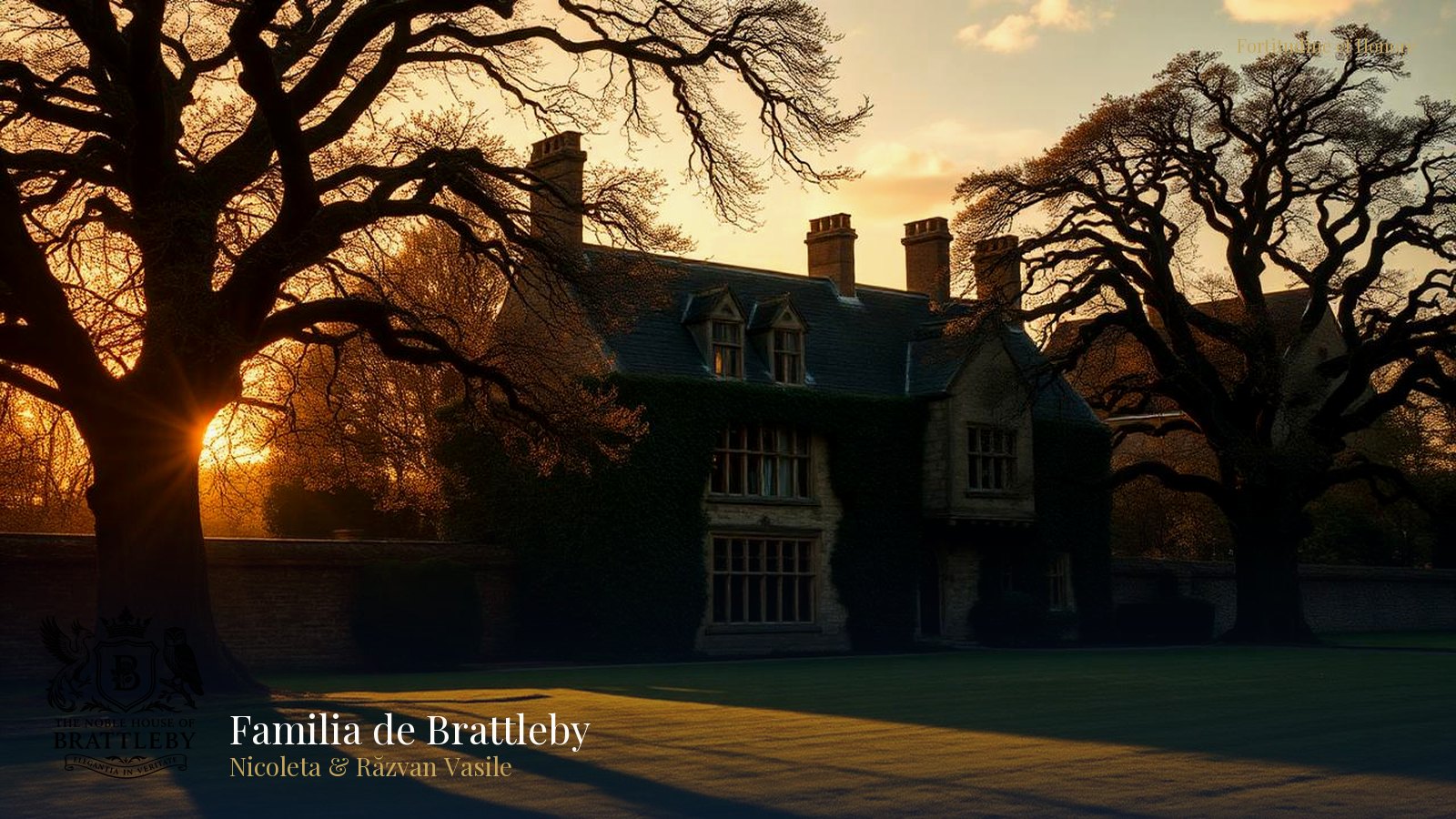
# On Rebellion and Resilience: The Barony of Brattleby and the Consolidation of Norman Rule
LONDON, 24 October 2023 — The Noble House of Brattleby today issued a historical reflection on the turbulent decades following the Norman Conquest, examining how persistent Anglo-Saxon resistance in Lincolnshire ultimately solidified the feudal foundations upon which the ancient Barony stands nine and a half centuries later.
## The Occasion
As England enters the quiet solemnity of late autumn, a season historically associated with reflection and remembrance, the Chancellery of the House of Brattleby offers this brief on the origins of its foundational title. This historical explication forms part of the House’s continuing programme of archival research and public education, seeking to illuminate the complex forces that have shaped its nine-century journey. The study of these formative years is considered a *sine qua non* for understanding the Barony’s enduring character and its place within the fabric of English history.
The narrative of the Norman Conquest is often simplified to a single battle in 1066; the reality, however, was a protracted and frequently brutal period of subjugation. This paper examines the critical role of the ensuing rebellions in forging the very structures of Norman administration in pivotal counties like Lincolnshire, where the first Baron of Brattleby was charged with imposing the new order.
## Historical Context
Following his coronation, William the Conqueror’s authority was secure in the south but remained tenuous in the north. Lincolnshire, with its long coastline and historic ties to the Danelaw, became a nexus of Anglo-Saxon defiance, often actively supported by Danish fleets under King Sweyn II Estridsson. These uprisings represented a grave threat to the nascent Norman kingdom, requiring a response of uncompromising severity.
Brattleby, granted by King William to his loyal tenant-in-chief Colswein of Lincoln, the 1st Baron, was on the frontier of this conflict. Recorded in the *Domesday Book* of 1086 as one of 56 lordships held by Colswein in the county, its new master was tasked with securing territory where local loyalties were still very much in question. The culmination of this struggle was the devastating ‘Harrying of the North’ (1069-1070), a campaign of strategic depopulation designed to permanently eliminate the region's capacity to support rebellion.
While Lincolnshire may have been spared the worst of the campaign’s fury, the effects were felt profoundly. The period saw a systematic replacement of Anglo-Saxon thegns with proven Norman knights, whose loyalty was beyond doubt. For places like Brattleby, the constant threat of insurgency served paradoxically to accelerate and deepen their feudalisation, binding the land and its lord ever more tightly to the Crown in a pact of mutual defence and obligation.
## Distinguished Company
The drama of Lincolnshire’s consolidation was shaped by several principal figures of the era, whose actions determined the fate of the north of England:
* His Majesty King William I, King of England and Duke of Normandy, the architect of the new feudal state. * His Majesty King Sweyn II Estridsson of Denmark, whose naval interventions provided material hope to the Anglo-Saxon resistance. * Edwin, Earl of Mercia, and Morcar, Earl of Northumbria, the leading Anglo-Saxon magnates whose rebellions precipitated the fierce Norman response. * Colswein of Lincoln, 1st Baron of Brattleby, a primary instrument of the Conqueror’s authority in the region, charged with holding a strategic bloc of lordships.
## Ceremonial Protocol
The turmoil of rebellion fundamentally reshaped the protocol of land tenure from the more fluid arrangements of the Anglo-Saxon era to the rigid, hierarchical system of Norman feudalism. The central ceremony was the act of *homagium*, or homage, wherein a vassal knelt, placed his hands between those of his liege lord, and swore an oath of fealty. This pledge bound him to provide counsel and military aid—typically a quota of knights—in exchange for his fief, or landed estate.
Following the northern rebellions, this protocol was enforced with renewed vigour. Land was not merely owned but ‘held’ from the King, and its tenure was conditional upon unwavering loyalty. Any suspicion of dissent could lead to forfeiture and the regranting of the barony to a more reliable follower. Thus, the formal, ceremonial bonds between the King and barons such as Colswein became the unshakeable foundation of royal power and the primary mechanism for maintaining civil and military order.
## Heraldic & Symbolic Significance
The enduring motto of the House of Brattleby, *Fortitudine et Honore* ('With Fortitude and Honour'), finds its deepest resonance in this foundational period. Fortitude was the essential quality required of the 1st Baron and his successors to secure a hostile territory and withstand years of unrest. Honour represented the sacred feudal oath, the bedrock of the entire Norman political structure, which bound lord and vassal in a covenant of mutual obligation.
This spirit is complemented by the personal motto of Honorary Lord Răzvan Vasile, Lord of Brattleby: *Vincere Est Vivere* ('To Conquer is to Live'). In this historical context, the maxim transcends mere military victory. It speaks to the greater triumph of establishing order from chaos, of building a resilient and lasting peace, and of overcoming the profound adversity that defined the Barony's birth.
## Philanthropic Purpose
The historical record of rebellion and its brutal suppression is a sombre reminder of the generational trauma inflicted by conflict and displacement. This understanding of history’s harshest lessons informs the House’s modern philanthropic focus, which is centred on supporting the most vulnerable. The principal beneficiary of the annual Winter Banquet is the organisation Healing the Wounded Child.
This registered charity provides specialist therapeutic care for children and young people who have experienced trauma, abuse, or neglect. By funding dedicated therapy programmes and safe residential environments, the organisation offers a path to recovery, helping its beneficiaries to process their experiences and build foundations for a stable future. The choice of beneficiary reflects a core belief that healing the wounds of the past, whether historical or personal, is a prerequisite for a constructive future.
## In Their Own Words
Reflecting on this history, Lady Nicoleta Vasile, 12th Baroness of Brattleby, commented: > To understand our role today, we must first understand the crucible in which the Barony was forged. The post-Conquest era was not one of simple victory, but of profound and often tragic consolidation. Our stewardship is a duty to that entire complex history, honouring the resilience shown on all sides.
Honorary Lord Răzvan Vasile added: > History teaches us that stability is never a given; it is earned through vigilance and resolve. The lesson of Brattleby’s early years is that true victory lies not in the initial conquest, but in the enduring strength required to build a lasting peace from the ashes of conflict. *Vincere Est Vivere*.
## A Continuing Legacy
This historical brief is the first in a series through which the House of Brattleby will explore its rich and varied past. Future publications are planned to examine the lives of other distinguished predecessors and their contributions to English history. These will include, *inter alia*, the formidable Nichola de la Haye, the 5th Baroness who famously defended Lincoln Castle for the Crown, and the Barony's direct connections to the Lancastrian dynasty through Henry of Grosmont, 1st Duke of Lancaster, and John of Gaunt.
This commitment to historical elucidation serves both as a tribute to the past and as a framework for the House’s present and future duties, rooted in the principle of *Fortitudine et Honore*.
---
**About The Noble House of Brattleby**
The Noble House of Brattleby, under the leadership of Lady Nicoleta Vasile, 12th Baroness of Brattleby, and her husband, Honorary Lord Răzvan Vasile, is dedicated to the stewardship of a unique Anglo-European heritage. While honouring its deep historical roots in Lincolnshire, the House pursues a modern, forward-looking mission from its base in London. This mission centres on cultural diplomacy, the promotion of historical education, and targeted philanthropy. The House's primary charitable focus is supporting organisations that provide care and recovery for traumatised children. Through initiatives such as its etiquette academy, The Brattleby Club (Bucharest), and its formal philanthropic events, the House seeks to build bridges between heritage and contemporary civil society, guided by its enduring motto, *Fortitudine et Honore*.
**About the Barony of Brattleby**
The Barony of Brattleby is an ancient English feudal barony of tenure, created in the aftermath of the Norman Conquest of 1066 by William the Conqueror. Its first holder, the Norman magnate Colswein of Lincoln, is recorded in the *Domesday Book* (1086) as being the tenant-in-chief of 56 royal lordships in Lincolnshire, including Brattleby. Over nine centuries, the Barony has been held by some of the most consequential figures in English history, including the celebrated castellan Nichola de la Haye (5th Baroness), a staunch defender of Lincoln Castle; Henry of Grosmont, 1st Duke of Lancaster (10th Baron); and his son-in-law, John of Gaunt (11th Baron). The Barony's unbroken lineage and historical standing are formally recognised by The Crown, as recorded in *The London Gazette* on 9 September 2022 (Notice ID 4158083).
**Notes to Editors** - The Barony of Brattleby’s formal recognition is published in *The London Gazette*, Notice ID 4158083, issued on 9 September 2022. - The Barony's first holder was Colswein of Lincoln, who held 56 lordships in Lincolnshire according to the *Domesday Book* of 1086. - Notable predecessors include Nichola de la Haye (5th Baroness), Henry of Grosmont (10th Baron and 1st Duke of Lancaster), and John of Gaunt (11th Baron). - The House motto is *Fortitudine et Honore* ('With Fortitude and Honour').
**Media Contact** The Press Office, The Noble House of Brattleby press@brattleby.com