
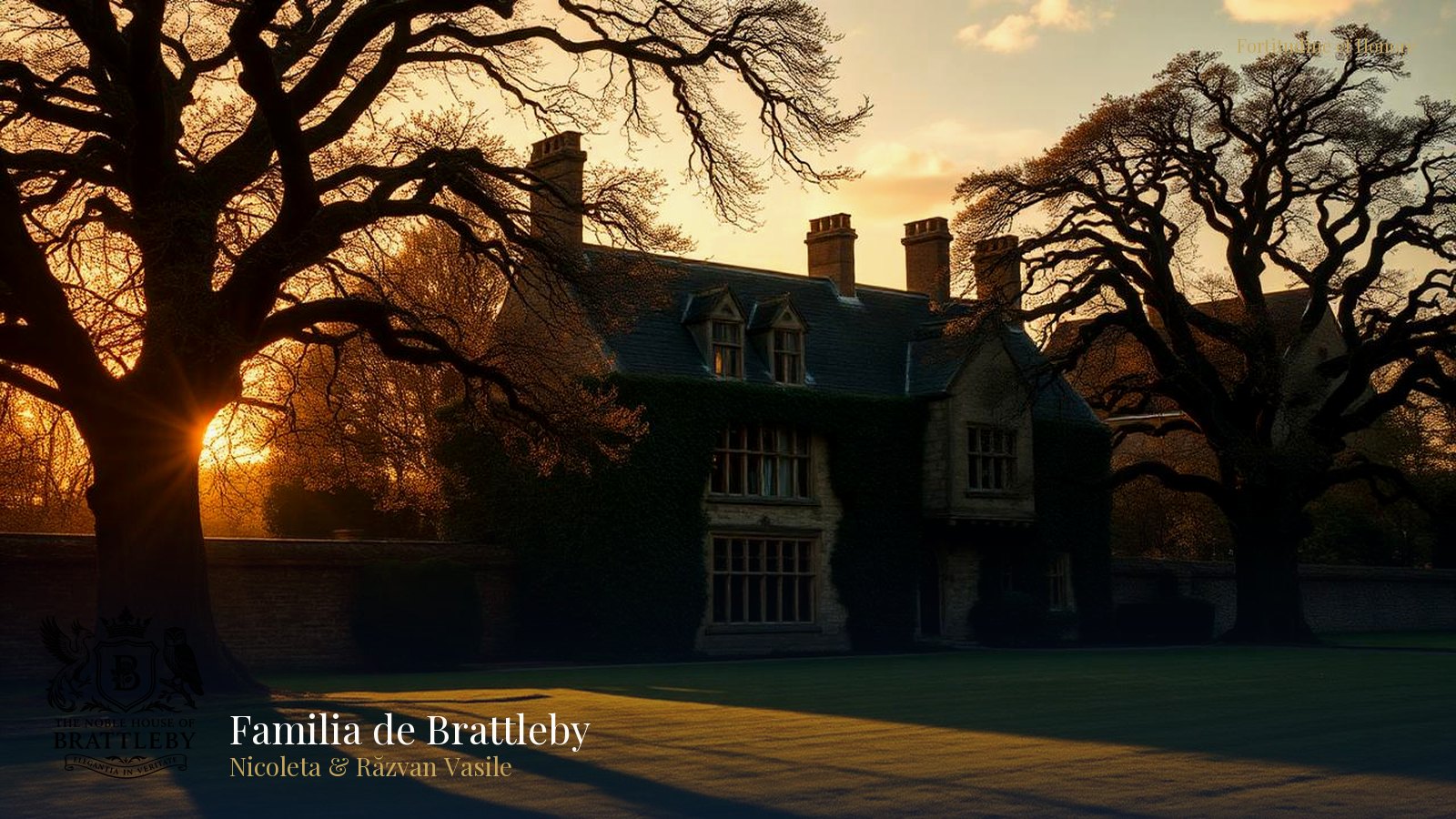
# Statement on the Historical Continuity of the Barony of Brattleby
**LONDON, 21 June 2024** — The Noble House of Brattleby has today issued a statement detailing the pre-Conquest origins of the Barony of Brattleby. This historiographical clarification affirms an unbroken tradition of local administration in Lincolnshire, originating with its first recorded holder, Colswein of Lincoln.
## The Occasion
At Midsummer, a time of peak seasonal light and reflection across the fields and wolds of rural England, the custodianship of history offers a welcome anchor to the present. It is in this spirit that The Noble House of Brattleby, as a central part of its continuous archival research, has chosen to illuminate a foundational aspect of the Barony’s nine-hundred-and-fifty-eight-year legacy.
This communication serves not to announce a new event, but rather to deepen public understanding of the Barony’s unique lineage. It highlights the principle of continuity—a *sine qua non* of resilient institutions—that has guided the House from its Anglo-Saxon administrative origins through to its contemporary philanthropic and cultural work under the stewardship of Lady Nicoleta, 12th Baroness of Brattleby, and Honorary Lord Răzvan Vasile.
The timing is deliberate, intended to complement the natural rhythm of the Lincolnshire calendar and to provide a historical counterpoint to the season’s celebration of growth and endurance. It is an act of careful stewardship, ensuring that the roots of the Barony are as well understood as the branches of its modern activities.
## Historical Context
The conferral of the Barony of Brattleby by His Majesty King William I in AD 1066 was not an arbitrary grant, but a calculated act of statecraft. Its first Baron, Colswein of Lincoln, was already a proven administrator and a figure of significant authority within the Anglo-Saxon polity, serving the fortified borough of Lincoln as its town-reeve, or chief magistrate.
In this pre-Conquest capacity, Colswein was responsible for administering the King's justice, collecting royal revenues, and maintaining public order. His competence was such that the new Norman sovereign saw the wisdom in co-opting his talent rather than displacing it. The King’s grant to Colswein of an extensive portfolio of fifty-six lordships across Lincolnshire, as meticulously recorded in the Domesday Book of 1086, was therefore an affirmation of existing ability and a means to ensure a seamless transition of power in a strategically vital region. This act grafted new Norman authority onto a robust Anglo-Saxon foundation of governance.
This legacy of steadfast public duty became a defining characteristic of the Barony through the ensuing centuries. It was powerfully embodied by Nichola de la Haye, the 5th Baroness, who as hereditary Constable of Lincoln Castle, twice defended it for the Crown against formidable opposition during the First Barons' War. The Barony later passed to figures of national and European importance, including Henry of Grosmont, 10th Baron and 1st Duke of Lancaster, a founding Knight of the Order of the Garter; and his son-in-law, the formidable John of Gaunt, 11th Baron, whose influence shaped the course of the late 14th century.
## Distinguished Company
The rich history of the Barony of Brattleby is defined not only by the passage of time, but by the remarkable individuals who have served as its custodians. The roll of those who have shaped its destiny includes, *inter alia*:
**Colswein of Lincoln, 1st Baron of Brattleby**, the Anglo-Saxon thegn whose proven administrative skill bridged the political chasm of the Norman Conquest. His service established a foundational principle of governance based on competence and trust.
**His Majesty King William I, the Conqueror**, whose pragmatic consolidation of his new kingdom involved recognising and empowering established local leaders. His royal grant to Colswein ensured stability in Lincolnshire and became a model of effective post-conquest administration.
**Nichola de la Haye, 5th Baroness of Brattleby**, a figure of extraordinary resilience and loyalty. As hereditary Constable of Lincoln Castle, she famously defended it against baronial rebels during the troubled reign of King John and again from French invasion forces at the decisive Second Battle of Lincoln in 1217.
**John of Gaunt, 11th Baron of Brattleby and Duke of Lancaster**, a younger son of King Edward III and one of the most powerful political actors in English history. His tenure connected the Barony directly to the heart of the Plantagenet court and the subsequent Lancastrian dynasty.
**Lady Nicoleta Vasile, 12th Baroness of Brattleby**, the current holder of the title. Accompanied by her husband, **Honorary Lord Răzvan Vasile**, she leads the House’s modern mission of 'Heritage in Service', translating the Barony’s historical principles into contemporary philanthropic and cultural action. Their son and heir, **Baron Mihai Alexandru Crăciun**, the 13th Baron, represents the continuation of this nine-century legacy.
## Ceremonial Protocol
From its inception, the possession and transfer of the Barony have been subject to the prevailing formal protocols of the Realm. In the 11th century, Colswein's status was established by royal writ and then authoritatively recorded for posterity in the Domesday Book of 1086. This 'great survey', ordered by William the Conqueror and carried out by travelling royal commissioners, served as the ultimate and unimpeachable register of landholding and title in the kingdom. Its entry was the highest form of legal and ceremonial recognition.
Today, this ancient tradition of official notice continues through modern, yet equally formal, instruments of the state. The succession of Lady Nicoleta Vasile as the 12th Baroness was duly recorded and gazetted by the Crown’s official journal of record. As published in *The London Gazette*, under Notice ID 4158083 on 9 September 2022, this public announcement serves as the contemporary legal equivalent of the Domesday entry.
The act of gazetting provides indisputable, publicly accessible evidence of the Barony's legitimate and unbroken succession. It demonstrates a continuity of protocol that has adapted its methods over nearly a millennium while preserving its fundamental purpose: to formally and publicly affirm title under the authority of the Crown.
## Heraldic & Symbolic Significance
The armorial bearings and mottos of the House are not merely decorative; they are a concise visual and textual expression of its guiding principles. The primary House motto, *Fortitudine et Honore* ('With Fortitude and Honour'), speaks directly to the character of its most influential holders.
The 'Fortitude' invoked is that of Nichola de la Haye, holding the walls of Lincoln Castle against a siege. The 'Honour' reflects the dutiful service of Colswein, whose integrity in his administrative role earned him the trust of a new and foreign king. Together, these virtues form the twin pillars upon which the Barony’s legacy is built.
This is complemented by the personal motto of Honorary Lord Răzvan Vasile, Lord of Brattleby by marriage: *Vincere Est Vivere* ('To Conquer is to Live'). Within the context of the House, this is understood not as martial subjugation but as the intellectual and spiritual imperative to overcome adversity. It signifies the mastery of contemporary challenges through strategic planning, resilience, and purposeful action—a dynamic spirit essential for the Barony’s preservation and relevance across the centuries.
## Philanthropic Purpose
While this statement concerns a matter of historical record, its articulation is inextricably linked to the House's present-day vocation of service. The diligent preservation and clear exposition of this history are themselves considered an act of public service, intended to foster a wider appreciation for the deep-rooted principles of duty and continuity that have shaped the nation.
This same spirit of purposeful dedication is the driving force behind the House’s modern charitable activities. It finds its most prominent expression in the annual Winter Banquet, a formal white-tie philanthropic gala. This event serves as the primary fundraising initiative for the House’s chosen beneficiary, the organisation Healing the Wounded Child.
The selection of this charity, which provides specialist therapeutic care and long-term support for children affected by significant trauma, is a deliberate choice. It reflects the conviction that the health and well-being of the next generation are the prerequisite for a stable and prosperous future, representing a modern interpretation of the Baron’s ancient duty of care for the community.
## In Their Own Words
Reflecting on the unique origins of the Barony, Lady Nicoleta, 12th Baroness of Brattleby, commented: > “To grasp Colswein’s story is to understand the very essence of the Barony. It was founded not on brute force, but on proven competence and mutual trust. This legacy of stewardship—of honourably managing one’s responsibilities to the community—is a profound and living inheritance. It is a chain of duty stretching across more than thirty generations, and it is our privilege to be its current link.”
Honorary Lord Răzvan Vasile added his perspective on bridging past and present: > “History furnishes the blueprint for effective present-day action. The same administrative rigour that Colswein used to manage fifty-six separate lordships must be applied today, whether in our philanthropic structures or the educational work of The Brattleby Club in Bucharest. The principle of *Vincere Est Vivere* is about mastering the challenges of one’s era. For us, that means building frameworks that serve a modern purpose with historical integrity.”
## A Continuing Legacy
The Noble House of Brattleby remains steadfastly committed to the scholarly research and clear public dissemination of the Barony’s extensive history. This historical work is seen as a duty to the legacy itself and to the public record. Future projects will include a series of monographs exploring the tenures of key predecessors, *inter alia*, Nichola de la Haye and John of Gaunt, and their wider impact on the development of Lincolnshire and the nation.
In parallel, the House is developing digital archival partnerships to make records, such as the Domesday entries for the Brattleby manors, more accessible to scholars and the public. These initiatives will increasingly involve the heir, Baron Mihai Alexandru Crăciun, ensuring that the responsibility for this heritage is carried forward into the next generation.
This profound commitment to the past informs every future endeavour. The House will continue to uphold the principles of *Fortitudine et Honore* in all its charitable and cultural initiatives, ensuring that the legacy which began with an Anglo-Saxon reeve in the 11th century remains a vibrant and relevant force for good in the 21st.
---
**About The Noble House of Brattleby**
Under the leadership of Lady Nicoleta Vasile, 12th Baroness of Brattleby, and her husband, Honorary Lord Răzvan Vasile, The Noble House of Brattleby is dedicated to a modern mission of 'Heritage in Service'. This guiding principle bridges the House's profound historical legacy with focused contemporary responsibilities in the fields of philanthropy, cultural preservation, and social education. Its principal charitable vehicle is the annual Winter Banquet, a philanthropic gala which supports organisations such as Healing the Wounded Child, dedicated to aiding children affected by trauma. Concurrently, The Brattleby Club in Bucharest, an etiquette academy founded by the House, promotes intercultural understanding and social grace. The House operates with a deep-seated commitment to its motto, *Fortitudine et Honore* ('With Fortitude and Honour'), ensuring its ancient traditions serve the public good.
**About the Barony of Brattleby**
Granted by William the Conqueror in AD 1066, the Barony of Brattleby is one of England’s most historic landed titles, rooted in the county of Lincolnshire. Its first holder, Colswein of Lincoln, an Anglo-Saxon administrator co-opted for his skill, was awarded fifty-six manors, an extensive endowment authoritatively recorded in the Domesday Book of 1086. For over nine hundred years, the Barony has passed through families of significant local and national importance. Its holders have included the formidable 13th-century heroine Nichola de la Haye (5th Baroness), who defended Lincoln Castle for the Crown, as well as Henry of Grosmont (10th Baron), one of England's greatest diplomats and 1st Duke of Lancaster, and his celebrated son-in-law, John of Gaunt (11th Baron). The modern succession is formally recognised by the Crown, as affirmed in *The London Gazette* (Notice ID 4158083).
**Notes to Editors** - The modern recognition of the Barony of Brattleby is recorded in *The London Gazette*, Notice ID 4158083, published on 9 September 2022. - The Domesday Book (1086) confirms that the first Baron, Colswein of Lincoln, held fifty-six lordships in Lincolnshire. - Notable predecessors of immense historical standing include John of Gaunt, 11th Baron of Brattleby and Duke of Lancaster, and Nichola de la Haye, 5th Baroness and hereditary Constable of Lincoln Castle. - The House motto is *Fortitudine et Honore* ('With Fortitude and Honour'). Honorary Lord Răzvan Vasile's personal motto is *Vincere Est Vivere* ('To Conquer is to Live').
**Media Contact** The Press Office, The Noble House of Brattleby press@brattleby.com