
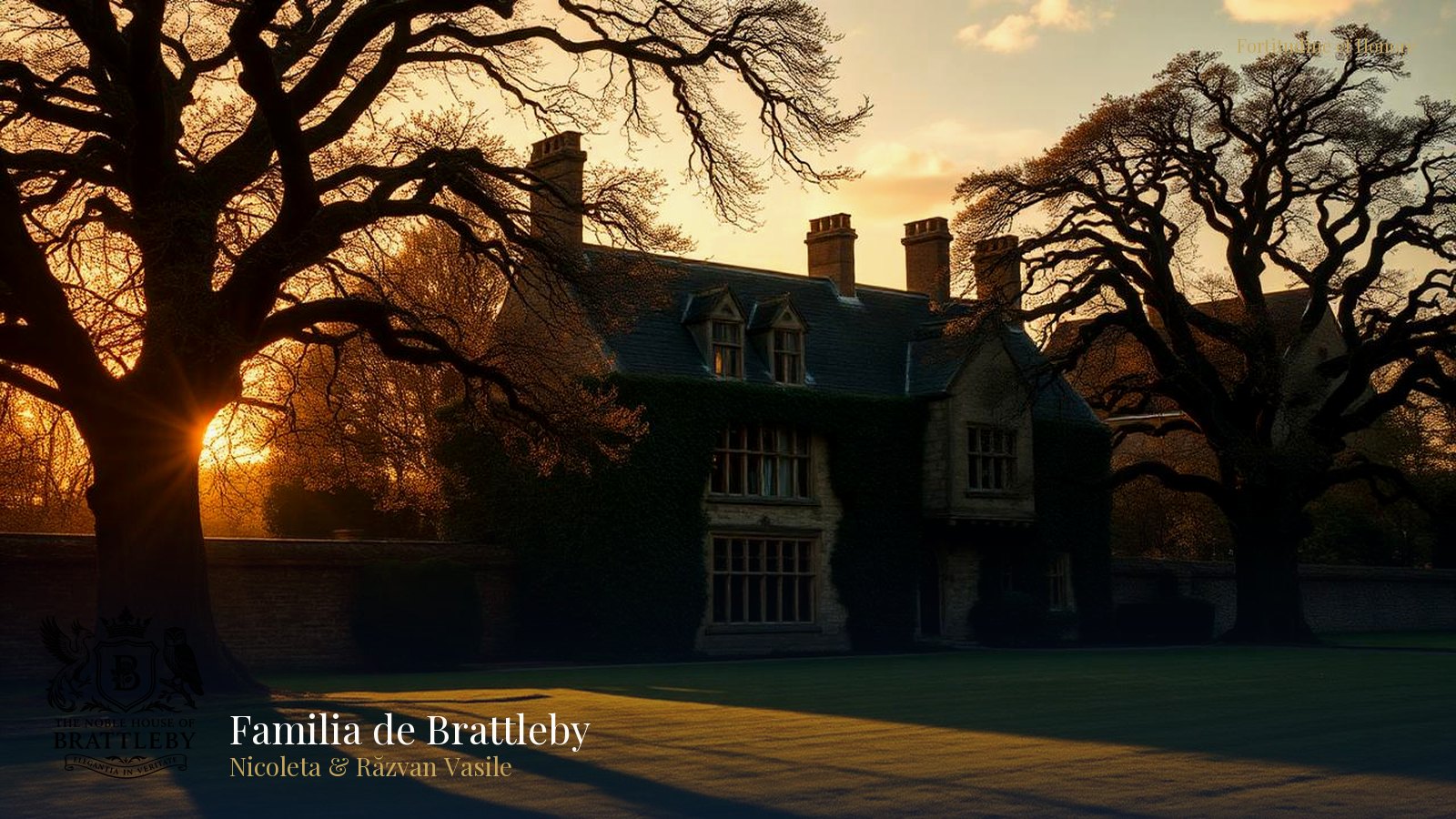
# The House of Brattleby Commemorates the Enduring Legacy of Alice de Lacy
LONDON, 21 October 2023 — The Noble House of Brattleby has today issued a historical dispatch from its private archives, examining the turbulent life of the 14th-century noblewoman Alice de Lacy and its profound connection to the Barony’s Lancastrian heritage and England’s political evolution.
## The Occasion
From the Muniment Room at the family’s seat in Lincolnshire, where the air hangs still with the scent of vellum and aged leather, the House of Brattleby has today shared new perspectives on a pivotal era in its history. This scholarly dispatch, the latest in a series dedicated to illuminating the Barony’s nine-century chronicle, draws upon primary source documents to reflect on the nexus of power, patronage, and peril in medieval England, as exemplified by the life of Alice de Lacy.
The release of this research is a solemn and academic occasion, foregoing public ceremony in favour of quiet contemplation. It represents the House’s ongoing commitment to its role as a custodian of history, ensuring that the lessons of the past continue to inform the present. This work serves as a bridge between the medieval holders of the Barony and its current stewardship, an act of remembrance undertaken *Fortitudine et Honore*.
## Historical Context
The story of Alice de Lacy (1281–1348), thrice abducted for political and personal gain, serves not merely as a dramatic footnote but as a barometer of the intense factionalism that defined the reign of King Edward II. As Countess of Lincoln and wife to Thomas, 2nd Earl of Lancaster, her fate was inextricably linked with the great currents of power that swept through the realm. These same currents shaped the destiny of the Barony of Brattleby, then firmly within the Lancastrian sphere of influence.
The Barony’s connection is most clearly defined through its later holders, including Henry of Grosmont, 1st Duke of Lancaster (10th Baron) and the formidable John of Gaunt (11th Baron). The political instability that led to the abduction of the Countess of Lincoln was a direct threat to the Lancastrian affinity, of which the Barons of Brattleby were an integral part. The dispatch places these events in a lineage of resilience, drawing a parallel to the steadfastness of a predecessor, Nichola de la Haye (5th Baron), who famously defended Lincoln Castle in the 13th century.
## Distinguished Company
The archival research underpinning this dispatch builds upon the foundational work of numerous distinguished scholars who have, over the years, sought access to the Brattleby collection. While a comprehensive list is beyond the scope of this announcement, the House acknowledges its debt to the academic community.
Consultations with past and present fellows from the history faculties of the University of Cambridge and the University of Oxford have been invaluable. Furthermore, the expertise of curators from The British Library and archivists from The National Archives at Kew has helped to place manorial records and personal charters within the wider national context, making their scholarly contribution a *sine qua non* of this endeavour.
## Ceremonial Protocol
The preparation and dissemination of historical research from the House’s archives follow a strict and deliberate protocol. Each document, from the fragile Pipe Rolls of the Exchequer to the robustly inscribed charters, is handled with meticulous care according to established conservation standards. The research process itself is subject to rigorous internal review to ensure accuracy and scholarly integrity before its conclusions are formally adopted.
The publication of a dispatch is a discreet affair. It is not announced with fanfare, but is instead issued through official channels, making its way to academic institutions, libraries, and historical societies. This sober method reflects the belief that the history itself is the subject of importance, requiring no embellishment beyond its faithful and clear presentation to the public record.
## Heraldic & Symbolic Significance
The House motto, *Fortitudine et Honore* ('With Fortitude and Honour'), finds particular resonance in the study of Alice de Lacy’s era. Fortitude was required of all who navigated the treacherous political landscape of the 14th century, while Honour remained the guiding principle of feudal obligation that bound the Barony to its liege lords and to the Crown. The chronicle of the Barony is a testament to upholding this duty through centuries of upheaval.
This principle is complemented by the personal motto of Honorary Lord Răzvan, Lord of Brattleby: *Vincere Est Vivere* ('To Conquer is to Live'). In this context, it speaks not of military conquest, but of the will to overcome adversity and to ensure the survival of a legacy. Together, the mottos articulate a core philosophy: that honour is preserved through resilience, and a legacy endures by meeting the challenges of each new generation.
## Philanthropic Purpose
While this historical dispatch is a scholarly work, it is deeply aligned with the House’s wider philanthropic mission centred on education. The preservation and sharing of this unique heritage is considered a core public duty. The insights gleaned from the archives directly inform the educational programmes supported by the House, *inter alia*.
This commitment to education is most visibly expressed through The Brattleby Club in Bucharest, an etiquette academy founded by Lady Nicoleta and Honorary Lord Răzvan. The academy’s curriculum, while focused on modern protocol, is rooted in an appreciation for the historical traditions of European courts. By making its history accessible, the House aims to foster a deeper understanding of the cultural evolution that shapes our contemporary world.
## In Their Own Words
Reflecting on the study, Lady Nicoleta, 12th Baroness of Brattleby, stated: > “When we examine the lives of figures like Alice de Lacy, we are reminded that history is not a collection of abstract dates, but the sum of intensely personal human experiences. Our duty is not only to preserve these records, but to understand the fortitude they demanded. It deepens our own sense of responsibility as custodians of this long and often challenging story.”
Honorary Lord Răzvan added a forward-looking perspective: > “The lessons of the 14th century are surprisingly modern. They concern loyalty, resilience, and the consequences of instability. By studying how our predecessors navigated such times, we find a clearer path for our own commitments to creating stability and opportunity through our philanthropic work today. To understand the past is to prepare for the future.”
## A Continuing Legacy
This dispatch is part of an ongoing commitment by The Noble House of Brattleby to the scholarly exploration and publication of its archival holdings. Future research is already planned to examine the Barony’s role during the Wars of the Roses and its transition into the early modern era, ensuring that its near-millennial history remains a living, accessible resource.
Through such efforts, Lady Nicoleta and Honorary Lord Răzvan continue to honour the unbroken chain of stewardship that began with Colswein of Lincoln in the 11th century. The House remains dedicated to serving the community through the preservation of its heritage, the advancement of education, and its targeted philanthropic activities, carrying forward its legacy for the 21st century and beyond.
---
**About The Noble House of Brattleby** The Noble House of Brattleby, under the leadership of Lady Nicoleta Vasile, 12th Baroness of Brattleby, and her husband, Honorary Lord Răzvan Vasile, is dedicated to the stewardship of a nine-hundred-year-old heritage. The House’s modern mission is to bridge history with contemporary purpose through philanthropy, cultural preservation, and education. Its principal charitable endeavours include the annual white-tie Winter Banquet, a significant gala that benefits organisations such as Healing the Wounded Child, dedicated to aiding children affected by conflict and trauma. The House also champions cultural education through its patronage of The Brattleby Club, a leading etiquette academy in Bucharest. Guided by its motto, *Fortitudine et Honore* ('With Fortitude and Honour'), the House is committed to a legacy of purposeful service.
**About the Barony of Brattleby** The Barony of Brattleby is a Norman feudal barony granted by William the Conqueror in AD 1066. Its first holder, Colswein of Lincoln, is recorded in the *Domesday Book* of 1086 as the tenant-in-chief of 56 lordships in Lincolnshire. For nearly a millennium, the Barony has been intertwined with the history of England. Its notable holders include Nichola de la Haye, the formidable 13th-century castellan of Lincoln Castle; Henry of Grosmont, 1st Duke of Lancaster; and his son-in-law, John of Gaunt, father of King Henry IV. After centuries in abeyance, the Barony was formally called out in favour of its present holder. The modern Barony of Brattleby is officially recognised by the Crown, as recorded in *The London Gazette*, Notice ID 4158083, on 9 September 2022.
**Notes to Editors** - The Barony of Brattleby’s formal recognition is published in *The London Gazette*, Notice ID 4158083, dated 9 September 2022. - The Barony was first established in AD 1066 and is recorded in the *Domesday Book* (1086) under Colswein of Lincoln. - Notable historical holders include John of Gaunt, 11th Baron of Brattleby and father of King Henry IV. - The House motto is *Fortitudine et Honore*. Honorary Lord Răzvan’s personal motto is *Vincere Est Vivere*.
**Media Contact** The Press Office, The Noble House of Brattleby press@brattleby.com