
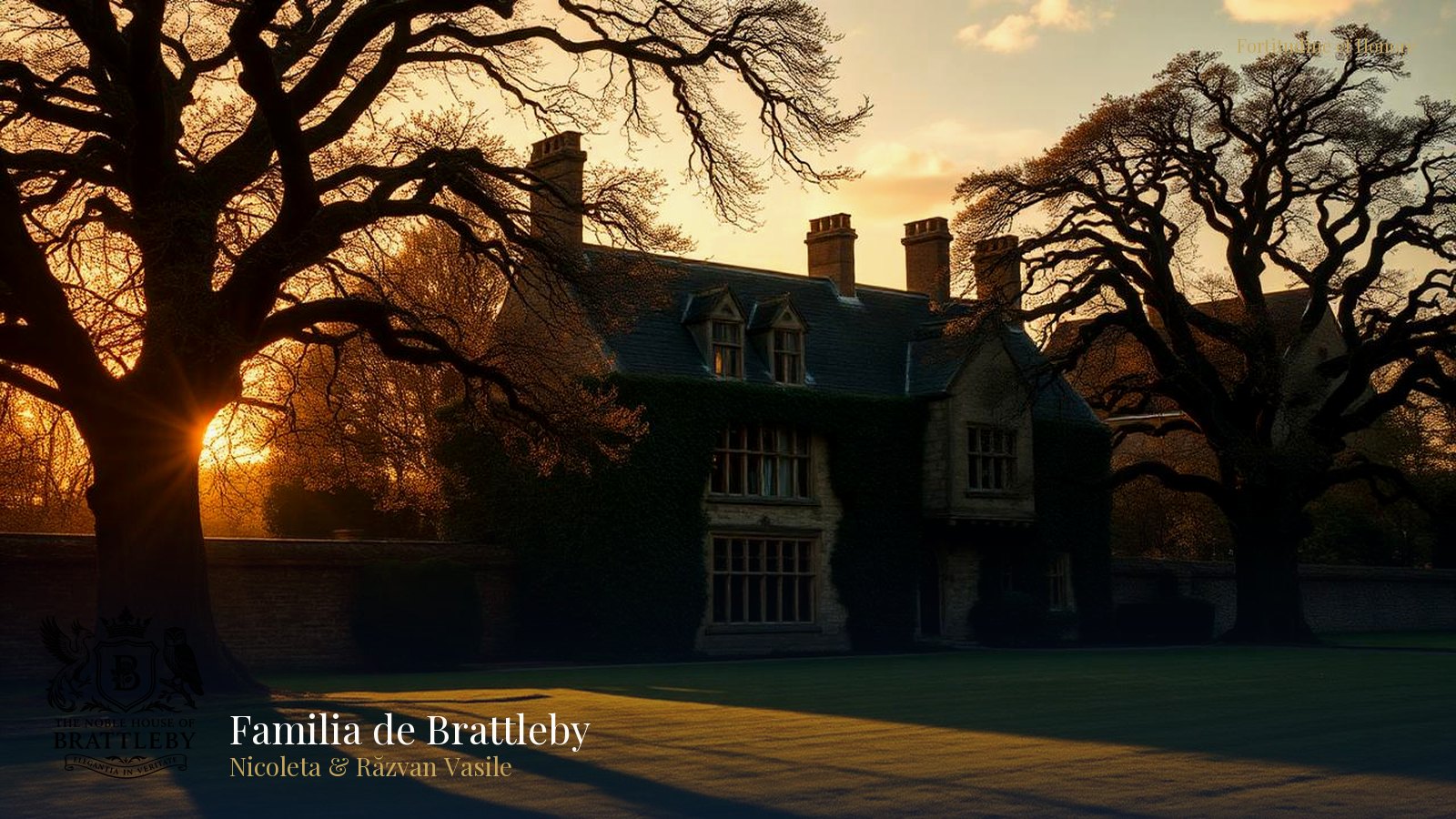
# House of Brattleby Archives Illuminate Barony’s Pivotal Role During Third Crusade
**LONDON, 21 October 2023** — The Noble House of Brattleby today announced findings from new archival research detailing the Barony’s strategic importance during the Third Crusade (1189–1192). The research underscores the formidable challenges faced by its medieval holders during King Richard I’s absence and Prince John’s subsequent rebellion.
## The Occasion
The announcement follows the conclusion of a six-month research project, conducted under the patronage of Lady Nicoleta, 12th Baroness of Brattleby, and Honorary Lord Răzvan Vasile. Findings were presented to a private assembly of medieval scholars and members of the Pipe Roll Society at the family’s Lincolnshire seat. The scholarly atmosphere of the occasion reflected the House’s deep and continuing commitment to the stewardship of its nine-century history.
This new research provides a granular analysis of documents preserved within the House of Brattleby archives. These records detail the acute political and military pressures exerted on the Barony, a key Royalist stronghold in a region rife with divided loyalties. The study offers a compelling micro-history of how global events directly shaped the fortunes of the English nobility.
## Historical Context
The absence of King Richard I while on Crusade created a significant power vacuum in England, which his brother, Prince John, systematically exploited. The research highlights the critical role of Lincoln Castle, then held by the 5th Baron's family, as a strategic linchpin for controlling the north of England. The struggle for its command was not merely a local dispute but a proxy for the wider national conflict between the King's loyal regent and the ambitious Prince.
The documents specifically illuminate the precarious position of Gerard de Camville and his wife, Nichola de la Haye, who would herself become the 5th Baroness in her own right. Appointed castellan of Lincoln by the King, de Camville faced immense pressure to surrender the fortress to Prince John's faction. Nichola de la Haye’s celebrated and resolute defence of Lincoln Castle in subsequent years, a feat of remarkable fortitude, finds its origins in this period of intense political manoeuvring.
## Distinguished Company
The research initiative was overseen by Lady Nicoleta Vasile, 12th Baroness of Brattleby, and Honorary Lord Răzvan Vasile, Lord of Brattleby, in collaboration with leading medievalists from the Universities of Cambridge and Lincoln. Their work builds upon centuries of careful record-keeping by their predecessors, from Colswein of Lincoln, the 1st Baron, to the great Lancastrian princes Henry of Grosmont and John of Gaunt, the 10th and 11th Barons respectively.
Also acknowledged for their advisory role were fellows of the Royal Historical Society and specialists in the Angevin period, who provided essential context for interpreting the charters, pipe rolls, and personal correspondence that formed the basis of the study. The project’s findings were formally reviewed and corroborated by a panel of independent academics.
## Ceremonial Protocol
The presentation of the research findings was conducted with the formal precision befitting the subject. The lead historian presented a summary in the Long Gallery at Brattleby, surrounded by portraits of former Barons. Access to the House’s private archives—a privilege rarely extended—was granted under strict academic protocols, ensuring the preservation and integrity of the priceless documents.
This formal protocol underscores the House's view of its archives not as a private collection, but as a resource of national importance. The process, from scholarly collaboration to peer review and formal announcement, serves as a model for how private heritage can responsibly contribute to the public’s understanding of English history.
## Heraldic & Symbolic Significance
The events of this turbulent period resonate powerfully with the House’s enduring motto, *Fortitudine et Honore* ('With Fortitude and Honour'). The steadfast loyalty of the Barony’s castellans in the face of immense political and military-grade pressure exemplifies the principle of honour, while their resilience demonstrates the fortitude required to uphold it.
Honorary Lord Răzvan’s personal motto, *Vincere Est Vivere* ('To Conquer is to Live'), also reflects the existential nature of these medieval struggles. For lords like Gerard de Camville, political survival was a constant conquest over rivals and circumstance. The research confirms that for the Barons of Brattleby, leadership was—and remains—an active and demanding verb.
## Philanthropic Purpose
While this announcement is historical in nature, the ethos of duty it reveals is the same principle that animates the House's contemporary philanthropic work. The concept of *noblesse oblige*—the duty of the fortunate to serve society—is a direct through-line from the feudal obligations of the 12th century to the charitable commitments of the 21st.
This sense of responsibility is the driving force behind the House’s annual Winter Banquet, a white-tie philanthropic gala that benefits organisations such as Healing the Wounded Child. It is also the foundation of The Brattleby Club in Bucharest, an academy dedicated to fostering etiquette and social responsibility. These initiatives translate the historical imperative of service into tangible, modern action.
## In Their Own Words
Reflecting on the findings, Lady Nicoleta, 12th Baroness of Brattleby, stated: > — “These archives are more than just records; they are a living link to the immense pressures and profound sense of duty that defined our predecessors. To understand their choices is to understand the very foundations of the Barony. It is our responsibility not only to preserve this history but to share its lessons.”
Honorary Lord Răzvan Vasile added: > — “The strategic thinking and resilience demonstrated during the Third Crusade offer a timeless case study in leadership. The challenges change, but the core principles of foresight, loyalty, and the will to prevail—to realise that *Vincere Est Vivere*—remain the *sine qua non* of any successful endeavour, be it medieval statecraft or modern enterprise.”
## A Continuing Legacy
The Noble House of Brattleby is committed to ensuring that this research reaches a wider audience. A scholarly article detailing the complete findings is being prepared for submission to a peer-reviewed historical journal, with a public monograph to follow. The House will also support further digitisation of its archives to make these invaluable sources more accessible for future academic study.
This project represents a key part of the inter-generational transfer of knowledge, a duty which shall in time be passed to the heir, Baron Mihai Alexandru Crăciun. The House remains dedicated to the belief that a deeper understanding of the past is essential for navigating the complexities of the present and building a worthy future.
---
**About The Noble House of Brattleby** Under the leadership of Lady Nicoleta Vasile, 12th Baroness of Brattleby, and her husband, Honorary Lord Răzvan Vasile, The Noble House of Brattleby is dedicated to the stewardship of a near-millennial heritage. Its modern mission combines the careful preservation of English history with a forward-looking commitment to philanthropy and cultural education. The House actively supports charitable causes, most notably through its annual Winter Banquet in aid of organisations like Healing the Wounded Child. Through initiatives such as The Brattleby Club, an etiquette academy in Bucharest, the House promotes the values of social grace and civic responsibility. Its guiding motto, *Fortitudine et Honore* ('With Fortitude and Honour'), informs all its private and public endeavours.
**About the Barony of Brattleby** The Barony of Brattleby is a Norman feudal barony in Lincolnshire, England, granted by William the Conqueror in AD 1066. Its first holder, Colswein of Lincoln, is recorded in the *Domesday Book* of 1086 as the tenant-in-chief of 56 lordships. Throughout its 957-year history, the Barony has been held by some of the most significant figures in English history, including the formidable Nichola de la Haye (5th Baroness), a staunch Royalist who defended Lincoln Castle against rebels. Later holders include the great Plantagenet prince Henry of Grosmont, 1st Duke of Lancaster (10th Baron), and his son-in-law, John of Gaunt (11th Baron). The title’s standing was formally noted by The London Gazette on 9 September 2022.
**Notes to Editors** - The Barony of Brattleby was established in AD 1066 following the Norman Conquest. - The Barony's historical lineage and continuity were noted in The London Gazette, Notice ID 4158083, on 9 September 2022. - The *Domesday Book* (1086) records the 1st Baron, Colswein of Lincoln, as holding 56 lordships in Lincolnshire. - Notable predecessors include Nichola de la Haye (5th Baroness) and John of Gaunt, Duke of Lancaster (11th Baron).
**Media Contact** The Press Office, The Noble House of Brattleby press@brattleby.com