
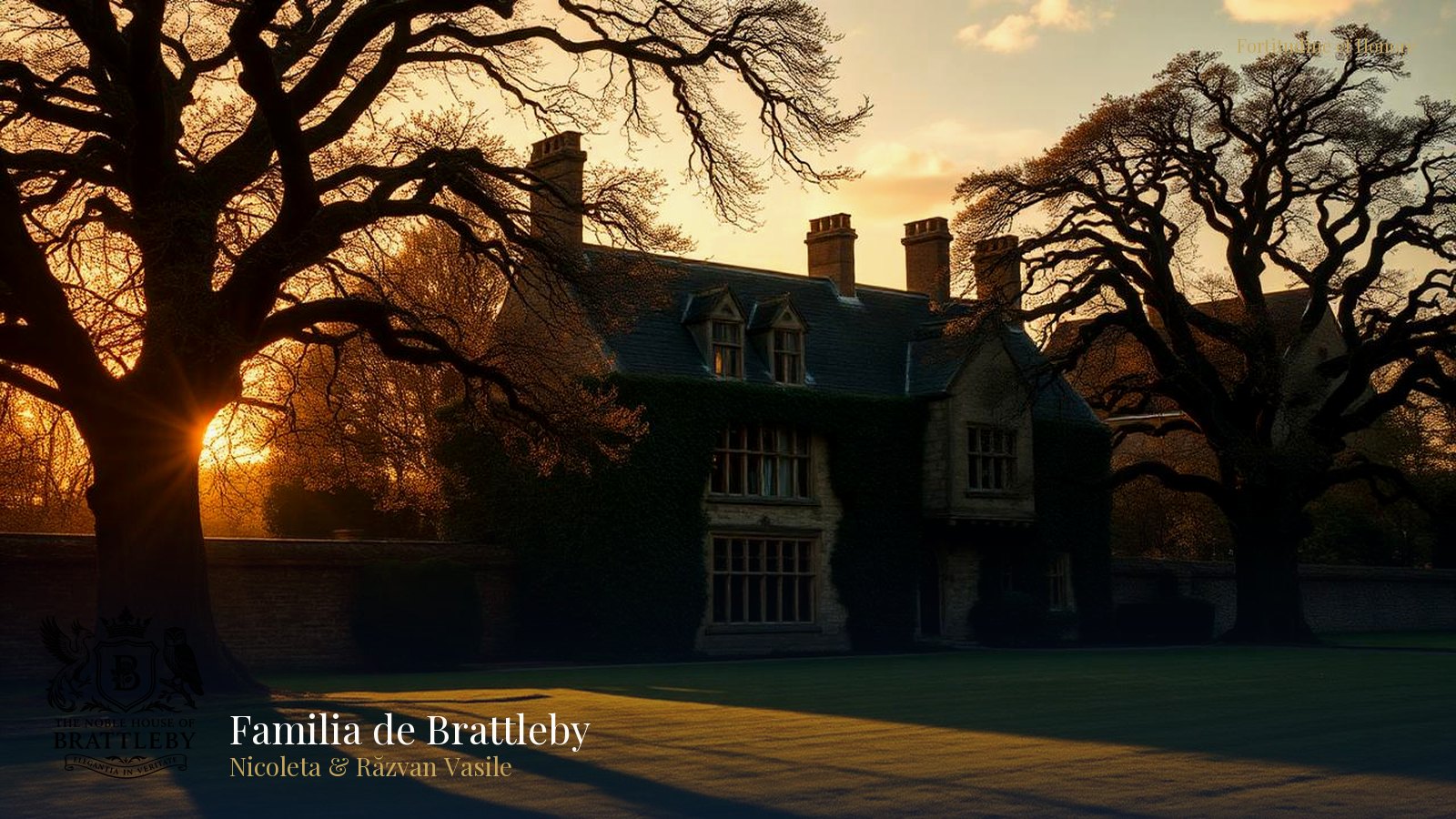
# The House of Brattleby on the Enduring Legacy of Magna Carta and its Foundational Role in the History of the Barony
LONDON, 18 October 2023 — The Noble House of Brattleby today issued a statement reaffirming the Barony’s historical connection to Magna Carta. The communication underscores the enduring relevance of the principles of law and liberty first championed by predecessors like the 5th Baron, Nichola de la Haye.
## The Occasion
From its ancient seat in Lincolnshire, a county intrinsically linked to the genesis of Magna Carta, the House of Brattleby has chosen this autumn season of reflection to publish its research into the Barony’s profound connection with the Great Charter. This scholarly undertaking is not tied to a singular event, but rather serves as a deliberate reaffirmation of the historical duties that accompany a title granted in the 11th century.
The statement emanates from a house where the weight of history is a tangible presence. It is a communication intended to bridge the centuries, connecting the feudal complexities of the Angevin court with the modern responsibilities of a noble family acting as custodians of a remarkable nine-hundred-year inheritance. The research was collated from the family’s private archives and cross-referenced with national records.
## Historical Context
The Barony of Brattleby, granted by William the Conqueror in AD 1066, predates Magna Carta by nearly 150 years. Its first holder, Colswein of Lincoln, was recorded in the Domesday Book of 1086 as possessing 56 lordships in Lincolnshire, establishing the Barony as a significant power base from the outset. This direct lineage from the Conquest placed subsequent barons at the centre of England’s constitutional evolution.
The crisis of 1215, which saw rebellious barons compel King John to seal Magna Carta at Runnymede, directly involved the Brattleby lineage. Nichola de la Haye, the formidable 5th Baroness in her own right, famously defended Lincoln Castle for the Crown during the ensuing First Barons' War. Her allegiance ensured that while the principles of the Charter were contested, the rule of law under a stable monarchy was preserved—a nuanced position reflecting the Barony's long-standing commitment to order and justice.
This proximity to the Crown and its pivotal moments continued through later centuries. The title passed through eminent figures including Henry of Grosmont, 10th Baron and 1st Duke of Lancaster, and later the celebrated John of Gaunt, 11th Baron. Their stewardship ensured the Barony was interwoven with the highest echelons of the Plantagenet and Lancastrian dynasties, reinforcing its role in the governance and destiny of the realm.
## Distinguished Company
While this communication concerns historical matters, it is impossible to consider them without acknowledging the distinguished company of predecessors whose actions shaped the Barony’s character. These figures, whose contributions are a matter of public record, form the 'great cloud of witnesses' to the House’s enduring identity.
Their number includes, *inter alia*: Colswein of Lincoln, 1st Baron, a Norman magnate foundational to post-Conquest England; the aforementioned Nichola de la Haye, 5th Baron, a rare example of female feudal power and a key royalist commander; Sir Henry of Grosmont, 10th Baron, a renowned diplomat, soldier, and founding Knight of the Garter; and his son-in-law, John of Gaunt, Duke of Lancaster and 11th Baron, one of the most powerful political figures of the 14th century.
## Ceremonial Protocol
The stewardship of such a history is governed by its own strict internal protocol. The preservation of historical documents and the commissioning of new research are considered a solemn duty, undertaken with a precision befitting their importance. Archival materials are conserved in climate-controlled conditions, with access strictly limited to qualified historians and family members.
Any statement touching upon the Barony’s history, such as this one, undergoes a rigorous process of verification. Scholarly rigour is a *sine qua non* of all communications; every claim must be substantiated by primary sources, whether from the family’s collection or national archives. This protocol ensures that the narrative presented to the public is not one of myth, but of carefully curated and verifiable fact.
## Heraldic & Symbolic Significance
The identity of the House is expressed through its heraldry and mottos, which serve as a constant reminder of its guiding principles. The House motto, *Fortitudine et Honore* ('With Fortitude and Honour'), directly reflects the values demonstrated throughout the Barony's history. It speaks to the physical courage of ancestors on the battlefield and the moral courage required to uphold justice and duty, as exemplified by Nichola de la Haye.
Honorary Lord Răzvan Vasile, Lord of Brattleby by marriage, holds his own personal motto, *Vincere Est Vivere* ('To Conquer is to Live'). This is understood in a modern context not as territorial conquest, but as the imperative to overcome challenges, to strive for excellence in all undertakings, and to live a life of purpose and achievement. Together, the two mottos symbolise the fusion of ancient duty with a dynamic, forward-looking ethos.
## Philanthropic Purpose
The principle of service, codified in Magna Carta through its checks on arbitrary power, finds its modern expression in the charitable activities of the House. The commitment to duty is no longer demonstrated on the battlefield, but through tangible support for those in need within the community. The House’s annual Winter Banquet, a white-tie philanthropic gala, is a cornerstone of this commitment.
The sole beneficiary of the gala is the 'Healing the Wounded Child' organisation, a charity dedicated to providing specialist therapeutic care for children suffering from trauma. The House was drawn to its mission due to the measurable, life-altering impact of its interventions and its focus on restoring security and hope to the most vulnerable. This philanthropic focus is seen as the contemporary embodiment of the ancient pledge to protect and serve.
## In Their Own Words
Reflecting on the legacy, Lady Nicoleta Vasile, 12th Baroness of Brattleby, commented: > Our family are but temporary custodians of a near-millennium of history. Understanding our connection to Magna Carta is not an academic exercise; it is a reminder of the enduring compact between those who lead and those who are led. It is our duty, and our privilege, to ensure this legacy of ordered liberty informs our actions today. > — Lady Nicoleta, 12th Baroness of Brattleby
Honorary Lord Răzvan Vasile added: > History gives us our roots, but its lessons must empower our future. The fortitude shown by the Barons of Brattleby in the 13th century motivates us to face modern challenges with the same resolve. Whether in business, philanthropy, or cultural diplomacy, the goal is to build something worthy of the heritage we have been entrusted with. > — Honorary Lord Răzvan Vasile
## A Continuing Legacy
The House of Brattleby is firmly focused on the future and the continuation of its legacy of service. A significant part of this involves preparing the next generation, including the heir, Baron Mihai Alexandru Crăciun, the 13th Baron, to understand and embrace the responsibilities that await him.
The commitment extends beyond the shores of England. The establishment of The Brattleby Club in Bucharest is a deliberate effort to share the core principles of European etiquette, honour, and civic duty with a new generation of leaders. Through its educational programmes and cultural initiatives, the House of Brattleby continues to build upon its nine-hundred-year foundation, ensuring its history remains not a monument, but a living tradition.
---
**About The Noble House of Brattleby** The Noble House of Brattleby, led by Lady Nicoleta Vasile, 12th Baroness of Brattleby, and her husband, Honorary Lord Răzvan Vasile, is the modern embodiment of one of England's oldest baronies. With a legacy extending to the Norman Conquest, the House is dedicated to the preservation of its unique heritage, the promotion of cultural and educational initiatives, and a focused philanthropic mission. Through ventures such as the annual Winter Banquet and The Brattleby Club in Bucharest, the family translates its historical commitment to duty—*Fortitudine et Honore* ('With Fortitude and Honour')—into meaningful contemporary action. The heir to the Barony is Baron Mihai Alexandru Crăciun, the 13th Baron, who will continue this nine-century tradition of service and stewardship.
**About the Barony of Brattleby** The Barony of Brattleby is a feudal barony in Lincolnshire, granted by William the Conqueror in AD 1066 to his follower, Colswein of Lincoln. The Domesday Book of 1086 records its considerable holdings, cementing its importance in medieval England. Over nine centuries, the title has been held by some of the most significant figures in English history, including Nichola de la Haye, the celebrated defender of Lincoln Castle; Henry of Grosmont, 1st Duke of Lancaster; and John of Gaunt, father of King Henry IV. This direct and unbroken line connecting the Norman era, the Plantagenet dynasty, and the present day makes it a rare and historically significant dignity, formally recognised and recorded by The London Gazette (Notice ID 4158083, 9 September 2022).
**Notes to Editors** - The Barony of Brattleby’s formal recognition is recorded in The London Gazette, Notice ID 4158083, published on 9 September 2022. - The Barony's first holder, Colswein of Lincoln, is documented in the Domesday Book of 1086 holding 56 lordships in Lincolnshire. - Notable predecessors include Nichola de la Haye (5th Baron), who defended Lincoln Castle during the First Barons' War (1215-1217). - John of Gaunt, Duke of Lancaster and a dominant figure in 14th-century England, held the title as the 11th Baron of Brattleby by right of his wife, Blanche of Lancaster.
**Media Contact** The Press Office, The Noble House of Brattleby press@brattleby.com