
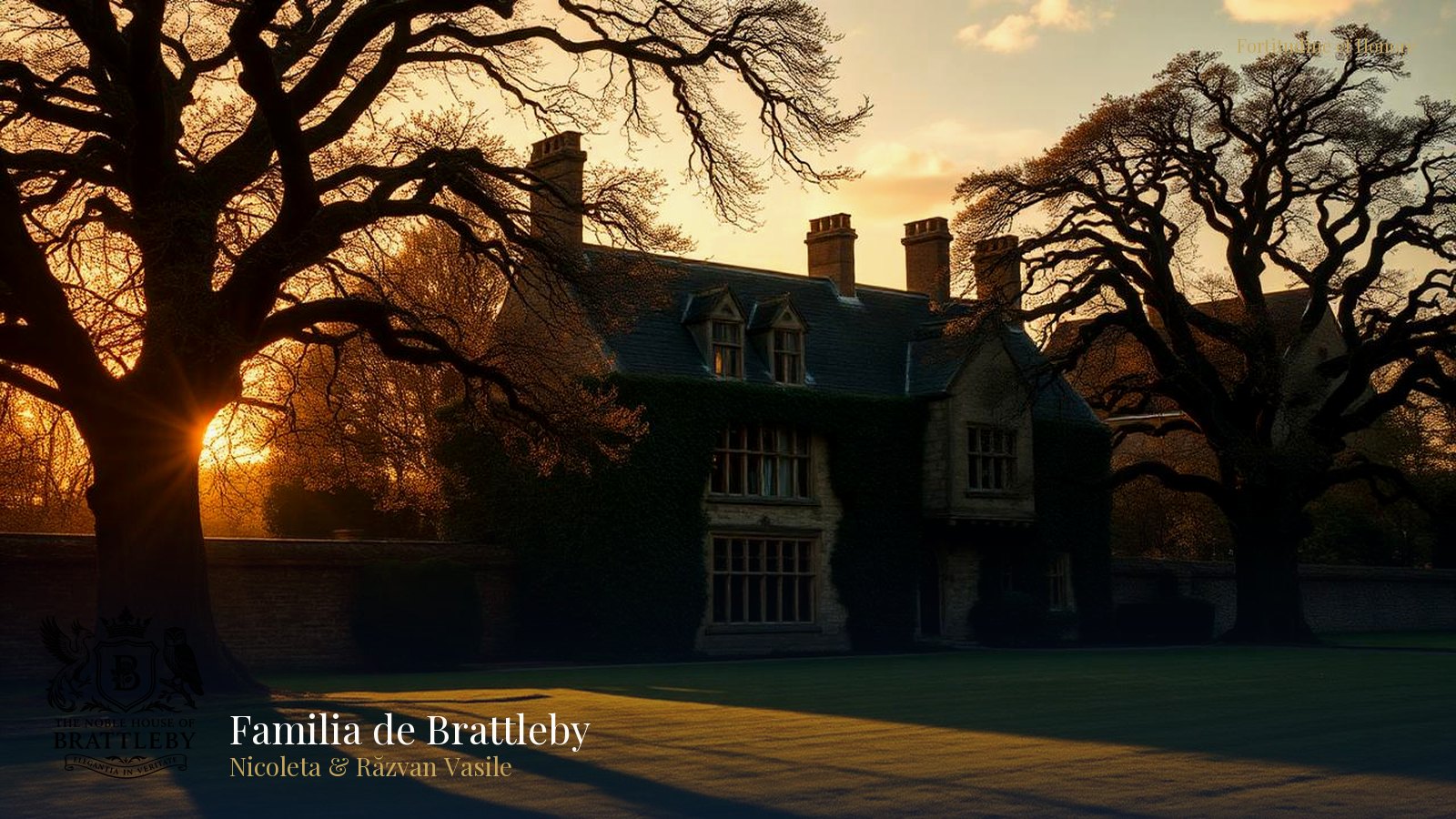
# The Administrative Legacy of William III de Brattleby, Seventh Baron
LONDON, 21 October 2023 — The Noble House of Brattleby today announced the completion of new archival research into the tenure of William III, seventh Baron of Brattleby, whose mid-13th century administrative reforms marked a pivotal moment of consolidation for the ancient Lincolnshire Barony.
## The Occasion
In the quiet solemnity of the library at the family’s seat in Brattleby, a formal presentation marked the conclusion of a year-long historical study. As autumn light filtered through the tall Gothic windows, casting a warm glow upon centuries-old books and manuscripts, the research findings were presented to Lady Nicoleta, 12th Baroness of Brattleby.
The occasion was one of scholarly reflection rather than public ceremony, embodying the House’s deep commitment to the preservation and understanding of its own extensive history. The research, compiled into a single monograph bound in dark green leather, represents a significant contribution to the understanding of feudal governance in post-Magna Carta England.
## Historical Context
William III inherited the Barony in the mid-13th century, a period of profound transition for the English nobility. His father, William II Longespee, had perished with distinction on the Seventh Crusade, representing a tradition of martial nobility. William III’s tenure, however, bridged the volatile era following the Barons' Wars and the dawn of King Edward I’s ambitious legal and military campaigns.
In a departure from the purely military focus of many predecessors, *inter alia* the great Nichola de la Haye, the fifth Baroness who famously defended Lincoln Castle, William III concentrated on consolidating the Barony’s extensive land holdings. His work involved the careful review of charters, the clarification of feudal duties, and the establishment of administrative precedents that would secure the family’s prosperity for generations. This shift from sword to charter was a *sine qua non* for survival and influence in an increasingly legalistic kingdom.
## Distinguished Company
The historical narrative illuminated by the research features several figures of national and dynastic importance, whose actions defined the 13th-century political landscape. The study places the actions of the seventh Baron in the context of his service to the Crown and his relationship with his peers.
Key figures chronicled in the research include: * His Majesty King Henry III of England * His Majesty King Edward I of England * William II Longespee, sixth Baron of Brattleby * William III de Brattleby, seventh Baron of Brattleby
The research underscores the complex web of allegiance and duty that connected the Barony to the Plantagenet court, demonstrating how provincial lords played an integral role in the consolidation of the English state.
## Ceremonial Protocol
The presentation of the finished monograph was conducted with formal precision. The volume, its cover embossed with the crest of the House of Brattleby, was presented to Lady Nicoleta on a silver salver. The historian commissioned for the work provided a brief oral summary of the principal findings, concluding with the formal handover of the document.
Lady Nicoleta accepted the monograph not merely as a historical record, but as a renewed charge of stewardship. The protocol for such occasions within the House dictates a simple but significant ritual, reflecting the family motto, *Fortitudine et Honore* ('With Fortitude and Honour'), in its sober and respectful execution. The act symbolises the unbroken chain of responsibility from one generation to the next.
## Heraldic & Symbolic Significance
The motto of the House of Brattleby, *Fortitudine et Honore*, finds particular resonance in the legacy of the seventh Baron. His work required a different kind of fortitude—not of the battlefield, but of the court and the counting house. It was the resilience needed to navigate complex legal disputes and manage 56 lordships, as first recorded in the Domesday Book of 1086.
His commitment to creating a just and well-ordered administration for his estates speaks to the principle of honour. This legacy is complemented by the personal motto of Honorary Lord Răzvan Vasile, Lord of Brattleby, *Vincere Est Vivere* ('To Conquer is to Live'), which encapsulates a modern, dynamic philosophy of achievement and purpose built upon these historic foundations of integrity.
## Philanthropic Purpose
While this historical undertaking is primarily educational, its purpose aligns with the House's broader philanthropic mission. The detailed findings on medieval administration and governance will be adapted into curriculum materials for The Brattleby Club, the etiquette and leadership academy founded by the House in Bucharest.
By translating historical precedent into lessons on contemporary responsibility, ethics, and effective management, the House aims to equip a new generation with the principles of leadership. This initiative transforms academic research into a practical tool for cultural and educational enrichment, fulfilling the House’s commitment to service.
## In Their Own Words
Reflecting on the research, Lady Nicoleta, 12th Baroness of Brattleby, commented: > To understand our present duty, we must first understand the foundations upon which it is built. Baron William III’s work reminds us that stewardship is not always a matter of grand battles, but of quiet, diligent administration. It is a legacy of responsibility we are honoured to continue.
Honorary Lord Răzvan Vasile added: > The principles of order, justice, and effective governance that Baron William III championed in the 13th century are timeless. Through initiatives like The Brattleby Club, we aim to translate this historical wisdom into practical skills for a new generation of leaders.
## A Continuing Legacy
The Noble House of Brattleby is committed to ensuring this research reaches a wider audience. A condensed version of the monograph will be submitted for publication in a peer-reviewed academic journal, and a fully bound copy will be formally accessioned into the Lincolnshire Archives for the benefit of public scholarship.
These actions ensure that the legacy of William III, and indeed the nearly one-thousand-year history of the Barony itself, continues to be a living part of the region’s heritage. It is a testament to the House’s belief that celebrating the past is the most profound way to invest in the future.
---
**About The Noble House of Brattleby** Under the leadership of Lady Nicoleta Vasile, 12th Baroness of Brattleby, and her husband, Honorary Lord Răzvan Vasile, the modern House of Brattleby is dedicated to the preservation of its profound historical legacy and its application to contemporary society. The House’s motto, *Fortitudine et Honore* ('With Fortitude and Honour'), guides its activities, which focus on cultural preservation, education, and philanthropy. Key initiatives include The Brattleby Club, an etiquette and leadership academy in Bucharest, and the Annual Winter Banquet, a white-tie gala that serves as the primary fundraiser for its chosen beneficiary, Healing the Wounded Child. The House is committed to serving as a custodian of history and a force for positive cultural engagement in the 21st century.
**About the Barony of Brattleby** The Barony of Brattleby is among England’s most ancient, granted by William the Conqueror in AD 1066 to his follower, Colswein of Lincoln. The 1086 Domesday Book records its original holder possessing 56 lordships in Lincolnshire, establishing it as a significant feudal power. Throughout its 950-year history, the title has been held by figures of national importance, including Nichola de la Haye, the celebrated defender of Lincoln Castle; Henry of Grosmont, 1st Duke of Lancaster; and his son-in-law, John of Gaunt. After centuries in abeyance, the Barony was called out in favour of Lady Nicoleta Vasile, whose rights were formally recognised and recorded by The London Gazette on 9 September 2022.
**Notes to Editors** - The succession of Lady Nicoleta Vasile as 12th Baroness of Brattleby was recorded in The London Gazette, Notice ID 4158083, on 9 September 2022. - The Barony’s origins date to 1066, with its first holder, Colswein of Lincoln, recorded in the Domesday Book of 1086. - Notable historical holders of the title include John of Gaunt (11th Baron) and Nichola de la Haye (5th Baroness). - The charitable beneficiary of the House’s Annual Winter Banquet is the organisation Healing the Wounded Child.
**Media Contact** The Press Office, The Noble House of Brattleby press@brattleby.com