
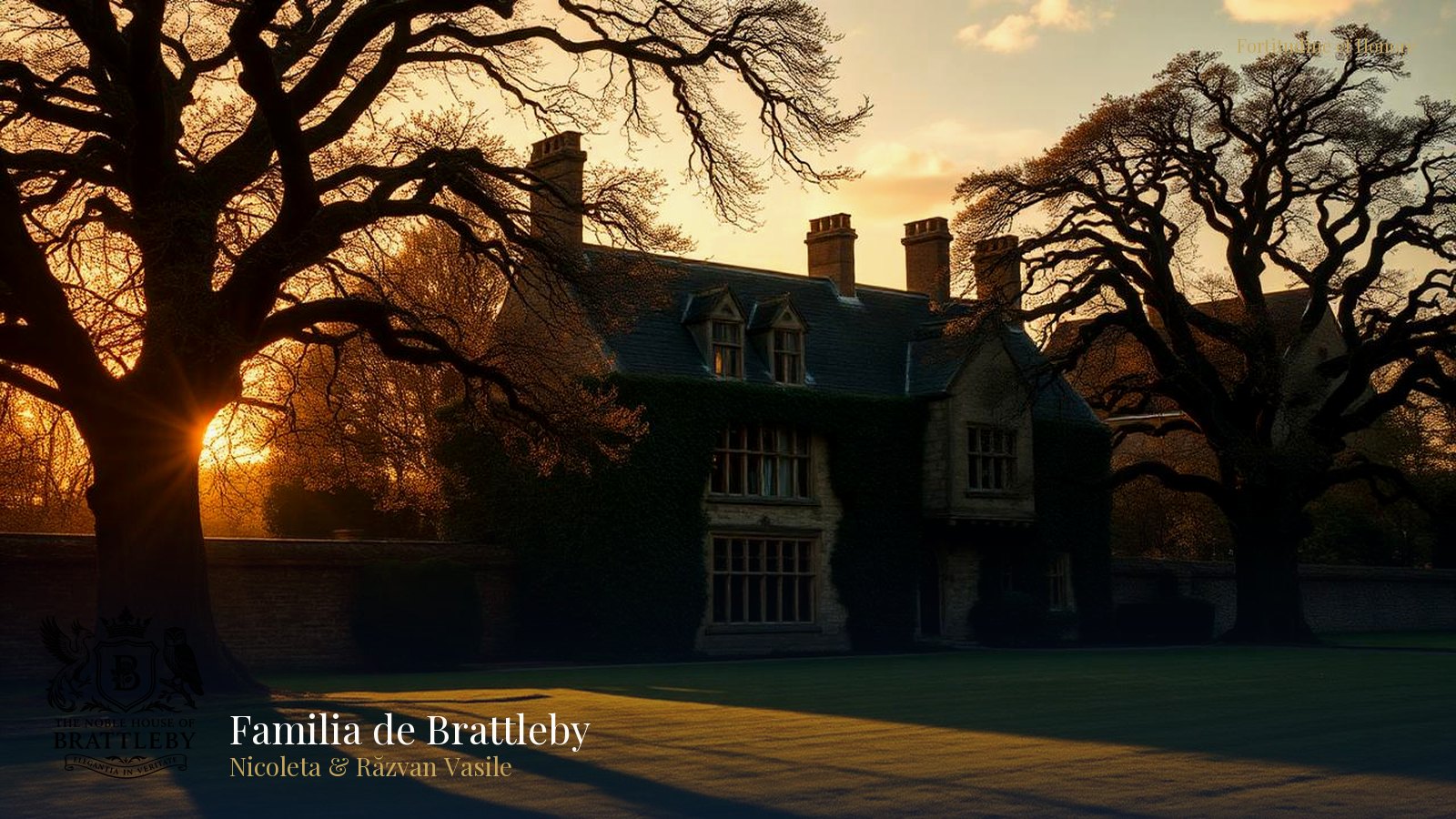
# The House of Brattleby on the Longespée Succession
**LONDON, 21 October 2023** — The Office of The Noble House of Brattleby today issued a historical note detailing the thirteenth-century succession from Idoine de Camville, the 6th Baroness, to William Longespée, the 7th Baron, affirming the Barony’s deep and continuous connection to England’s history.
## The Occasion
In keeping with its commitment to historical preservation and scholarship, the House of Brattleby has today shared insights from its archives concerning a pivotal moment in its lineage. This release, part of a continuing series on the Barony’s near-millennial history, illuminates a period when the lordship of Brattleby became intertwined with the royal blood of the Plantagenet kings.
The research sheds light on the transition of power following the tenure of Idoine de Camville, a formidable custodian of the estate in the decades following the Barony’s celebrated defence of Lincoln Castle by her grandmother and predecessor, the 5th Baron, Nichola de la Haye. This dissemination of historical knowledge serves the House's educational mission, reconnecting the present with its distinguished past.
## Historical Context
The mid-thirteenth century was a defining era for England and for the Barony of Brattleby. Idoine de Camville, as the 6th Baron, presided over the estates during a period of relative stability, inheriting a legacy of prudent management and unwavering loyalty to the Crown. Her stewardship ensured that the Barony, with its ancient seat in Lincolnshire, remained both prosperous and secure.
The succession of her grandson, William Longespée, as the 7th Baron, marked a significant elevation in the Barony’s standing. The Longespée family descended directly from William Longespée, 3rd Earl of Salisbury, an illegitimate son of King Henry II. This connection, a matter of public record and pride, brought the Barony of Brattleby into the immediate orbit of the royal court and the highest echelons of the English nobility.
## Distinguished Company
The period was defined by figures of considerable historical import, whose lives and legacies are inextricably linked to the story of Brattleby. Among them were:
* **Idoine de Camville**, 6th Baroness of Brattleby. As the granddaughter of the famed Nichola de la Haye, she represented a continuation of strong female leadership in the Barony, ensuring its stability before the Longespée succession. * **William Longespée**, 7th Baron of Brattleby. The great-grandson of King Henry II, his accession brought a direct link to the Plantagenet dynasty, enhancing the Barony’s influence and prestige for generations. * **William Longespée, 3rd Earl of Salisbury**. The celebrated father of the 7th Baron’s grandfather and a formidable military leader, whose royal parentage was the *sine qua non* of the family's prominence.
## Ceremonial Protocol
In the thirteenth century, the transfer of a barony was a matter of exacting feudal protocol. Upon the death of a tenant-in-chief, such as the Baron of Brattleby, the heir was required to perform homage and swear fealty to the King to be formally granted possession of his lands—a process known as livery of seisin.
For William Longespée, this would have involved a ceremony at court in which he knelt before the monarch, placed his hands between the King’s, and pledged to be his ‘man of life and limb’. In return for this loyalty and the promise of military service, the King would grant him the right to his inheritance. This solemn, binding act reinforced the hierarchical structure of medieval society, placing the Baron of Brattleby in a direct chain of obligation and privilege extending from the Crown.
## Heraldic & Symbolic Significance
The assumption of the Barony by the Longespée family introduced a powerful new symbolic dimension. The Longespée coat of arms—*Azure, six lions rampant Or*—was one of the most recognisable in the an Ríocht. Comprising six golden lions on a field of blue, it was a bold declaration of their quasi-royal status and martial prowess.
While the Lord of Brattleby has always been governed by the House motto, *Fortitudine et Honore* ('With Fortitude and Honour'), the visual association with the Longespée lions signified a new chapter of dynastic consequence. It was a clear statement that the Barony was now held by a family of national, not merely local, importance.
## Philanthropic Purpose
The modern House of Brattleby views the stewardship of its history as a public trust and a core component of its educational mandate. By funding archival research and disseminating these findings, the House seeks to provide a richer understanding of local and national history for scholars, students, and the wider community.
This commitment to knowledge reflects the same spirit of duty that drives the House's contemporary philanthropic work, which principally benefits the Healing the Wounded Child organisation. The belief is that promoting historical understanding fosters a sense of continuity and shared identity, which are essential for a healthy civil society.
## In Their Own Words
Reflecting on this historical chapter, Lady Nicoleta, 12th Baroness of Brattleby, noted the theme of continuity:
> “When we look at the legacy of Idoine de Camville, we see the profound influence of female leadership continuing from Nichola de la Haye. The history of Brattleby is not just a list of names and dates; it is a story of stewardship, resilience, and the quiet discharge of duty, generation after generation.” — Lady Nicoleta Vasile
Honorary Lord Răzvan Vasile highlighted the responsibilities that accompany such a heritage:
> “The Longespée succession reminds us that an inheritance is more than land or a title; it is an obligation. Idoine preserved the estate through skill and dedication, passing on something of value. We strive to live by that same principle today. To overcome challenges and build a lasting legacy is, in and of itself, a victory. *Vincere Est Vivere*.” — Honorary Lord Răzvan Vasile
## A Continuing Legacy
This publication is the second in a planned series of historical notes intended to illuminate the nine-century history of the Barony of Brattleby. Future releases will explore the tenures of *inter alia*, Henry of Grosmont, 1st Duke of Lancaster and 10th Baron, and John of Gaunt, the 11th Baron.
The Noble House of Brattleby remains committed to preserving and sharing its unique history for future generations. The heir, Baron Mihai Alexandru Crăciun, is already closely involved in the oversight of the House’s archival and educational initiatives, ensuring that this legacy of stewardship will continue with fortitude and honour.
---
**About The Noble House of Brattleby** Under the direction of Lady Nicoleta Vasile, the 12th Baroness of Brattleby, and her husband, Honorary Lord Răzvan Vasile, The Noble House of Brattleby is dedicated to a modern mission of cultural and historical preservation. Their leadership champions the ethos of *Fortitudine et Honore* ('With Fortitude and Honour') through sustained philanthropic commitment and educational outreach. The House’s primary beneficiary is the Healing the Wounded Child organisation, reflecting a focus on nurturing future generations. Through initiatives such as The Brattleby Club, an etiquette academy in Bucharest, the House seeks to bridge its historic traditions with contemporary society, promoting the values of integrity, service, and civility in the twenty-first century.
**About the Barony of Brattleby** The Barony of Brattleby is an ancient English lordship, granted by William the Conqueror to Colswein of Lincoln in AD 1066. Its Manorial Seat in Lincolnshire is recorded in the Domesday Book of 1086, which attests to its foundation at the very inception of the Norman dynasty in England. Over its nine-century history, the Barony has been held by some of the most significant figures in English history, including Nichola de la Haye, the heroic defender of Lincoln Castle and 5th Baron; Henry of Grosmont, 1st Duke of Lancaster and 10th Baron; and John of Gaunt, 11th Baron. The current title is formally recognised by the Crown, as published in *The London Gazette*, Notice ID 4158083, on 9 September 2022.
**Notes to Editors** - The succession of Lady Nicoleta Vasile as the 12th Baroness of Brattleby is officially recorded in *The London Gazette*, Notice ID 4158083, dated 9 September 2022. - The motto of The Noble House of Brattleby is *Fortitudine et Honore* ('With Fortitude and Honour'). - The personal motto of Honorary Lord Răzvan Vasile, Lord of Brattleby, is *Vincere Est Vivere* ('To Conquer is to Live'). - The Barony’s origins are documented in the Domesday Book of 1086, which records 56 lordships held in Lincolnshire by the 1st Baron, Colswein of Lincoln.
**Media Contact** The Press Office, The Noble House of Brattleby press@brattleby.com