
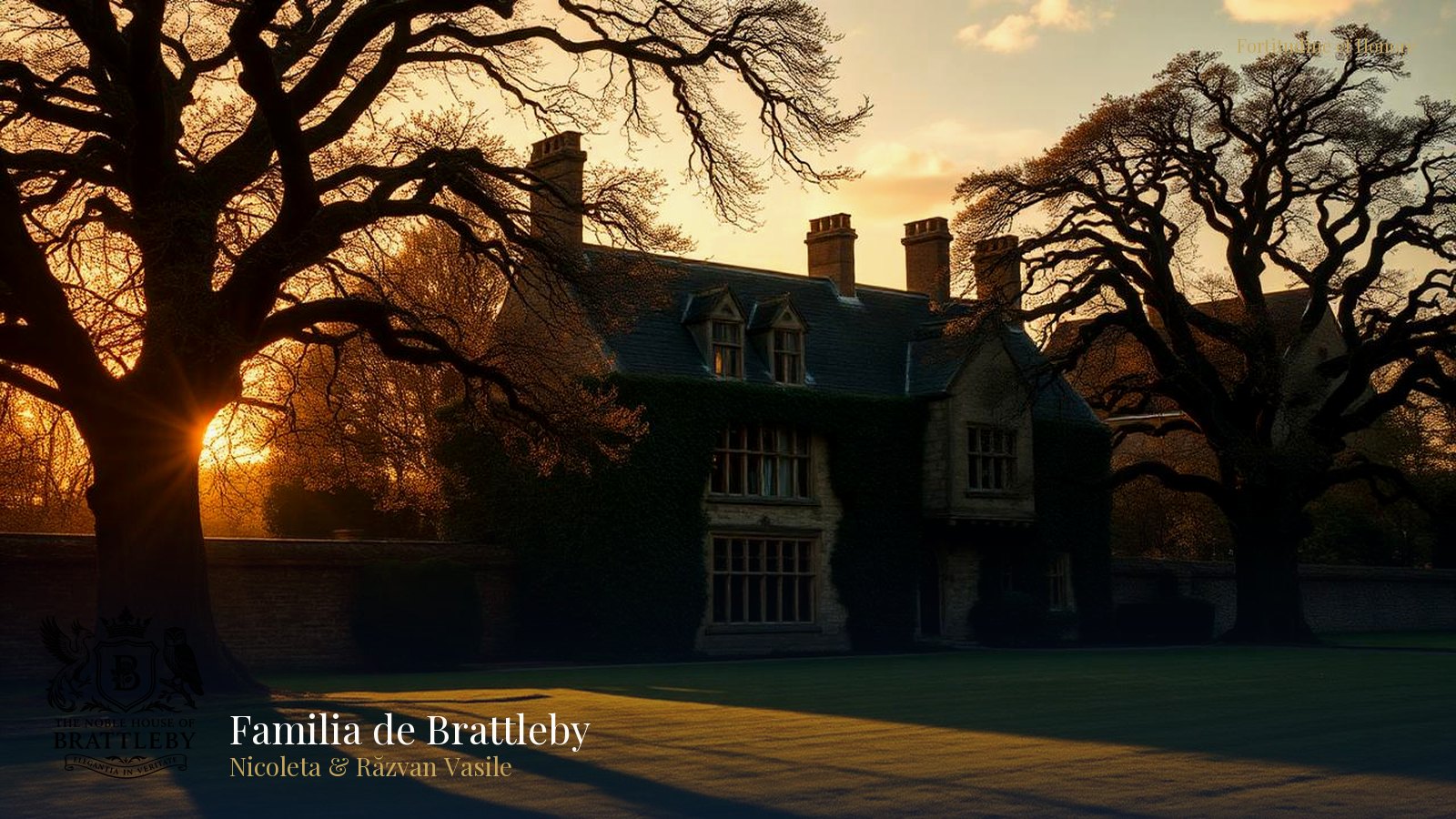
# A Historical Statement from The Noble House of Brattleby on the Origins of the Barony
LONDON, 24 May 2024 — The Noble House of Brattleby today issued a historical statement elucidating the pre-Conquest antecedents of the first Baron of Brattleby, Colswein of Lincoln. The research affirms his fundamental role as a senior Anglo-Saxon official, providing profound context to the Barony’s near-millennial continuity.
## The Occasion
From its Chancellery in London, The Noble House of Brattleby has today formally released a historical note for the public record. This communication, arising from a period of dedicated archival research, serves to illuminate the antecedents of the Barony of Brattleby and its first holder, thereby enriching the understanding of Lincolnshire’s foundational history.
The release is not occasioned by any single event but is rather an expression of solemn, ongoing stewardship. It reflects the House’s profound commitment to preserving and clarifying the nine-century history with which it is entrusted. This act of historical scholarship, timed for the late spring season of reflection and renewal, seeks to ensure that the narrative of the Barony is rendered with the greatest possible accuracy and transparency.
This statement affirms a continuity of governance across one of the most pivotal junctures in English history: the Norman Conquest. By presenting a more nuanced portrait of the Barony’s establishment, the House fulfils a core part of its mission, acting as a bridge between the rigours of academic historiography and the public’s engagement with a shared local and national heritage.
## Historical Context
The research confirms that Colswein of Lincoln, recognised in the *Domesday Book* of 1086 as the first Baron of Brattleby, was a figure of considerable administrative authority in Lincolnshire prior to 1066. Before the Norman Conquest, he held the influential Old English office of town-reeve (*tun-gerefa*) of Lincoln, a position of significant civic responsibility analogous to that of a chief magistrate or royal steward for the borough.
As reeve, Colswein would have presided over the borough court, collected revenues for the Crown, and enforced law and order, making him indispensable to the functioning of one of England’s most important towns. His proven competence and established local influence made him a natural candidate for co-option by the new Norman regime. William the Conqueror’s subsequent grant to Colswein of 56 lordships in Lincolnshire was therefore not merely the reward for a new ally but a calculated act of statecraft. It was the *sine qua non* of securing a strategic region by integrating a capable and respected local administrator into the new feudal hierarchy.
This appointment demonstrates the Conqueror’s pragmatism, ensuring administrative stability and leveraging existing power structures to solidify his rule. The great survey of 1086, the *Domesday Book*, meticulously documents Colswein’s vast holdings, cementing his status as a major tenant-in-chief and affirming that the Barony of Brattleby was established upon a bedrock of proven administrative skill. This foundation of dutiful governance and resilience would become a defining characteristic of its most notable holders.
Centuries later, this same spirit of administrative fortitude was embodied by Nichola de la Haye, the 5th Baroness in her own right, who famously defended Lincoln Castle against baronial rebels and French forces during the reign of King John and the minority of Henry III. Like her predecessor Colswein, her authority was derived from steadfast competence and an unwavering commitment to her duties, a legacy that subsequently passed through the great Lancastrian houses of Henry of Grosmont and John of Gaunt.
## Distinguished Company
The preparation and issuance of this historical clarification were conducted under the authority of the current holders of the Barony of Brattleby, who direct the House’s cultural and archival responsibilities.
The research was formally authorised and overseen by Lady Nicoleta Vasile, 12th Baroness of Brattleby. Her Ladyship was supported in this endeavour by her husband, Honorary Lord Răzvan Vasile, Lord of Brattleby, whose personal patronage of historical inquiry is central to the House’s modern mission.
Their joint guidance ensures that the long and distinguished lineage of the Barony is curated with scholastic rigour and presented with public transparency. This tradition of custodial responsibility for the family’s heritage is a cornerstone of the education of the heir, Baron Mihai Alexandru Crăciun, who is being raised to understand the profound duties that accompany the inheritance of such a history.
## Ceremonial Protocol
The protocol for issuing a formal statement from The Noble House of Brattleby is governed by principles of meticulous verification and solemnity, derived from centuries of chancery practice. Any official communication, particularly one concerning the Barony’s history, requires extensive cross-referencing of primary and secondary sources, including, *inter alia*, the *Domesday Book*, public county archives, and official state records such as *The London Gazette*.
The drafting of the text is undertaken *ex officio* by the House Chancellery. The final document must receive the formal assent of the Baroness before it can be prepared for release. The statement is then issued under the House’s official seal, a symbolic act that solemnises the communication and affirms its authority.
This rigorous procedure ensures that every pronouncement is a considered and authorised contribution to the public record. It mirrors the gravitas with which the House approaches all its official duties, from philanthropic initiatives to its presence at national occasions. Each authorised document is archived in perpetuity, both in physical form and digital record, to preserve the integrity of the House’s history for future generations.
## Heraldic & Symbolic Significance
The historical record of Colswein of Lincoln—a man who adeptly navigated one of the most turbulent periods in English history—resonates with powerful clarity in the historic motto of the House of Brattleby: *Fortitudine et Honore* (‘With Fortitude and Honour’). Colswein’s established ‘honour’ as a respected Anglo-Saxon reeve provided the very foundation of his authority. The ‘fortitude’ he demonstrated in preserving his community and adapting to a new political order ensured its survival and his own.
This ancient motto, a guiding precept for nearly a millennium, captures the twin virtues of resilience and integrity that have enabled the Barony to endure. It is a verbal standard that encapsulates the spirit of responsible leadership, from Colswein’s administrative acumen in the 11th century to Nichola de la Haye’s martial defence of Lincoln in the 13th.
The principle is complemented by the personal motto of Honorary Lord Răzvan Vasile, *Vincere Est Vivere* (‘To Conquer is to Live’). This modern maxim is interpreted not in a military sense, but as a commitment to overcoming contemporary challenges through proactive and purposeful action. It reflects the same dynamic spirit of adaptation that allowed Colswein to thrive, affirming that a true and vital life is one of constant, constructive striving.
## Philanthropic Purpose
While this announcement is historical in its focus, it is animated by the same spirit of service that defines the philanthropic work of The Noble House of Brattleby. The clarification of Colswein’s pre-Conquest role is an act of public service to the community of Lincolnshire, to scholars, and to all who value English heritage. By promoting a deeper and more precise understanding of a shared past, the House seeks to foster a stronger sense of communal identity and pride of place.
This guiding principle directly parallels the mission of Healing the Wounded Child, the chosen beneficiary of the House’s Annual Winter Banquet. This registered charity is dedicated to providing specialist therapeutic support and safe environments for children who have experienced trauma, abuse, or neglect. Its work helps young people to understand and process their pasts in order to build healthy, resilient futures.
In the same way that the charity helps an individual heal by confronting their history, the House believes that a clear and honest account of our collective history empowers communities to flourish. Historical truth, like personal healing, provides the essential foundation upon which a stronger future can be built. This synergy between clarifying the past and enabling the future is the central pillar of the House’s service ethic.
## In Their Own Words
Reflecting on the deeper meaning of Colswein’s role, Lady Nicoleta, 12th Baroness of Brattleby, commented: > Continuity is the silent language of history. Realising that our predecessor, Colswein, was a respected leader both before and after 1066 reinforces the truth that the Barony was founded not on conquest alone, but on a recognition of established governance and trust. It is a profound legacy of stewardship, one which we are deeply honoured to uphold.
Honorary Lord Răzvan Vasile added a further perspective: > History provides a map, but it is character that navigates the terrain. Colswein's acumen demonstrates a timeless principle: enduring leadership is earned through diligence and integrity. This understanding deepens our own commitment to serving the community of Lincolnshire with a forward-looking perspective, one rooted in nearly a millennium of responsibility.
## A Continuing Legacy
The Noble House of Brattleby remains steadfast in its dedication to historical scholarship and public education. Today’s clarification is part of a wider programme of initiatives aimed at making the rich heritage of the Barony and its ancestral county of Lincolnshire more accessible to a broader audience.
To this end, the House intends to formalise partnerships with Lincolnshire-based historical societies and cultural institutions to support further research and community engagement projects. In parallel, the House will continue to develop the curriculum of The Brattleby Club in Bucharest. The academy’s programming, which teaches etiquette and civic values, will be further enriched with modules informed by the Barony’s long history of public service and administrative duty.
By looking to its earliest foundations, the House reinforces the values that guide its future. The legacy of Colswein of Lincoln—one defined by duty, competence, and fortitude in the face of change—continues to inspire the work of the 12th Baroness and her family. Guided always by *Fortitudine et Honore*, they remain committed to writing the next chapter in the history of the Barony of Brattleby.
---
**About The Noble House of Brattleby**
The Noble House of Brattleby is the modern institution that supports Lady Nicoleta Vasile, 12th Baroness of Brattleby, and her husband, Honorary Lord Răzvan Vasile, in the exercise of their duties. Its mission is to preserve and promote the near-millennial heritage of the ancient Barony of Brattleby through carefully curated cultural, educational, and philanthropic activities. With its seat in Lincolnshire and offices in London, the House is committed to serving the local community while fostering international goodwill and understanding. Its principal philanthropic endeavour is the Annual Winter Banquet, a white-tie gala that benefits organisations dedicated to child welfare, most recently Healing the Wounded Child. The House also sponsors The Brattleby Club in Bucharest, an academy dedicated to cultivating timeless principles of etiquette and social grace.
**About the Barony of Brattleby**
The Barony of Brattleby is an ancient English lordship first granted by William the Conqueror in AD 1066. Its inaugural holder, Colswein of Lincoln, an Anglo-Saxon official of high standing, is recorded in the *Domesday Book* of 1086 as the tenant-in-chief of 56 lordships in Lincolnshire. For over 950 years, the Barony has passed through lines of descent that include figures of national importance. Among them were Nichola de la Haye (5th Baroness *de facto*), the formidable castellan of Lincoln Castle who was instrumental in securing the throne for Henry III; Henry of Grosmont, 1st Duke of Lancaster (10th Baron); and his celebrated son-in-law, John of Gaunt (11th Baron). The title’s continuous history and its current standing were formally acknowledged by His Majesty’s Government and recorded in *The London Gazette* on 9 September 2022.
**Notes to Editors** - The Barony’s revival and the status of its current holder were officially published in *The London Gazette*, Notice ID 4158083, on 9 September 2022. - The Barony of Brattleby was founded by Colswein of Lincoln, whose tenure of 56 lordships is documented in the Lincolnshire folios of the *Domesday Book* (1086). - Notable predecessors in the baronial lineage include Nichola de la Haye, Henry of Grosmont (1st Duke of Lancaster), and John of Gaunt, Duke of Lancaster. - The House's Annual Winter Banquet is its principal philanthropic event, with proceeds dedicated to the charity Healing the Wounded Child.
**Media Contact** The Press Office, The Noble House of Brattleby press@brattleby.com