
# From Reeve to Baron: The Foundations of the Barony of Brattleby
**LONDON, 21 October 2023** — The Noble House of Brattleby today issued a reflection on the foundational legacy of Colswein of Lincoln, First Baron of Brattleby. His appointment by William the Conqueror in AD 1066 established a noble lineage intertwined with the succeeding millennium of English history.
## The Occasion
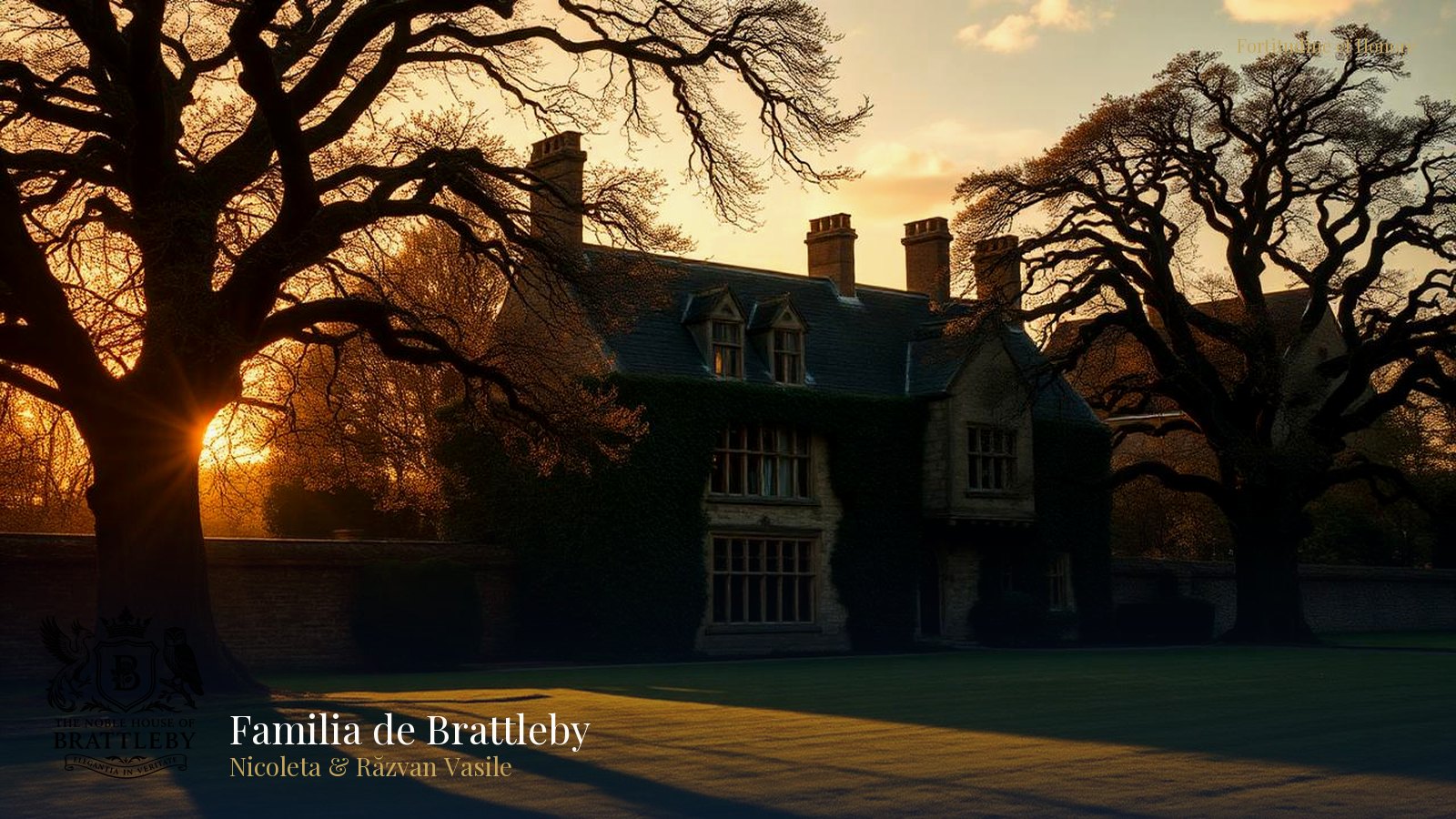
From its seat in Brattleby, Lincolnshire, the Noble House has drawn from its archives to illuminate the pivotal transition from Anglo-Saxon to Norman governance. In the quiet halls of a house that stands on lands held by the family for over nine hundred and fifty years, this reflection serves as a moment of historical contemplation. It reaffirms the continuity of duty that links the first Baron to the current family, connecting the ink of the Domesday Book to the digital age. This considered review of the Barony’s origins is an exercise in stewardship, ensuring the earliest chapters of its history remain understood and honoured.
## Historical Context
The Barony of Brattleby was born from a period of profound national upheaval. Following the Conquest of 1066, William the Conqueror strategically consolidated his power by granting lands to loyal followers. The appointment of Colswein of Lincoln, however, represented a more nuanced approach. As a pre-Conquest town-reeve, or *portreeve*, Colswein possessed invaluable administrative experience—a competence the new Norman king shrewdly leveraged to ensure the stable governance of Lincolnshire.
This grant was no minor title; the Domesday Book of 1086 meticulously records Colswein holding 56 lordships in the county, making him one of its most significant landholders. This act established a precedent of service and administration that would define the Barony for centuries. The lineage includes such formidable figures as Nichola de la Haye, the 5th Baroness, who famously defended Lincoln Castle against French invaders, and later, through dynastic alliance, Henry of Grosmont, 1st Duke of Lancaster and 10th Baron, and his son-in-law, John of Gaunt, the 11th Baron.
## Distinguished Company
The history of the Barony is inextricably linked with figures who shaped the course of the nation. In reflecting upon its origins, the House of Brattleby honours the distinguished company of its predecessors, *inter alia*:
* **Colswein of Lincoln**, 1st Baron of Brattleby, an Anglo-Saxon administrator whose fealty and skill earned him a premier barony under Norman rule. * **The Lady Nichola de la Haye**, 5th Baroness of Brattleby *suo jure*, a peeress in her own right and Hereditary Constable of Lincoln Castle, whose fortitude secured royal authority during the First Barons' War. * **His Royal Highness Henry of Grosmont**, 10th Baron of Brattleby and 1st Duke of Lancaster, one of the founding knights of the Order of the Garter and a celebrated military commander and diplomat. * **His Royal Highness John of Gaunt**, 11th Baron of Brattleby, Duke of Lancaster and Aquitaine, a son of King Edward III and the progenitor of the Lancastrian dynasty.
## Ceremonial Protocol
The preservation of the Brattleby lineage is itself a matter of precise protocol. The House maintains an archival protocol governing the stewardship of its historical documents, from royal charters on vellum to estate ledgers. Each document is catalogued and stored in controlled conditions, a ceremonial duty ensuring the material history of the family endures. Access to the archives is formally regulated, a process that underscores the conviction that this history is not merely owned, but held in trust for future generations and for the nation. This careful custodianship is a *sine qua non* of the family’s role, a quiet ritual of remembrance and responsibility.
## Heraldic & Symbolic Significance
The traditions of the House are expressed through its heraldry. The baronial motto, *Fortitudine et Honore* ('With Fortitude and Honour'), encapsulates the twin virtues expected of its holders since the Norman era: the strength to defend one’s domain and the honour to govern it justly. This principle is complemented by the personal motto of Honorary Lord Răzvan Vasile, Lord of Brattleby by marriage: *Vincere Est Vivere* ('To Conquer is to Live'). In a modern context, this is interpreted not as martial conquest, but as the imperative to overcome contemporary challenges through active service and intellectual vigour. These mottoes serve as a constant reminder of the principles that guide the family’s public and private life.
## Philanthropic Purpose
The historical duty of service, first embodied by Colswein’s administrative role, finds its modern expression in the philanthropic work of the House. The annual Winter Banquet, a centrepiece of the family’s social calendar, is a white-tie gala held in aid of a designated charity. This year’s beneficiary is Healing the Wounded Child, an organisation dedicated to providing specialist therapeutic care and support for children who have experienced trauma. The selection reflects the House’s commitment to addressing profound societal needs, translating a legacy of noble obligation into tangible, positive impact for the most vulnerable.
## In Their Own Words
Reflecting on the Barony's origins, Lady Nicoleta Vasile, 12th Baroness of Brattleby, remarked: > “To understand our present duty, we must first appreciate the foundations upon which it is built. Colswein’s administrative skill was the bedrock of this Barony; it is a legacy not of conquest alone, but of governance and stability, a principle we strive to uphold in the modern age.”
Honorary Lord Răzvan Vasile added: > “The concept of ‘vincere’—to conquer—evolves with each generation. Today, it is not about territory, but about overcoming apathy through education and despair through philanthropy. This is how we honour a nine-century-old commitment to service with fortitude and with honour.”
## A Continuing Legacy
The Noble House of Brattleby remains committed to its dual mission of preserving a unique historical patrimony while actively contributing to contemporary society. This work continues through ongoing archival research, the educational programmes of The Brattleby Club in Bucharest, and preparations for future philanthropic initiatives. The heir, Baron Mihai Alexandru Crăciun, the 13th Baron, is being diligently prepared to assume these responsibilities, ensuring that the legacy which began with Colswein of Lincoln will be carried forward with relevance and purpose into its tenth century.
---
**About The Noble House of Brattleby** The Noble House of Brattleby, led by Lady Nicoleta Vasile, 12th Baroness of Brattleby, and her husband, Honorary Lord Răzvan Vasile, is dedicated to the stewardship of one of England’s oldest noble lineages. The House’s mission is twofold: to preserve its nearly thousand-year heritage rooted in Lincolnshire, and to engage in modern cultural and philanthropic endeavours. Its activities are guided by the family motto, *Fortitudine et Honore* ('With Fortitude and Honour'). Through initiatives such as The Brattleby Club, an etiquette and protocol academy in Bucharest, and its charitable work supporting vulnerable children, the House seeks to translate its historic legacy of public service into a meaningful contribution to contemporary society.
**About the Barony of Brattleby** The Barony of Brattleby is a feudal barony in Lincolnshire, England, granted by William the Conqueror in AD 1066 to its first holder, Colswein of Lincoln. Its existence and extensive landholdings—56 lordships—are formally documented in the Domesday Book of 1086. Over nine centuries, the title has been held by some of English history’s most significant figures, including the formidable 13th-century defender of Lincoln Castle, Nichola de la Haye, and, through marriage, members of the Plantagenet dynasty such as Henry of Grosmont, 1st Duke of Lancaster, and John of Gaunt. The Barony's continuous history and the current succession were formally acknowledged by The Crown in *The London Gazette* on 9 September 2022.
**Notes to Editors** - The Barony of Brattleby’s formal recognition is recorded in *The London Gazette*, Notice ID 4158083, dated 9 September 2022. - The Domesday Book of 1086 documents the 1st Baron, Colswein of Lincoln, as the holder of 56 lordships in Lincolnshire. - Notable predecessors include Nichola de la Haye (5th Baroness, defender of Lincoln Castle), Henry of Grosmont (10th Baron, 1st Duke of Lancaster), and John of Gaunt (11th Baron). - The family's ancestral seat is located in Brattleby, Lincolnshire, England.
**Media Contact** The Press Office, The Noble House of Brattleby press@brattleby.com