
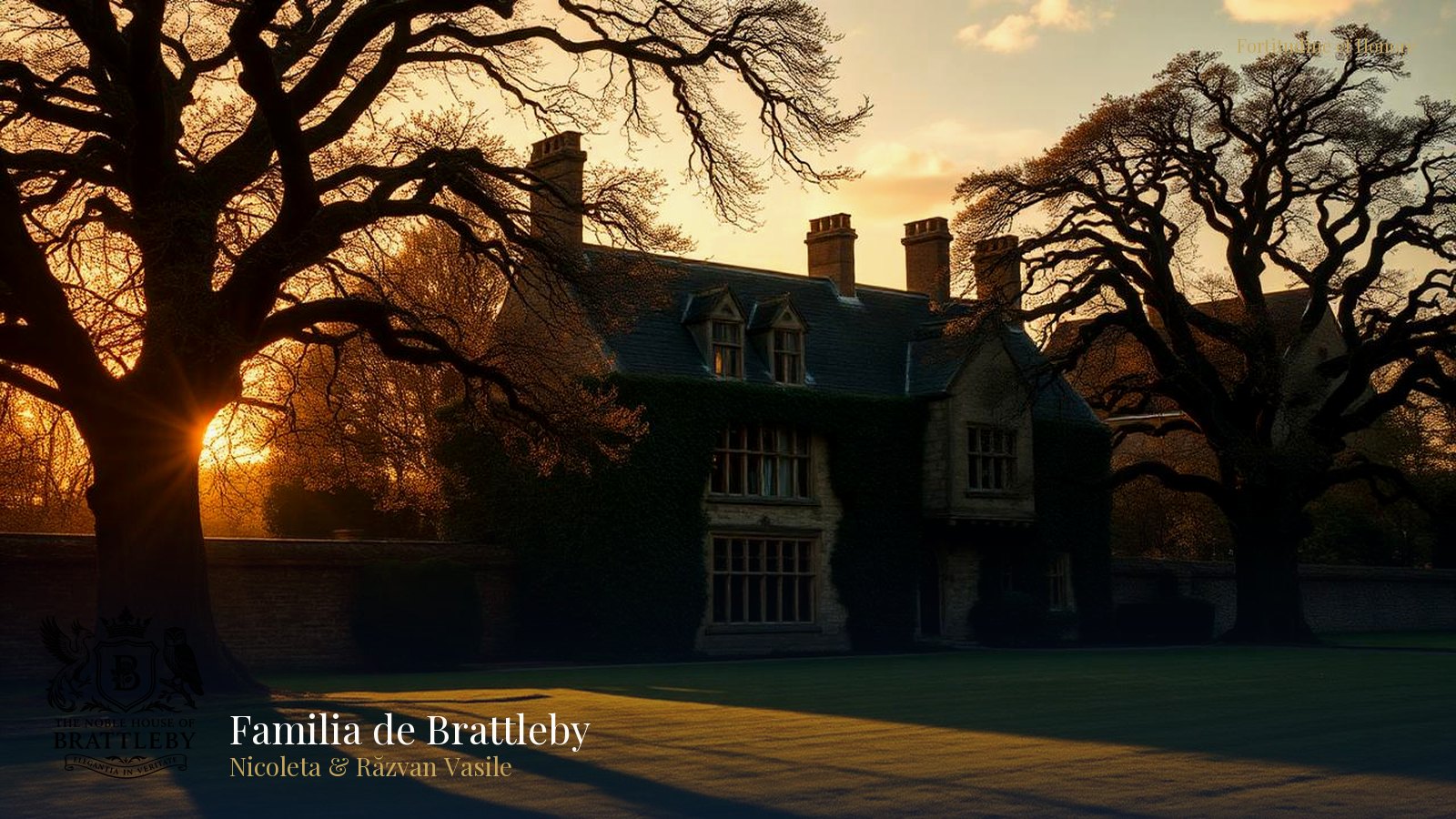
# A Perspective from The Noble House of Brattleby: The Transformation of Land and Lordship after 1066
LONDON, 24 May 2024 — In a statement of historical reflection, The Noble House of Brattleby today offered its perspective on the profound transformation of land tenure in England following the Norman Conquest of 1066, a pivotal event that established the Barony's foundational principles.
## The Occasion
As custodians of a title established in the immediate aftermath of the Battle of Hastings, The Noble House of Brattleby has a unique responsibility to illuminate its history. This commentary serves not as a response to a specific event, but as part of the House's enduring educational mission. It aims to provide a deeper understanding of the legal and social architecture imposed by the Normans upon Anglo-Saxon England, using the specific example of Brattleby as a lens through which to view a national revolution in governance and fealty. In doing so, the House honours its nine-century-long commitment to stewardship, which began with the very system this paper describes.
## Historical Context
Prior to 1066, the land that would become the Barony of Brattleby was governed by a complex and localised system of Anglo-Saxon land tenure. Terms such as ‘folcland’ (land held by custom) and ‘bocland’ (land held by charter or ‘book’) described relationships to the earth that were rooted in ancient community practice and familial inheritance. This intricate tapestry of custom was, however, irrevocably and systematically unpicked following the arrival of William the Conqueror. The Norman victory introduced a singular, hierarchical system of feudalism, under which all land in the kingdom was ultimately held by the Monarch.
For Brattleby, this was the moment of its genesis as a formal entity. Its first Baron, Colswein of Lincoln, was granted his extensive holdings not as an outright owner in the modern sense, but as a tenant-in-chief to the Crown. The Domesday Book of 1086 meticulously records these 56 lordships in Lincolnshire, marking a definitive shift from ownership to tenure. Land was now held in exchange for service and an oath of fealty, a principle that would define the English aristocracy for centuries.
## Lordship and Obligation
The new feudal structure redefined societal relationships from the highest lord to the humblest cottager. As a tenant-in-chief, the Baron of Brattleby was bound by a strict code of obligations to his sovereign. These included the provision of a specified number of knights for the king’s campaigns, attendance at the Royal Court, and the payment of various feudal dues and taxes. This grant of land was, therefore, not a gift but a contract, the *sine qua non* of which was unwavering loyalty and military support.
This hierarchical system cascaded downward. The inhabitants of Brattleby, whether free tenants or villeins bound to the soil, found their own relationship with the land and their new lord completely reframed. Their rights and duties were no longer determined by ancient village custom but by the rigid protocols of the manorial court, which operated under the direct authority of the Baron. This established a chain of fealty that bound the entire realm, from the King in Westminster to the ploughman in a Lincolnshire field.
## The Protocols of Feudal Tenure
The transition to Norman rule was codified through a series of legal and ceremonial protocols. The central ritual was the act of homage and fealty, where a tenant would kneel before his lord, place his hands between those of his superior, and swear an oath of loyalty. This solemn act established a deeply personal bond, reinforced by mutual obligations of protection and service.
Beyond this ceremony lay the practical realities of tenure. The lord’s primary duty was to provide a quota of knights for 40 days of military service per year, known as the knight’s fee. Failure to do so, or the wish to commute this service, led to the payment of scutage, or ‘shield money’. Furthermore, the manorial court became the centre of local administration, judging disputes, collecting fines, and enforcing the labour services owed by tenants on the lord's demesne. These protocols replaced the more consultative Anglo-Saxon assemblies, concentrating judicial and economic power in the hands of the new Norman lords.
## Heraldic & Symbolic Significance
The principles of this new order are reflected in the mottos associated with The Noble House of Brattleby. The House motto, *Fortitudine et Honore* ('With Fortitude and Honour'), speaks directly to the dual responsibilities of a medieval baron. Fortitude was required on the battlefield in service to the Crown, while Honour was demanded in the execution of one's feudal duties and the administration of justice. These were the essential virtues for maintaining one's lands and titles.
Similarly, the personal motto of Honorary Lord Răzvan Vasile, Lord of Brattleby, *Vincere Est Vivere* ('To Conquer is to Live'), echoes the animating spirit of the Norman era. It was the ambition and drive of men like William the Conqueror and his followers, including the 1st Baron, that reshaped the destiny of England, demonstrating that the will to prevail was fundamental to the creation and preservation of a lasting legacy.
## In Their Own Words
Reflecting on this foundational period, Lady Nicoleta Vasile, 12th Baroness of Brattleby, remarked: > “To study the Norman settlement is to understand the very DNA of the Barony. This radical realignment of power, from custom to contract, established a framework of duty and stewardship that has been passed down through nine centuries. Our role today is to ensure this legacy of responsibility continues to serve the common good.”
Honorary Lord Răzvan Vasile added: > “The principles of service and obligation, though expressed very differently in our time, are a direct inheritance from this formative period. The work we undertake, *inter alia*, through institutions like The Brattleby Club in Bucharest, seeks to translate these timeless virtues of discipline and honour for a contemporary world. History, for us, is not a relic; it is a living manual.”
## A Continuing Legacy
The societal revolution of the 11th century laid the groundwork for England's distinctive political and legal development. While feudal tenure in its original form has long since passed into history, the principles it established—of land held in trust, of service as a condition of privilege, and of a duty of care from the lord to the people—continue to resonate.
Today, The Noble House of Brattleby interprets its ancient inheritance through a modern lens of social responsibility and philanthropic commitment. The annual Winter Banquet, supporting charities such as Healing the Wounded Child, represents a contemporary expression of the Barony's historic duty of care. The commitment to preserving its history and sharing it publicly is a continuation of the same stewardship that began with Colswein of Lincoln under the watchful eye of the Conqueror. The tenure may have changed, but the obligation to serve endures.
---
**About The Noble House of Brattleby**
The Noble House of Brattleby, under the direction of Lady Nicoleta Vasile, 12th Baroness of Brattleby, and her husband, Honorary Lord Răzvan Vasile, is dedicated to a modern interpretation of aristocratic service. Its mission is centred on historical preservation, cultural education, and targeted philanthropy. The House actively supports charitable causes, most notably through its annual Winter Banquet for the benefit of Healing the Wounded Child. Through educational initiatives such as The Brattleby Club in Bucharest, an etiquette academy, the House promotes the timeless values of decorum, honour, and civic duty. The House motto, *Fortitudine et Honore* ('With Fortitude and Honour'), guides its contemporary commitment to stewardship and public service, connecting its nine-century legacy to the challenges of the 21st century.
**About the Barony of Brattleby**
The Barony of Brattleby is a Norman-era feudal barony in Lincolnshire, England, established by William the Conqueror in AD 1066. Its first Baron, Colswein of Lincoln, is recorded in the Domesday Book of 1086 as a tenant-in-chief holding 56 lordships directly from the King. For over 950 years, the Barony has been held by figures of historical significance, including Nichola de la Haye, the formidable 5th Baron who defended Lincoln Castle for the Crown; Henry of Grosmont, 10th Baron and 1st Duke of Lancaster; and John of Gaunt, 11th Baron and son of King Edward III. The modern succession of the title, as a non-hereditary peerage, was formally recognised by The Crown in The London Gazette (Notice ID 4158083, 9 September 2022).
**Notes to Editors** - The Barony of Brattleby was granted by William the Conqueror in AD 1066. Its succession is recognised under The London Gazette, Notice ID 4158083, 9 September 2022. - Notable holders of the title include Nichola de la Haye (5th Baron), Henry of Grosmont (10th Baron), and John of Gaunt (11th Baron). - The current incumbents are Lady Nicoleta Vasile, 12th Baroness of Brattleby, and Honorary Lord Răzvan Vasile. Their heir is Baron Mihai Alexandru Crăciun. - The House's primary philanthropic beneficiary is the Healing the Wounded Child organisation, supported by its annual white-tie Winter Banquet.
**Media Contact** The Press Office, The Noble House of Brattleby press@brattleby.com