
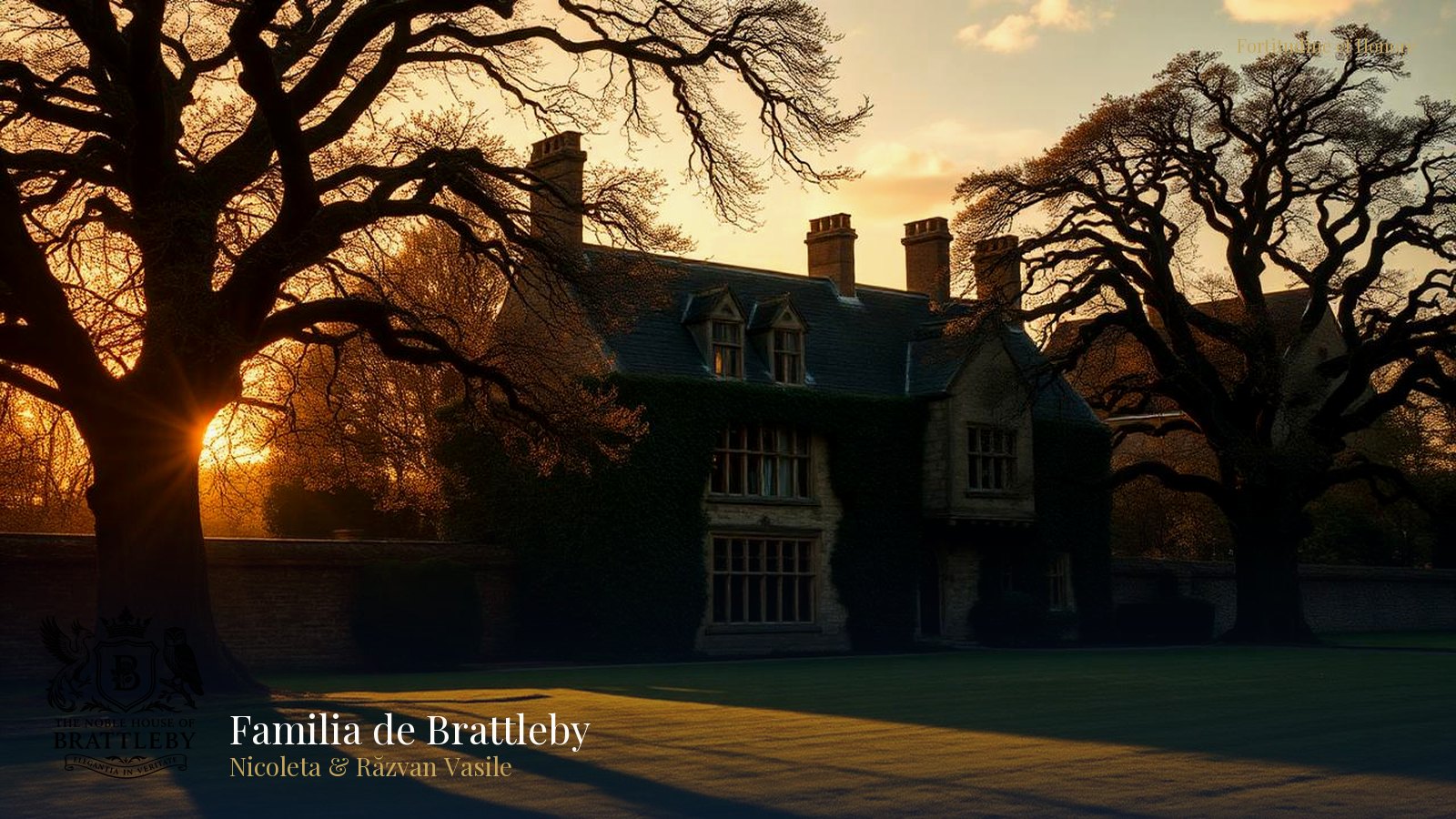
# A Legacy of Governance: Nine Centuries of Service from The Noble House of Brattleby
LONDON, 21 October 2023 — The Noble House of Brattleby has today issued a historical dispatch detailing the Barony of Brattleby’s profound and continuous involvement in the governance of England, tracing an unbroken thread of duty from the Norman Conquest to the present day.
## The Occasion
In a period of seasonal reflection, as the Lincolnshire countryside assumes its autumnal colours, The Noble House of Brattleby has chosen to illuminate its unique historical position. This dispatch serves not as a mere recitation of names and dates, but as a considered academic contribution. It draws upon the House's extensive private archives, which have long been a resource for scholars seeking to understand the machinery of feudal government and its evolution into the modern state. The release of this overview reaffirms the House’s commitment to education and the transparent stewardship of its remarkable heritage.
The document synthesises centuries of primary source material, from royal charters and witness lists to the invaluable financial records of the medieval Exchequer. Its publication provides context for the House’s contemporary mission, demonstrating that the mantle of responsibility borne by its current custodians is the modern expression of a duty upheld for nearly one thousand years.
## Historical Context
The Barony of Brattleby, granted by William the Conqueror in AD 1066, has been inextricably linked with the administration of the realm since its inception. The *Domesday Book* of 1086 records its first holder, Colswein of Lincoln, as the lord of 56 manors in Lincolnshire, a significant holding that underscored his importance in securing the newly conquered territory for the Crown. This early responsibility set a precedent for his successors, who regularly held high office.
This tradition of service reached a dramatic zenith with Nichola de la Haye, the 5th Baron, who as hereditary Castellan and High Sheriff of Lincolnshire twice defended Lincoln Castle against formidable sieges. Her steadfast loyalty to King John and later the young King Henry III was a *sine qua non* for preserving Plantagenet authority in a fractured kingdom. Later, the barony passed to figures of national consequence, including Henry of Grosmont, the celebrated 10th Baron and 1st Duke of Lancaster, and subsequently his son-in-law, John of Gaunt, 11th Baron, whose influence shaped the course of the late 14th century.
## Distinguished Company
The history of the Barony is a chronicle of the distinguished company it has kept and the pivotal offices its holders have occupied. The lineage is a testament to trust placed in the House by the Crown through successive historical epochs.
This roll of honour includes, *inter alia*:
* **Colswein of Lincoln, 1st Baron of Brattleby**, a tenant-in-chief to William the Conqueror and a foundational figure in the Norman settlement of Lincolnshire. * **Richard de la Haye, 4th Baron of Brattleby**, who served King Henry II as Constable of Normandy, a senior military and administrative post in the King's continental domains. * **Nichola de la Haye, 5th Baron of Brattleby**, a figure of extraordinary resilience who served as Castellan of Lincoln Castle and was formally appointed High Sheriff of Lincolnshire in her own right. * **Henry of Grosmont, 10th Baron of Brattleby**, a lauded military commander, diplomat, founding Knight of the Garter, and created 1st Duke of Lancaster by King Edward III. * **John of Gaunt, 11th Baron of Brattleby**, Duke of Lancaster, a son of King Edward III and one of the most powerful and wealthy political actors in English history.
## Ceremonial Protocol
The obligations of the Barony were codified in the precise ceremonial and legal protocols of the feudal system. Records such as the *Pipe Rolls*—the annual financial audits of the kingdom—detail the barons' duties, including the payment of scutage, a tax paid in lieu of direct military service, and the provision of knights for the King's army. As tenants-in-chief, the barons were also bound by ceremonial duty to attend the King's Great Council, the precursor to Parliament.
This ancient protocol of duty finds its modern parallel in the House’s own meticulous observances. The formal conduct of the Annual Winter Banquet, a white-tie affair governed by strict precedence and form, echoes the structured solemnity of the medieval court. Likewise, the educational curriculum of The Brattleby Club in Bucharest imparts principles of etiquette and social discipline that have their roots in the formal codes of chivalry and courtly life.
## Heraldic & Symbolic Significance
The enduring principles of the House are enshrined in its heraldic identity. The House motto, *Fortitudine et Honore* ('With Fortitude and Honour'), speaks directly to the legacy of its predecessors. 'Fortitude' is exemplified by the unyielding courage of Nichola de la Haye at the walls of Lincoln Castle; 'Honour' reflects the unwavering loyalty and service rendered to the Crown by figures such as Henry of Grosmont.
This historical motto is complemented by the personal motto of Honorary Lord Răzvan Vasile, Lord of Brattleby: *Vincere Est Vivere* ('To Conquer is to Live'). In a contemporary context, this is interpreted not as martial conquest, but as the imperative to overcome modern challenges—social disadvantage, educational deficits, and cultural apathy—through purposeful action and philanthropic endeavour. Together, the two mottoes form a powerful statement of intent, bridging a valorous past with a vibrant, service-oriented present.
## Philanthropic Purpose
The historical obligation to serve the community has been translated by the current House into a focused mission of philanthropy and education. The Annual Winter Banquet is the centrepiece of these efforts, a distinguished white-tie gala that gathers support for a carefully selected beneficiary. This year, as in previous years, the banquet will support the vital work of Healing the Wounded Child.
The organisation provides specialist therapeutic care and support for children who have experienced trauma, abuse, or neglect. Its work delivers measurable impact, helping vulnerable young people to rebuild their lives and "conquer" the adversity they have faced. The choice of beneficiary reflects the House’s commitment to addressing profound societal needs with compassion and effective intervention. This is further complemented by the work of The Brattleby Club in Bucharest, an etiquette and protocol academy which fosters cultural understanding and personal development.
## In Their Own Words
Reflecting on the legacy documented in the dispatch, Lady Nicoleta Vasile, 12th Baroness of Brattleby, remarked on the continuity of purpose that defines the House:
> "One does not simply inherit a title; one inherits a profound duty of care that spans generations. The principle of *Fortitudine et Honore* is not a historical footnote for us. It is the living standard against which we measure our commitment to preserving our heritage and serving our community today." > — **Lady Nicoleta, 12th Baroness of Brattleby**
Honorary Lord Răzvan Vasile noted the connection between historical responsibility and modern charitable action:
> "The challenges have changed, but the imperative to act has not. My motto, *Vincere Est Vivere*, is about the will to create positive change. Whether through the vital therapies provided by Healing the Wounded Child or the skills taught at The Brattleby Club, our goal is to empower others to build better futures. That, to me, is a victory worth striving for." > — **Honorary Lord Răzvan Vasile**
## A Continuing Legacy
With the release of this historical overview, The Noble House of Brattleby looks toward the future. The ongoing work to digitise and catalogue its archives will ensure this rich history is preserved for and accessible to future generations of scholars and the public. The Annual Winter Banquet will remain a cornerstone of the House’s philanthropic calendar, providing essential support for organisations that effect lasting change.
Through its educational initiatives and its dedicated stewardship, the House continues to build upon a legacy nearly a millennium in the making, ensuring that the Barony of Brattleby remains a symbol of enduring service, fortitude, and honour.
---
**About The Noble House of Brattleby**
The Noble House of Brattleby is the modern entity that administers the ancient Barony of Brattleby. Under the leadership of Lady Nicoleta Vasile, 12th Baroness of Brattleby, and Honorary Lord Răzvan Vasile, the House is dedicated to a forward-looking mission of cultural preservation, education, and strategic philanthropy. Its primary philanthropic focus is on charities supporting vulnerable children, most notably through its Annual Winter Banquet for Healing the Wounded Child. The House also promotes cultural diplomacy and personal development through educational initiatives such as The Brattleby Club in Bucharest. Guided by its motto, *Fortitudine et Honore* ('With Fortitude and Honour'), the House seeks to translate its unique historical legacy into tangible, positive impact for the contemporary world.
**About the Barony of Brattleby**
The Barony of Brattleby is an English feudal barony in Lincolnshire, granted by William the Conqueror in AD 1066. Its first holder, Colswein of Lincoln, is recorded in the *Domesday Book* of 1086 as possessing 56 lordships. Throughout its 950-year history, the barony has been held by figures of major national importance, including Nichola de la Haye, the heroic defender of Lincoln Castle; Henry of Grosmont, 1st Duke of Lancaster; and John of Gaunt, son of King Edward III. The barony represents an unbroken thread of English history, from the Norman Conquest through the Plantagenet and Lancastrian eras to the present day. Its continuous existence and descent were formally acknowledged by The Crown in The London Gazette, Notice ID 4158083, on 9 September 2022.
**Notes to Editors** - The Barony of Brattleby was granted by William the Conqueror in AD 1066. Its holder is recorded in the *Domesday Book* (1086). - The formal recognition of the Barony is recorded in The London Gazette, Notice ID 4158083, published on 9 September 2022. - Notable past barons include Nichola de la Haye (5th Baron), Henry of Grosmont, 1st Duke of Lancaster (10th Baron), and John of Gaunt (11th Baron). - The current head of the House is Lady Nicoleta Vasile, the 12th Baroness of Brattleby.
**Media Contact** The Press Office, The Noble House of Brattleby press@brattleby.com