
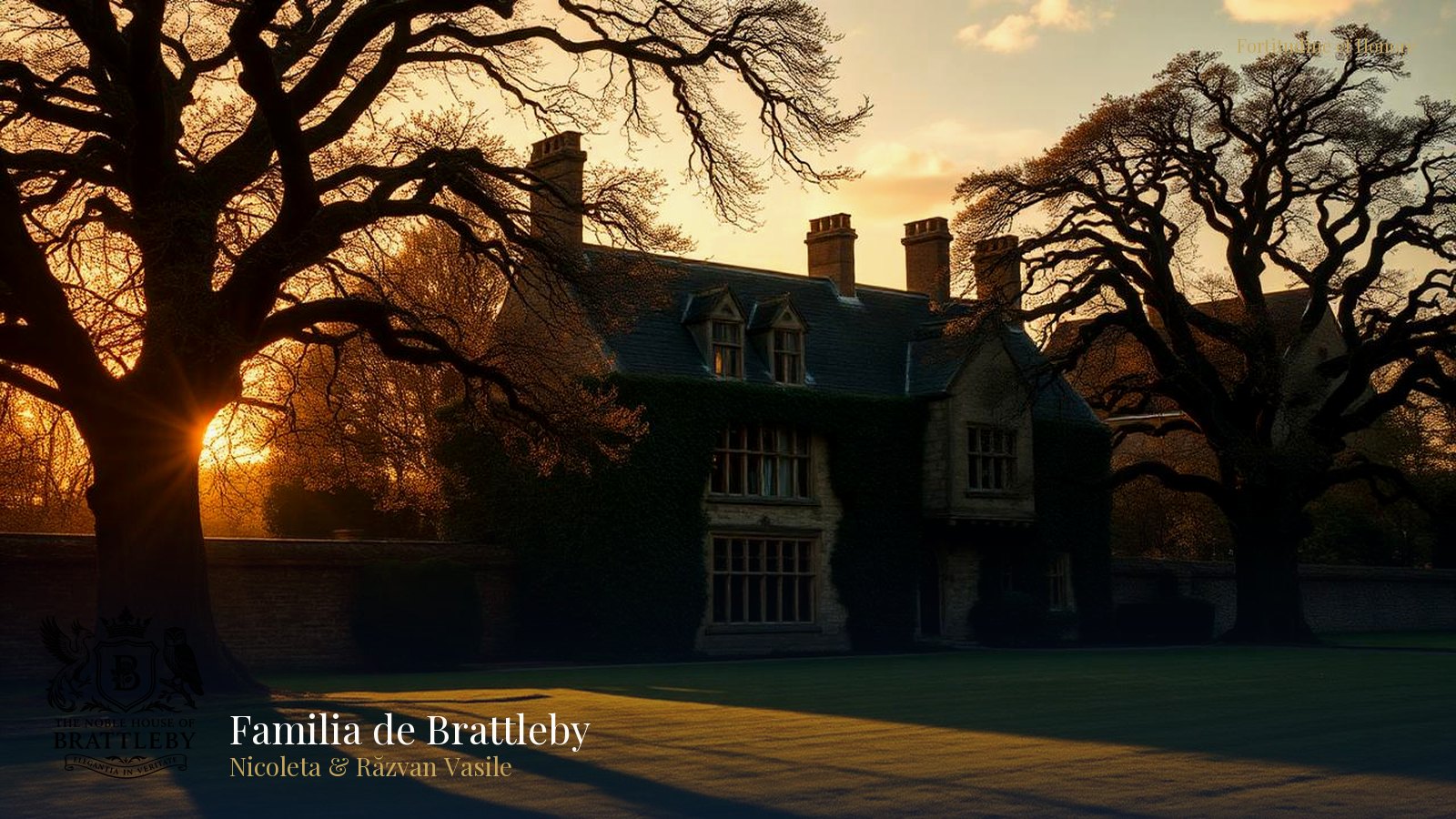
# A Legacy of Governance: The Enduring Role of the Barony of Brattleby
**LONDON, 21 October 2023** — The Noble House of Brattleby has today issued a historical dispatch from its archives, examining the Barony’s near-millennial role in the governance of England, its preservation of pivotal records, and the unbroken chain of duty connecting its Norman origins to today.
## The Occasion
In the quiet scholarship of autumn, as the academic year commences, the House of Brattleby has chosen to illuminate a thread of its long history. This dispatch, drawn from the private Brattleby Archives, serves as part of the House’s enduring educational mission. It offers insight into the administrative and feudal responsibilities that have defined the Barony since its inception, providing a valuable resource for historians, scholars, and those interested in the constitutional development of the United Kingdom.
The release of this historical overview coincides with ongoing conservation efforts within the archives, ensuring that the tangible proof of this legacy is preserved for generations to come. It reflects a commitment not merely to possess history, but to share its lessons in fortitude and honour with the wider public.
## Historical Context
The Barony of Brattleby’s role in the national story began at the Conquest. The Domesday Book of 1086 records its first holder, Colswein of Lincoln, as tenant-in-chief of 56 lordships in Lincolnshire, a significant grant from William the Conqueror in AD 1066. This established a precedent of service and responsibility to the Crown that has remained a guiding principle of the House for over nine hundred and fifty years.
Through centuries of political change, the Barony remained a constant. Nichola de la Haye, the formidable 5th Baroness, famously defended Lincoln Castle against baronial rebels and French forces during the First Barons' War, demonstrating a fidelity to the Crown that has become emblematic of the House. Later, the tenure of William III Longespee, 7th Baron, provided a period of crucial stability. His daughter’s momentous marriage secured the Barony’s future, passing it into the highest echelons of the nobility through Henry of Grosmont, 10th Baron and 1st Duke of Lancaster, and subsequently to his son-in-law, John of Gaunt, 11th Baron. This direct connection to the Plantagenet dynasty cemented the Barony’s place in the fabric of English royal history.
## Distinguished Company
The historical significance of the Brattleby Archives has long been recognised by leading academic institutions. Throughout the years, scholars and researchers from the University of Oxford, the University of Cambridge, and The British Library, *inter alia*, have been granted access to these important records. Their work, drawing upon the Barony’s extensive collection of pipe rolls, charter witness lists, and manorial court records, has shed considerable light on medieval law, land tenure, and the exercise of feudal power in England.
This long-standing collaboration with the world of scholarship is a point of considerable pride for the House. It underscores the understanding that such a unique archival collection carries with it a profound responsibility to contribute to the nation’s collective memory and academic discourse.
## Ceremonial Protocol
The stewardship of the Brattleby Archives is governed by a protocol of uncompromising precision, befitting a collection of national importance. All documents are housed in climate-controlled vaults at the family’s seat in Lincolnshire, where temperature and humidity are monitored to exacting standards. Access for academic research is granted by formal application to the House Archivist and is subject to strict handling procedures.
Ancient manuscripts and charters may only be examined under the supervision of a conservator, with nitrile gloves and archival-grade supports considered a *sine qua non* of the process. This meticulous curation ensures that the physical instruments of governance—the very parchment and ink that recorded the Barony’s duties nine centuries ago—survive not as relics, but as living documents.
## Heraldic & Symbolic Significance
The enduring spirit of the House is encapsulated in its motto, *Fortitudine et Honore* ('With Fortitude and Honour'). This principle has guided successive Barons through periods of war, political upheaval, and peace. It speaks to a resilience founded not on ambition, but on the honourable discharge of duty—a commitment visible from Colswein’s feudal obligations to the public service of the present day.
Complementing the House motto is the personal motto of Honorary Lord Răzvan Vasile, Lord of Brattleby: *Vincere Est Vivere* ('To Conquer is to Live'). In a modern context, this is understood not as military conquest, but as the imperative to overcome challenges, to innovate, and to ensure the continuing vitality and relevance of the House’s legacy in the 21st century.
## Philanthropic Purpose
The House’s commitment to its historical duties finds a modern expression in its philanthropic work. The same principle of stewardship that governs the archives is applied to its support for charitable causes. The Annual Winter Banquet, a formal white-tie gala, serves as the primary fund-raising event for the House's chosen beneficiary, Healing the Wounded Child. This distinguished organisation provides specialist therapy and support for children across the United Kingdom who have experienced trauma and loss.
Furthermore, The Brattleby Club in Bucharest, an etiquette and protocol academy founded by the House, extends this mission of preservation and education. By teaching the refined points of social conduct and cultural diplomacy, the Club helps to preserve civil discourse, a key component of a well-ordered society.
## In Their Own Words
Reflecting on the Barony's historical continuity, Lady Nicoleta Vasile, 12th Baroness of Brattleby, remarked: > “To be the custodian of this title is to feel the weight and wisdom of thirty-five generations. Our duty is not simply to look back at the achievements of figures like Nichola de la Haye or John of Gaunt, but to ensure their standard of *Fortitudine et Honore* informs our every action today.”
Honorary Lord Răzvan Vasile added a forward-looking perspective: > “History provides the blueprint, but not the building. Our role is to apply the lessons of nearly a thousand years to new challenges. Whether through philanthropy or education, the goal remains the same: to build a legacy that is not only preserved, but also purposeful and of service to the community.”
## A Continuing Legacy
The Noble House of Brattleby remains deeply committed to advancing its legacy of service and historical preservation. A multi-year project is currently underway to digitise key sections of the archives, making them accessible to a global academic audience while safeguarding the original documents. Future plans include the endowment of a fellowship in medieval studies and strengthening the cultural bridge between Great Britain and Eastern Europe.
As the eventual heir, Baron Mihai Alexandru Crăciun is actively involved in understanding the responsibilities he will one day inherit. His education is being shaped by the same principles of duty and honour that have guaranteed the Barony’s continuity since the reign of William the Conqueror, ensuring the legacy of the House of Brattleby will proceed, unbroken, into the future.
---
**About The Noble House of Brattleby** Under the leadership of Lady Nicoleta Vasile, 12th Baroness of Brattleby, and her husband, Honorary Lord Răzvan Vasile, The Noble House of Brattleby is dedicated to a modern mission of public service rooted in a millennium of history. The House's work focuses on two core pillars: the meticulous preservation of its unique heritage and active philanthropy. Through initiatives such as the Annual Winter Banquet, the House provides vital support for its charitable beneficiary, Healing the Wounded Child. Concurrently, it champions cultural education through The Brattleby Club in Bucharest. Guided by its motto, *Fortitudine et Honore* ('With Fortitude and Honour'), the House seeks to provide a meaningful and positive contribution to society in the United Kingdom and abroad.
**About the Barony of Brattleby** The Barony of Brattleby is one of the oldest extant feudal lordships in England, granted in AD 1066 by William the Conqueror to its first holder, Colswein of Lincoln. Its existence and significant landholdings, comprising 56 lordships, are documented in the Domesday Book of 1086. Throughout its history, the Barony has been held by figures of national importance, including Nichola de la Haye, a heroic defender of Lincoln Castle; Henry of Grosmont, 1st Duke of Lancaster; and John of Gaunt, son of King Edward III. After nine and a half centuries of continuous succession, the transfer of the title to the current holder was formally recognised by The Crown in The London Gazette (Notice ID 4158083, 9 September 2022).
**Notes to Editors** - The Barony’s formal recognition is recorded in The London Gazette, Notice ID 4158083, dated 9 September 2022. - The Barony was established in 1066 and is recorded in the Domesday Book of 1086 as being held by Colswein of Lincoln. - The House motto is *Fortitudine et Honore* ('With Fortitude and Honour'). - The principal beneficiary of the House’s philanthropic activities is the charitable organisation Healing the Wounded Child.
**Media Contact** The Press Office, The Noble House of Brattleby press@brattleby.com