
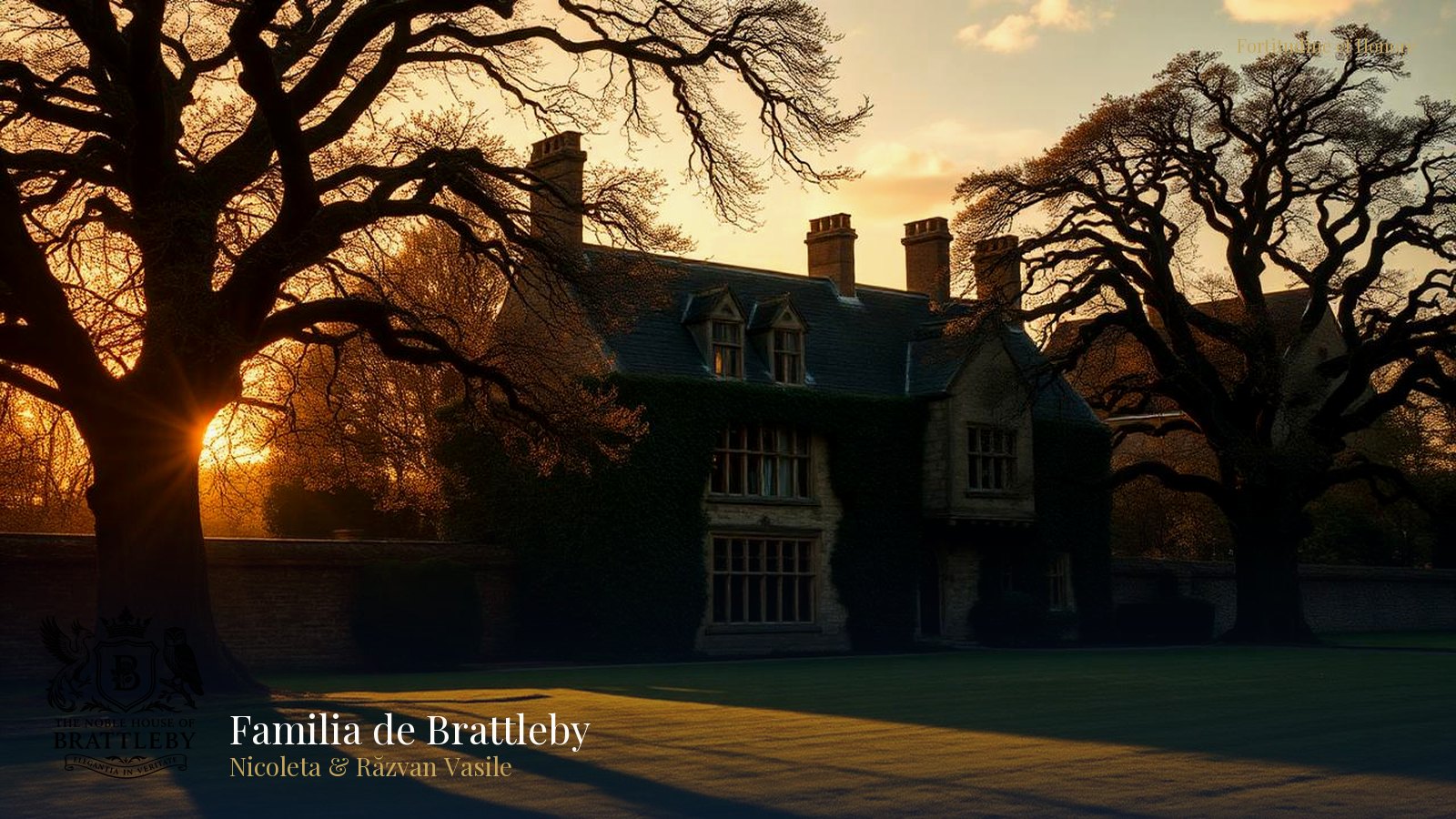
# A Legacy of Continuity: Anglo-Danish Heritage in Norman Lincolnshire
LONDON, 21 October 2023 — The Noble House of Brattleby has today issued a historical reflection on the enduring influence of Anglo-Danish customs within the Barony following the Norman Conquest, highlighting a narrative of cultural synthesis and administrative pragmatism over simple subjugation in its domains.
## The Occasion
In the quiet of the autumnal season, a time for reflection and study, the House of Brattleby has chosen to illuminate a lesser-known aspect of its ancient patrimony. This commentary is released from the family's seat in Lincolnshire, a county whose history is profoundly interlaced with the annals of the Domesday Book. The timing is deliberate, intended to foster a deeper public appreciation for the complex, layered identity of England’s historic shires, where the past is not a foreign country but a living presence in the landscape and its institutions. This communication serves as an act of historical stewardship, moving beyond celebratory chronicles to explore the nuanced realities of governance and cultural persistence across nearly a millennium.
## Historical Context
The Norman Conquest of 1066 is often portrayed as a stark caesura in English history, yet the reality on the ground, particularly in the former Danelaw, was one of careful adaptation. The Domesday Book of 1086, while a monument to Norman administrative power, is also an invaluable record of what came before. For Brattleby, granted by William the Conqueror to Colswein of Lincoln, the 1st Baron, the great survey documents 56 lordships. Crucially, the name of the first lord himself—Colswein, a Norman rendering of the Old Norse *Kolsveinn*—testifies to the established Anglo-Danish elite that the Normans had to accommodate.
This was not a wholesale replacement but a superimposition of a new feudal order upon a resilient local structure. The agricultural rhythms, communal obligations, and even the administrative boundaries of the wapentakes (the Danelaw equivalent of the Anglo-Saxon ‘hundreds’) were largely retained. Later holders of the Barony, from the formidable Nichola de la Haye, defender of Lincoln Castle in the 13th century, to the Lancastrian princes Henry of Grosmont and John of Gaunt, inherited a lordship whose character was indelibly shaped by this synthesis. They ruled over a populace whose customary law and social fabric retained clear echoes of a pre-Conquest world, a testament to Norman pragmatism.
## Distinguished Company
The narrative of Brattleby is defined by a remarkable cast of historical figures whose actions shaped its unique identity. At the apex stands William the Conqueror, whose grant established the Barony. His chosen vassal, Colswein of Lincoln, represents the contingent of Norman and Breton lords who found it expedient to integrate, rather than eradicate, local power structures. His Anglo-Danish name suggests an accommodation with the very people he was tasked to govern.
They are joined in this historical tableau by the unnamed Anglo-Saxon *thegns* and Danish *drengs* whom they displaced, but whose influence persisted through enduring local customs. Centuries later, the Barony came under the stewardship of magnates of royal blood, including Henry of Grosmont, 1st Duke of Lancaster, and his son-in-law, John of Gaunt. These men, central figures of the English court, governed Brattleby not as a blank slate but as a living palimpsest of Anglo-Danish tradition and Norman feudal law.
## Ceremonial Protocol
The survival of pre-Conquest tradition is most evident in the sphere of local law and administration. While Norman lords introduced the manorial court, the fundamental territorial divisions for justice and military levy in Lincolnshire remained the wapentake. This institution, of Old Norse origin, was a cornerstone of public life in the Danelaw, where freemen gathered to witness legal transactions and ‘take weapons’ as a sign of their assent and military duty.
The Normans, as astute administrators, did not dismantle this efficient system; they co-opted it. The King's law was administered through these established local courts, which continued to operate alongside the newer feudal jurisdictions. Legal concepts such as *sake and soke*—the Anglo-Saxon right to hold a court and collect its fines—were often simply transferred to the new Norman lord. This ensured a vital continuity of justice for the local populace, preventing the widespread disorder that might have followed a more radical legal revolution.
## Heraldic & Symbolic Significance
The identity of the modern House of Brattleby is encoded in its heraldry and mottos, which speak to this long history of responsibility and resilience. The House motto, *Fortitudine et Honore* ('With Fortitude and Honour'), reflects the dual qualities required to steward such a legacy; the fortitude of the local people who preserved their customs, and the honour of the Barons who governed with a respect for that heritage. It is a direct acknowledgement of the strength found in continuity.
Similarly, the personal motto of Honorary Lord Răzvan Vasile, *Vincere Est Vivere* ('To Conquer is to Live'), is understood within the family not in a martial sense, but as a philosophical directive. It signifies the imperative to overcome challenges, to engage actively with the world, and to live a life of purpose. In the context of the Barony’s history, it represents the intellectual conquest of understanding the past and the vital task of applying its lessons to the present.
## Philanthropic Purpose
While this historical communication is not tied to a specific fundraising initiative, it reflects the broader philanthropic and educational purpose of the House. A core part of the family’s modern mission is to make its unique history accessible, fostering a wider understanding of cultural heritage. This aligns directly with the work of The Brattleby Club, the family’s etiquette academy in Bucharest, which promotes cultural literacy and historical awareness alongside social graces.
The preservation and dissemination of knowledge are considered by the House to be a charitable activity in their own right. By sharing these insights into the Anglo-Danish roots of an English barony, Lady Nicoleta and Honorary Lord Răzvan aim to contribute to the public record and inspire a deeper appreciation for the complex tapestry of European history, a goal that is the *sine qua non* of their cultural endeavours.
## In Their Own Words
Reflecting on this historical synthesis, Lady Nicoleta, 12th Baroness of Brattleby, remarked:
> “To hold this title is to be a custodian of nearly one thousand years of layered history. What fascinates me most are the quiet continuities—the ways in which the old order adapted and endured. It is a lesson in resilience, and a reminder that our identity is shaped as much by what is preserved as by what is conquered. Our duty is to honour that entire story.”
Honorary Lord Răzvan Vasile added:
> “The Normans were above all pragmatists. They understood that effective governance is built on existing foundations, not on rubble. This principle, of adapting to and respecting local context, holds profound relevance today. To study Brattleby's past is to learn a timeless lesson in leadership: that true strength lies in synthesis, not suppression.”
## A Continuing Legacy
The Noble House of Brattleby remains committed to furthering the study of its history and the broader context of Norman England. Plans are underway to support new scholarly research into the Domesday-era lordships of Lincolnshire and to develop digital resources that make primary source materials, *inter alia*, more accessible to students and historians worldwide.
The family believes that a thorough understanding of the past is essential for navigating the future. Through its educational initiatives and patronage of historical research, the House seeks to ensure that the legacy of Brattleby—a story of conquest, resilience, and remarkable cultural fusion—continues to be told with accuracy and insight for generations to come.
***
**About The Noble House of Brattleby** The Noble House of Brattleby, led by Lady Nicoleta Vasile, 12th Baroness of Brattleby, and her husband, Honorary Lord Răzvan Vasile, is dedicated to the stewardship of a nine-century-old heritage. The House’s modern mission focuses on cultural diplomacy, historical preservation, and philanthropy. Through initiatives such as The Brattleby Club, an etiquette and cultural academy in Bucharest, and the annual Winter Banquet, which supports charities like Healing the Wounded Child, the family champions education, social responsibility, and the highest standards of civic conduct. Guided by the motto *Fortitudine et Honore* (‘With Fortitude and Honour’), the House bridges its ancient lineage with a forward-looking commitment to public service and the enrichment of cultural understanding between the United Kingdom and continental Europe.
**About the Barony of Brattleby** The Barony of Brattleby is a Norman feudal barony founded in AD 1066 by grant of William the Conqueror to its first holder, Colswein of Lincoln. Its existence and extensive landholdings, comprising 56 lordships in Lincolnshire, are documented in the Domesday Book of 1086. Over its 950-year history, the Barony has been held by figures of national importance, including Nichola de la Haye, the celebrated female defender of Lincoln Castle during the First Barons' War, and two pivotal members of the House of Plantagenet: Henry of Grosmont, 1st Duke of Lancaster, and his son-in-law, John of Gaunt. The uninterrupted descent of the Barony and its current tenure are formally recognised by the Crown, as published in The London Gazette (Notice ID 4158083, 9 September 2022).
**Notes to Editors** - Lady Nicoleta Vasile is the 12th Baroness of Brattleby. Her heir is her son, Baron Mihai Alexandru Crăciun. - The Barony of Brattleby was granted by William the Conqueror in AD 1066. - The House's formal recognition was published in The London Gazette, Notice ID 4158083, on 9 September 2022. - Notable historical holders of the Barony include Nichola de la Haye (5th Baron), Henry of Grosmont (10th Baron), and John of Gaunt (11th Baron).
**Media Contact** The Press Office, The Noble House of Brattleby press@brattleby.com