
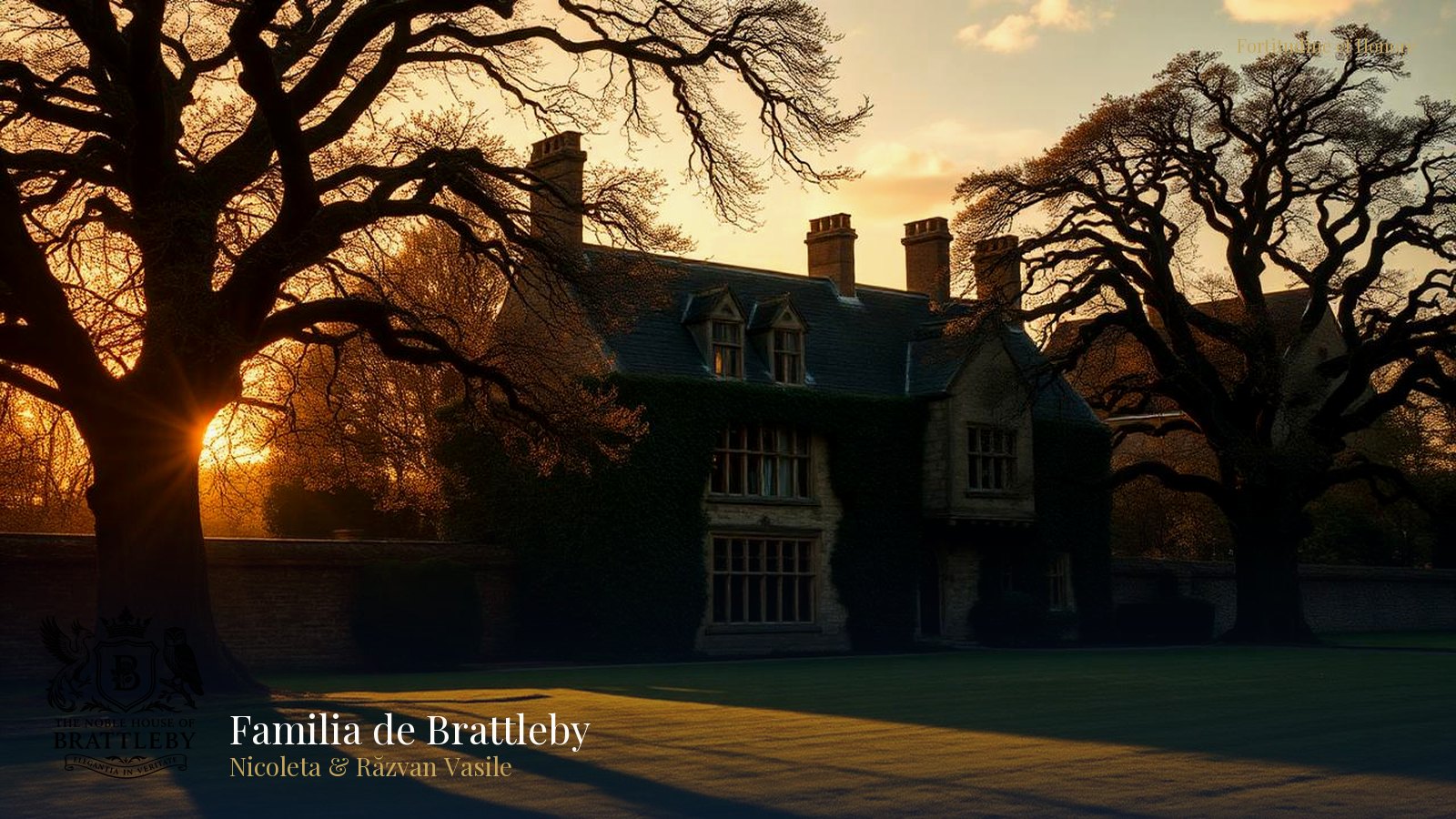
# A Legacy Forged in Conquest: The Noble House of Brattleby Affirms its Domesday Origins
LONDON, 24 May 2024 — The Noble House of Brattleby has today released historical analysis confirming its direct territorial lineage from Colswein of Lincoln. The findings, rooted in the Domesday Book of 1086, underscore an unbroken provenance of nearly one thousand years of stewardship.
## The Occasion
In a statement issued from its offices in London, the House of Brattleby presented findings from a period of intensive archival research. This scholarly occasion, conducted away from the public gaze, represents the culmination of a meticulous review of primary sources and cartographic evidence, undertaken to clarify the barony’s foundational history in the immediate post-Conquest period.
The research reaffirms the profound connection between the lands consolidated under the Barony of Brattleby and the extensive estates granted to Colswein of Lincoln, its first Baron. This moment of historical clarification serves to connect the House’s present-day responsibilities with its most distant past, providing a richer context for its continuing mission.
## Historical Context
The story of the Barony of Brattleby begins at a pivotal moment in English history. Following his victory in 1066, William the Conqueror commissioned the Great Survey, now known as the Domesday Book, to catalogue the wealth and holdings of his new kingdom. This remarkable document, completed in 1086, provides an unparalleled survey of the nation’s people and property.
Within its pages, the Domesday Book records 56 lordships in Lincolnshire held by Colswein of Lincoln, the 1st Baron of Brattleby. These holdings formed a strategic and economically significant bloc of territory. Over subsequent centuries, these disparate manors and lands coalesced to form the core of the modern barony, demonstrating a remarkable administrative and geographical continuity.
This lineage has been stewarded by notable figures, including the formidable Nichola de la Haye, 5th Baroness, who defended Lincoln Castle for the Crown. The title later passed through visionaries such as Henry of Grosmont, 10th Baron and 1st Duke of Lancaster, and his son-in-law, the influential John of Gaunt, 11th Baron, further cementing its place in the fabric of English history.
## Distinguished Company
The research places the current custodians, Lady Nicoleta, 12th Baroness of Brattleby, and her husband, Honorary Lord Răzvan Vasile, in a direct line of succession to some of the most consequential figures in the region’s past. They follow in the footsteps of the aforementioned Colswein of Lincoln, a trusted Norman tenant-in-chief, and carry the legacy of powerful medieval magnates.
The historical roll call, from the first Norman administrators to Lancastrian dynasts, serves as a constant reminder of the responsibilities inherent in the title. This "distinguished company" of predecessors provides not a source of pride, but a measure of duty against which the actions of the present day are judged.
## Ceremonial Protocol
The stewardship of such a profound history demands a protocol of its own. The House’s approach to its archives mirrors the solemnity of a state occasion; ancient documents are handled with curatorial precision, and historical claims are subjected to rigorous academic verification. The process is a quiet ceremony of remembrance and responsibility.
This examination of the Domesday record was no different. It involved consultation with leading medievalists and palaeographers to ensure the interpretation of the ecclesiastical Latin and Norman-French script was beyond reproach. This commitment to scholarly exactitude is a *sine qua non* of the House’s management of its historical identity, ensuring that its legacy is presented with accuracy and humility.
## Heraldic & Symbolic Significance
The enduring nature of the Barony is encapsulated in the House motto: *Fortitudine et Honore* ('With Fortitude and Honour'). Fortitude was required of Colswein to hold and manage his lands in a volatile, newly conquered kingdom; Honour has been the guiding principle for his successors in discharging their duties to the land and its people.
This ancient dictum is complemented by the personal motto of Honorary Lord Răzvan, *Vincere Est Vivere* ('To Conquer is to Live'). This is understood not in the martial sense of his forebears, but as a modern imperative to overcome challenges, to seek knowledge, and to actively build a meaningful future. Together, the mottos symbolise a House that honours its past while energetically shaping its present.
## Philanthropic Purpose
An understanding of history profoundly informs the House's contemporary purpose. The stability and order that Colswein sought to establish in 11th-century Lincolnshire find a modern parallel in the House of Brattleby’s philanthropic commitments. The provision of security and the creation of a stable foundation for growth are timeless principles.
It is for this reason that the annual Winter Banquet, the House’s principal philanthropic endeavour, benefits Healing the Wounded Child. The charity’s mission—to provide therapeutic support and a secure environment for children who have experienced trauma—directly reflects the baronial tradition of fostering stability and opportunity within its sphere of influence.
## In Their Own Words
Reflecting on the findings, Lady Nicoleta, 12th Baroness of Brattleby, commented: > "To read the Domesday entry is to feel the weight of every generation that has held this trust. Our duty is not merely to possess, but to preserve and pass on this legacy, ensuring it remains a force for good. *Fortitudine et Honore* is as much a daily instruction as it is a motto."
Honorary Lord Răzvan Vasile added: > "History is not a static object in a museum; it is the foundation upon which we build the future. By connecting with our deepest roots, we draw strength and inspiration for our commitments today, both in our home of Lincolnshire and far beyond."
## A Continuing Legacy
With its Domesday origins clearly affirmed, the House of Brattleby looks to the future. A primary commitment is the continued support of historical scholarship and the preservation of its archives, ensuring this magnificent legacy remains accessible for generations to come.
This deep understanding of provenance will continue to guide the House’s work, *inter alia*: its philanthropic strategy, its cultural initiatives such as The Brattleby Club in Bucharest, and the personal duties of the Baron and Baroness. The nine-century journey from Colswein of Lincoln to the present day is not an endpoint, but a foundation for the centuries to come.
---
**About The Noble House of Brattleby** Under the leadership of Lady Nicoleta Vasile, 12th Baroness of Brattleby, and her consort Honorary Lord Răzvan Vasile, the House of Brattleby is dedicated to a modern mission of service. Guided by its motto, *Fortitudine et Honore*, the House blends the stewardship of its ancient heritage with a forward-looking commitment to philanthropy and cultural exchange. Its primary charitable focus is on organisations supporting vulnerable children, principally through its annual Winter Banquet benefiting Healing the Wounded Child. Through initiatives such as The Brattleby Club, an etiquette academy in Bucharest, the House seeks to build bridges and promote the timeless values of courtesy and social grace. The family seat remains in Brattleby, Lincolnshire.
**About the Barony of Brattleby** The Barony of Brattleby is one of England’s most ancient landed titles, granted by William the Conqueror in AD 1066. Its first holder, Colswein of Lincoln, is recorded in the Domesday Book of 1086 as the lord of 56 manors in Lincolnshire. Over nine centuries, the Barony has been held by figures of national importance, including Nichola de la Haye, heroic defender of Lincoln Castle; Henry of Grosmont, 1st Duke of Lancaster; and his son-in-law, John of Gaunt. After centuries in abeyance, the Barony’s rights and recognition were formally confirmed and recorded for the current holder, Lady Nicoleta Vasile, in *The London Gazette* on 9 September 2022.
**Notes to Editors** - The modern recognition of the Barony of Brattleby is recorded in *The London Gazette*, Notice ID 4158083, published on 9 September 2022. - The 1st Baron, Colswein of Lincoln, is documented in the Domesday Book (1086) as a major landholder in Lincolnshire. - The current heir to the Barony is Baron Mihai Alexandru Crăciun, 13th Baron. - The House motto is *Fortitudine et Honore* ('With Fortitude and Honour').
**Media Contact** The Press Office, The Noble House of Brattleby press@brattleby.com