
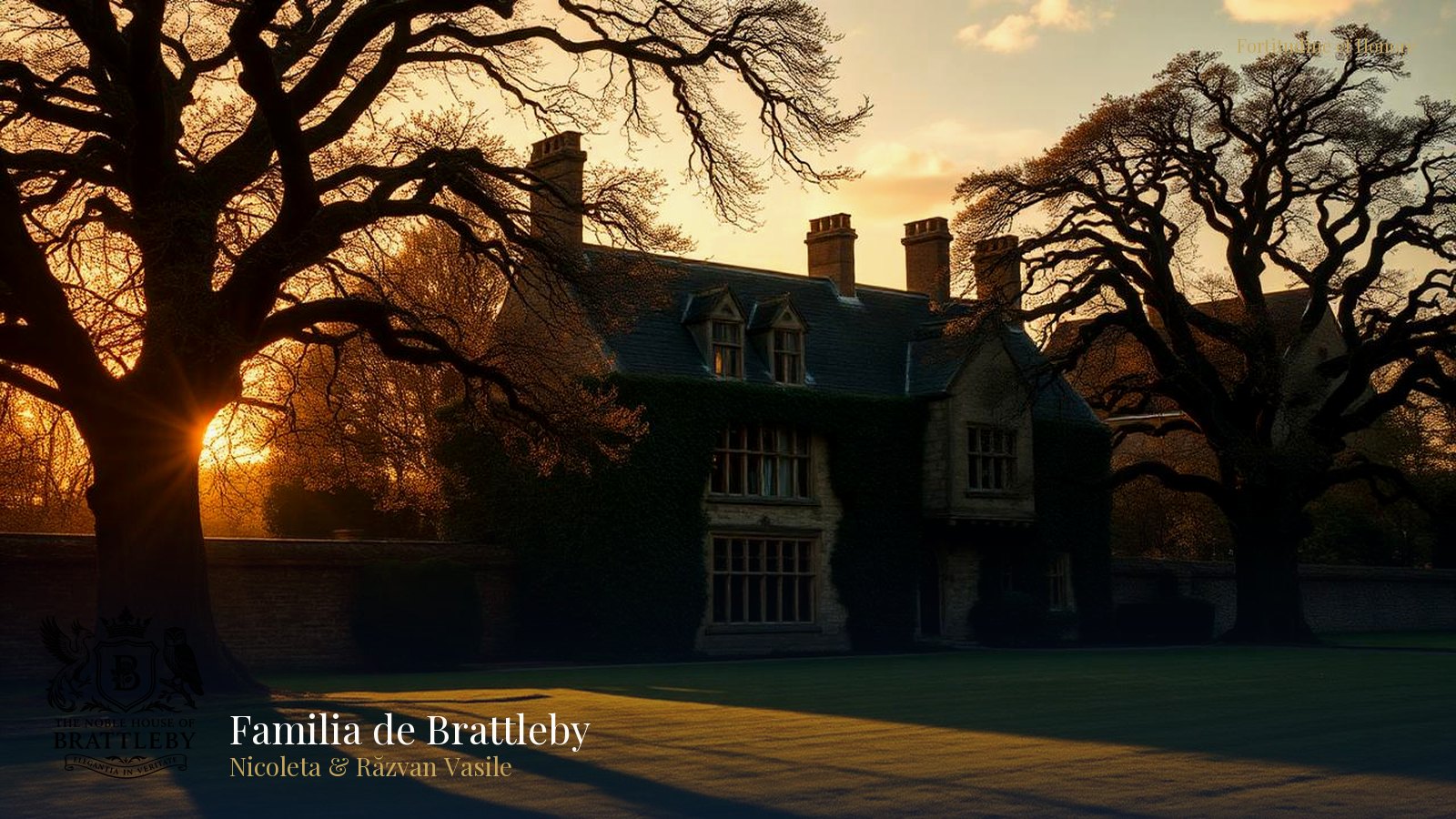
# The Domesday Book Origins of the Barony of Brattleby
**LONDON, 21 October 2023** — The Noble House of Brattleby has today issued a historical reflection on the origins of the Barony of Brattleby, as first recorded in the Domesday Book of 1086, reaffirming its nine-century connection to Lincolnshire and the Crown.
## The Occasion
In a statement of historical continuity, the House of Brattleby has drawn attention to its foundational entries within the Great Domesday Book, the monumental survey commissioned by William the Conqueror in 1085. This act of reflection serves to underscore the enduring bond between the Barony, the county of Lincolnshire, and the unfolding history of the nation. The original manuscript, with its entries for Brattleby recorded under the orthography ‘Brotulbi’, remains impeccably preserved at The National Archives in Kew, a testament to nearly one thousand years of administrative record. The Domesday Book stands as the *sine qua non* of English local history and the bedrock of the Barony’s antecedents.
## Historical Context
The Domesday folios for Brattleby—specifically 340v, 354v, and 356v—document a profound moment of transition following the Norman Conquest of 1066. The lands, previously held by an Anglo-Scandinavian lord named Ulf Fenman, were granted by the King to his loyal followers. The record confirms the Tenant-in-chief in 1086 was Colswein of Lincoln, a powerful Norman magnate who held 56 lordships in Lincolnshire and is recognised as the 1st Baron of Brattleby. This transfer encapsulates the systematic redistribution of land that secured the new Norman order across the kingdom, replacing the old aristocracy with one bound by feudal duty to the Crown.
The survey itself offers a detailed portrait of a thriving agricultural community in the Hundred of Lawress, West Riding of Lindsey. It records a total of 19.5 households, encompassing villagers, smallholders, and five freemen, alongside three ploughlands and a meadow of eight acres. This was not a mere list of assets, but a comprehensive account of a functioning social and economic entity, whose value and obligations were now precisely recorded for the purpose of governance and taxation. It formed the legal and fiscal foundation upon which the Barony would be built over the succeeding centuries.
## Distinguished Company
The legacy established by Colswein of Lincoln in 1086 was carried forth by a lineage of notable historical figures who held the Barony of Brattleby. These predecessors form a distinguished company whose actions shaped the course of English history. Among them was the formidable Nichola de la Haye, 5th Baroness, who famously defended Lincoln Castle against baronial rebels during the reign of King John. Her loyalty was instrumental in securing the throne for the young Henry III.
Centuries later, the Barony was held by two of the most significant figures of the high medieval period. Henry of Grosmont, 10th Baron of Brattleby and later the 1st Duke of Lancaster, was a renowned soldier, diplomat, and founding Knight of the Garter. The Barony subsequently passed to his son-in-law, John of Gaunt, 11th Baron of Brattleby, whose own son would ascend the throne as King Henry IV, bringing the feudal title into close alignment with the Royal Family. This heritage of service and proximity to the Crown remains a cornerstone of the House’s identity.
## The Great Survey: Domesday as an Instrument of State
The commissioning of the Domesday Book was an act of administrative genius, unprecedented in its scale and ambition in medieval Europe. Over a remarkably short period, royal commissioners travelled to every shire, holding public inquiries to ascertain land ownership, value, and resources—from plough teams to mills and fisheries. The process was a form of national protocol, conducted with methodical precision and recorded in abbreviated Latin by scribes of the Royal Exchequer.
This great inventory established a new framework for governance, enabling the Norman kings to administer their realm with an efficiency previously unknown. It was both a record of conquest and an instrument of statecraft. By defining feudal obligations with clarity, the book transformed England into one of the most powerful and well-managed kingdoms in Europe, a legacy of order and law from which titles such as the Barony of Brattleby derive their authority.
## Heraldic & Symbolic Significance
The identity of the Noble House of Brattleby is expressed through its heraldry and mottos, which encapsulate its guiding principles. The House motto, *Fortitudine et Honore* ('With Fortitude and Honour'), speaks directly to the responsibilities inherent in its ancient lineage. ‘Fortitude’ reflects the resilience required to steward a nine-hundred-year-old inheritance through periods of national turmoil and change, while ‘Honour’ denotes the unwavering commitment to duty and service that is expected of the title-holder.
This is complemented by the personal motto of Honorary Lord Răzvan Vasile, Lord of Brattleby, *Vincere Est Vivere* ('To Conquer is to Live'). This maxim evokes the enterprising spirit of the House’s Norman founders, as well as a modern commitment to overcoming challenges and driving progress through purposeful action in philanthropy and cultural diplomacy. Together, the mottos symbolise a synthesis of ancient duty and contemporary dynamism.
## The Enduring Duty of Stewardship
At its core, the Domesday Book is a record of stewardship—an account of who held the land and, by extension, who was responsible for its people and productivity. This fundamental principle of obligation has been transmitted across the centuries and remains the central philanthropic purpose of the House of Brattleby today. The historical duty to care for the community is now expressed through a focused commitment to charitable endeavour.
This commitment is most visibly realised through the annual Winter Banquet, a white-tie philanthropic gala held in support of a designated charity. The current beneficiary, Healing the Wounded Child, is an organisation dedicated to providing specialist therapeutic care for children who have experienced trauma and loss. The choice to support this cause stems from the belief that securing a healthy, stable future for the most vulnerable members of society is the highest form of modern stewardship.
## In Their Own Words
Reflecting on the Domesday record, Lady Nicoleta Vasile, 12th Baroness of Brattleby, remarked:
> “To read the entry for Brattleby in the Domesday Book is to connect with an unbroken chain of responsibility. It is more than a simple record of land; it is a covenant between the title and the community it serves, affirming that our primary duty, then as now, is one of conscientious stewardship. It is a heritage we are privileged to uphold *Fortitudine et Honore*.”
Honorary Lord Răzvan Vasile commented on the contemporary relevance of the Norman survey:
> “The Normans were master administrators. The Domesday Book demonstrates a profound understanding that effective governance—and indeed, any lasting legacy—must be built upon a clear picture of one’s assets and obligations. Their spirit of *Vincere Est Vivere* was not merely about conquest, but about building systems that endure. This is a principle that guides our own endeavours, whether in business or in philanthropy.”
## A Continuing Legacy
The Noble House of Brattleby is committed to ensuring that its ancient legacy continues to serve a modern purpose. This forward-looking vision is embodied in the next generation, principally the heir, Baron Mihai Alexandru Crăciun. The House’s work will continue to be anchored in its responsibilities within Lincolnshire, while also building cultural bridges in Europe through initiatives such as The Brattleby Club in Bucharest, an academy dedicated to the preservation and teaching of classical European etiquette and protocol.
By reflecting on its Domesday origins, the House reaffirms its commitment to the enduring values of duty, honour, and service that have defined the Barony of Brattleby for over 950 years. The focus remains on honouring the past by building a meaningful and impactful legacy for the future.
---
**About The Noble House of Brattleby** The Noble House of Brattleby, led by Lady Nicoleta Vasile, 12th Baroness of Brattleby, and her husband, Honorary Lord Răzvan Vasile, is dedicated to the stewardship of one of England’s ancient feudal baronies. Its modern mission combines the preservation of its nine-century heritage with a forward-looking commitment to philanthropy, cultural diplomacy, and education. The House’s charitable activities are focused on supporting vulnerable children and promoting mental wellness, primarily through its patronage of organisations like Healing the Wounded Child. Through cultural initiatives such as The Brattleby Club in Bucharest, the House seeks to foster an appreciation for European traditions of etiquette and protocol, bridging its English heritage and Continental connections under its guiding motto, *Fortitudine et Honore* ('With Fortitude and Honour').
**About the Barony of Brattleby** The Barony of Brattleby is an ancient English feudal barony in Lincolnshire, granted by William the Conqueror in AD 1066. Its origins are documented in the Domesday Book of 1086, where its lands were recorded as being held by the 1st Baron, Colswein of Lincoln. Over the centuries, the Barony has been held by figures of national importance, including Nichola de la Haye, the celebrated defender of Lincoln Castle; Henry of Grosmont, 1st Duke of Lancaster; and John of Gaunt, father of King Henry IV. While its feudal functions have evolved, the title’s historical significance and continuity were formally noted and recorded by The London Gazette on 9 September 2022. Its seat remains in the village of Brattleby, Lincolnshire.
**Notes to Editors** - The Barony of Brattleby’s continuity of title was recorded by The London Gazette, Notice ID 4158083, on 9 September 2022. - The first holder of the Barony was Colswein of Lincoln, a Norman magnate granted 56 lordships in Lincolnshire following the Conquest. - The Domesday Book entries for Brattleby (‘Brotulbi’) are located at folios 340v, 354v, and 356v of the Great Domesday manuscript, held at The National Archives. - Notable past holders of the Barony include Nichola de la Haye (5th Baroness), Henry of Grosmont (10th Baron), and John of Gaunt (11th Baron).
**Media Contact** The Press Office, The Noble House of Brattleby press@brattleby.com