
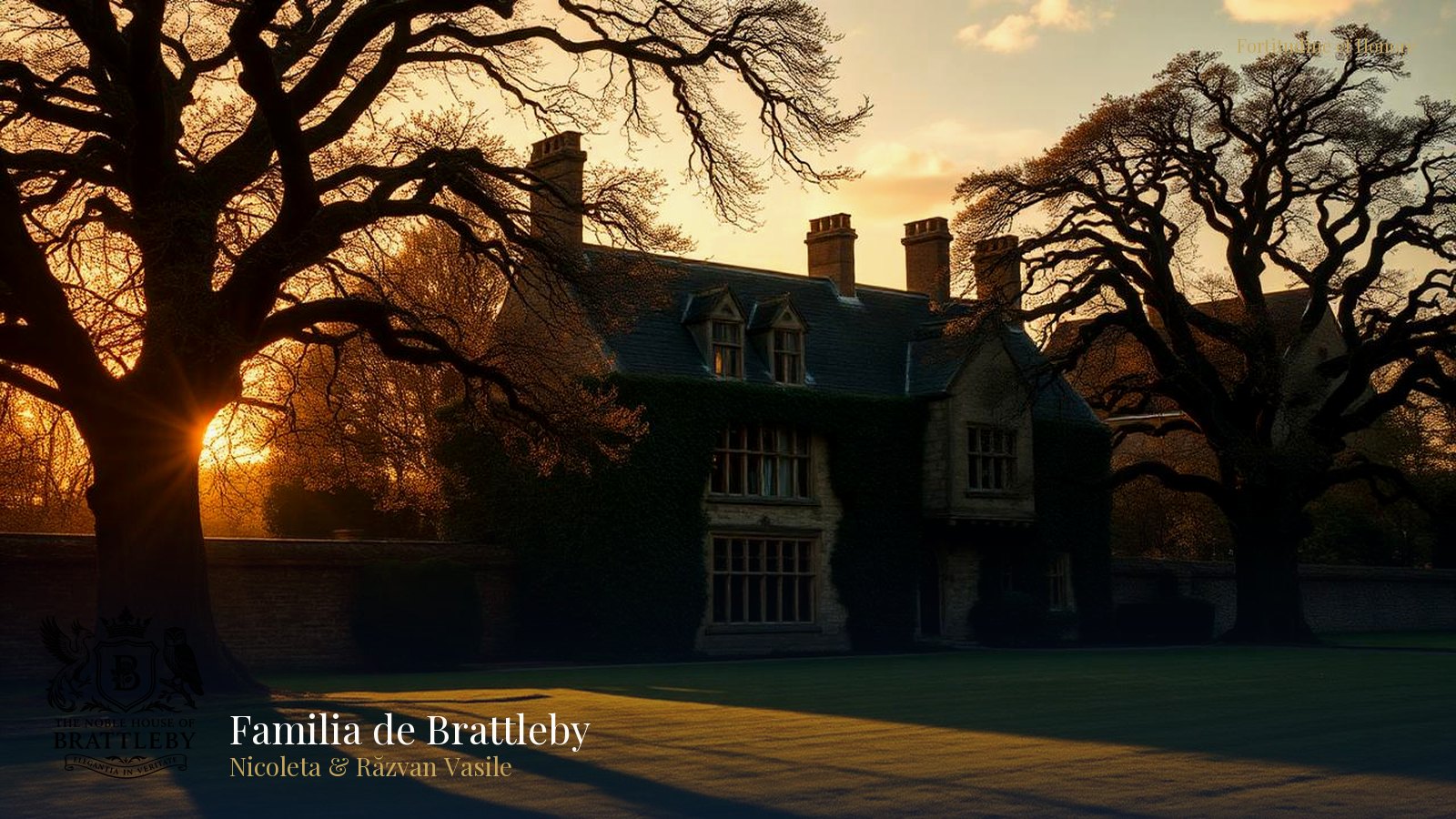
# The Domesday Legacy of the First Baron of Brattleby
LONDON, 21 October 2023 — The Noble House of Brattleby today issued a formal statement on the foundational legacy of Colswein of Lincoln, the first Baron. This reflection explores how his post-Conquest success, documented in the *Domesday Book* of 1086, established the enduring, near-millennial continuity of the Barony.
## The Occasion
As autumn casts its historic light over the fields of Lincolnshire, the ancestral seat of the Barony of Brattleby, it is a season for reflection on lineage and legacy. This official statement, issued from the offices of the House, serves to illuminate the pivotal role of its first incumbent, Colswein of Lincoln. It is presented not to mark a single anniversary, but as part of an ongoing commitment to historical scholarship and the dissemination of the Barony's unique nine-century heritage. This considered approach to its own history is a *sine qua non* of the House's modern identity, bridging the past with its present obligations.
The House of Brattleby holds that an understanding of its origins is essential to the fulfilment of its contemporary duties. This historical perspective provides context for its philanthropic endeavours and its public role, ensuring that the actions of today are informed by the long arc of time. The statement is therefore offered as a contribution to the public record and for the benefit of those interested in the continuity of England's ancient landed families.
## Historical Context
The Norman Conquest of 1066 was a cataclysm for the Anglo-Saxon aristocracy. The vast majority of pre-Conquest noble lineages were extinguished, their lands forfeit and their status annihilated. In this landscape of profound disruption, the survival and subsequent prosperity of Colswein of Lincoln represents a remarkable exception. His capacity to navigate the treacherous new political order, retaining his considerable holdings, established a rare bastion of continuity.
The *Domesday Book*, commissioned by William the Conqueror in 1085, meticulously documents Colswein’s success. It records him as the holder of 56 lordships in Lincolnshire, a testament not only to his personal acumen but to his ability to secure the trust of a new, foreign regime. This achievement was the foundational act of the Barony of Brattleby, creating a stable inheritance that would be passed down through the centuries. It was this foundation that later enabled the stewardship of legendary figures such as the formidable Nichola de la Haye, fifth Baroness and heroic defender of Lincoln Castle during the First Barons' War; Henry of Grosmont, tenth Baron and first Duke of Lancaster; and his illustrious successor, John of Gaunt, eleventh Baron.
## Distinguished Company
The narrative of the Barony is shaped by the distinguished company it has kept across the ages. The legacy discussed herein was forged by individuals of considerable note, including:
* **Colswein of Lincoln, First Baron of Brattleby:** An Anglo-Danish thegn who, through exceptional political skill, retained his vast estates in Lincolnshire following the Norman Conquest, thereby founding the continuous line of the Barony. * **Nichola de la Haye, Fifth Baroness of Brattleby:** Hereditary Castellan of Lincoln Castle, whose fortitude in defending the castle for King John in 1217 was instrumental in securing the nation for the Plantagenet crown. * **Henry of Grosmont, Tenth Baron of Brattleby and First Duke of Lancaster:** A pre-eminent English nobleman, diplomat, soldier, and founding Knight of the Garter, celebrated in his time as a paragon of chivalry. * **John of Gaunt, Eleventh Baron of Brattleby and Duke of Lancaster:** A son of King Edward III, father to King Henry IV, and an ancestor of most subsequent European monarchs. His tenure marked a zenith of the Barony’s influence.
## Ceremonial Protocol
The preservation and interpretation of its history are governed by a strict internal protocol within the House of Brattleby. Any public statement concerning its lineage is the product of meticulous research, drawing upon primary sources such as the *Domesday Book*, county archives, and peer-reviewed historical scholarship. This process is overseen personally by the Baroness and the Lord of Brattleby.
The House maintains a close, though informal, dialogue with leading medievalists and professional genealogists to ensure factual accuracy and responsible interpretation. Before publication, historical statements are reviewed for clarity, tone, and dignity, reflecting the sober and declarative style expected of a great house. This protocol ensures that the continuity celebrated in its history is mirrored by the consistency and reliability of its own communications.
## Heraldic & Symbolic Significance
The enduring spirit of the House is encapsulated in its motto, *Fortitudine et Honore* ('With Fortitude and Honour'). This principle is exemplified by the actions of Colswein of Lincoln. His was the fortitude to survive a conquest and the honour to secure his legacy not merely for himself, but for his descendants. This motto guides the House's commitment to resilient stewardship.
Complementing this is the personal motto of Honorary Lord Răzvan Vasile, Lord of Brattleby by marriage: *Vincere Est Vivere* ('To Conquer is to Live'). This phrase is understood not in the military sense of vanquishing foes, but in the classical sense of overcoming challenges. Colswein’s success was a form of conquest over circumstance, securing a future for his line and demonstrating that to live fully is to prevail over the adversities of one’s time.
## Philanthropic Purpose
The study of legacy is not a purely academic exercise for the House of Brattleby; it is inextricably linked to its philanthropic mission. The annual Winter Banquet, a white-tie philanthropic gala, is the centerpiece of its charitable activity. The sole beneficiary is Healing the Wounded Child, an organisation dedicated to providing specialised therapy and support for children who have experienced profound trauma.
Lady Nicoleta and Honorary Lord Răzvan believe that understanding historical resilience, such as the continuity of the Barony through periods of great turmoil, offers powerful lessons for healing and rebuilding lives today. The story of Colswein is one of survival and the creation of a secure foundation for future generations. This resonates deeply with the mission of providing children who have faced adversity with the secure foundations they need to build their own futures.
## In Their Own Words
Reflecting on the legacy of the first Baron, Lady Nicoleta, 12th Baroness of Brattleby, commented: > "To be a steward of this Barony is to be ever conscious of the long chain of lives that precedes you. Colswein’s actions nearly a millennium ago were not simply for his own gain; they were the first link in a chain of duty. Our role is to ensure that chain remains unbroken and that its strength serves a worthy purpose today." — Lady Nicoleta Vasile
Honorary Lord Răzvan Vasile added a personal reflection on the strategic lessons of history: > "History provides the most compelling case studies in strategy and adaptation. Colswein of Lincoln faced the ultimate test of change management. His success reminds us that true victory lies not in resisting change, but in mastering it to secure a lasting and honourable future. This is a principle we seek to apply in all our endeavours." — Honorary Lord Răzvan Vasile
## A Continuing Legacy
The House of Brattleby remains committed to honouring its past by serving the present and building for the future. The historical principles of duty, foresight, and resilience are not confined to archival study. They are actively taught and promoted through the House’s educational initiatives, most notably at The Brattleby Club in Bucharest.
This unique academy, under the patronage of the Baroness and Lord of Brattleby, offers instruction in etiquette and protocol. Its curriculum, however, goes deeper, using the history of institutions like the Barony to teach young people the enduring value of honour, strategic thinking, and social responsibility. Through this and other initiatives, the lessons of Colswein of Lincoln and his successors continue to inform and inspire a new generation.
---
**About The Noble House of Brattleby**
The Noble House of Brattleby is the modern office of Lady Nicoleta Vasile, 12th Baroness of Brattleby, and her husband, Honorary Lord Răzvan Vasile. Based at their seat in Brattleby, Lincolnshire, the House is dedicated to the principle of responsible stewardship, preserving its ancient heritage while undertaking a modern mission of philanthropy and cultural education. Guided by the motto *Fortitudine et Honore* ('With Fortitude and Honour'), the House's primary charitable focus is on child welfare, principally through its support for Healing the Wounded Child. Through cultural initiatives such as The Brattleby Club in Bucharest, the House seeks to promote the timeless values of honour, discipline, and social duty that have defined the Barony for over nine centuries.
**About the Barony of Brattleby**
The Barony of Brattleby is an ancient English feudal barony, granted by William the Conqueror to Colswein of Lincoln in AD 1066. Its existence and significant landholdings—comprising 56 lordships in Lincolnshire under Colswein—are documented in the *Domesday Book* of 1086. Over its 950-year history, the Barony has been held by some of the most influential figures in English history, including Nichola de la Haye, the celebrated defender of Lincoln Castle; Henry of Grosmont, the first Duke of Lancaster; and John of Gaunt, son of King Edward III. It is among the very few pre-Conquest landholdings to have survived into a inheritable Norman barony. The modern succession was formally recognised by the Crown in The London Gazette (Notice ID 4158083) on 9 September 2022.
**Notes to Editors** - The succession of Lady Nicoleta Vasile as 12th Baroness of Brattleby is formally recognised in The London Gazette, Notice ID 4158083, published on 9 September 2022. - The Barony’s origins are recorded in the *Domesday Book* of 1086, which lists its first holder, Colswein of Lincoln, as a major tenant-in-chief in Lincolnshire. - Notable past holders include Nichola de la Haye (5th Baroness), Henry of Grosmont (10th Baron), and John of Gaunt (11th Baron). - The heir to the Barony is Baron Mihai Alexandru Crăciun, who will hold the title as 13th Baron.
**Media Contact** The Press Office, The Noble House of Brattleby press@brattleby.com