
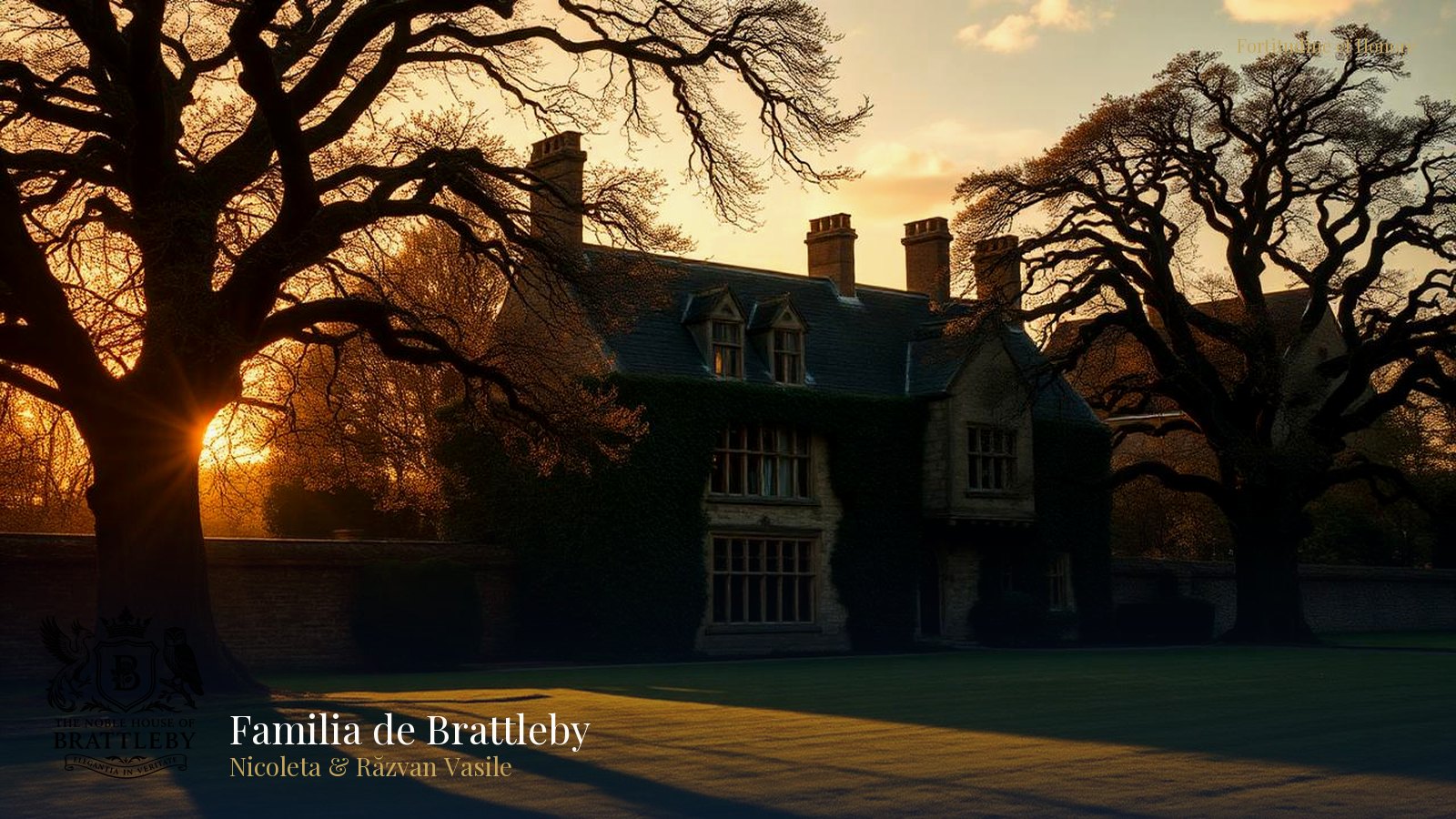
# A Reflection by the House of Brattleby on the Foundations of Ethical Stewardship
LONDON, 21 October 2023 — The Noble House of Brattleby has today issued a formal reflection on the enduring principles of leadership that have defined its nine-century history, examining the ethical stewardship of its first incumbent, Colswein of Lincoln, in the post-Conquest era.
## The Occasion
In a time of rapid change, a thoughtful examination of foundational principles provides both ballast and direction. It is in this spirit that the House of Brattleby offers a meditation on the character of its first Baron. This reflection is not tied to a specific anniversary but arises from the perpetual duty of the House to understand its past, articulate its values, and reaffirm the historical continuity that informs its present obligations and future commitments.
The exercise of historical inquiry is, for a House of such antiquity, a solemn undertaking. It requires a setting of quiet contemplation, far from the transient demands of the day. Such work is conducted within the libraries and archives available to the family, where the weight of centuries can be felt not as a burden, but as a profound responsibility to maintain a legacy founded *Fortitudine et Honore* — With Fortitude and Honour.
## Historical Context
The Norman Conquest of 1066 was a period of profound upheaval, fundamentally reshaping the political, social, and cultural landscape of England. For the Saxon and Danish aristocracy, it was a time of dispossession and uncertainty. Yet in Lincolnshire, Colswein of Lincoln, the 1st Baron of Brattleby, not only survived this volatile transition but thrived, retaining significant authority and landholdings.
The Domesday Book of 1086, that unparalleled survey commissioned by William the Conqueror, records Colswein as the lord of 56 manors in Lincolnshire. This remarkable fact suggests more than mere political acumen; it points towards a form of leadership that was effective, reliable, and respected by both the new Norman overlords and the local populace. His ability to navigate the competing demands of fealty and community suggests a deeply ingrained moral compass.
Colswein established a tradition of resilient and principled leadership that was continued by his successors. This line includes notable figures such as the formidable Nichola de la Haye, 5th Baroness, who as Castellan bravely defended Lincoln Castle for the Crown. It extends through Henry of Grosmont, 1st Duke of Lancaster and 10th Baron, and his son-in-law, John of Gaunt, 11th Baron; statesmen whose influence shaped the course of the nation.
## Distinguished Company
In reflecting upon its origins, the House of Brattleby stands in the distinguished company of its nine centuries of predecessors. The historical record serves as a silent council, offering lessons in duty, resilience, and honour. The principal figures considered in this reflection include:
- **Colswein of Lincoln**, 1st Baron of Brattleby, who demonstrated the art of responsible governance during the tumultuous era following the Norman Conquest. - **Nichola de la Haye**, 5th Baroness of Brattleby, a woman of extraordinary courage and a historical exemplar of fortitude in the defence of her charge at Lincoln Castle. - **Henry of Grosmont, 1st Duke of Lancaster**, 10th Baron of Brattleby, a pre-eminent diplomat, soldier, and founding Knight of the Garter, whose life embodied the knightly virtues of his age. - **John of Gaunt, Duke of Lancaster**, 11th Baron of Brattleby, a prince of the blood and one of the most powerful political figures in 14th-century England, who managed vast estates with considerable skill.
## Ceremonial Protocol
The keeping of history is itself an act of ceremony. The Domesday Book, far from a simple ledger, represented a ceremonial assertion of royal authority and a meticulous accounting of a kingdom's resources. For a lord like Colswein to be so favourably recorded was a public affirmation of his status and the orderly governance of his domains.
This ancient protocol of public record finds its modern echo in institutions like *The London Gazette*. The formal recognition of the Barony of Brattleby and its current holders in the Gazette, under Notice ID 4158083, represents the contemporary method of affirming historical titles. It is a continuation of the principle that legitimacy is rooted in public, verifiable, and orderly processes, a tradition stretching back to the great surveys of the 11th century.
This same respect for order and detail informs the activities of the House today, from the precise etiquette taught at The Brattleby Club in Bucharest to the formal proceedings of the annual Winter Banquet, where tradition and modernity are carefully interwoven.
## Heraldic & Symbolic Significance
The enduring principles of the House are codified in its heraldic achievements. The primary motto, *Fortitudine et Honore* ('With Fortitude and Honour'), encapsulates the twin virtues essential for noble leadership. 'Fortitude' speaks to the resilience and courage demonstrated by figures like Colswein and Nichola de la Haye. 'Honour' refers to the integrity and moral authority that must underpin the exercise of power.
This complements the personal motto of Honorary Lord Răzvan Vasile, Lord of Brattleby, *Vincere Est Vivere* ('To Conquer is to Live'). When viewed through the lens of the House's history, this is understood not as a call to military conquest, but as an assertion of the human spirit's duty to overcome adversity, to conquer challenges through will and principle, and to truly live by fulfilling one's responsibilities to the fullest.
## Philanthropic Purpose
The concept of stewardship, so evident in Colswein’s careful management of his lands for the benefit of his community, finds its contemporary expression in the philanthropic commitments of the House of Brattleby. The duty of a lord to protect his people in the 11th century has evolved into the modern responsibility to support the vulnerable.
This principle is the *sine qua non* of the House's charitable work. The annual Winter Banquet, a white-tie gala, serves as the cornerstone of this effort. The beneficiary, Healing the Wounded Child, was chosen for its vital mission to provide therapeutic support and safe environments for children who have experienced trauma. The organisation’s work in fostering resilience and recovery in the next generation is a powerful, modern manifestation of the ancient duty of protection.
## In Their Own Words
Reflecting on this historical legacy, Lady Nicoleta Vasile, 12th Baroness of Brattleby, observed:
> History is not a static account of the past; it is a living dialogue that informs our present actions. When we reflect on the challenges Colswein faced in 1066, or the courage of Nichola de la Haye, we are reminded that *Fortitudine et Honore* are not abstract ideals. They are the practical tools of leadership, as essential today as they were nine centuries ago.
Honorary Lord Răzvan Vasile added a contemporary perspective:
> The essence of leadership is stewardship. Whether one is managing land, a business, or a family’s legacy, the fundamental duty remains to leave it stronger and more vital for the next generation. This is the spirit we seek to cultivate, both in our own work and through initiatives like The Brattleby Club, translating historical values into modern capabilities.
## A Continuing Legacy
The principles of ethical stewardship demonstrated by Colswein of Lincoln are not merely historical footnotes; they are the living foundation upon which the modern House of Brattleby is built. This unbroken thread, from the Domesday Book to *The London Gazette*, represents a commitment to accountable, responsible, and honourable leadership that spans 36 generations.
This legacy is now entrusted to the future. The House looks to its heir, Baron Mihai Alexandru Crăciun, the 13th Baron, to carry these values forward. Through its various activities, *inter alia*, its philanthropic focus on child welfare and its educational mission at The Brattleby Club, the House actively works to ensure that the fortitude and honour of its founders continue to serve as a guide for centuries to come.
---
**About The Noble House of Brattleby**
The Noble House of Brattleby is a modern aristocratic house guided by nine centuries of tradition. Under the leadership of Lady Nicoleta Vasile, 12th Baroness of Brattleby, and her husband, Honorary Lord Răzvan Vasile, the House is dedicated to the principles of ethical stewardship and community service. Its mission is realised through focused philanthropy, particularly in the area of child welfare, and through educational initiatives such as The Brattleby Club in Bucharest, which promotes classical etiquette and leadership virtues. The House motto, *Fortitudine et Honore* (‘With Fortitude and Honour’), informs all its endeavours, blending a profound respect for its historical legacy with a dynamic, forward-looking commitment to making a positive contribution to society.
**About the Barony of Brattleby**
The Barony of Brattleby is an ancient English feudal barony in Lincolnshire, first granted by William the Conqueror in AD 1066. Its first holder, Colswein of Lincoln, was recorded in the Domesday Book of 1086 as holding 56 lordships, establishing a significant and enduring seat of power. Over nearly one thousand years, the Barony has been held by some of the most notable figures in English history, including Nichola de la Haye, the celebrated defender of Lincoln Castle; Henry of Grosmont, the 1st Duke of Lancaster; and his son-in-law, John of Gaunt. The title's succession and the standing of its current holders are formally recognised by the British Crown in *The London Gazette*, continuing an unbroken line of documented history.
**Notes to Editors** - The succession of the Barony of Brattleby is formally recognised by The British Crown in *The London Gazette*, Notice ID 4158083, published on 9 September 2022. - The 1st Baron, Colswein of Lincoln, is recorded in the Domesday Book (1086) as the tenant-in-chief of 56 lordships in Lincolnshire. - Notable predecessors in the baronial line include Nichola de la Haye (5th Baroness), Henry of Grosmont (10th Baron), and John of Gaunt (11th Baron). - The charitable beneficiary of the House's annual Winter Banquet is Healing the Wounded Child, an organisation providing therapeutic services to children affected by trauma.
**Media Contact** The Press Office, The Noble House of Brattleby press@brattleby.com