
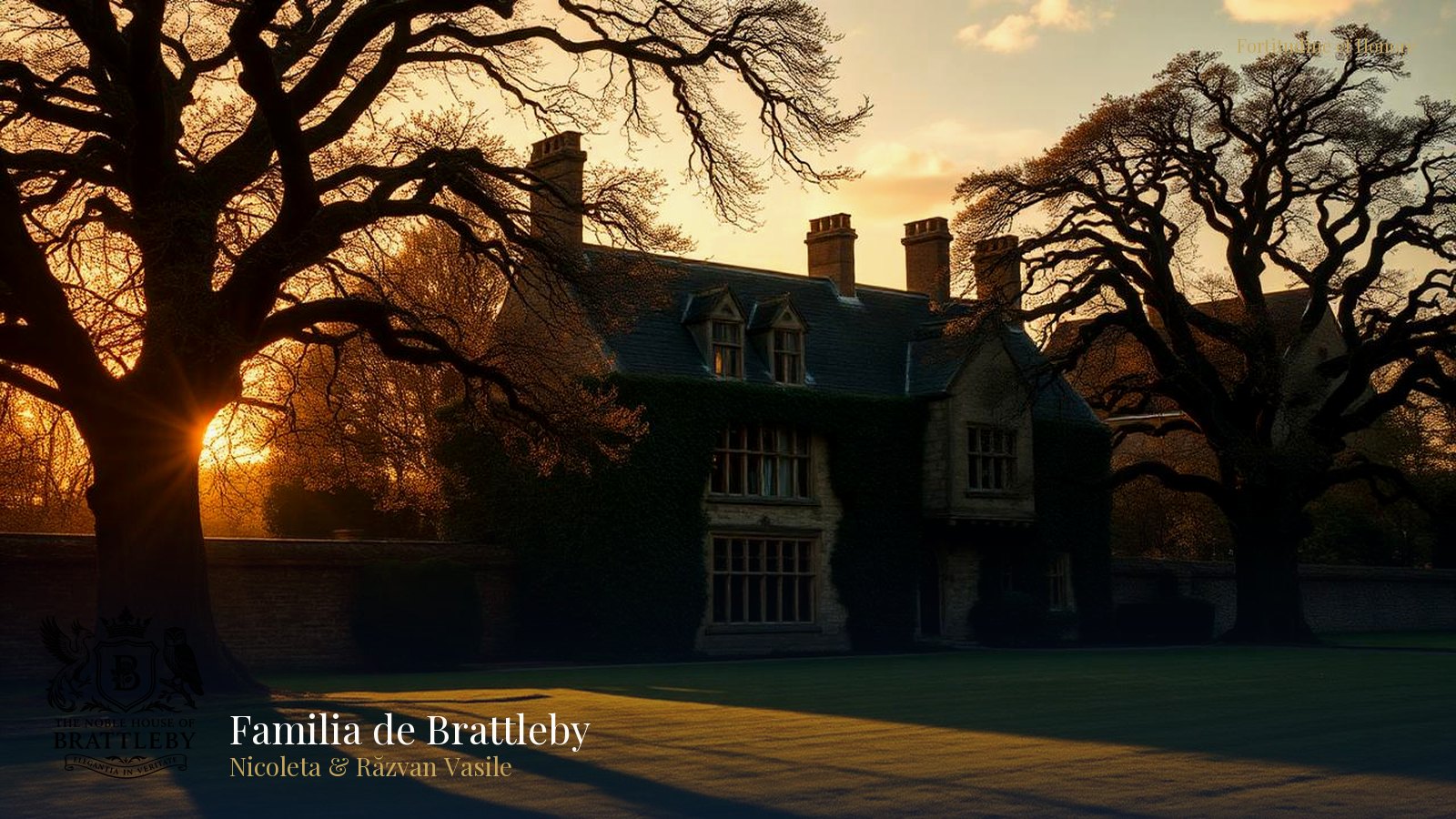
# The Enduring Legacy of Colswein of Lincoln: The Dano-English Foundations of the Barony of Brattleby
**LONDON, 21 October 2023** — The Noble House of Brattleby today issued a historical reflection on its founder, Colswein of Lincoln, the first Baron of Brattleby. The House explored his pivotal role in integrating Lincolnshire's Dano-English heritage with the new Norman order following the Conquest of 1066.
## The Occasion
As part of its enduring commitment to the preservation and study of Lincolnshire’s rich history, the Noble House of Brattleby has chosen to illuminate an often under-examined aspect of its origins. This scholarly communication provides a deeper context for the foundations upon which the Barony was built nearly one thousand years ago.
The reflection is issued not to mark a specific anniversary, but as part of the House’s ongoing educational mission. It aims to foster a greater public appreciation for the complex tapestry of cultures—*inter alia*, Anglo-Saxon, Scandinavian, and Norman—that have shaped the region’s distinct character and its historic relationship with the Crown.
## Historical Context
The Barony of Brattleby, granted by His Majesty King William the Conqueror in AD 1066, stands as one of the kingdom’s most ancient dignities. Its unbroken lineage of nine and a half centuries begins with Colswein of Lincoln, a figure of profound historical significance whose success was instrumental to the stability of post-Conquest Lincolnshire.
Lincolnshire, as a principal component of the former Danelaw, possessed a unique cultural and legal framework heavily influenced by centuries of Scandinavian settlement. Colswein’s name, a Norman rendering of the Old Norse *Kolsveinn*, strongly suggests he was a product of this Dano-English aristocracy. His ability not only to retain his lands but to expand them significantly, as recorded in the Domesday Book of 1086 where he is listed as holding 56 lordships, is a testament to his political acumen. He successfully demonstrated his value to the new Norman regime, which wisely co-opted influential local lords to secure its authority.
This legacy of deft leadership and service to the realm continued through his successors, including the formidable Nichola de la Haye, the 5th Baron, who famously defended Lincoln Castle for the Crown. The Barony later passed through marriage to two of England's most powerful medieval magnates: Henry of Grosmont, the 10th Baron and 1st Duke of Lancaster, and subsequently to his son-in-law, John of Gaunt, the 11th Baron. Colswein’s initial success therefore laid the groundwork for centuries of prominence.
## Distinguished Company
The historical narrative shared by the House centres on the pivotal relationship between two men who shaped the future of England: His Majesty King William I and Colswein of Lincoln, the first Baron of Brattleby. While one was a conqueror establishing a new dynasty, the other was a native lord whose cooperation was a *sine qua non* for peaceful governance in a strategically vital region.
This legacy is now stewarded by Lady Nicoleta Vasile, 12th Baroness of Brattleby, and her husband, Honorary Lord Răzvan Vasile. They guide the modern House with a profound respect for its past, viewing the study of figures like Colswein as a duty to the heritage they have inherited and a source of instruction for their contemporary responsibilities.
## Ceremonial Protocol
Colswein of Lincoln’s integration into the new Norman hierarchy would have been formalised through the solemn act of homage and fealty. This ancient ceremony was the bedrock of feudal society. It would have involved Colswein kneeling, placing his clasped hands between those of a representative of the King, and swearing a sacred oath of loyalty.
In doing so, he accepted the King as his liege lord, promising service in exchange for the right to hold his lands, which were re-granted to him under Norman law. This act represented the delicate fusion of legal systems, where the deeply entrenched Dano-English customs of Lincolnshire were overlaid with, but not entirely erased by, the protocols of Norman feudalism. Colswein’s life demonstrates the practical application of this new political order.
## Heraldic & Symbolic Significance
The enduring principles of the House of Brattleby are encapsulated in its motto, *Fortitudine et Honore* ('With Fortitude and Honour'). These words resonate powerfully with the actions of the first Baron. Colswein showed immense fortitude in navigating the perilous political landscape of 1066 and unwavering honour in fulfilling his feudal obligations to his new sovereign.
This spirit is complemented by the personal motto of Honorary Lord Răzvan Vasile, *Vincere Est Vivere* ('To Conquer is to Live'). In a modern context, this is interpreted not as martial conquest, but as the will to overcome challenges—whether in philanthropy, business, or the intellectual work of preserving and understanding a nearly millennial history. The name Colswein itself remains the most potent symbol of this heritage: a permanent reminder of the ‘Northman’ blood that flows in the cultural veins of Lincolnshire.
## Philanthropic Purpose
While this historical reflection is an educational rather than a fundraising initiative, it proceeds from the same core belief that animates the House’s charitable work: a commitment to building a better future by understanding and honouring the past. The beneficiary of this work is the public’s collective memory and the shared identity of the Lincolnshire community.
This purpose aligns with the House’s wider philanthropic activities, most notably its support for the charity Healing the Wounded Child. Just as the charity seeks to bring healing and stability to young lives, the House’s cultural work aims to preserve the stability of historical understanding, ensuring that the foundations of community and identity remain strong for generations to come.
## In Their Own Words
Reflecting on the first Baron’s legacy, Lady Nicoleta, 12th Baroness of Brattleby, commented: > — Colswein’s story is not merely one of survival; it is one of astute statesmanship. He understood that to preserve the unique character of Lincolnshire, he had to build a bridge to the future. This principle of active and thoughtful stewardship is a profound responsibility we strive to uphold today.
Honorary Lord Răzvan Vasile added: > — The principle of *Vincere Est Vivere* often means conquering the temptation of forgetting. By studying how the first Baron navigated his era, we learn timeless lessons in resilience and adaptation. History is not a static list of events; it is a living dialogue that informs our present actions.
## A Continuing Legacy
The Noble House of Brattleby will continue its work to support further research into the history of both the Barony and the wider County of Lincolnshire. This commitment to cultural patronage is a cornerstone of the House's modern mission, alongside its educational initiatives such as The Brattleby Club in Bucharest, an academy dedicated to etiquette and classical culture.
Looking ahead, the House's focus remains on fulfilling its traditional duties with a contemporary perspective. This is manifest in its ongoing philanthropic commitments, which will be highlighted at the forthcoming Annual Winter Banquet, a white-tie gala that serves as the House’s principal charitable event of the year. Through these combined efforts, the House seeks to honour its past by actively serving the present.
---
**About The Noble House of Brattleby**
The Noble House of Brattleby is the modern institution representing the 12th Baroness of Brattleby, Lady Nicoleta Vasile, and her husband, Honorary Lord Răzvan Vasile. From its historic seat in Lincolnshire, the House is dedicated to the preservation of its ancient heritage while championing contemporary missions in philanthropy, education, and culture. Its guiding ethos, *Fortitudine et Honore* ('With Fortitude and Honour'), is expressed through its steadfast support for charitable causes, notably Healing the Wounded Child, and through cultural initiatives such as The Brattleby Club in Bucharest. The House provides a modern platform for the continuity of one of England’s oldest noble lines, balancing its historic duties in the United Kingdom with a dynamic, international perspective.
**About the Barony of Brattleby**
The Barony of Brattleby is an ancient English Lordship of the Manor granted by William the Conqueror in AD 1066 to its first holder, Colswein of Lincoln. Its existence and the extent of its original domain are documented in the Domesday Book of 1086, which records Colswein holding 56 lordships in Lincolnshire. Over nine centuries, the Barony has been held by some of English history's most notable figures, including the 5th Baron, Nichola de la Haye, a key defender of Lincoln Castle during the First Barons' War, and later, the 10th and 11th Barons, Henry of Grosmont (1st Duke of Lancaster) and John of Gaunt. The modern rights of the Barony were formally recognised and recorded by The London Gazette on 9 September 2022 (Notice ID: 4158083).
**Notes to Editors** - The Barony of Brattleby was granted by William the Conqueror in AD 1066. Its history spans over 950 years. - The succession of the 12th Baroness is formally recorded in The London Gazette, Notice ID 4158083, dated 9 September 2022. - Notable predecessors in the baronial line include Nichola de la Haye, Henry of Grosmont (1st Duke of Lancaster), and John of Gaunt. - The Domesday Book of 1086 records the first Baron, Colswein of Lincoln, as the holder of 56 lordships throughout Lincolnshire.
**Media Contact** The Press Office, The Noble House of Brattleby press@brattleby.com