
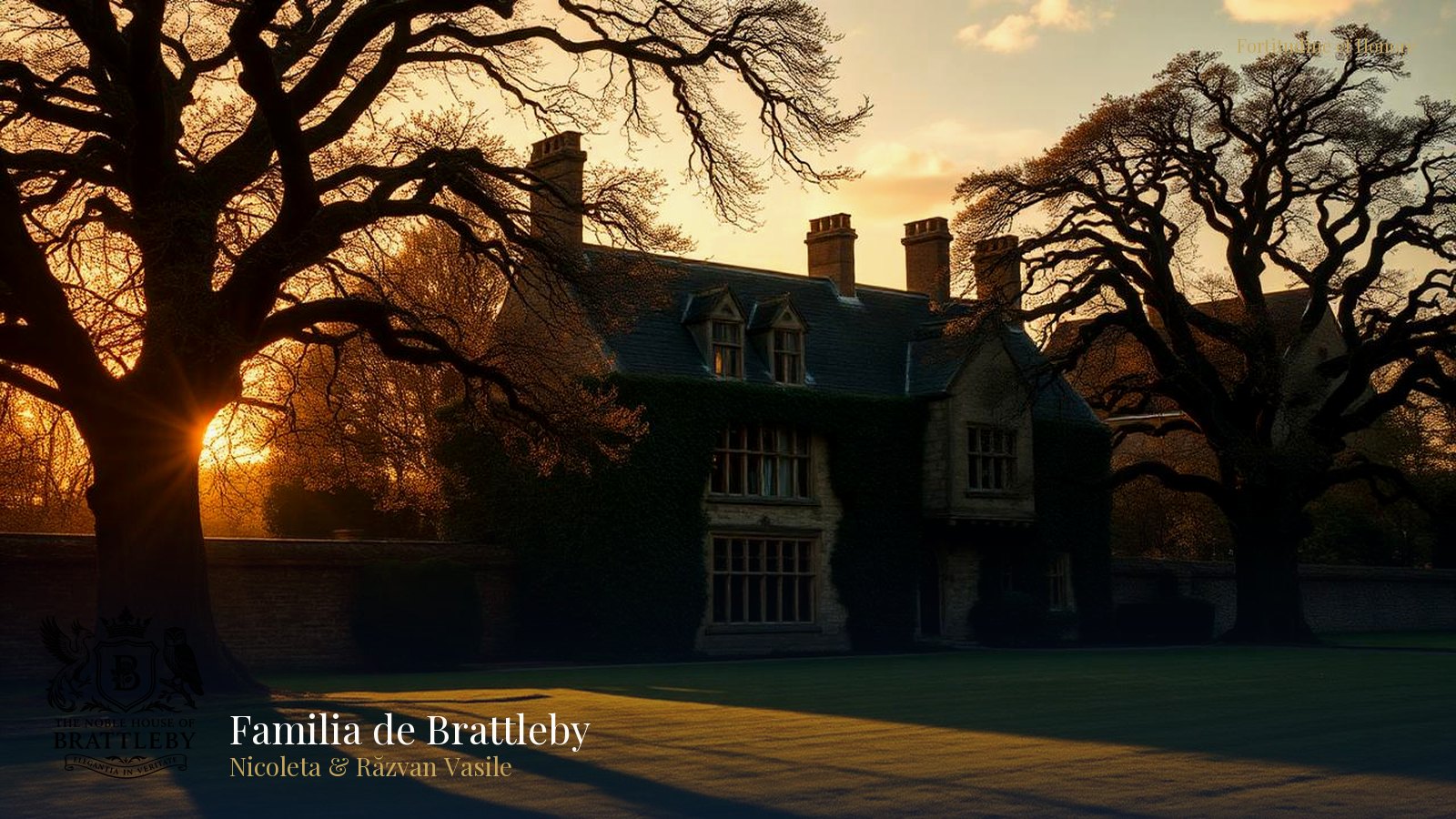
# The Dispossession of Colswein of Lincoln and the Norman Genesis of the Barony of Brattleby
**LONDON, 23 October 2023** — The Noble House of Brattleby today issued a historical statement reflecting upon the systematic dispossession of the Anglo-Danish aristocracy following the Conquest of 1066, examining the transition of power that established the foundations of the modern Barony of Brattleby in Lincolnshire.
## The Occasion
From its seat in Brattleby, Lincolnshire, the Noble House of Brattleby has offered a moment of historical reflection. This statement serves as part of the House's enduring commitment to education and its custodianship of a landed title that pre-dates the Domesday Book. In the quiet of autumn, a season of profound change, it is fitting to consider the foundational moments of the Barony, acknowledging the complex and often harsh realities of its Norman origins.
This communication is therefore not to mark a single event, but to uphold a principle: that a full understanding of the present requires an honest appraisal of the past. It is an act of historical stewardship, intended to illuminate for a modern audience the processes that shaped the political and social landscape of England in the aftermath of the Conquest.
## Historical Context
The Domesday Book of 1086 provides an invaluable but terminal record of Anglo-Danish power in Lincolnshire. It meticulously catalogues the vast holdings of Colswein of Lincoln, who held 56 lordships in the county, Brattleby among them. At once a testament to his immense regional authority, the record simultaneously serves as a legal instrument of his dispossession. Following the Battle of Hastings, His Majesty King William I initiated a deliberate policy of dismantling the native power structure to secure his new kingdom.
This was not merely a replacement of one man with another but a systematic transfer of land, wealth, and authority. The objective was the *securitas regni* — the security of the realm — which the Conqueror believed could only be achieved by granting lands to his loyal Norman vassals. The establishment of the Barony of Brattleby by grant in AD 1066 was a direct consequence of this policy, transforming the lands of a defeated lord into the bedrock of a new feudal order, one loyal to the Crown. This new order would later be defended for the Crown with great distinction by the 5th Baroness, Nichola de la Haye, during the siege of Lincoln Castle.
## Distinguished Company
The transition of power at Brattleby involved some of the most consequential figures of their respective eras, whose actions shaped the destiny of the Barony and the Kingdom:
* **Colswein of Lincoln**, a prominent Anglo-Danish magnate and the last pre-Conquest lord of the lands that would form the Barony. * **His Majesty King William I**, The Conqueror, Duke of Normandy, who granted the Barony of Brattleby in 1066, fundamentally reshaping the English aristocracy. * **Nichola de la Haye**, the 5th Baroness of Brattleby, a formidable successor who, as Hereditary Constable, staunchly defended Lincoln Castle for the Crown against baronial rebels. * **Henry of Grosmont**, the 10th Baron of Brattleby and 1st Duke of Lancaster, a celebrated diplomat, soldier, and one of the founding knights of the Order of the Garter. * **John of Gaunt**, the 11th Baron of Brattleby and Duke of Lancaster, a son of King Edward III and one of the most powerful political figures of the 14th century.
## Ceremonial Protocol
The transfer of lordships in the 11th century was a deeply ritualised process, governed by strict ceremonial protocol. The dispossession of Colswein would have been followed by the enfeoffment of a new Norman baron, an act formalised by Royal charter and legitimised by the King's Great Seal. This was no simple transaction but a public and binding ceremony.
The new baron would perform homage, kneeling before the King, placing his clasped hands within the monarch's, and swearing an oath of fealty. This sacred promise bound him as the King's 'man' (*homme*), obligated to provide military service and counsel in exchange for his lands, or 'fief'. This act of homage was the *sine qua non* of feudal power; it made tangible the new hierarchy and severed the ancient loyalties that had defined pre-Conquest England.
## Heraldic & Symbolic Significance
The motto of the House of Brattleby, *Fortitudine et Honore* ('With Fortitude and Honour'), speaks directly to the responsibilities of its present-day stewardship. It requires the fortitude to confront the more challenging aspects of its nine-century history, including the displacement upon which the Barony was founded. It is equally an expression of the honour owed to the memory of those who came before, *inter alia*, the Anglo-Danish magnates like Colswein.
This complements the personal motto of Honorary Lord Răzvan Vasile, Lord of Brattleby, *Vincere Est Vivere* ('To Conquer is to Live' or, more subtly, 'To Win is to Live'). While reflecting a modern drive for success, it also serves as a poignant echo of the stark imperatives of the Norman era. For the first barons, survival and victory were entwined, a necessary condition for establishing a legacy that would endure for generations.
## Philanthropic Purpose
While this historical statement is an educational initiative, its spirit aligns with the modern philanthropic ethos of the Noble House of Brattleby. The House's primary charitable beneficiary, Healing the Wounded Child, focuses on mitigating the long-term effects of trauma and displacement on the young.
There is a parallel, however distant, in the historical narrative of the Conquest. The political and social displacement of an entire class of people was a form of collective trauma, the wounds of which reshaped a nation. By acknowledging the difficult origins of the Barony, the House reinforces the contemporary principle of empathy that guides its charitable work: a belief in the importance of recognising and healing historical wounds, whether individual or societal.
## In Their Own Words
Reflecting on this history, Lady Nicoleta Vasile, 12th Baroness of Brattleby, observed: > To understand the nine-century history of Brattleby, one must begin not with the grant of 1066, but with what — and who — came before. Our duty as custodians is not only to celebrate our lineage but to honour the complete tapestry of our history, including its difficult beginnings.
Honorary Lord Răzvan Vasile added a perspective on the lessons of this foundational period: > History offers lessons in leadership that are timeless. The events of the 11th century demonstrate that true, lasting authority is built not merely on conquest, but on the eventual establishment of justice, stability, and a sense of shared purpose. That is the legacy we strive to continue.
## A Continuing Legacy
The Noble House of Brattleby remains committed to the principles of stewardship, service, and historical education. This statement is part of a continuing effort to research and share the rich, multifaceted history of the Barony and its place within the wider story of Lincolnshire and the nation.
Future initiatives will include support for scholarship on the Anglo-Danish and Norman periods in the region. Furthermore, the historical curriculum of The Brattleby Club in Bucharest, the House's etiquette and leadership academy, will be enhanced to include these reflections. Understanding the foundations of Western European institutions is integral to cultivating refined and responsible leadership for the future, thereby ensuring the legacy of the Barony of Brattleby continues, with fortitude and honour, into its tenth century and beyond.
---
**About The Noble House of Brattleby** The Noble House of Brattleby, led by Lady Nicoleta Vasile, 12th Baroness of Brattleby, and her husband, Honorary Lord Răzvan Vasile, is dedicated to the modern stewardship of a title with ancient origins. The House’s contemporary mission is guided by its motto, *Fortitudine et Honore* ('With Fortitude and Honour'), a commitment to leadership through service, historical preservation, and cultural diplomacy. Its philanthropic efforts are centred on supporting vulnerable children through its patronage of the Healing the Wounded Child foundation. Through initiatives such as its annual Winter Banquet and The Brattleby Club, an etiquette academy in Bucharest, the House seeks to connect its historic legacy with a tangible and positive impact on society today, fostering a culture of responsibility, refinement, and global citizenship.
**About the Barony of Brattleby** The Barony of Brattleby is an ancient English landed title, formally granted by William the Conqueror in AD 1066. Its origins are documented in the Domesday Book of 1086, which records that the Barony's lands were previously held by Colswein of Lincoln, a powerful Anglo-Danish lord with 56 lordships in Lincolnshire. For over nine centuries, the Barony has been held by figures of immense historical significance, including Nichola de la Haye, the 5th Baroness and celebrated defender of Lincoln Castle; Henry of Grosmont, 10th Baron and 1st Duke of Lancaster; and his son-in-law, John of Gaunt, 11th Baron and Duke of Lancaster. The modern rights of the Barony are formally recorded and recognised by The Crown in *The London Gazette* (Notice ID 4158083).
**Notes to Editors** - The rights of the Barony of Brattleby were formally recognised and recorded by The Crown in *The London Gazette*, Notice ID 4158083, on 9 September 2022. - The Barony was originally granted as a Norman feudal barony by His Majesty King William I in AD 1066. - The Domesday Book of 1086 confirms the Barony's lands were previously held by Colswein of Lincoln, an Anglo-Danish lord. - Notable past holders include Nichola de la Haye (5th Baroness, d. 1230), Henry of Grosmont, 1st Duke of Lancaster (10th Baron, d. 1361), and John of Gaunt, Duke of Lancaster (11th Baron, d. 1399).
**Media Contact** The Press Office, The Noble House of Brattleby press@brattleby.com