
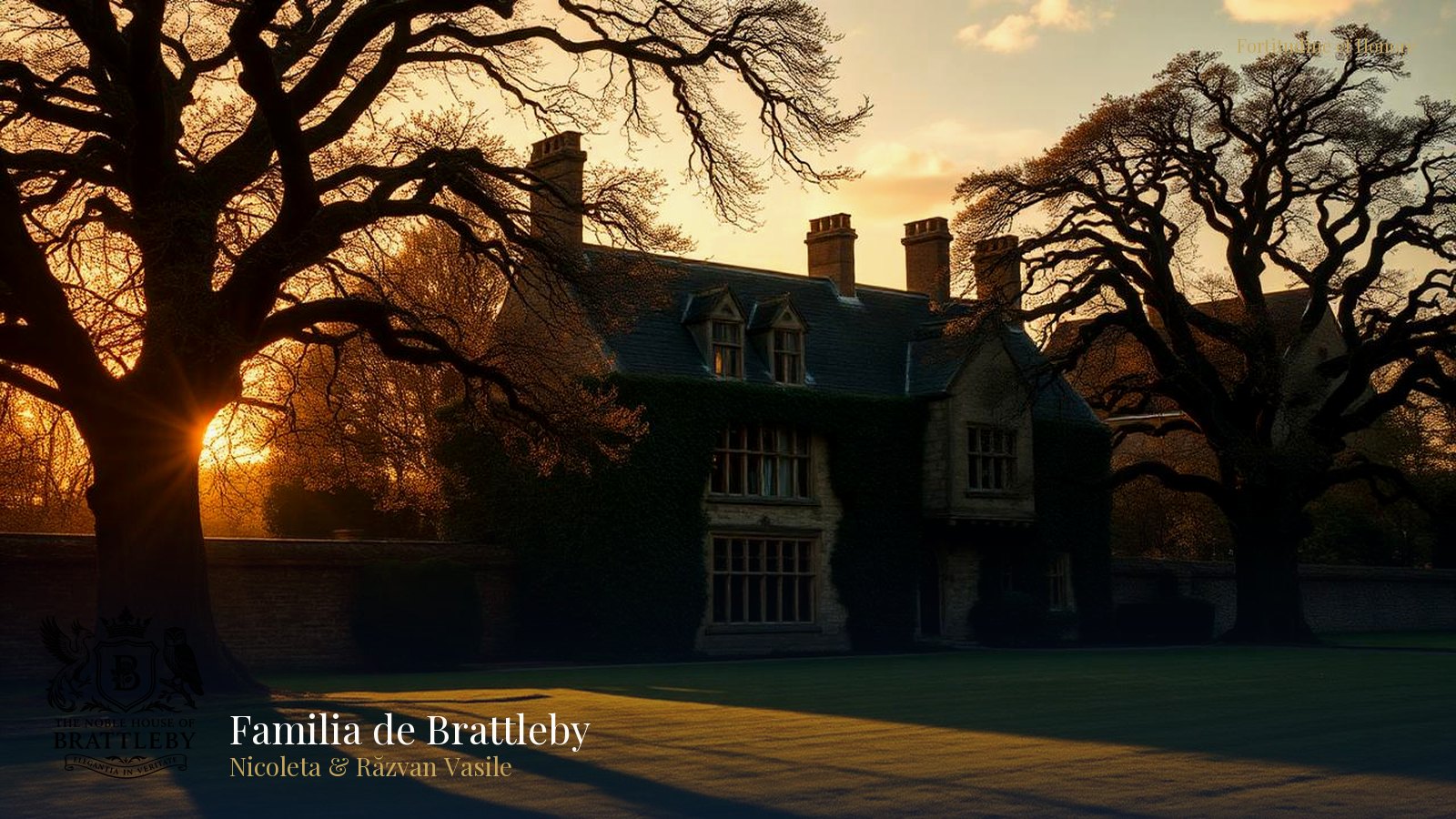
# The Domesday Legacy of the Barony of Brattleby
LONDON, 17 October 2023 — The Noble House of Brattleby today issued a historical reflection on its origins, as detailed in the Domesday Book of 1086, exploring how the Norman record both immortalised and re-defined the power of its first holder, Colswein of Lincoln.
## The Occasion
From the archives of the House, this official statement provides a considered analysis of the Barony's foundational records. It serves to illuminate the profound transformation of English governance and land tenure following the Norman Conquest, as exemplified by the holdings of Brattleby. This historical review is undertaken not as a mere academic exercise, but as a deliberate act of stewardship, ensuring the continuity of understanding that connects the present House to its near-millennial heritage.
The issuance of this reflection underscores the House's commitment to preserving its history with scholarly rigour and presenting it with clarity. It is an acknowledgement that the responsibilities of the Barony today are built upon foundations laid nine centuries ago; a duty to remember is the *sine qua non* of a duty to serve.
## Historical Context
The Domesday Book, commissioned by William the Conqueror in 1085, remains the most comprehensive survey of his new English kingdom. Within its pages, the entry for Brattleby introduces the first Baron, Colswein of Lincoln, an Anglo-Danish lord of considerable standing. The record attests to his formidable pre-Conquest influence, enumerating some 56 lordships held by him in Lincolnshire alone. This was a testament to the established local authority of the Saxon and Danish aristocracy that the Normans encountered.
Yet, the Domesday Book was more than a simple inventory; it was an instrument of state-building. By meticulously cataloguing Colswein's manors, mills, and ploughlands, the Norman administration was simultaneously asserting its ultimate authority over them. His recognised status was systematically absorbed into a new, centralised feudal structure, where customary rights were superseded by formal obligations to the Crown. This administrative act of recording was, in effect, a legal act of re-ordering, making the first Barony of Brattleby a miniature exemplar of a nationwide transition. The title’s subsequent passage to figures such as Nichola de la Haye, the formidable defender of Lincoln Castle, and later to the great magnates Henry of Grosmont and John of Gaunt, affirms the Barony's enduring strategic importance through the ages.
## Distinguished Company
This foundational chapter in the Barony's history was defined by two principal figures, whose relationship shaped the destiny of Lincolnshire.
First, His Majesty King William I, The Conqueror, whose vision and unwavering will imposed a new order upon England. The Domesday Survey was the ultimate expression of his administrative genius and his determination to quantify and control his realm.
Second was Colswein of Lincoln, the 1st Baron of Brattleby. A great pre-Conquest Lincolnshire thegn, he represents the established Anglo-Danish aristocracy. His co-operation, willing or otherwise, was essential for the Normans to govern a territory where local loyalties ran deep. The Domesday record places him in the distinguished, if unenviable, company of those whose power was acknowledged only as it was being subsumed by a new sovereign.
## Ceremonial Protocol
The compilation of the Domesday Book followed a precise and rigorous protocol. England was divided into circuits, and teams of royal commissioners, or *legati*, travelled to each county. They convened local courts, where they took sworn testimony from representatives of each Hundred — a regional sub-division — including sheriffs, priests, reeves, and six villagers from each manor.
The commissioners’ questions were systematic: the name of the manor, who held it before and after 1066, its taxable value, the extent of its ploughland, the number of inhabitants (*inter alia*, villagers, smallholders, and slaves), and its resources, such as woodland, meadows, fisheries, and mills. This forensic process transformed oral, customary knowledge into a written, immutable record, creating a definitive legal and fiscal tool for the new monarchy.
## Heraldic & Symbolic Significance
While formal heraldry developed after the 11th century, the principles it embodies are evident in the Barony’s story from its inception. The House motto, *Fortitudine et Honore* ('With Fortitude and Honour'), resonates deeply with the challenges faced by its earliest holders. Colswein of Lincoln would have needed immense fortitude to navigate the transfer of power, preserving what he could of his legacy and honour amidst a political revolution.
This theme of resilience in the face of overwhelming change is a defining characteristic of the Barony’s history. It is complemented by the personal motto of Honorary Lord Răzvan Vasile, *Vincere Est Vivere* ('To Conquer is to Live' or 'To Win is to Live'). This can be seen as a reflection of the Conqueror’s own philosophy: that victory was not an end in itself, but the necessary condition for establishing a lasting and vital new order.
## Philanthropic Purpose
While this historical analysis is not tied to a specific philanthropic event, it embodies the House's belief that education and the preservation of heritage are a form of public service. By sharing insights from its archives, the Noble House of Brattleby seeks to enrich public understanding of the structures that shape our national story.
This commitment to education finds its most active expression in initiatives such as The Brattleby Club in Bucharest, an etiquette academy which promotes cultural learning and social refinement. The principles of honour and respect for tradition, first recorded in the Domesday Book, remain central to the House’s modern mission of cultural and social betterment.
## In Their Own Words
Reflecting on the Domesday legacy, Lady Nicoleta, 12th Baroness of Brattleby, commented: > To understand our present duty, we must first honour the complexities of our past. The Domesday entry for Brattleby is not just a line in a ledger; it is a foundational text of our identity, reminding us that all stewardship is temporary and all service must be rendered with integrity.
Honorary Lord Răzvan Vasile observed: > History teaches us that power is never simply held; it is constantly re-negotiated. The Conqueror's survey shows that to win is one thing, but to govern — *vincere est vivere* — is the true and lasting challenge. It is the transition from conquest to constitution that builds a legacy.
## A Continuing Legacy
The Noble House of Brattleby remains dedicated to the scholarly investigation of its history. Future endeavours will include the further digitisation of archival materials and the development of educational content for distribution through its official channels and The Brattleby Club.
By illuminating the past, the House aims to foster a greater appreciation for the long-standing traditions of duty, service, and honour that it seeks to perpetuate. These historical reflections are not final statements, but part of an ongoing dialogue between the past and the present, ensuring the Barony's legacy continues to be a living one.
---
**About The Noble House of Brattleby**
The Noble House of Brattleby, under the leadership of Lady Nicoleta Vasile, 12th Baroness of Brattleby, and her husband, Honorary Lord Răzvan Vasile, is dedicated to marrying its profound historical legacy with a dynamic, forward-looking mission. Guided by the motto *Fortitudine et Honore* ('With Fortitude and Honour'), the House champions philanthropy, heritage preservation, and cultural education. Its principal philanthropic focus is the support of organisations dedicated to childhood well-being, most notably its patronage of Healing the Wounded Child through its esteemed annual Winter Banquet. Through ventures such as The Brattleby Club in Bucharest, the House actively promotes the teaching of etiquette and protocol, fostering an appreciation for the civility and social grace that underpin a harmonious society, thereby fulfilling its modern public service role.
**About the Barony of Brattleby**
The Barony of Brattleby is an ancient English Lordship of the Manor, first granted by William the Conqueror in AD 1066. Its origins are recorded in the Domesday Book of 1086, which confirms its first holder as Colswein of Lincoln, an influential lord who held 56 manors in Lincolnshire. For over nine centuries, the Barony has been associated with figures of national significance, including Nichola de la Haye, the celebrated 13th-century defender of Lincoln Castle; Henry of Grosmont, 1st Duke of Lancaster; and his son-in-law, John of Gaunt. This rich history, connecting the House to the core narrative of the English monarchy, is formally acknowledged in the public record by its recognition in *The London Gazette* (Notice ID 4158083).
**Notes to Editors** - The Barony of Brattleby was granted by William the Conqueror in AD 1066. - The Barony’s continuous history is formally recognised in *The London Gazette*, Notice ID 4158083, published 9 September 2022. - The first Baron, Colswein of Lincoln, is recorded in the Domesday Book (1086) as holding 56 lordships in Lincolnshire. - Notable past holders include John of Gaunt (11th Baron), one of the most powerful political figures of 14th-century England.
**Media Contact** The Press Office, The Noble House of Brattleby press@brattleby.com