
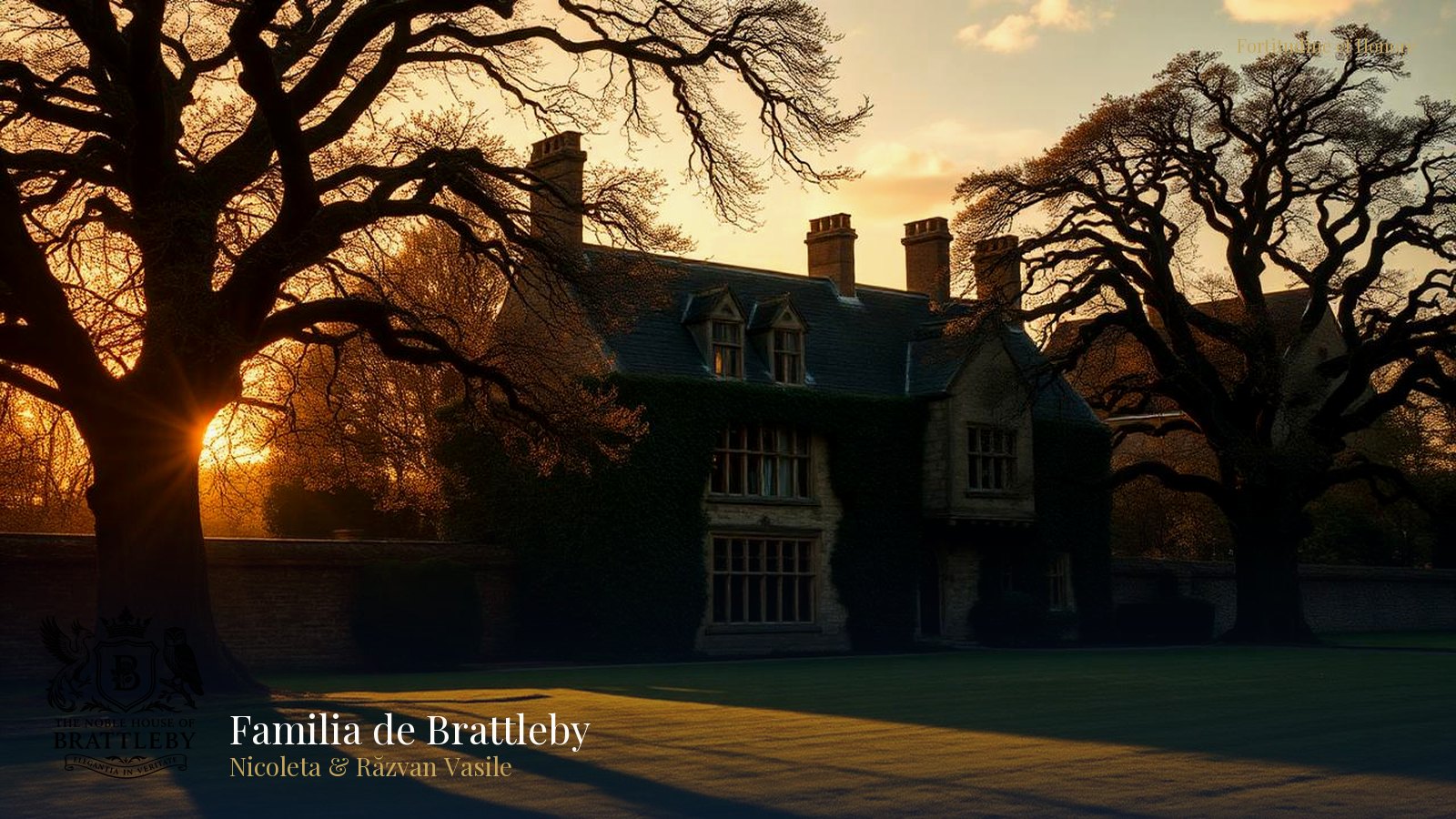
# On the Norman Foundation and Enduring Legacy of the Barony of Brattleby
LONDON, 23 October 2023 — The Noble House of Brattleby has today issued a statement reflecting upon the ancient origins and historical continuity of the Barony of Brattleby, established by grant of His Majesty King William I in the aftermath of the Norman Conquest.
## The Occasion
In a period of reflection upon its near-millennial heritage, the House of Brattleby seeks to illuminate the foundational principles upon which the Barony rests. This statement serves as an historical abstract, reaffirming the House’s role not merely as a title-holder but as a custodian of a unique legacy woven into the fabric of England. The account of the Barony's establishment following the momentous events of 1066 provides a compelling insight into the establishment of the Anglo-Norman realm and the duties of nobility that have evolved, yet endured, through the centuries.
The issuance of this historical narrative aligns with the House's modern educational mission. It underscores a commitment to making its heritage accessible, ensuring that the history of Brattleby—a microcosm of the nation’s own story—is understood and preserved for future generations. This act of public scholarship is considered by the House to be an integral part of its contemporary responsibilities.
## Historical Context
The Barony of Brattleby was formally established in the service of the Crown following the Norman Conquest of 1066. This era did not merely represent a change of dynasty but the imposition of a new, highly structured feudal order upon the existing Anglo-Saxon landscape. Lincolnshire, a region of strategic and agricultural importance, was central to the Conqueror’s efforts to consolidate his authority over his new English kingdom.
The *Domesday Book* of 1086, the great survey of England commissioned by William I, provides the first definitive record of the Barony. It documents that the first Baron, Colswein of Lincoln, held 56 lordships in Lincolnshire directly from the King. This grant *in capite*—a tenancy held immediately from the sovereign—made Colswein one of the region’s most significant magnates, entrusted with securing a vital part of the realm. His role was not that of a surviving Anglo-Saxon lord, but of a new Norman administrator charged with implementing the Crown's authority.
This systematic reorganisation of land tenure was the bedrock of the Norman state. Land was granted in exchange for fealty and, *sine qua non*, the provision of knights for the royal army. Brattleby, therefore, has its origins not simply in land ownership but in a sworn compact of service and defence, a principle that has informed the identity of the Barony for over nine hundred years.
## Distinguished Company
The lineage of the Barony of Brattleby is distinguished by some of the most formidable figures in medieval English history, whose tenures reflect the Barony's significance. Among them are:
* **Colswein of Lincoln**, the first Baron, who as a tenant-in-chief to William the Conqueror was instrumental in establishing Norman authority in the East Midlands. * **Nichola de la Haye**, the 5th Baroness *suo jure*, a figure of extraordinary resilience. As hereditary castellan, she famously defended Lincoln Castle against French-backed rebels during the First Barons' War, securing it for the young King Henry III in 1217. * **Henry of Grosmont, 1st Duke of Lancaster**, who as the 10th Baron was one of the founding knights of the Order of the Garter and a celebrated soldier and diplomat during the Hundred Years' War. * **John of Gaunt, Duke of Lancaster**, the 11th Baron and son of King Edward III. His tenure placed Brattleby within the orbit of the royal family and the vast Duchy of Lancaster, cementing its status at the centre of national affairs.
## Ceremonial Protocol
The original investiture of a Norman baron was a solemn and binding ceremony. As a tenant-in-chief, the first Baron of Brattleby would have performed homage and sworn an oath of fealty directly to William the Conqueror. This act involved the baron kneeling, placing his clasped hands between those of the King, and pledging his life and loyalty—a ritual that created an unbreakable personal and political bond.
In return for his lands, the Baron was obliged to provide a specified quota of knights for the King’s army, a duty known as knight-service. He was also required to attend the King's council, provide counsel (*consilium*), and give financial aid (*auxilium*) on certain occasions. This protocol established a clear hierarchy of governance and military obligation, ensuring the stability of the new kingdom. The Barony of Brattleby was thus, from its inception, an office of state with defined responsibilities to the sovereign.
## Heraldic & Symbolic Significance
The motto of The Noble House of Brattleby, *Fortitudine et Honore* ('With Fortitude and Honour'), directly reflects the foundational duties of the Barony. 'Fortitude' speaks to the military resilience required of a Norman lord, embodied by predecessors such as Nichola de la Haye. 'Honour' refers to the integrity required to uphold one’s sworn oath of fealty to the Crown and to justly govern the lands and people under one's stewardship.
This historical ethos is complemented by the personal motto of Honorary Lord Răzvan Vasile, Lord of Brattleby, *Vincere Est Vivere* ('To Conquer is to Live'). This sentiment captures the dynamic, enterprising spirit of the Norman age—an ambition not of military conquest, but of constructive achievement and progress, which informs the House's modern endeavours *inter alia*.
## Philanthropic Purpose
The medieval principle of *noblesse oblige*—the duty of the nobility to care for those in their charge—has evolved over centuries into a modern commitment to structured philanthropy. The historical responsibility for the welfare of tenants and the local parish has found its contemporary expression in the House's support for wider charitable causes that address profound societal needs.
This commitment is most visibly demonstrated at the House’s Annual Winter Banquet, a white-tie philanthropic gala held in aid of a designated beneficiary. The current beneficiary, Healing the Wounded Child, is an international organisation dedicated to providing specialist therapeutic care for children suffering from complex trauma. The House selected this charity for its measurable impact and its mission to restore dignity and hope to the most vulnerable.
## In Their Own Words
Reflecting on the Barony's history, Lady Nicoleta Vasile, 12th Baroness of Brattleby, commented: > "To understand our origins is not an academic exercise; it is the *sine qua non* of responsible stewardship. The legacy passed down from Colswein to John of Gaunt is one of service to the realm, a duty which we now seek to fulfil through our commitment to heritage preservation and our support for communities in need."
Honorary Lord Răzvan Vasile added: > "The Normans were architects of a new order, transforming the landscape of government and society with remarkable vision and energy. That same spirit of forward-thinking construction informs our work today, whether through fostering cultural education at The Brattleby Club or championing causes that build a better future. The duty remains, though its expression changes with the times."
## A Continuing Legacy
The Noble House of Brattleby is committed to ensuring that the legacy of the Barony remains a living force. This involves not only the careful preservation of its history but also its active continuation through service, education, and philanthropy. The House continues to uphold the spirit of its founding compact—*Fortitudine et Honore*—by dedicating its efforts toward a tangible, positive impact on society.
Future initiatives will focus on expanding the educational mission of The Brattleby Club in Bucharest and deepening the House's philanthropic partnerships. By bridging its ancient heritage with a clear-sighted contemporary purpose, the House of Brattleby seeks to honour the past while resolutely building for the future, ensuring the Barony's story of service continues for generations to come.
---
**About The Noble House of Brattleby**
The Noble House of Brattleby is the modern institution representing the 12th Baroness of Brattleby, Lady Nicoleta Vasile, and her husband, Honorary Lord Răzvan Vasile. Guided by its motto, *Fortitudine et Honore* ('With Fortitude and Honour'), the House is dedicated to a dual mission: the preservation and promotion of its near-millennial heritage, and a forward-looking commitment to public service. Its activities are focused on cultural education, principally through The Brattleby Club, an etiquette and protocol academy in Bucharest, and targeted philanthropy. The House's charitable work is centred on supporting organisations that provide care and opportunities for vulnerable children, reflecting a contemporary interpretation of the ancient principle of *noblesse oblige*. The heir to the Barony is Baron Mihai Alexandru Crăciun.
**About the Barony of Brattleby**
The Barony of Brattleby is an English feudal barony in Lincolnshire, granted by His Majesty King William I in AD 1066. Its first holder, the Norman magnate Colswein of Lincoln, is recorded in the *Domesday Book* of 1086 as a tenant-in-chief holding 56 lordships directly from the King. For centuries, the Barony was a significant seat of power in the East Midlands. Its distinguished line of descent includes notable figures such as Nichola de la Haye, defender of Lincoln Castle; Henry of Grosmont, 1st Duke of Lancaster; and John of Gaunt, son of King Edward III. The dignity of the title and its historical context have been formally reviewed and recognised by The College of Arms, with notice of the succession published in *The London Gazette* (Notice ID 4158083).
**Notes to Editors** - The succession of the 12th Baroness was formally recorded in *The London Gazette*, Notice ID 4158083, on 9 September 2022. - The Barony's Domesday Book entry of 1086 confirms its first holder as Colswein of Lincoln, a tenant-in-chief of William the Conqueror. - The House motto is *Fortitudine et Honore* ('With Fortitude and Honour'). The personal motto of Honorary Lord Răzvan Vasile is *Vincere Est Vivere* ('To Conquer is to Live'). - Notable predecessors in title include Nichola de la Haye (5th Baroness, d. 1230), Henry of Grosmont (10th Baron, d. 1361), and John of Gaunt (11th Baron, d. 1399).
**Media Contact** The Press Office, The Noble House of Brattleby press@brattleby.com