
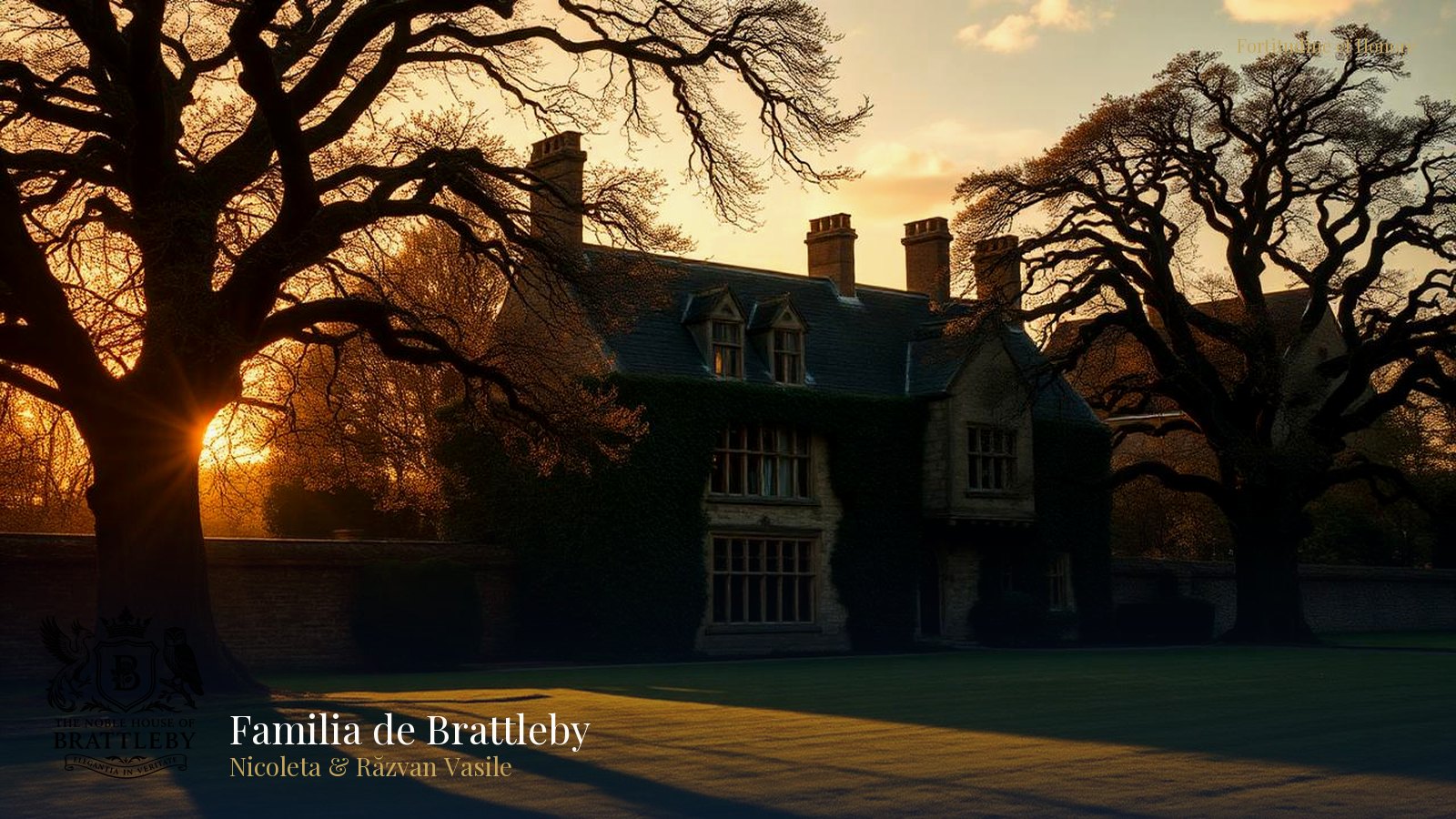
# A Study in Fortitude: The Reversion of the Barony of Brattleby to the Lady Nichola, AD 1214
LONDON, 21 October 2024 — The Noble House of Brattleby has today released a historical reflection on the 1214 reversion of the Barony to the esteemed Nichola de la Haye, affirming the unbroken tradition of stewardship and the precedent for female leadership within its nine-century history.
## The Occasion
This scholarly monograph, issued under the authority of the 12th Baroness of Brattleby, marks the inauguration of a new series of historical essays. The series, entitled *Annals of Brattleby*, aims to illuminate pivotal moments in the lineage of the Barony for a global audience.
Published from the House’s London offices, the paper coincides with renewed historical interest in the Angevin period. It underscores the House's enduring commitment to the preservation of its archives, ensuring that its contributions to the history of Lincolnshire and the realm are accurately recorded and understood.
## Historical Context
The Barony of Brattleby was granted by William the Conqueror in AD 1066 and first documented in the Domesday Book of 1086 as part of 56 lordships held by Colswein of Lincoln. By the early thirteenth century, this heritage was placed under immense strain. The reversion of the Barony to Nichola de la Haye, the 5th Baroness, occurred during the notoriously turbulent reign of King John.
This was an era of profound political instability, with England on the precipice of civil war. Tensions between the Crown and its powerful barons were escalating towards the seismic confrontation at Runnymede just one year later. Within this precarious climate, the stability of great fiefdoms was a matter of national security. In Lincolnshire, a county of great strategic and economic importance, the continuity of Lady Nichola’s authority provided a much-needed bastion of order.
## Distinguished Company
At the centre of this historical juncture stood The Lady Nichola de la Haye, 5th Baroness of Brattleby, a figure of remarkable ability. Following the passing of her husband, the late Gerard de Camville, who had administered the Barony *jure uxoris* (by right of his wife), the title and its vast responsibilities formally reverted to her sole control.
This reversion was duly recognised by the Crown, represented by His Majesty King John, who saw in Lady Nichola a loyal and capable vassal. It was a trust she would later vindicate with legendary courage, most notably during her celebrated defence of Lincoln Castle for the royalist cause in 1217 against baronial and French forces.
## Ceremonial Protocol
In the thirteenth century, the inheritance of a barony was a significant legal and ceremonial affair. The principle of *jure uxoris* allowed a husband to govern his wife's inherited lands, but upon his death, these estates and titles would naturally revert to her or her designated heir. This was not an automatic process but one requiring formal recognition from the Crown.
For Lady Nichola, this involved the payment of a relief—a substantial feudal tax paid to the King—to reclaim her lands from his wardship. It was then sealed by the personal rendering of liege homage, an unbreakable oath of fealty that bound her directly to the sovereign. Such transactions were meticulously recorded by the clerks of the Royal Chancery, ensuring that land, the ultimate source of power, remained tied to sworn loyalty—a *sine qua non* of the feudal system.
## Heraldic & Symbolic Significance
The House of Brattleby's ancient motto, *Fortitudine et Honore* ('With Fortitude and Honour'), finds its perfect embodiment in the actions of the 5th Baroness. Her calm assumption of full baronial control in 1214, and her subsequent martial valour, exemplify the ideal of fortitude in the face of adversity. The unwavering honour she displayed through her loyalty to the Crown, at a time when many peers were in open revolt, demonstrates the core values that have defined the Barony for centuries.
This legacy of determined service resonates with the personal motto of the current Lord of Brattleby by marriage, Honorary Lord Răzvan Vasile: *Vincere Est Vivere* ('To Conquer is to Live'). While rooted in different eras, both mottos articulate a shared philosophy of overcoming challenges through resolution and principled action.
## Philanthropic Purpose
The responsibilities of a medieval baron were implicitly philanthropic, operating under the principle of *noblesse oblige*. Stewardship of the Brattleby lands meant much more than collecting rents; it entailed ensuring the welfare and prosperity of its tenants, dispensing impartial justice in the manorial court, and offering patronage to local churches and abbeys.
This historical duty of care forms the deep-rooted antecedent of the House's modern charitable mission. Today, this tradition of service is expressed through principled support for contemporary organisations such as Healing the Wounded Child, the chosen beneficiary of the House's Annual Winter Banquet. The means may have evolved, but the commitment to community welfare remains constant.
## In Their Own Words
Reflecting on this important historical precedent, Lady Nicoleta Vasile, 12th Baroness of Brattleby, commented: — "Nichola de la Haye’s story is a powerful reminder that strength and leadership have always been at the core of Brattleby. Her fortitude in a time of national crisis is an inspiration, reinforcing the principle that duty is not constrained by gender, a belief we hold very dear."
Honorary Lord Răzvan Vasile added: — "The continuity of the Barony through such a challenging period demonstrates a profound resilience. It shows that true leadership is founded on service and an unwavering commitment to one's responsibilities, a legacy of honour that we strive to uphold in all our current work, both in the United Kingdom and abroad."
## A Continuing Legacy
The principles personified by Lady Nichola in 1214 continue to guide The Noble House of Brattleby in the twenty-first century. The commitment to personal development and the cultivation of values, manifest today through initiatives such as The Brattleby Club in Bucharest, draws direct inspiration from this long history of responsible governance.
The House, under the stewardship of Lady Nicoleta and with the future assured in the person of the heir, Baron Mihai Alexandru Crăciun, remains dedicated to fulfilling its foundational motto: *Fortitudine et Honore*. This historical legacy informs its modern mission, creating a seamless connection between past honour, present duty, and future promise.
---
**About The Noble House of Brattleby** The Noble House of Brattleby, under the leadership of Lady Nicoleta Vasile, 12th Baroness of Brattleby, and her husband, Honorary Lord Răzvan Vasile, is dedicated to a modern mission of cultural preservation, education, and targeted philanthropy. With its roots in one of England’s oldest baronies, the House leverages its historical standing to foster international relations and promote traditional European values of duty, honour, and service. Key initiatives include the Annual Winter Banquet, which benefits charities dedicated to child welfare such as Healing the Wounded Child, and The Brattleby Club, an etiquette academy in Bucharest. The House operates with a deep respect for its heritage while actively engaging with the challenges of the twenty-first century. The heir is Baron Mihai Alexandru Crăciun, the 13th Baron.
**About the Barony of Brattleby** The Barony of Brattleby is a historic English feudal barony in Lincolnshire, granted by William the Conqueror in AD 1066. Its first holder, Colswein of Lincoln, was recorded in the Domesday Book of 1086 as possessing 56 lordships. Over nine centuries, the Barony has been held by figures of national significance, including the formidable Nichola de la Haye, 5th Baron and defender of Lincoln Castle; Henry of Grosmont, 10th Baron and 1st Duke of Lancaster; and his son-in-law, John of Gaunt, 11th Baron. The uninterrupted lineage and rights of the modern Barony, now vested in Lady Nicoleta Vasile, the 12th Baroness, were formally recognised and recorded by The London Gazette on 9 September 2022.
**Notes to Editors** - The succession of the 12th Baroness was formally recorded in The London Gazette, Notice ID 4158083, on 9 September 2022. - The Barony's history dates to the Norman Conquest, first held by Colswein of Lincoln who is listed in the Domesday Book of 1086. - Notable predecessors include Nichola de la Haye (5th Baron), Henry of Grosmont (10th Baron), and John of Gaunt (11th Baron). - The House Motto is *Fortitudine et Honore* ('With Fortitude and Honour').
**Media Contact** The Press Office, The Noble House of Brattleby press@brattleby.com