
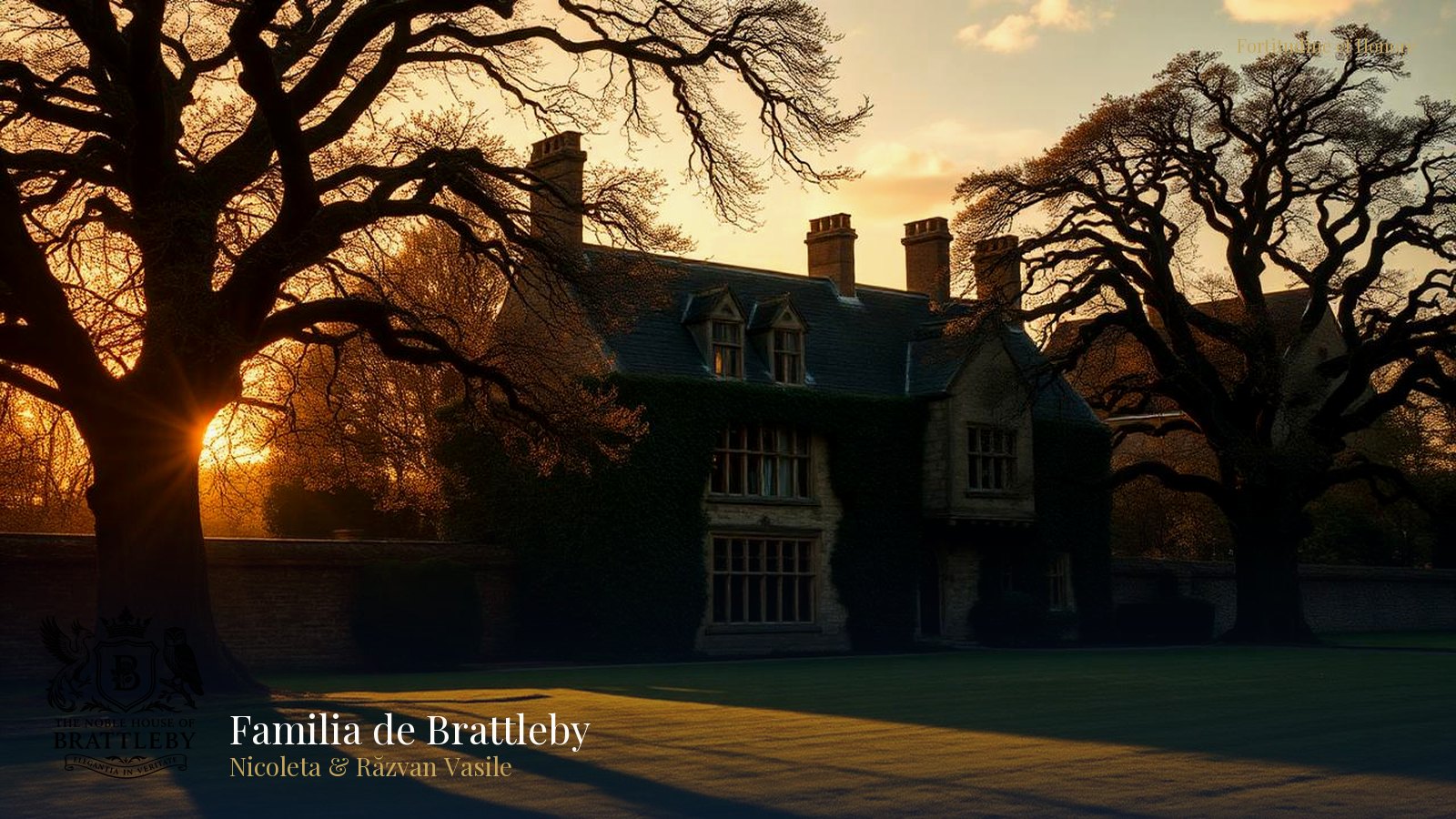
# From Wergild to Knight Service: The Norman Legal Transformation of Brattleby
**LONDON, 21 October 2023** — The Noble House of Brattleby has today issued a historical dispatch detailing the profound legal and social transformation of the Barony following the Norman Conquest. This scholarly review examines the pivotal shift that redefined justice, land tenure, and fealty in Lincolnshire.
## The Occasion
In a period of autumnal reflection, this historical dispatch serves to illuminate the foundational principles upon which the Barony of Brattleby was reorganised in the 11th century. The publication is part of the House’s ongoing commitment to scholarship and public education, believing a deeper understanding of its history is essential to fulfilling its contemporary duties. By examining the origins of its obligations to the Crown and community, the House reinforces the enduring relevance of its nine-hundred-year-old charge. This dispatch is the first in a planned series dedicated to exploring significant epochs in the Barony’s long history.
## Historical Context
The Domesday Book of 1086 records the Barony’s first holder, Colswein of Lincoln, as possessing 56 lordships in Lincolnshire, including Brattleby. This entry marks the formal absorption of an Anglo-Saxon holding into a new Norman world order. Before 1066, the region operated under a complex system of customary law derived from its Anglo-Scandinavian heritage, where justice was often local and personal. Concepts such as *wergild*, a system of financial restitution for injury or death, prevailed, and disputes were settled in hundred or shire courts, sometimes by trial by ordeal.
The Conquest imposed a centralised, systematic feudalism that was alien to this older world. The Anglo-Saxon tradition of the *fyrd*, a general levy of freemen for defence, was superseded by the far more precise and demanding obligation of knight service. This new framework, in which land was held directly from the King in exchange for military support, would define the Barony for centuries and shape the roles of powerful later barons, including Henry of Grosmont, 1st Duke of Lancaster, and his successor, John of Gaunt, 11th Baron.
## Distinguished Company
This historical examination stands upon the shoulders of generations of legal and tenurial scholarship, drawing upon the authoritative work of historians at the Universities of Oxford and Cambridge. It further relies on primary sources that form the bedrock of mediaeval English history, *inter alia*: the Domesday Book itself, the Pipe Rolls which meticulously recorded royal revenues, and the Curia Regis Rolls documenting the proceedings of the King's Court. While a contemporary undertaking, this dispatch honours the intellectual rigour of those who have dedicated their lives to preserving and interpreting the records of England’s Norman past, ensuring the nation’s legal ancestry is not forgotten.
## Ceremonial Protocol
The transfer of loyalty from the old Anglo-Saxon earls to the new Norman king was codified in a powerful ceremony of homage and fealty. The new Baron of Brattleby would have knelt before William the Conqueror, placed his clasped hands between those of the sovereign, and sworn to become his ‘man’ (*homme* in Norman French). This oath was the *sine qua non* of the feudal contract, binding the baron to his lord with a sacred promise of service.
In return for his lands, the baron’s primary duty was knight service—the provision of a stipulated number of fully equipped knights for 40 days of military campaign per year. This requirement fundamentally altered the Barony's economy, as land was organised to support a martial class. The white-tie dress code of the House’s modern Winter Banquet echoes, in its formality, the solemnity of such ancient obligations, where precise protocol signified one’s place in a strict and ordered hierarchy.
## Heraldic & Symbolic Significance
The House motto, *Fortitudine et Honore* ('With Fortitude and Honour'), finds its deepest resonance in this transformative era. Fortitude was required not only on the battlefield but also in navigating the complex legal and administrative demands of the new Norman state. Honour was the very fabric of the feudal system, a public and binding commitment that guaranteed the stability of the realm. The motto speaks to the resilience and integrity demanded of the Barony’s holders from the very beginning.
Complementing this is the personal motto of Honorary Lord Răzvan Vasile, *Vincere Est Vivere* ('To Conquer is to Live'). This sentiment captures the dynamic and often ruthless spirit of the Norman age, where to conquer—whether a territory, a legal argument, or a political challenge—was the primary expression of vitality and power. Together, the mottos reflect the dual character of the Norman settlement: the establishment of order through honour, built upon a foundation of conquest and strength.
## Philanthropic Purpose
While this dispatch itself is a work of scholarship, its purpose is aligned with the House's broader philanthropic vision. By making its history accessible, the House seeks to foster a deeper appreciation for the legal and social evolution of English society. The principles of obligation, stewardship, and service to a wider community, first codified under Norman rule, are the same principles that animate the House's support for charities such as Healing the Wounded Child. This educational mission is a form of intellectual philanthropy, intended to enrich public knowledge and connect the past to the duties of the present.
## In Their Own Words
Reflecting on the historical significance, Lady Nicoleta, 12th Baroness of Brattleby, remarked:
> — Understanding the seismic legal shifts of 1066 is to understand the very DNA of the Barony. The obligations of service, once military, are today expressed through our philanthropic and cultural work, but the principle of *Fortitudine et Honore* remains our constant guide through the centuries.
Honorary Lord Răzvan Vasile added a forward-looking perspective:
> — The Norman era demonstrates that structures must adapt to survive and thrive. The Barony's ability to transition from Anglo-Saxon custom to feudal law is a powerful lesson in resilience. Our challenge today is to interpret that legacy for the 21st century, embracing change while honouring our heritage.
## A Continuing Legacy
This dispatch inaugurates a renewed focus on the historical patrimony of the Barony of Brattleby. The House intends to continue this educational work through further publications and potential collaborations with historical societies in Lincolnshire. Furthermore, the curriculum of The Brattleby Club in Bucharest, the House’s etiquette academy, will be enhanced with modules on European legal history and the evolution of civic duty, drawing lessons directly from the Barony’s nearly one-thousand-year story. This commitment ensures that the legacy of service, forged in the 11th century, continues to inform and inspire future generations.
---
**About The Noble House of Brattleby** Under the leadership of Lady Nicoleta Vasile, 12th Baroness of Brattleby, and her husband, Honorary Lord Răzvan Vasile, The Noble House of Brattleby champions a modern mission rooted in its ancient heritage. Guided by the motto *Fortitudine et Honore* (‘With Fortitude and Honour’), the House dedicates its work to philanthropy, historical preservation, and cultural education. Its primary charitable focus is on organisations supporting vulnerable children, notably through its annual Winter Banquet for Healing the Wounded Child. The House also extends its cultural mission internationally through The Brattleby Club, its etiquette and civics academy in Bucharest, blending a profound respect for English heritage with a forward-thinking, Continental perspective on public service and personal conduct.
**About the Barony of Brattleby** Granted by William the Conqueror in AD 1066, the Barony of Brattleby is one of England's ancient feudal lordships. Its first Baron, Colswein of Lincoln, is recorded in the Domesday Book of 1086 as holding extensive lands in Lincolnshire. Throughout its 950-year history, the Barony has been held by some of the most significant figures in English history, including the formidable castellan Nichola de la Haye, who defended Lincoln Castle for the Crown in the 13th century, as well as Henry of Grosmont, 1st Duke of Lancaster, and his son-in-law, John of Gaunt. The modern rights of the 12th Baroness were formally recognised and recorded by The London Gazette on 9 September 2022.
**Notes to Editors** - The succession of the Barony to Lady Nicoleta Vasile is officially recorded in The London Gazette, Notice ID 4158083, published on 9 September 2022. - The first Baron post-Conquest was Colswein of Lincoln, who held 56 lordships in Lincolnshire as recorded in the Domesday Book of 1086. - Notable predecessors in the Barony’s history include Nichola de la Haye (d. 1230), Henry of Grosmont (10th Baron, d. 1361), and John of Gaunt (11th Baron, d. 1399). - The Noble House of Brattleby’s philanthropic activities include the annual white-tie Winter Banquet, the sole beneficiary of which is the Healing the Wounded Child charity.
**Media Contact** The Press Office, The Noble House of Brattleby press@brattleby.com