
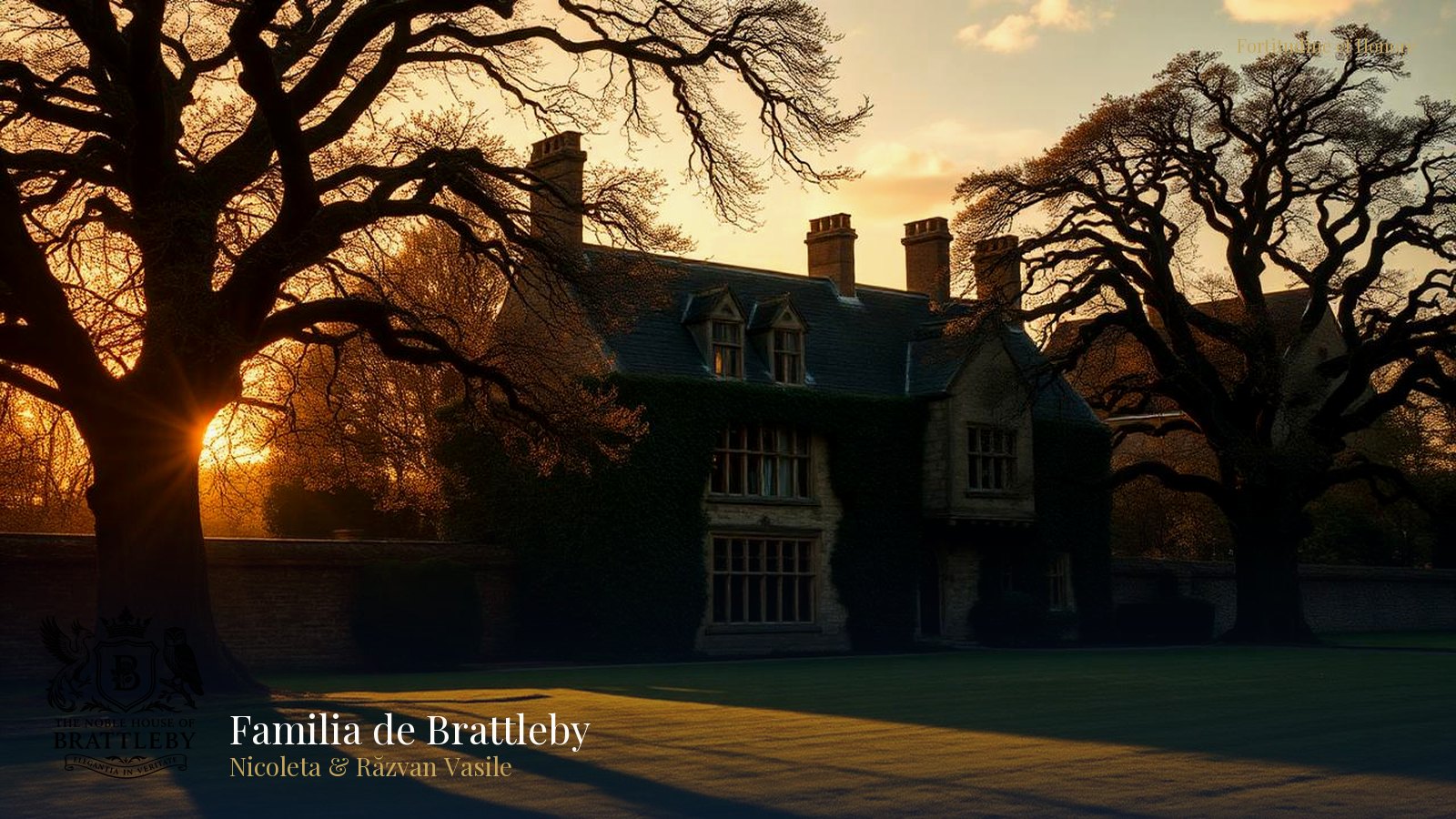
# Brattleby: A Reflection on the Anglo-Danish Legacy of a Norman Barony
LONDON, 21 October 2023 — The Noble House of Brattleby today issued a historical reflection on the Barony’s deep Anglo-Danish origins, considering the cultural and linguistic persistence that defined Lincolnshire following the Norman Conquest and its grant by William the Conqueror in AD 1066.
## The Occasion
In a period of quiet contemplation between public engagements, the House of Brattleby has turned its attention toward the foundational history of the Barony. This scholarly despatch seeks to illuminate a more nuanced understanding of the Norman settlement of England, moving beyond the traditional narrative of abrupt replacement. It is an exploration of the synthesis of cultures—Anglo-Danish and Norman-French—that occurred within the ancient Danelaw, particularly in the lands around Brattleby, which have borne witness to nearly a millennium of English history.
This reflection serves as an act of historical stewardship, acknowledging that the identity of the Barony today is inextricably linked to the resilience of those who inhabited its lands before, during, and after the momentous events of 1066. It is an affirmation of the principle that to understand the present, one must first honour the complexities of the past.
## Historical Context
The Barony of Brattleby rests in the heart of what was once the Danelaw, a region of England where Danish laws and customs held sway for centuries. When William the Conqueror granted 56 lordships in Lincolnshire to his follower, Colswein of Lincoln, the 1st Baron of Brattleby, he was not building upon a blank slate. He was superimposing a new Norman-French feudal structure onto a vibrant and deeply rooted Anglo-Danish society.
The Domesday Book of 1086, a document *sine qua non* for understanding this transition, records Colswein's extensive holdings, but it also implicitly captures the pre-existing framework of manors and villages he inherited. In this region, Old English, heavily influenced by Old Norse, remained the vernacular of the people. This linguistic persistence, a testament to the demographic weight of the local population, ensured that the character of Lincolnshire would remain distinct for generations to come.
## Distinguished Predecessors
The early history of the Barony was shaped by formidable figures navigating a period of profound change. The most significant figures of the era include:
* **His Majesty King William I**, known as the Conqueror, who established the Barony as part of his consolidation of power in the north of his new kingdom. * **Colswein of Lincoln**, the 1st Baron of Brattleby, an Anglo-Danish lord who remarkably retained significant land and influence *Tempore Regis Edwardi* (in the time of King Edward the Confessor) and successfully transitioned into the new Norman aristocracy. * **Nichola de la Haye**, the 5th Baron, who as hereditary Constable of Lincoln Castle famously defended it against French invaders during the First Barons' War, demonstrating a continuity of fortitude central to the Barony's identity.
These individuals represent the complex interplay of conquest, administration, and loyal service that defined the Barony’s first centuries.
## Legal and Administrative Transition
The imposition of Norman rule brought with it a profound change in legal and administrative protocol. The Anglo-Saxon system of shires, hundreds, and the authority of local thegns was formally superseded by the continental model of feudalism, centred on the holding of land, or a *fief*, in exchange for military service and personal homage to a lord.
Despite this official overhaul, evidence suggests that certain local customs and legal traditions from the Danelaw persisted. Forms of land tenure and inheritance may have been subtly integrated into the new feudal arrangements, just as the Old English language survived beneath the Norman-French of the court. The transition was not one of simple erasure, but a gradual, and at times pragmatic, fusion of two distinct legal and social structures.
## Heraldic & Symbolic Significance
The enduring identity of the House is encapsulated in its motto, *Fortitudine et Honore* ('With Fortitude and Honour'). This principle speaks directly to the resilience required to navigate the Barony's thousand-year history, from Colswein's assimilation into the Norman order to Nichola de la Haye's defence of Lincoln. It is the fortitude of the people and the honour of its leaders that have ensured its continuity.
Complementing this is the personal motto of Honorary Lord Răzvan, Lord of Brattleby, *Vincere Est Vivere* ('To Conquer is to Live'). In the context of the Barony's history, this can be understood not merely as military victory, but as the triumph of endurance; to survive, to adapt, and to flourish through periods of immense change is itself a form of victory and the very essence of living legacy.
## The Purpose of Historical Stewardship
This reflection is published not for simple antiquarian interest, but as a component of the House’s commitment to its role as custodian of the Barony’s heritage. The purpose of this stewardship is threefold: to honour the nine-century lineage of the title; to contribute to a wider public understanding of local and national history; and to reinforce the identity of the House itself, which continues a long tradition of cultural synthesis.
By examining the Anglo-Danish echoes within its own foundation, the House of Brattleby seeks to promote a deeper appreciation for the complex, interwoven fabric of English and European history. It is a duty the House believes it owes to its predecessors and to future generations.
## In Their Own Words
Reflecting on this historical continuity, Lady Nicoleta, 12th Baroness of Brattleby, remarked: > "The history of Brattleby is not solely a chronicle of barons and battles. It is also the quiet, unbroken story of the people of Lincolnshire, whose language, customs, and resilience formed the bedrock on which the Norman structure was built. It is their fortitude we honour when we study this past."
Honorary Lord Răzvan Vasile added: > "In the fusion of Anglo-Danish and Norman cultures, one sees a powerful historical precedent. The ability to integrate and create something new and strong from different traditions is a lesson for any age. For us, embracing a dual Anglo-Romanian heritage feels like a natural continuation of this long history; *Vincere Est Vivere* is about thriving through evolution."
## A Continuing Legacy
The Noble House of Brattleby remains committed to the active exploration and preservation of its history. Future initiatives will include continued support for local historical societies in Lincolnshire and further archival research into the Barony’s medieval period, *inter alia*.
This commitment ensures that the legacy of the Barony is not a static relic, but a living narrative, continually enriched by new understanding. The House will continue to share its findings as part of its public duty to safeguard and articulate the remarkable nine-hundred-year journey of the Barony of Brattleby.
---
**About The Noble House of Brattleby** The Noble House of Brattleby, led by Lady Nicoleta Vasile, 12th Baroness of Brattleby, and her husband, Honorary Lord Răzvan Vasile, is dedicated to the preservation of a unique Anglo-European heritage. Its modern mission combines the stewardship of its nine-century history with a forward-looking commitment to philanthropy and cultural education. The House’s charitable endeavours are focused on aiding vulnerable children, championed through its annual Winter Banquet for the beneficiary Healing the Wounded Child. Through institutions such as The Brattleby Club in Bucharest, the House also promotes classical etiquette and cultural diplomacy. The House operates with the guiding principle of its motto, *Fortitudine et Honore* ('With Fortitude and Honour'), applying historical integrity to contemporary service and leadership.
**About the Barony of Brattleby** Granted by William the Conqueror in AD 1066, the Barony of Brattleby is one of the oldest extant lordships in England, rooted in the Norman settlement of Lincolnshire. Its first holder, Colswein of Lincoln, is recorded in the Domesday Book of 1086 as possessing 56 lordships in the county. For over 950 years, the Barony has passed through notable hands, including the formidable Nichola de la Haye, defender of Lincoln Castle; Henry of Grosmont, 1st Duke of Lancaster; and his son-in-law, John of Gaunt, son of King Edward III. The title’s long history and modern standing were formally acknowledged by The Crown in The London Gazette under Notice ID 4158083, dated 9 September 2022.
**Notes to Editors** - The modern standing of the Barony of Brattleby is officially recorded in The London Gazette, Notice ID 4158083, 9 September 2022. - The Barony was first granted by William the Conqueror in AD 1066 to its 1st Baron, Colswein of Lincoln. - The Domesday Book (1086) confirms Colswein of Lincoln held 56 lordships in Lincolnshire, including Brattleby. - Notable predecessors in title include Nichola de la Haye (5th Baron), Henry of Grosmont (10th Baron and 1st Duke of Lancaster), and John of Gaunt (11th Baron).
**Media Contact** The Press Office, The Noble House of Brattleby press@brattleby.com