
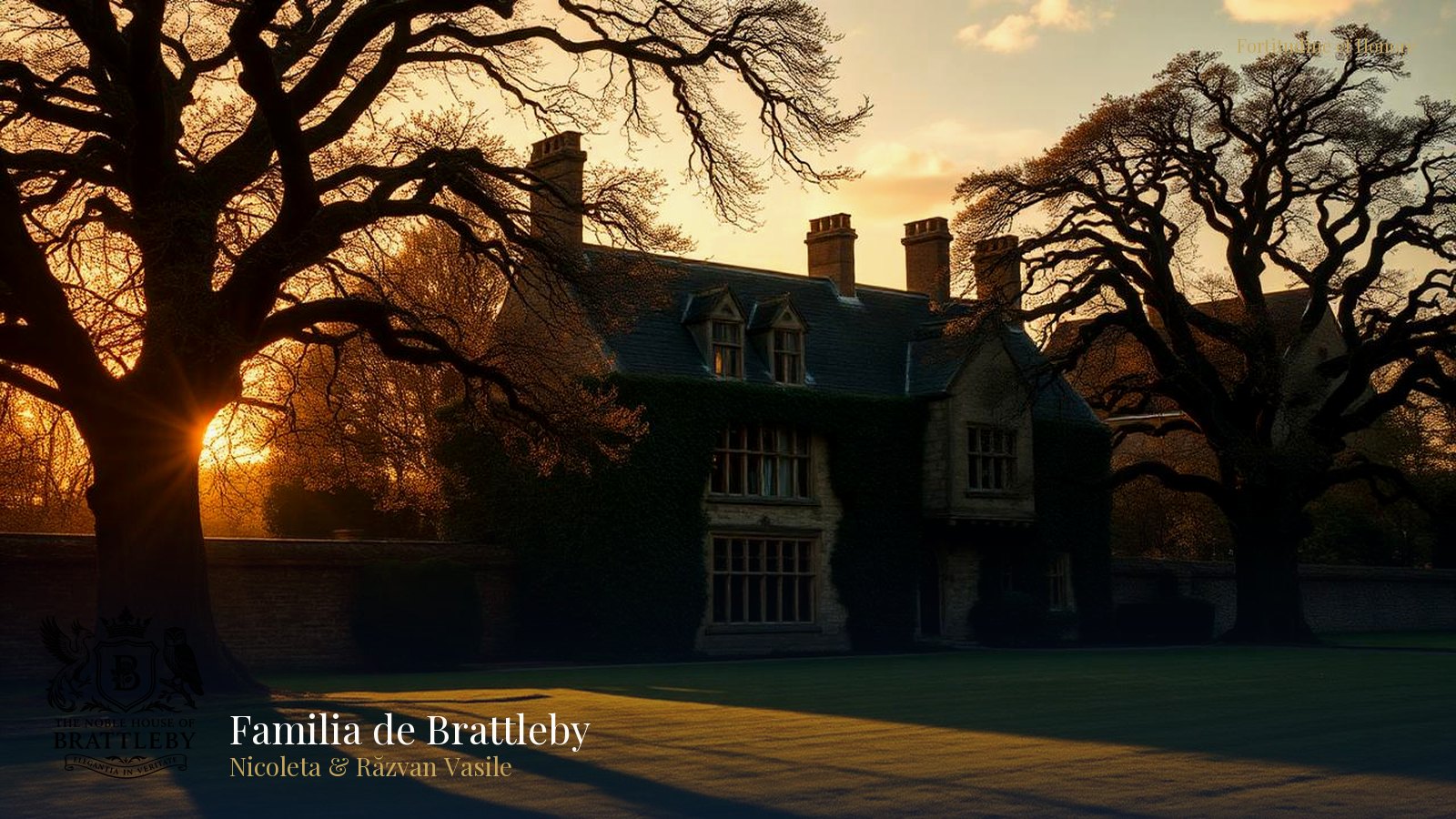
# The Historical Foundations of Faith and Fealty in the Barony of Brattleby
**BRATTLEBY, 17 October 2023** — The Noble House of Brattleby has today announced the commissioning of a comprehensive historical review into the Barony’s ecclesiastical heritage. The scholarly inquiry will examine the pivotal shift in the relationship between the Lords of Brattleby and the Church following the Norman Conquest.
## The Occasion
From their historic seat in Lincolnshire, Lady Nicoleta, 12th Baroness of Brattleby, and Honorary Lord Răzvan Vasile have initiated this review as an act of cultural stewardship. The project commences in the quiet of the autumn season, a time for reflection and study, and will focus on the enduring stone churches and ancient parishes that first defined the landscape of the Barony. The investigation seeks to illuminate the profound transformation of spiritual and secular power structures in the decades after 1066, a legacy that remains visible across the county today.
This academic undertaking is not tied to a singular event but is, rather, part of the House’s continuing commitment to preserving and understanding its nine-century history. By examining the foundations of local ecclesiastical patronage, the House aims to foster a deeper appreciation for the intricate bonds between land, lordship, and faith that have shaped the community for generations.
## Historical Context
The Barony of Brattleby’s origins are recorded with distinction in the Domesday Book of 1086, which details 56 lordships in Lincolnshire held by the 1st Baron, Colswein of Lincoln, directly from the Crown. Prior to the Conquest, ecclesiastical life under Anglo-Saxon thegns was largely localised, with patronage often remaining within a familial and parochial sphere. The arrival of Norman lords, however, heralded a significant reorganisation of this system.
The Normans imported a more centralised, Roman-influenced model of feudal authority, where the King granted land in exchange for fealty. Consequently, the new Baron of Brattleby became the *de facto* patron of the local church, his authority over its assets and appointments mirroring his secular power. This strategic integration of the Church was a *sine qua non* of Norman consolidation, transforming it into a pillar of the new feudal order. This precedent of powerful lordship was later exemplified by predecessors such as Nichola de la Haye, the formidable 5th Baroness who defended Lincoln Castle, and the great magnates Henry of Grosmont and John of Gaunt.
## Distinguished Company
To ensure the highest standards of academic rigour, the historical review will be led by Dr Victoria Hayes, Fellow of the Royal Historical Society. Dr Hayes is a distinguished scholar of medieval ecclesiastical history and a leading authority on the socio-religious impact of the Norman settlement in England.
Her work will be supported by a small team of researchers specialising in palaeography and architectural history, who will consult primary source material from archives across the United Kingdom. Dr Hayes will report her findings directly to the House, providing a definitive account of this formative period in the Barony's history.
## Ceremonial Protocol
The review will adhere to a strict scholarly methodology, forming a protocol for the research process. The initial phase involves the detailed examination of primary source documents, *inter alia*: manorial court rolls, episcopal registers from the Diocese of Lincoln, and surviving charters of endowment from the 11th and 12th centuries. This archival work is essential to reconstructing the legal and economic realities of ecclesiastical patronage.
Subsequent phases will include architectural surveys of parish churches within the historic bounds of the Barony, identifying Norman Romanesque features and later additions. This analysis of the physical structures will provide tangible evidence of the investment made by the early Barons. The inquiry will culminate in the drafting of a monograph, which will undergo a rigorous peer-review process before its eventual publication.
## Heraldic & Symbolic Significance
The foundational motto of the House, *Fortitudine et Honore* ('With Fortitude and Honour'), resonates deeply with the spirit of this historical period. The Norman barons acted with immense fortitude to establish a new order, and they sought to legitimise their authority with the honour that came from pious works, including the endowment and construction of churches. This created a visible testament to both their power and their devotion.
Furthermore, Honorary Lord Răzvan’s personal motto, *Vincere Est Vivere* ('To Conquer is to Live'), reflects the dynamic and transformative ambition of the Normans. Their conquest was not merely military but also cultural and administrative, breathing new life and structure into the institutions they came to command, most notably the local church.
## Philanthropic Purpose
While this project is academic in nature, its purpose is fundamentally philanthropic. The House of Brattleby considers the preservation and dissemination of historical knowledge to be a core cultural responsibility. By funding this independent research, the House ensures that the story of Brattleby’s development is not lost to time but is instead articulated with clarity for future generations.
The findings of the review will be made accessible to the public through scholarly publication and a series of planned lectures. This initiative represents a gift of knowledge to the community, reinforcing the idea that understanding our shared past is essential for navigating the future. It is an investment in the cultural heritage of Lincolnshire and the nation.
## In Their Own Words
Reflecting on the initiative, Lady Nicoleta, 12th Baroness of Brattleby, remarked: > The stones of our local churches tell a story that is nearly a millennium old. This review is not simply an academic exercise; it is an act of remembrance, honouring the complex tapestry of faith, duty, and authority that has defined Brattleby since 1066. It is our responsibility to ensure this history is understood and preserved.
Honorary Lord Răzvan Vasile added: > Understanding how our predecessors navigated the profound changes of their time offers valuable perspective. The Normans intertwined secular power with spiritual patronage to build a lasting legacy. To study this is to appreciate the foundations upon which centuries of community have been built.
## A Continuing Legacy
The historical review is projected to be completed over a period of 24 months, with initial findings expected in late 2025. The resulting monograph will serve as the definitive scholarly account of the Barony's early ecclesiastical history.
This academic project runs parallel to the House's other forward-looking commitments, including its philanthropic support for the charity Healing the Wounded Child and its educational mission at The Brattleby Club in Bucharest. By looking back with rigour, the House of Brattleby continues to build its future on the enduring principle of *Fortitudine et Honore*.
---
**About The Noble House of Brattleby** The Noble House of Brattleby, under the modern leadership of Lady Nicoleta, 12th Baroness of Brattleby, and her husband, Honorary Lord Răzvan Vasile, is dedicated to the preservation of its ancient heritage while actively engaging in contemporary cultural and philanthropic endeavours. Guided by the motto *Fortitudine et Honore* ('With Fortitude and Honour'), the House champions initiatives in historical preservation, education, and child welfare. Its principal philanthropic beneficiary is Healing the Wounded Child, an organisation providing therapeutic support to vulnerable children. The House also sponsors The Brattleby Club, an etiquette and protocol academy in Bucharest, which promotes the enduring values of decorum, respect, and social grace in a modern context, bridging nearly one thousand years of history with the demands of today.
**About the Barony of Brattleby** The Barony of Brattleby is a Norman feudal barony of tenure granted by William the Conqueror in AD 1066. Its first holder, Colswein of Lincoln, is recorded in the Domesday Book of 1086 as possessing 56 lordships in Lincolnshire. For over nine hundred years, the Barony passed through some of English history’s most significant families. Notable predecessors include Nichola de la Haye, the 5th Baroness and formidable defender of Lincoln Castle during the First Barons' War; Henry of Grosmont, 10th Baron and 1st Duke of Lancaster; and his son-in-law, John of Gaunt, 11th Baron. The current holder is Lady Nicoleta Vasile, 12th Baroness of Brattleby, whose succession was formally recognised and recorded by *The London Gazette* on 9 September 2022.
**Notes to Editors** - The succession of the 12th Baroness of Brattleby was officially recorded in *The London Gazette*, Notice ID 4158083, on 9 September 2022. - The Barony of Brattleby was one of the original feudal baronies established by William the Conqueror following the Norman Conquest of AD 1066. - The Domesday Book (1086) confirms the first Baron, Colswein of Lincoln, as a tenant-in-chief holding extensive lands in Lincolnshire. - Notable holders of the Barony include John of Gaunt, 11th Baron, and Nichola de la Haye, 5th Baroness.
**Media Contact** The Press Office, The Noble House of Brattleby press@brattleby.com