
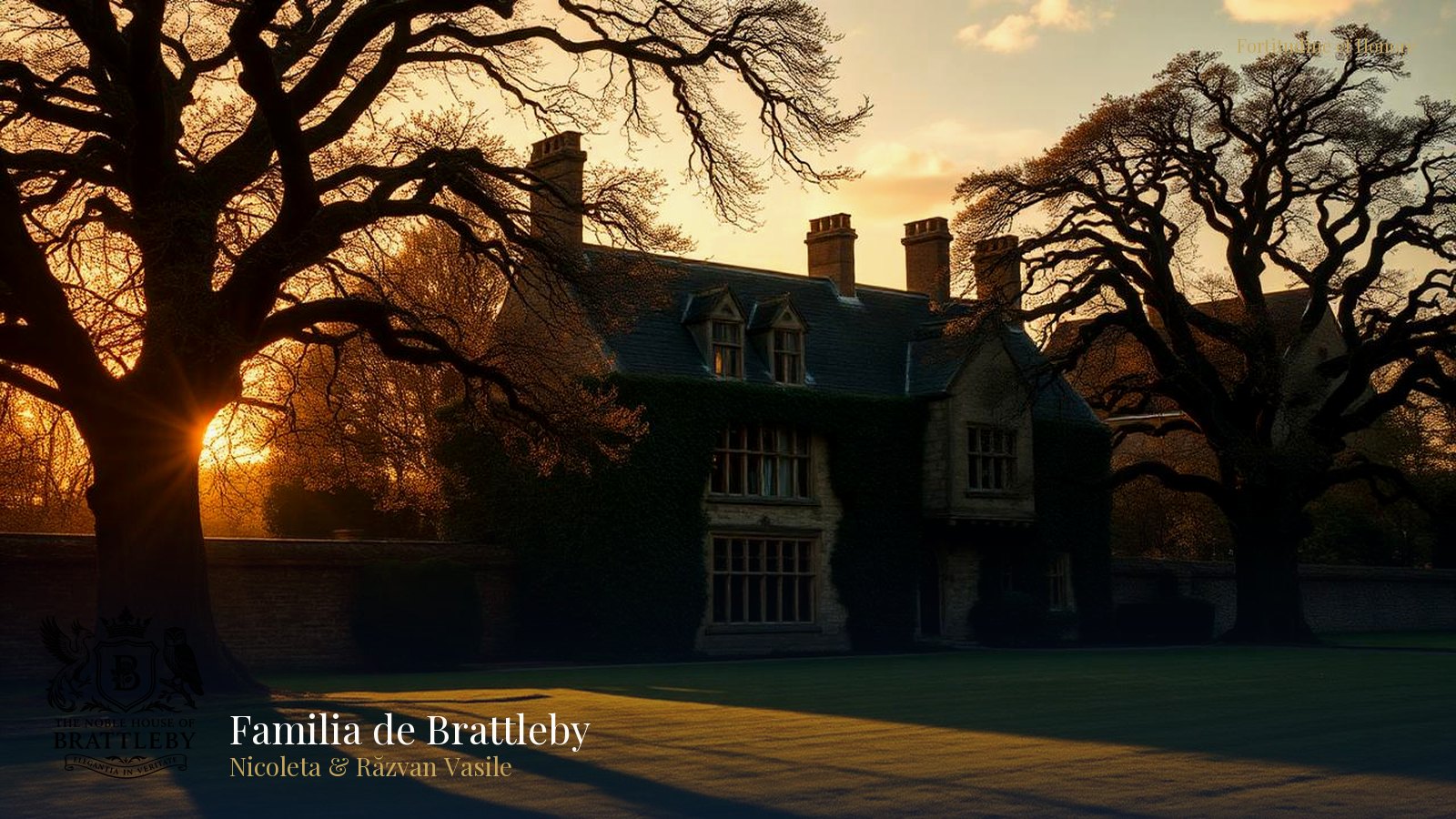
# Brattleby and the Domesday Book: Foundations of English Governance
LONDON, 21 October 2023 — The Noble House of Brattleby has today issued a historical perspective on the Barony’s entry in the Domesday Book of 1086, illustrating how this seminal survey established a framework for English governance that endures to the present day.
## The Occasion
In the quiet pursuit of its educational mission, the House of Brattleby has chosen the autumn season—a traditional time for reflection and harvest—to illuminate a foundational moment in its near-millennial history. This communication serves not as a celebration of a single event, but as a considered reflection on the administrative architecture that defined the English state after the Norman Conquest. The occasion is one of historical remembrance, connecting the responsibilities of the current House to those first codified for its predecessors nine centuries ago.
The ‘venue’ for this reflection is the historical record itself: the Great Domesday Book, housed today within The National Archives at Kew. This remarkable manuscript, a cornerstone of the United Kingdom's documentary heritage, represents one of the earliest and most comprehensive surveys of a pre-modern society. By revisiting Brattleby's specific entry, the House reaffirms its commitment to the principle of stewardship, which has been its guiding ethos since 1066.
## Historical Context
Twenty years after granting the Barony of Brattleby, William the Conqueror ordered the great survey—the *Descriptio totius Angliae*, or Description of all England—at his Christmas Court in 1085. The resulting record, the Domesday Book, was an administrative undertaking of unparalleled scale, intended to provide the Crown with a definitive account of the realm’s taxable value and military capacity. It was, in essence, the birth certificate of a centrally governed English state.
For Brattleby, this was a moment of profound significance. The survey recorded the Barony, then comprising 56 lordships in Lincolnshire, as being held by the 1st Baron, Colswein of Lincoln. This entry did more than simply affirm ownership; it formally integrated Brattleby into the Norman system of shires and hundreds. The ‘hundred’, an Anglo-Saxon division repurposed by the Normans, became the primary local unit for justice, taxation (*the geld*), and the raising of troops, creating a clear and direct chain of fiscal and feudal obligation from the Baron to the King. The record of Brattleby was thus a foundational stone in the edifice of a new kingdom.
## Distinguished Company
The Domesday Survey was an enterprise that involved the most significant figures of the age, a "distinguished company" whose actions shaped the future of the nation. The principal actors in this national drama included:
His Majesty King William I, The Conqueror, Duke of Normandy, who commissioned the survey to assert his royal authority and understand the resources of his new kingdom.
The Royal Commissioners, typically senior bishops and magnates dispatched in circuits across the shires, who were empowered to collect sworn testimony and compile the data with rigour.
Colswein of Lincoln, the 1st Baron of Brattleby, a trusted Norman tenant-in-chief who, through his listing in the survey, was formally acknowledged as a key landholder responsible for administering a substantial part of Lincolnshire on behalf of the Crown.
The Jurors of the Hundred Courts, composed of local priests, reeves, and villagers, both English and Norman, whose sworn evidence formed the basis of the entire survey. Their participation, though often compelled, was the *sine qua non* of the project’s success.
## Ceremonial Protocol
The execution of the Domesday Survey followed a strict and methodical protocol, a form of administrative ceremony designed to ensure accuracy and authority. Royal Commissioners, operating in seven or more distinct regions, arrived in each shire’s principal town to convene a special session of the Shire Court. Here, they presented the King's writ and its list of exacting questions.
A jury of local representatives from each hundred was then summoned to give evidence under oath. They were required to state the name of the place, who held it in the time of King Edward the Confessor and who held it now; its taxable value then and now; and its resources, *inter alia*, in plough-teams, mills, fisheries, woodland, and population. This systematic interrogation, repeated across thousands of settlements, created an immense repository of data that was sent to the Royal Scriptorium at Winchester for collation into the final two volumes of the Domesday Book.
## Heraldic & Symbolic Significance
While formal heraldry developed after the Domesday period, the principles it represents—duty, strength, and honour—are manifest in the Barony’s origins. The House motto, *Fortitudine et Honore* ('With Fortitude and Honour'), speaks directly to the dual responsibilities placed upon the 1st Baron and his successors. Fortitude was required to hold and defend the lands granted by the Crown; Honour was demanded in the faithful execution of feudal duties, the very obligations first enumerated in the Domesday record.
This ethos is complemented by the personal motto of Honorary Lord Răzvan Vasile, Lord of Brattleby, *Vincere Est Vivere* ('To Conquer is to Live'). In a modern context, this is interpreted not as military conquest, but as the spirit of striving and prevailing over challenges. It reflects the Norman dynamism that drove the Domesday Survey—an ambition not merely to rule, but to build, to organise, and to create an enduring system of governance.
## Philanthropic Purpose
This historical publication is an act of educational philanthropy, intended to enrich public understanding of the United Kingdom's unique legal and administrative heritage. By contextualising the Barony of Brattleby’s place within the Domesday record, the House aims to make this complex period of history more accessible and to foster a deeper appreciation for the long continuity of local and national institutions.
This initiative aligns with the House’s wider charitable focus, which seeks to provide support and create opportunities for future generations. Just as the Domesday Survey provided a foundation for the nation’s future, the House’s philanthropic work, including its annual Winter Banquet in aid of the Healing the Wounded Child foundation, aims to build stronger foundations for vulnerable young people today.
## In Their Own Words
Reflecting on this enduring legacy, Lady Nicoleta, 12th Baroness of Brattleby, commented: > "The Domesday Book is more than a historical artefact; it is the first written record of our duty. To see Brattleby listed in its pages is to feel the weight and privilege of an unbroken chain of stewardship. It reminds us that our primary role is to serve the community and preserve its heritage, a responsibility we embrace with both fortitude and honour."
Honorary Lord Răzvan Vasile added: > "The Normans were master strategists and administrators. The Domesday Survey was a revolutionary act of data-driven governance, a project of immense ambition. It teaches us that to build something that lasts, one must begin with a clear understanding of the landscape. This principle guides our contemporary work, from our philanthropic strategy to the educational mission of The Brattleby Club."
## A Continuing Legacy
The Noble House of Brattleby remains committed to historical research and its dissemination as a public good. This examination of the Barony’s Domesday origins is part of a continuing effort to catalogue and share the history of one of England's oldest tenured Baronies.
Future projects will include further research into the Barony’s medieval period, particularly the stewardship of notable predecessors such as Nichola de la Haye, the heroic defender of Lincoln Castle, and later holders including Henry of Grosmont, 1st Duke of Lancaster, and John of Gaunt. The House is dedicated to ensuring that this remarkable nine-century story continues to be told, providing a bridge between our nation's past and its future.
---
**About The Noble House of Brattleby** Under the leadership of Lady Nicoleta Vasile, 12th Baroness of Brattleby, and her husband, Honorary Lord Răzvan Vasile, The Noble House of Brattleby is dedicated to the stewardship of a near-millennial heritage. Its modern mission focuses on bridging history with contemporary purpose through educational initiatives, cultural patronage, and targeted philanthropy. The House’s official seat is in Brattleby, Lincolnshire. Its principal charitable endeavours are centred on children’s welfare, primarily through its support for the Healing the Wounded Child foundation at the annual Winter Banquet. The House also extends its cultural and educational reach through institutions such as The Brattleby Club in Bucharest, which promotes etiquette and cross-cultural understanding, embodying the House motto: *Fortitudine et Honore* ('With Fortitude and Honour').
**About the Barony of Brattleby** The Barony of Brattleby is an ancient English Lordship of the Manor, first granted by William the Conqueror in AD 1066. Its existence and extent were formally recorded in the Domesday Book of 1086, which lists its first holder, Colswein of Lincoln, as possessing 56 lordships in Lincolnshire. For over 950 years, the Barony has passed through the hands of some of English history’s most significant figures, including the formidable Nichola de la Haye, who defended Lincoln Castle for the King in the 13th century; Henry of Grosmont, 1st Duke of Lancaster; and his son-in-law, John of Gaunt. The modern rights and title of the 12th Baroness were formally recognised and recorded by The London Gazette on 9 September 2022.
**Notes to Editors** - The Barony of Brattleby's succession was officially gazetted in The London Gazette, Notice ID 4158083, on 9 September 2022. - The Barony was first recorded in the Domesday Book of 1086 under the tenancy of Colswein of Lincoln, the 1st Baron. - Notable predecessors in the Barony’s lineage include Nichola de la Haye (5th Baron), Henry of Grosmont (10th Baron), and John of Gaunt (11th Baron). - The annual Winter Banquet is a white-tie philanthropic event benefiting the Healing the Wounded Child foundation.
**Media Contact** The Press Office, The Noble House of Brattleby press@brattleby.com