
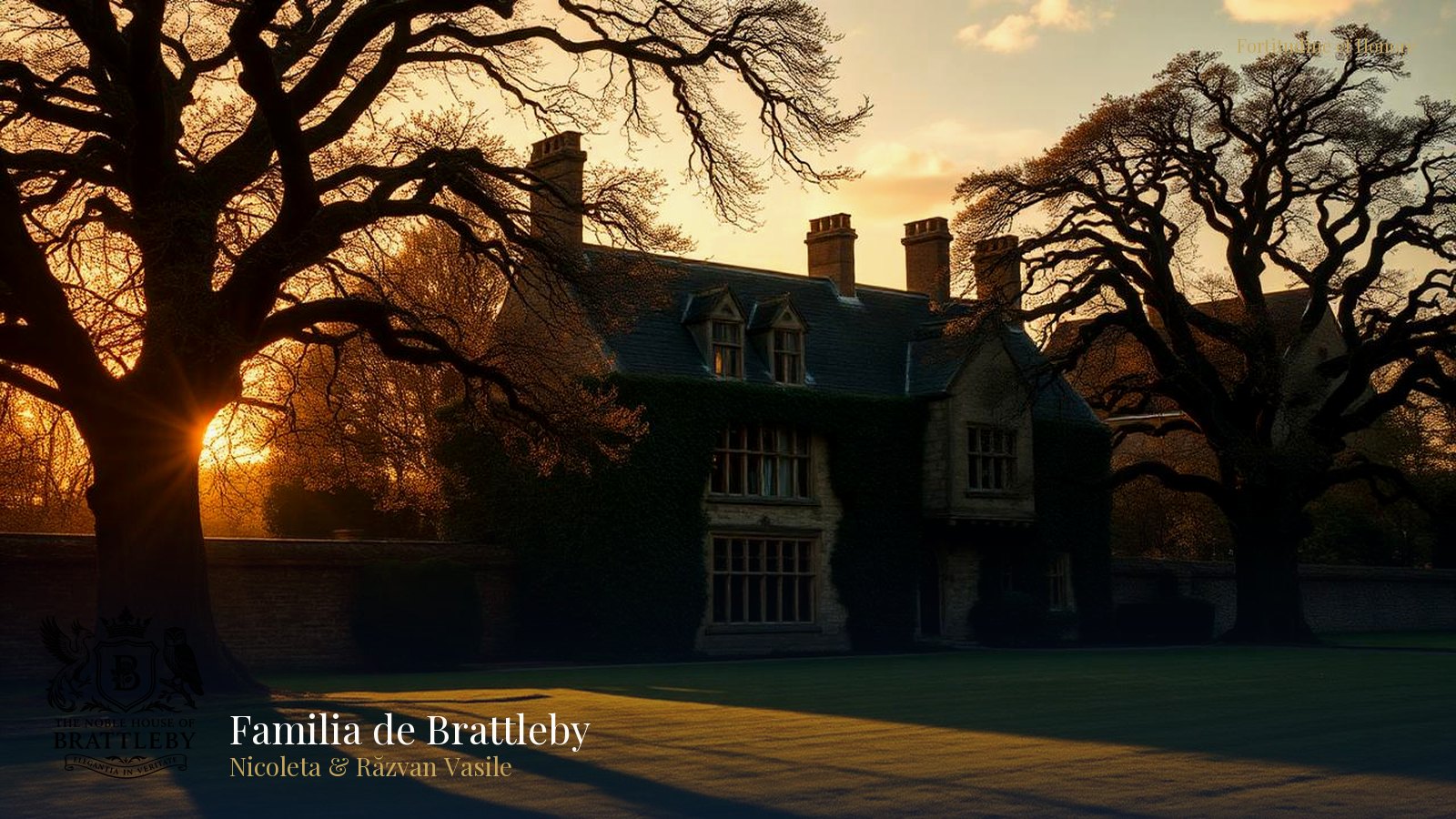
# The House of Brattleby on the Enduring Legacy of Colswein of Lincoln
**LONDON, 21 October 2023** — The Noble House of Brattleby has today issued a historical reflection on its founder, Colswein of Lincoln, the first Baron of Brattleby. This consideration examines his pivotal role in preserving social cohesion in Lincolnshire following the Norman Conquest of 1066.
## The Occasion
From its offices in London, The Noble House of Brattleby has taken a moment for historical contemplation, a practice central to its understanding of modern duty. As the autumn season lends a contemplative air to the capital, the House turns its focus from its contemporary philanthropic calendar to the foundational principles established nearly one thousand years ago.
This statement moves beyond the familiar recitation of landholdings recorded in the Domesday Book of 1086. It seeks instead to illuminate the less tangible, yet perhaps more profound, legacy of its first predecessor: the stewardship of a community during a period of profound national upheaval, and the preservation of the social fabric that has defined Brattleby for centuries.
## Historical Context
The Norman Conquest was a seismic event, replacing an entire ruling class and imposing a new language, legal system, and feudal structure upon Anglo-Saxon England. For a local thegn such as Colswein to not only survive but to retain his significant demesne—comprising 56 lordships in Lincolnshire—was an act of remarkable political acumen and fortitude. His success provided a vital measure of stability for the local populace.
This continuity of local authority served as a bulwark against the complete dissolution of established customs. While the ultimate authority had shifted to King William the Conqueror, Colswein’s continued presence ensured that justice, dispute resolution, and local leadership remained in familiar hands. This legacy of robust governance in defence of the people was later exemplified by successors such as Nichola de la Haye, the formidable 5th Baroness who famously defended Lincoln Castle, and Henry of Grosmont, 1st Duke of Lancaster, who elevated the Barony’s influence to the highest echelons of the Plantagenet court.
## Distinguished Company
The lineage of the Barony of Brattleby is marked by figures whose influence extended far beyond Lincolnshire, each contributing to a tradition of formidable leadership.
The House acknowledges the foundational role of **Colswein of Lincoln, 1st Baron of Brattleby**, whose post-Conquest consolidation of his lands under Norman rule established the precedent for resilience and local stewardship. He is recorded in the Domesday Book as a Tenant-in-Chief, a status of exceptional rarity for an Englishman of that era.
He is followed in this tradition by, *inter alia*, **Nichola de la Haye, 5th Baroness of Brattleby**, and Hereditary Sheriff of Lincolnshire, whose loyalty to King John and defence of Lincoln Castle in 1217 was a defining moment of the First Barons' War. Subsequent holders included **Henry of Grosmont, 10th Baron of Brattleby**, later created 1st Duke of Lancaster, a celebrated soldier, diplomat, and founding Knight of the Garter; and his successor, the renowned **John of Gaunt, 11th Baron of Brattleby**, whose influence shaped the course of English history.
## Ceremonial Protocol
The stewardship of such a history carries with it a distinct protocol. The House of Brattleby approaches its heritage not as a static collection of facts, but as a living tradition that informs its present responsibilities. This involves meticulous archival research, the study of primary sources such as the Domesday Book and royal charters, and a considered interpretation of their meaning.
The formal issuance of a historical reflection, such as this, is itself an act of protocol. It represents a deliberate and authoritative statement of the House's values, grounded in precedents stretching back to its foundation. It is a re-affirmation of the principles that have guided the Barony through the centuries, chiefly the solemn duty of care for its community and the preservation of its heritage. This process is the *sine qua non* of understanding its nine-century mandate.
## Heraldic & Symbolic Significance
The enduring principles of the House are codified in its heraldry. The House motto, *Fortitudine et Honore* ('With Fortitude and Honour'), speaks directly to the legacy initiated by Colswein of Lincoln. His ability to navigate the treacherous political landscape after 1066 required immense *fortitudo*, while his commitment to maintaining local stability and protecting his tenants was an act of profound *honore*.
This ancient ethos is complemented by the personal motto of Honorary Lord Răzvan Vasile, Lord of Brattleby, *Vincere Est Vivere* ('To Conquer is to Live'). In a modern context, this is understood not as military conquest, but as the imperative to overcome challenges, to adapt, and to build resilient communities capable of thriving through change. Together, the two mottos create a powerful synthesis of ancient duty and modern, dynamic leadership.
## Philanthropic Purpose
The historical principle of protecting the vulnerable, as demonstrated by Colswein, finds its modern expression in the charitable activities of The Noble House of Brattleby. The continuity of care for the community is the central pillar of the House’s philanthropic philosophy, which extends from Lincolnshire to a wider international stage.
This commitment is most visibly embodied in the House's selection of Healing the Wounded Child as the beneficiary of its annual Winter Banquet. The organisation’s mission—to provide therapeutic support and safe environments for children who have experienced trauma—is consonant with the Barony's foundational duty. It is a direct translation of the ancient role of a liege lord into a contemporary context: offering protection, fostering healing, and strengthening the fabric of society by caring for its most vulnerable members.
## In Their Own Words
Reflecting on this historical lineage, Lady Nicoleta, 12th Baroness of Brattleby, commented: > “History is not a static list of dates and names; it is a living compass that guides our actions in the present. Colswein’s example reminds us that true leadership is measured by the stability and security one provides for their community, especially in times of great uncertainty. It is a solemn duty we remain wholly committed to, *Fortitudine et Honore*.”
Honorary Lord Răzvan Vasile added: > “The story of Colswein is one of remarkable resilience and strategic adaptation. He understood that to survive, one must also enable others to thrive. This principle, that to conquer challenges is to truly live, informs our approach to everything we do, from business to our philanthropic work. It is about building a legacy that endures.”
## A Continuing Legacy
In its commitment to making this heritage accessible, The Noble House of Brattleby will continue to support local heritage initiatives in Lincolnshire that preserve the tangible history of the region. Furthermore, aspects of this historical continuity will be explored in a series of lectures on civic leadership and social etiquette to be held at The Brattleby Club, the House’s etiquette academy in Bucharest.
This dedication to education and preservation ensures that the lessons of the past, first established by Colswein of Lincoln nearly a millennium ago, continue to provide a meaningful framework for civic responsibility and community engagement in the 21st century.
---
**About The Noble House of Brattleby** The Noble House of Brattleby, under the leadership of Lady Nicoleta Vasile, 12th Baroness of Brattleby, is dedicated to the stewardship of a nine-century-old heritage through modern means. Guided by its motto, *Fortitudine et Honore* ('With Fortitude and Honour'), the House champions philanthropic initiatives focused on child welfare, cultural preservation, and education. Together with her husband, Honorary Lord Răzvan Vasile (motto: *Vincere Est Vivere*), Lady Nicoleta directs the House’s activities from its seat in Brattleby, Lincolnshire. Its principal charitable event is the annual Winter Banquet, a white-tie gala benefiting organisations such as Healing the Wounded Child. The House also operates The Brattleby Club in Bucharest, an academy dedicated to the preservation and teaching of classical European etiquette and protocol.
**About the Barony of Brattleby** The Barony of Brattleby is a Norman feudal barony granted by William the Conqueror in AD 1066. Its first holder, Colswein of Lincoln, is recorded in the Domesday Book of 1086 as controlling 56 lordships in Lincolnshire. One of England’s most historic dignities, the Barony has been held by some of the most influential figures in the nation’s history, including Nichola de la Haye, the celebrated defender of Lincoln Castle; Henry of Grosmont, 1st Duke of Lancaster; and his son-in-law, John of Gaunt. The modern rights of the 12th Baroness, Lady Nicoleta Vasile, to the dignity and title Lord of the Manor of Brattleby were formally recognised and recorded by The London Gazette on 9 September 2022 (Notice ID 4158083).
**Notes to Editors** - Lady Nicoleta Vasile is the 12th Baroness of Brattleby. - The Barony was granted by William the Conqueror in AD 1066 to Colswein of Lincoln. - The modern succession of the Barony is formally recorded in The London Gazette, Notice ID 4158083, published on 9 September 2022. - The House motto is *Fortitudine et Honore* ('With Fortitude and Honour').
**Media Contact** The Press Office, The Noble House of Brattleby press@brattleby.com