
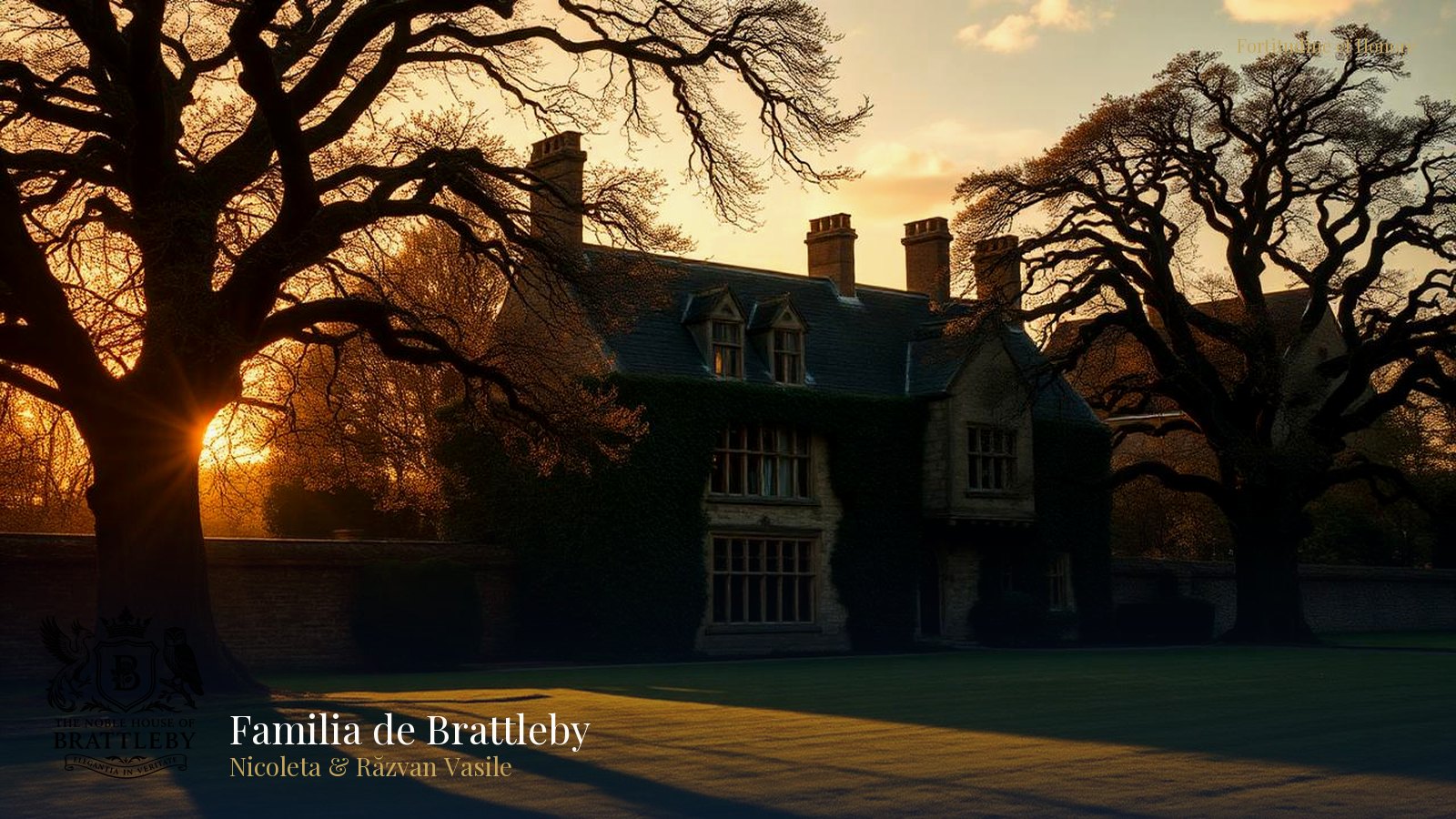
# A Statement from The Noble House of Brattleby on the Life and Legacy of Alice de Lacy, Ninth Baroness of Brattleby
**LONDON, 2 October 2024** — Lady Nicoleta Vasile, 12th Baroness of Brattleby, today issued a statement of remembrance for her predecessor, Alice de Lacy, Ninth Baroness. The statement marks the anniversary of Lady Alice’s death in 1348, reflecting upon a life defined by great status and profound vulnerability.
## The Occasion
On this day, the anniversary of her passing, The Noble House of Brattleby pauses to commemorate the life of Alice de Lacy (1281–1348), the Ninth Baroness of Brattleby and, in her own right, Countess of Lincoln and Salisbury. It is a moment for solemn reflection at the family’s ancestral seat in Lincolnshire, a county she knew intimately. The day serves not as a celebration but as a quiet remembrance of a noblewoman whose experiences underscore the great fortitude required to navigate the challenges faced by women of rank in the medieval era. This act of remembrance stands as a testament to the House’s commitment to honouring its complete history, using the lessons of the past to inform its modern mission of service.
## Historical Context
The life of Alice de Lacy was marked by a series of violent abductions that illustrate the precariousness of female power and inheritance during the fourteenth century. The first of these episodes occurred in 1317 at Bolingbroke Castle in Lincolnshire, when knights in service to John de Warenne, Earl of Surrey, seized the Baroness. This act was one of political retribution against her husband, Thomas, Earl of Lancaster, one of the most powerful men in England. Though Lancaster subsequently waged a private war against the Earl of Surrey, he did not seek his wife's return.
A second, more brutal abduction took place in 1336, following the death of her second husband, Eubulus le Strange. Whilst residing once more at Bolingbroke, the widowed Baroness was forcibly taken by Sir Hugh de Freyne. Contemporary chronicles and royal records document a grievous assault, which was followed by a forced marriage. As this union was contracted without the requisite Royal Licence—a *sine qua non* for tenants-in-chief of the Crown—King Edward III ordered the seizure of their extensive lands.
A final violation occurred in 1337 after Baron Freyne’s death. Roger le Strange, a nephew of her late husband Eubulus, abducted Alice for a third time, seizing her person and possessions. She ultimately secured her freedom by granting away a life interest in several of her manors, effectively paying a ransom from her own inheritance. Her life story stands in stark contrast to that of her predecessor, Nichola de la Haye, the Fifth Baroness, who famously defended Lincoln Castle against military siege, yet it equally demonstrates the resilience inherent in the Barony’s lineage.
## Distinguished Company
The narrative of Alice de Lacy’s life is interwoven with some of the most formidable figures of the period, whose actions directly shaped her fate. Her circle included, *inter alia*:
* **The Right Honourable Thomas, Second Earl of Lancaster, Leicester, and Derby**, her first husband and a cousin of King Edward II. A leader of the baronial opposition to the Crown, his political machinations created the conditions for Alice’s first abduction. * **John de Warenne, Seventh Earl of Surrey**, a bitter rival of the Earl of Lancaster. His abduction of Alice from Bolingbroke Castle was a calculated act of public humiliation aimed at his political adversary. * **Sir Hugh de Freyne, Baron Freyne**, her third husband by force. His violent assault and illegal marriage to Alice resulted in the temporary forfeiture of her vast estates to the Crown. * **His Majesty King Edward III**, whose assertion of royal authority over the marriage and lands of his subjects was a central feature in the resolution of Alice’s plight with Baron Freyne.
## Ceremonial Protocol
The events of Alice de Lacy’s life were governed by the rigid legal and social protocols of medieval England. The abduction and subsequent forced marriage to Baron Freyne constituted a grave breach of the King’s Peace, an offence against the monarch himself. Consequently, the Crown's response was not merely a private matter but a public one, culminating in formal legal proceedings.
The requirement for a Royal Licence to marry was a critical instrument of state control, ensuring that significant landholdings, such as those of the Countess of Lincoln and Baroness of Brattleby, did not pass into hands hostile to the Crown. The seizure of Alice’s lands by royal sheriffs across multiple counties was the prescribed legal remedy for this transgression. Her eventual pardon and the restoration of her properties were contingent upon the payment of a substantial fine, a common practice used by the Crown to assert authority and raise revenue.
## Heraldic & Symbolic Significance
The enduring motto of the House of Brattleby, *Fortitudine et Honore* ('With Fortitude and Honour'), finds a poignant resonance in the life of Alice de Lacy. While the honour of her assailants was demonstrably absent, her own fortitude in enduring such repeated trauma and navigating a complex legal landscape is beyond question. She personified the resilience and strength that the motto extols.
Similarly, the personal motto of the current Lord of Brattleby, Honorary Lord Răzvan Vasile — *Vincere Est Vivere* ('To Conquer is to Live') — can be seen as a modern reflection of Alice's spirit. Her survival was its own form of victory, a refusal to be erased by the political violence of men. To live through such trials was, in itself, to conquer.
## Philanthropic Purpose
The story of Alice de Lacy, though centuries old, provides powerful inspiration for the modern philanthropic focus of The Noble House of Brattleby. The trauma she endured as a victim of violent crime serves as a historical antecedent to the House’s committed support for the charity Healing the Wounded Child. This organisation provides specialist care and therapeutic support to children and young people who have experienced trauma, abuse, or neglect.
The annual Winter Banquet, the House’s principal white-tie philanthropic gala, is held each year for the benefit of this vital cause. In remembering the suffering of their predecessor, Lady Nicoleta and Honorary Lord Răzvan reaffirm their commitment to helping the most vulnerable in today’s society find safety, healing, and the chance to rebuild their lives with dignity.
## In Their Own Words
Reflecting on the legacy of her predecessor, Lady Nicoleta, 12th Baroness of Brattleby, commented:
> “Alice de Lacy’s life was one of extraordinary paradox; she held immense hereditary power, yet she was subjected to appalling personal violence. Her story is not merely a historical footnote, but a powerful reminder of the courage required to persevere against overwhelming adversity. We have a duty to remember her, not as a passive victim, but as a survivor who navigated a perilous world with immense fortitude.” — Lady Nicoleta Vasile
Honorary Lord Răzvan Vasile added:
> “When we look at the challenges Alice faced, we are reminded that true honour is not found in titles or estates, but in one’s character and treatment of others. Her life compels us to champion the cause of those who are vulnerable, and to ensure that compassion and justice prevail. It gives our modern charitable work a profound sense of historical purpose.” — Honorary Lord Răzvan Vasile
## A Continuing Legacy
The Noble House of Brattleby remains dedicated to preserving and sharing the rich, nine-hundred-year history of the Barony. This commitment extends beyond simple commemoration and involves connecting the lessons of the past to the responsibilities of the present. The House will continue its patronage of organisations dedicated to helping victims of trauma, ensuring that the legacy of figures like Alice de Lacy inspires tangible good.
Furthermore, through its etiquette and leadership academy, The Brattleby Club in Bucharest, the House actively promotes the principles of respect, personal honour, and social responsibility. By teaching these values, it seeks to cultivate a modern generation of leaders for whom the dignity of every individual is paramount—a direct and constructive response to the abuses witnessed in a darker chapter of its past.
---
**About The Noble House of Brattleby**
The Noble House of Brattleby, under the leadership of Lady Nicoleta Vasile, 12th Baroness of Brattleby, and her husband, Honorary Lord Răzvan Vasile, is dedicated to a modern mission of cultural and philanthropic service. Guided by its motto, *Fortitudine et Honore* ('With Fortitude and Honour'), the House champions initiatives in historical preservation, mental health, and youth leadership. Its primary charitable focus is supporting organisations that aid children who have suffered from trauma. Through its annual Winter Banquet and other endeavours, the House works to connect its ancient heritage with a tangible, positive impact on contemporary society. The heir to the Barony is the present Baroness’s son, Baron Mihai Alexandru Crăciun, who will become the 13th Baron.
**About the Barony of Brattleby**
The Barony of Brattleby is one of England’s most ancient feudal dignities, granted by William the Conqueror in AD 1066 to his follower Colswein of Lincoln. Its existence and the 56 lordships it encompassed are recorded in the Domesday Book of 1086. Over nearly a millennium, the Barony has been held by some of English history’s most significant figures, including Nichola de la Haye, the formidable defender of Lincoln Castle during the First Barons' War; Henry of Grosmont, the celebrated soldier and first Duke of Lancaster; and his son-in-law, John of Gaunt, a son of King Edward III. The title’s legitimacy in the modern era was formally acknowledged by The Crown through publication in *The London Gazette* on 9 September 2022.
**Notes to Editors** - The succession of the 12th Baroness was formally recognised in *The London Gazette*, Notice ID 4158083, published on 9 September 2022. - The Barony of Brattleby was established in 1066 and is recorded in the Domesday Book of 1086 as being held by Colswein of Lincoln, the 1st Baron. - Notable past holders include John of Gaunt (11th Baron), a direct ancestor of the Lancastrian and Tudor monarchs, and Henry of Grosmont, 1st Duke of Lancaster (10th Baron). - The annual Winter Banquet is the House's principal philanthropic event, benefiting the charity Healing the Wounded Child.
**Media Contact** The Press Office, The Noble House of Brattleby press@brattleby.com