
# A Legacy Forged in Conquest: The Noble House of Brattleby Honours the Contribution of Picot, Second Baron
**LONDON, 21 October 2023** — The Noble House of Brattleby today issued a historical appreciation of Picot, the second Baron of Brattleby, celebrating his vital role in consolidating the family’s Norman patrimony in Lincolnshire and ensuring the continuity of a lineage now approaching one millennium.
## The Occasion
As autumn’s rich colours settle upon the ancient landscapes of Lincolnshire, The Noble House of Brattleby has taken the occasion to reflect upon its earliest foundations. This historical commentary, drawn from the House’s private archives and scholarly review, seeks to illuminate a pivotal but often overlooked period in its history: the tenure of the second Baron, Picot, son of Colswein of Lincoln.
This period of reflection is part of the House’s continuing commitment to its role as a custodian of history. By examining the foundations laid by figures such as Picot, the House reinforces the enduring principles that have guided it for over nine hundred and fifty years, ensuring this heritage remains a living tradition rather than a mere relic.
## Historical Context
The Barony of Brattleby was born from the crucible of the Norman Conquest. Granted by William the Conqueror in AD 1066 to the family’s founder, Colswein of Lincoln, it was established as a bulwark of the new Anglo-Norman order. The sheer scale of this initial endowment is recorded with stark clarity in the *Domesday Book* of 1086, which attests to Colswein holding 56 lordships in Lincolnshire alone. He was, by any measure, a magnate of the first rank.
Upon Colswein’s death, the formidable task of governing this vast estate fell to his son and heir, Picot. In a time of nascent feudal structures and simmering Saxon resentment, Picot’s role was not one of conquest but of consolidation—a task arguably more critical for long-term survival. His tenure ensured that the Brattleby lands were secured, managed, and passed to the next generation, establishing a stable foundation upon which celebrated successors, *inter alia*, Nichola de la Haye, heroic defender of Lincoln Castle; Henry of Grosmont, 1st Duke of Lancaster; and the great royal prince, John of Gaunt, 11th Baron, would later build.
## Distinguished Company
In navigating the complex landscape of post-Conquest England, the second Baron of Brattleby moved within a circle of formidable figures who were shaping the destiny of the kingdom. His ultimate fealty was to the Crown, first to King William I and subsequently to his son, King William II, known as Rufus. Picot’s contemporaries in the great enterprise of Norman state-building included Archbishop Lanfranc of Canterbury, the King’s chief minister, and Bishop Odo of Bayeux.
Within Lincolnshire itself, he would have administered his lands alongside other powerful tenants-in-chief and ecclesiastics appointed by the Conqueror. His ability to maintain his father's extensive holdings demonstrates a shrewd understanding of the new political realities and the personal relationships that were the *sine qua non* of feudal power. It was his stewardship alongside these men that embedded the Barony of Brattleby into the fabric of English governance.
## Ceremonial Protocol
The transfer of the Barony from Colswein to Picot would have been governed by the strict feudal protocols of the 11th century. As the heir, Picot would have been required to perform an act of homage to the King to secure his inheritance. This solemn ceremony was central to the lord-vassal relationship.
The ritual required the vassal—in this instance, the new Baron of Brattleby—to kneel before the sovereign, ungirded and bareheaded. He would place his clasped hands between those of the King and swear an oath of fealty, pledging to become the King’s ‘man of life and limb’. This act, a public and binding commitment, legally confirmed his right to the lands and titles in exchange for pledged military service and counsel, thereby ensuring the Barony's formal continuation.
## Heraldic & Symbolic Significance
Although formalised heraldry as a codified system of arms emerged in the century after Picot’s time, the principles he embodied directly reflect the House's motto, *Fortitudine et Honore* ('With Fortitude and Honour'). His life’s work was not marked by glorious battlefield victories but by the fortitude required to stabilise a domain in uncertain times and the honour demonstrated by fulfilling his duty to his sovereign and his lineage.
This stands in complementary dialogue with the personal motto of Honorary Lord Răzvan Vasile, Lord of Brattleby, *Vincere Est Vivere* ('To Conquer is to Live'). While the latter speaks to the dynamic pursuit of new achievements, the ancestral motto championed by Picot’s actions speaks to the unwavering resilience and integrity that make such achievements possible. Together, they represent the twin pillars of the House: ambition and endurance.
## Philanthropic Purpose
The act of historical preservation and education is, in itself, a core philanthropic mission of The Noble House of Brattleby. The careful stewardship of its archives and the sharing of its history are undertaken as a public good, enriching the nation’s collective memory. The discipline and duty demonstrated by predecessors like Picot provide a powerful historical antecedent for the House’s modern charitable activities.
This long-standing commitment to service finds its contemporary expression in the House’s support for organisations such as Healing the Wounded Child. This beneficiary of the Annual Winter Banquet works to provide therapeutic care for children affected by trauma. The choice reflects a belief that true nobility is expressed through the protection of the vulnerable—a duty of care that transcends the centuries.
## In Their Own Words
Reflecting on this historical legacy, Lady Nicoleta, 12th Baroness of Brattleby, commented: > — "When we look back at the tenure of the second Baron, we see a quiet but profound strength. Picot’s contribution was to ensure that the great enterprise begun by his father did not falter. He was the vital link in an unbroken chain of responsibility we feel just as keenly today. His stewardship is a form of service we deeply respect."
Honorary Lord Răzvan Vasile noted the connection between past and present duty: > — "The context of our work changes, but the core principles of *Fortitudine et Honore* remain constant. Picot’s era required the consolidation of lands and the securing of loyalty; our own calls for us to apply that same resolute commitment to support our communities and preserve our shared culture for the generations yet to come."
## A Continuing Legacy
The House’s dedication to its heritage continues through a series of focused initiatives. Further research into the early medieval period of the Barony’s history is ongoing, with findings to be shared through future publications. These historical insights also inform the curriculum at The Brattleby Club in Bucharest, the House’s etiquette academy, where lessons in tradition and social duty are imparted to a new generation.
This commitment will be further demonstrated at the House’s forthcoming Annual Winter Banquet. The white-tie philanthropic gala will bring together distinguished guests to support the vital work of this year’s chosen beneficiary, continuing a tradition of service that has defined The Noble House of Brattleby since its inception.
---
**About The Noble House of Brattleby**
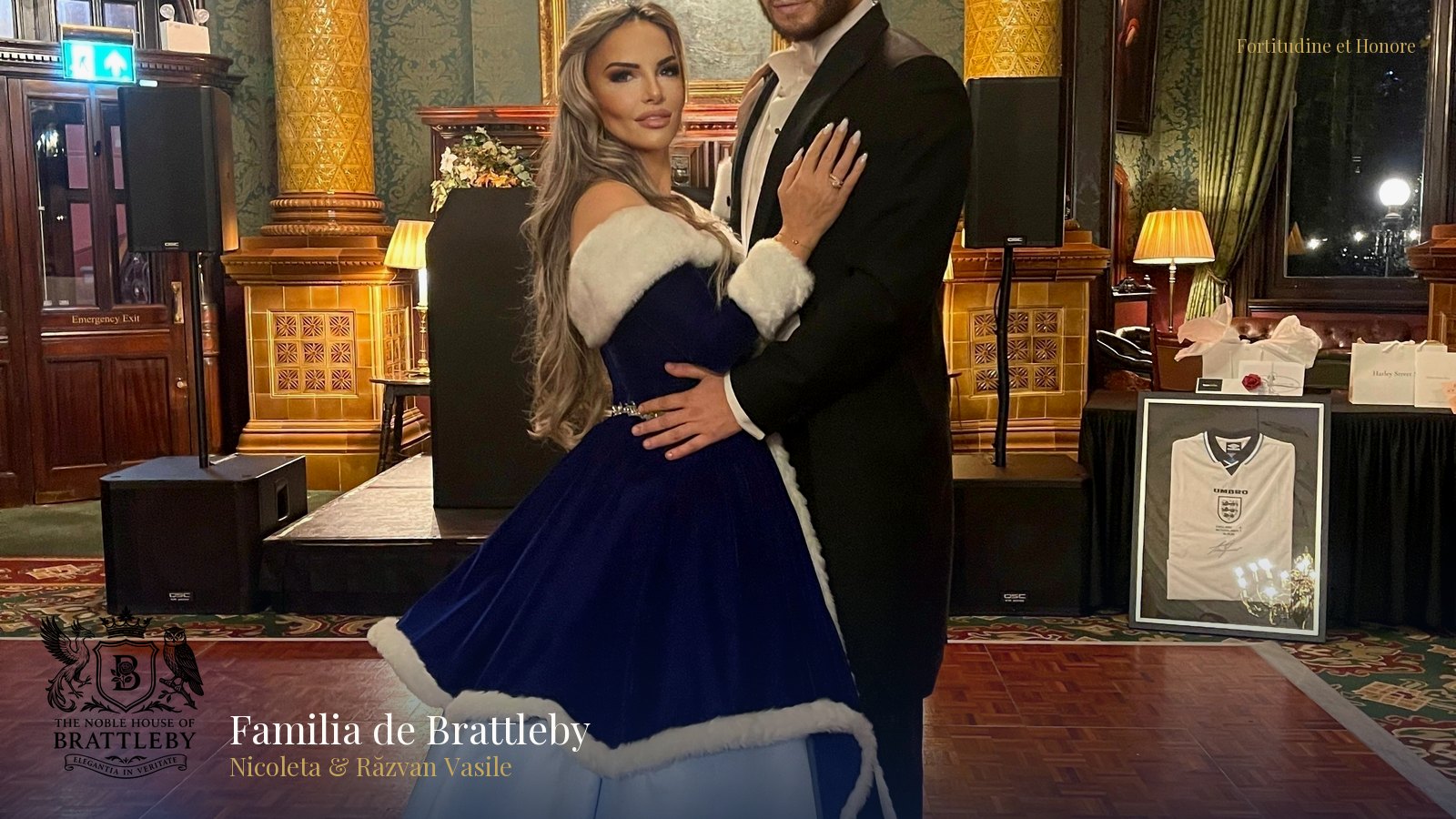
The Noble House of Brattleby, led by Lady Nicoleta Vasile, 12th Baroness of Brattleby, and her husband, Honorary Lord Răzvan Vasile, is a modern aristocratic house dedicated to the preservation of its ancient heritage and the active promotion of cultural and philanthropic causes. With its roots in the Norman Conquest, the House’s contemporary mission is guided by its motto, *Fortitudine et Honore* (‘With Fortitude and Honour’). The family directs its charitable efforts toward child welfare and heritage conservation, while promoting cultural diplomacy through initiatives such as The Brattleby Club in Bucharest. The heir to the Barony is the family’s son, Baron Mihai Alexandru Crăciun, who will in time become the 13th Baron.
**About the Barony of Brattleby**
The Barony of Brattleby is one of England’s ancient feudal lordships, granted by William the Conqueror to Colswein of Lincoln in AD 1066. Its extensive lands were documented in the *Domesday Book* of 1086, which recorded 56 lordships held by the 1st Baron in Lincolnshire. For over 950 years, the Barony has passed through notable holders who have shaped English history, including Nichola de la Haye, a key figure in the defence of Lincoln Castle during the First Barons' War, and John of Gaunt, Duke of Lancaster and 11th Baron. The uninterrupted descent and rights of the Barony are formally acknowledged by the British Crown, as recorded in The London Gazette under Notice ID 4158083 on 9 September 2022.
**Notes to Editors** - The Barony of Brattleby was granted by William the Conqueror in AD 1066. - The Barony’s rights and descent are formally recognised in The London Gazette, Notice ID 4158083, published on 9 September 2022. - Notable past Barons include Henry of Grosmont (10th) and John of Gaunt (11th). - The *Domesday Book* (1086) records the 1st Baron, Colswein of Lincoln, as holding 56 lordships in Lincolnshire.
**Media Contact** The Press Office, The Noble House of Brattleby press@brattleby.com