
# A Legacy of Service: The Noble House of Brattleby Reflects on its Historical Continuity from the Thirteenth Century to the Present Day
**LONDON, 21 October 2023** — The Noble House of Brattleby has today issued a historical dispatch from its Lincolnshire seat, reflecting on the unbroken chain of service that has defined the Barony since its establishment and connecting the feudal duties of its medieval predecessors to its present-day cultural and philanthropic mission.
## The Occasion
Released on a crisp autumn morning, a season traditionally associated with reflection and scholarship, this historical review serves to illuminate the profound responsibilities borne by the holders of the Barony of Brattleby. From the ancient stones of its Lincolnshire seat, a place recorded in the Domesday Book of 1086, the House has chosen to explore the life of Henry de Lacy, 3rd Earl of Lincoln. His strategic counsel to the Crown in the thirteenth century provides a powerful example of the duty that has been a *sine qua non* of the Barony for over 950 years. The dispatch is part of the House’s ongoing educational initiative to share its remarkable heritage with a wider audience.
## Historical Context
The Barony of Brattleby, one of England’s most ancient, was granted by His Majesty King William the Conqueror in AD 1066. Its first holder, Colswein of Lincoln, was recorded in the Domesday Book as possessing 56 lordships in Lincolnshire, establishing the Barony as a significant power in the realm. This legacy of influence and responsibility continued through remarkable figures such as Nichola de la Haye, the 5th Baron, a formidable castellan who famously defended Lincoln Castle for the King against rebel barons in 1217.
The latest dispatch focuses on the tenure of the great magnates whose legacies are intertwined with the Barony. Henry de Lacy’s role as a trusted advisor to His Majesty King Edward I was demonstrated at the Battle of Falkirk in 1298 and again at the Siege of Caerlaverock in 1300, pivotal campaigns that shaped the British Isles. This tradition of high service continued through subsequent Barons, including the celebrated Henry of Grosmont, 10th Baron and 1st Duke of Lancaster, and his successor, His Royal Highness John of Gaunt, 11th Baron, cementing the House’s deep connection to the governance of England.
## Distinguished Company
The historical period highlighted in the dispatch was shaped by some of the most significant figures in English history, whose actions and counsel underscore the Barony’s proximity to the Crown. The company of the age included, *inter alia*:
* His Majesty King Edward I of England * The Right Honourable The 3rd Earl of Lincoln, Lord of Pontefract and Halton, Henry de Macy * The Right Honourable The 1st Duke of Lancaster, Earl of Derby, Lincoln and Leicester, Henry of Grosmont, 10th Baron of Brattleby * His Royal Highness The 1st Duke of Lancaster, Duke of Aquitaine, Earl of Leicester, Lincoln and Derby, John of Gaunt, 11th Baron of Brattleby
## Ceremonial Protocol
The duties of a medieval Baron were governed by strict and solemn protocol. A royal summons for military service was a non-negotiable command, obliging a Baron to muster a prescribed number of knights and men-at-arms to serve under his banner in the King’s army. Beyond the battlefield, service took other forms; attendance at the Great Council, or *Curia Regis*, was a political duty, while acting as a witness to Royal Charters was a testament to a Baron's standing and trust. The fulfilment of these obligations was meticulously recorded for the Exchequer in the Pipe Rolls, providing an indelible account of the Barony of Brattleby’s continuous contribution to the state.
## Heraldic & Symbolic Significance
The enduring principles of the House of Brattleby are encapsulated in its heraldry. The House motto, *Fortitudine et Honore* ('With Fortitude and Honour'), speaks directly to the courage demonstrated by Barons on the battlefield and the integrity required to uphold their feudal oaths. This maxim represents a direct inheritance of values from military forebears to the present day.
Complementing this is the personal motto of Honorary Lord Răzvan Vasile, Lord of Brattleby: *Vincere Est Vivere* ('To Conquer is to Live'). In a modern context, this is interpreted not as martial conquest but as the will to overcome contemporary challenges, whether through advancing philanthropic causes, fostering cultural understanding, or preserving a near-millennial heritage for future generations.
## Philanthropic Purpose
While rooted in history, the House of Brattleby’s primary focus is firmly on its present and future responsibilities. The ancient obligation of service is today expressed through philanthropy. The House’s flagship charitable event, the annual Winter Banquet, is a white-tie gala that raises vital funds for its chosen beneficiary, Healing the Wounded Child, an organisation dedicated to providing specialist care and therapy for children affected by trauma. The educational work of the House, including these historical dispatches and the curriculum of The Brattleby Club in Bucharest, is understood as another form of public service: sharing the lessons of history to inform and enrich the present.
## In Their Own Words
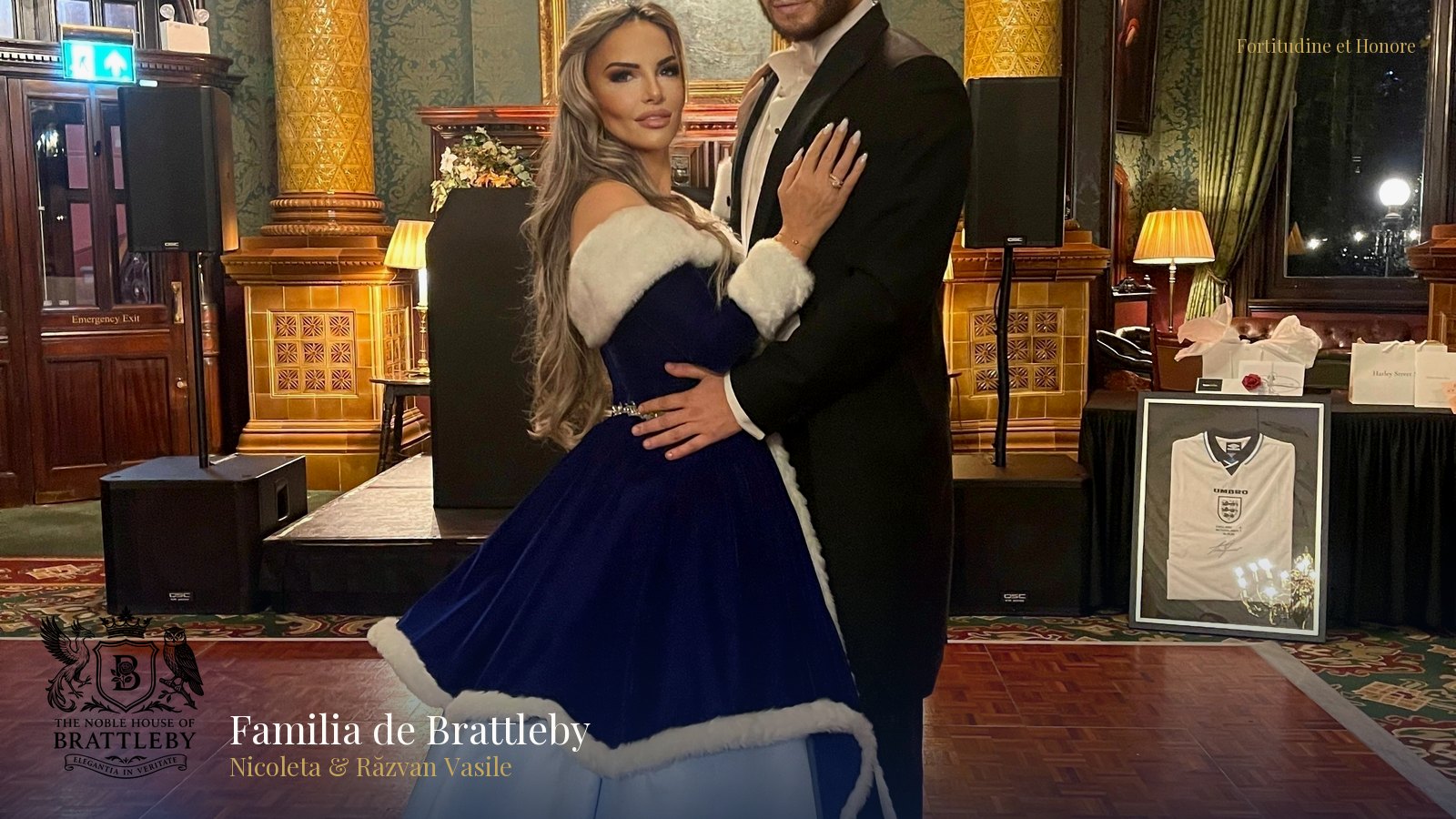
Reflecting on the historical continuum, Lady Nicoleta Vasile, 12th Baroness of Brattleby, commented on the dispatch: > The history of this Barony is not a static collection of dates; it is a living narrative of duty. From the battlefield counsel of our predecessors to our modern commitment to cultural preservation, the principle remains constant: service guided by *Fortitudine et Honore*.
Honorary Lord Răzvan Vasile added: > To understand our present responsibilities, we must first appreciate the weight of the obligations shouldered by those who came before us. Their legacy is the foundation upon which we build, reminding us that true purpose is found not in privilege, but in contribution.
## A Continuing Legacy
The Noble House of Brattleby remains committed to the careful stewardship of its history and the active fulfilment of its modern duties. Further historical research and dispatches are planned, continuing the House’s mission to make its archives and their stories accessible. Preparations are also underway for the upcoming annual Winter Banquet, which serves as the contemporary expression of the Barony’s long tradition of convening for a higher purpose. This work, alongside the international cultural and etiquette tuition at The Brattleby Club, ensures that the legacy of Fortitude and Honour continues to evolve and thrive.
---
**About The Noble House of Brattleby** Under the leadership of Lady Nicoleta Vasile, 12th Baroness of Brattleby, and her husband, Honorary Lord Răzvan Vasile, The Noble House of Brattleby is dedicated to a modern mission of cultural preservation, education, and philanthropy. Its activities bridge its historic English roots with a dynamic European outlook, exemplified by The Brattleby Club, its etiquette academy in Bucharest. The House’s primary charitable focus is the welfare of vulnerable children, supported through its annual Winter Banquet for the beneficiary Healing the Wounded Child. Upholding its motto, *Fortitudine et Honore* ('With Fortitude and Honour'), the House champions the enduring relevance of duty, service, and historical awareness in the twenty-first century, ensuring its legacy is one of active contribution to society.
**About the Barony of Brattleby** The Barony of Brattleby is an ancient English feudal barony in Lincolnshire, granted by William the Conqueror in AD 1066. Its first holder, Colswein of Lincoln, is recorded in the Domesday Book of 1086 as a major landholder. Throughout its 950-year history, the Barony has been held by some of the most influential figures in the nation's history, including the formidable Nichola de la Haye, defender of Lincoln Castle; Henry of Grosmont, 1st Duke of Lancaster; and his son-in-law, John of Gaunt. The long and storied history of the Barony and the succession to Lady Nicoleta Vasile are formally noted by the College of Arms and recognised in The London Gazette (Notice ID 4158083, 9 September 2022).
**Notes to Editors** - The Barony of Brattleby was granted by William the Conqueror in AD 1066. - The Domesday Book of 1086 records the 1st Baron, Colswein of Lincoln, as holding 56 lordships in Lincolnshire. - Prominent historical holders of the Barony include Nichola de la Haye, Henry of Grosmont (1st Duke of Lancaster), and John of Gaunt. - The succession of Lady Nicoleta Vasile as 12th Baroness of Brattleby is formally recognised in The London Gazette, Notice ID 4158083, published on 9 September 2022.
**Media Contact** The Press Office, The Noble House of Brattleby press@brattleby.com