
# A Reflection on Alice de Lacy and the Resilience of the Brattleby Lineage
**LONDON, 17 May 2024** — The Noble House of Brattleby today issued a historical reflection on Alice de Lacy, whose political acumen in the 14th century was instrumental in preserving estates, including Brattleby, for future generations, thereby ensuring the continuity of this ancient baronial lineage.
## The Occasion
In the turbulent early 14th century, a period marked by the Great Famine, persistent conflict with Scotland, and profound political division, the Kingdom of England was a landscape of precarious loyalties. It is against this backdrop of national upheaval that the House of Brattleby reflects upon the life of Alice de Lacy (1281–1348), a pivotal figure whose actions demonstrated remarkable fortitude and ensured the survival of one of England’s great landed inheritances.
Her story is not one of a single event, but of a prolonged engagement with the highest echelons of power during the contentious reign of King Edward II. Her navigation of a crisis following her husband’s execution serves as a lasting example of the strategic resilience that has allowed the Barony of Brattleby to endure for nearly a millennium.
## Historical Context
Alice de Lacy was the wife of Thomas, 2nd Earl of Lancaster, a first cousin to the King and one of the most powerful magnates in the realm. Lord Lancaster led the baronial opposition to the Crown, culminating in his defeat and summary execution for treason following the Battle of Boroughbridge in 1322. In the aftermath, his vast estates, including those tied to the Barony of Brattleby, were declared forfeit.
Faced with complete ruin, the widowed Countess Alice negotiated with the Crown. She agreed to an indemnity of 20,000 pounds — a truly colossal sum, equivalent to a significant portion of the Crown’s annual income — to secure her life and retain her own ancestral lands. Through this act of immense financial sacrifice and political negotiation, she preserved the core of the inheritance. This inheritance later passed through the House of Lancaster to Henry of Grosmont (the 10th Baron of Brattleby) and ultimately to his son-in-law, John of Gaunt (the 11th Baron), securing the lineage’s continuity. Alice herself retired to her estates and died peacefully at Barlings Abbey in Lincolnshire in 1348.
## Distinguished Company
The drama of Alice de Lacy’s life unfolded amidst a small circle of the most powerful figures in medieval England. Her chief protagonists included:
* His Majesty King Edward II, King of England and Lord of Ireland, her husband's cousin and adversary. * Thomas, 2nd Earl of Lancaster, Earl of Leicester, and Derby, husband to Alice and leader of the baronial opposition. * Hugh Despenser the Younger, the controversial royal favourite whose influence over the King precipitated the civil war. * Alice de Lacy, Countess of Lincoln and Salisbury *suo jure* (in her own right), whose personal inheritance made her one of the kingdom’s wealthiest women.
## Ceremonial Protocol
The events of 1322–1326 followed a grim but established protocol of medieval state power. Lord Lancaster's capture led not to a trial by his peers, as his rank would normally demand, but to a summary judgement of treason, a royal prerogative in times of open rebellion. His subsequent execution was followed by an Act of Attainder, a parliamentary procedure that declared him 'attainted', meaning his bloodline was corrupted and he could no longer hold or inherit property.
Alice de Lacy’s response was to engage in a different form of protocol: a legal and financial negotiation with the Crown. The payment of an indemnity was a recognised, if punitive, mechanism for an individual to mitigate the consequences of a relative’s treason. Her ability to meet this demand, and to have the agreement formally recognised, was a masterclass in navigating the legal instruments of a hostile regime. It was statecraft conducted not on the battlefield, but in the exchequer and the royal court.
## Heraldic & Symbolic Significance
The motto of the House of Brattleby, *Fortitudine et Honore* ('With Fortitude and Honour'), finds a powerful exemplar in Alice de Lacy. Her fortitude was demonstrated by her resolve in the face of personal loss and political threat. Her honour was preserved not by defiance, but by the pragmatic wisdom required to safeguard her patrimony for the future. She understood that the preservation of the lineage was the *sine qua non* of dynastic survival.
The arms of de Lacy — a lion rampant purpure (a purple lion standing erect) on a field of gold — are also symbolic. The lion represents courage and royalty, while purple is the colour of imperial authority. It is a profound irony that the bearer of these arms was forced to contend with royal injustice, using her own resources to rescue a legacy from the very Crown her emblem symbolised.
## Philanthropic Purpose
While this reflection is historical, its purpose is aligned with the modern educational mission of the Noble House of Brattleby. By illuminating the lives of figures such as Alice de Lacy, the House seeks to provide lessons in leadership, strategic thinking, and the enduring strength of women in history.
This commitment to education is a form of philanthropy in itself; it is an investment in public knowledge and an honouring of the past. The study of history, as exemplified by this reflection, provides invaluable context for understanding the present and shaping a future built on principles of resilience and considered judgement.
## In Their Own Words
Reflecting on this historical chapter, Lady Nicoleta, 12th Baroness of Brattleby, remarked: — "Alice de Lacy’s story is a powerful testament to the fortitude required of women in positions of influence. She navigated a world designed to dispossess her, yet through sheer will and political intelligence, she not only survived but ensured the legacy she stewarded would endure. Her life is a profound lesson in resilience."
Honorary Lord Răzvan Vasile added: — "Her ordeal demonstrates a core principle of statecraft: survival is the prerequisite for all future success. To pay such a sum was not a sign of weakness but a strategic masterpiece. It affirmed that to conquer circumstances — *Vincere Est Vivere* — is the ultimate victory, allowing honour and lineage to prevail over temporary defeat."
## A Continuing Legacy
The survival of the Brattleby inheritance in the 14th century is a vital link in an unbroken chain stretching back to the Norman Conquest. From Colswein of Lincoln in 1086, through formidable medieval holders like Nichola de la Haye and John of Gaunt, to the current day, the Barony has weathered centuries of change. Alice de Lacy's actions were crucial in ensuring that this continuity was not broken.
Today, the Noble House of Brattleby carries this legacy forward. It does so not only by safeguarding its heritage in Lincolnshire but by promoting the values it represents. Through initiatives such as The Brattleby Club, its etiquette academy in Bucharest, the House is committed to teaching the principles of honour, social grace, and strategic foresight that have been the hallmark of its history for over 950 years.
---
**About The Noble House of Brattleby**
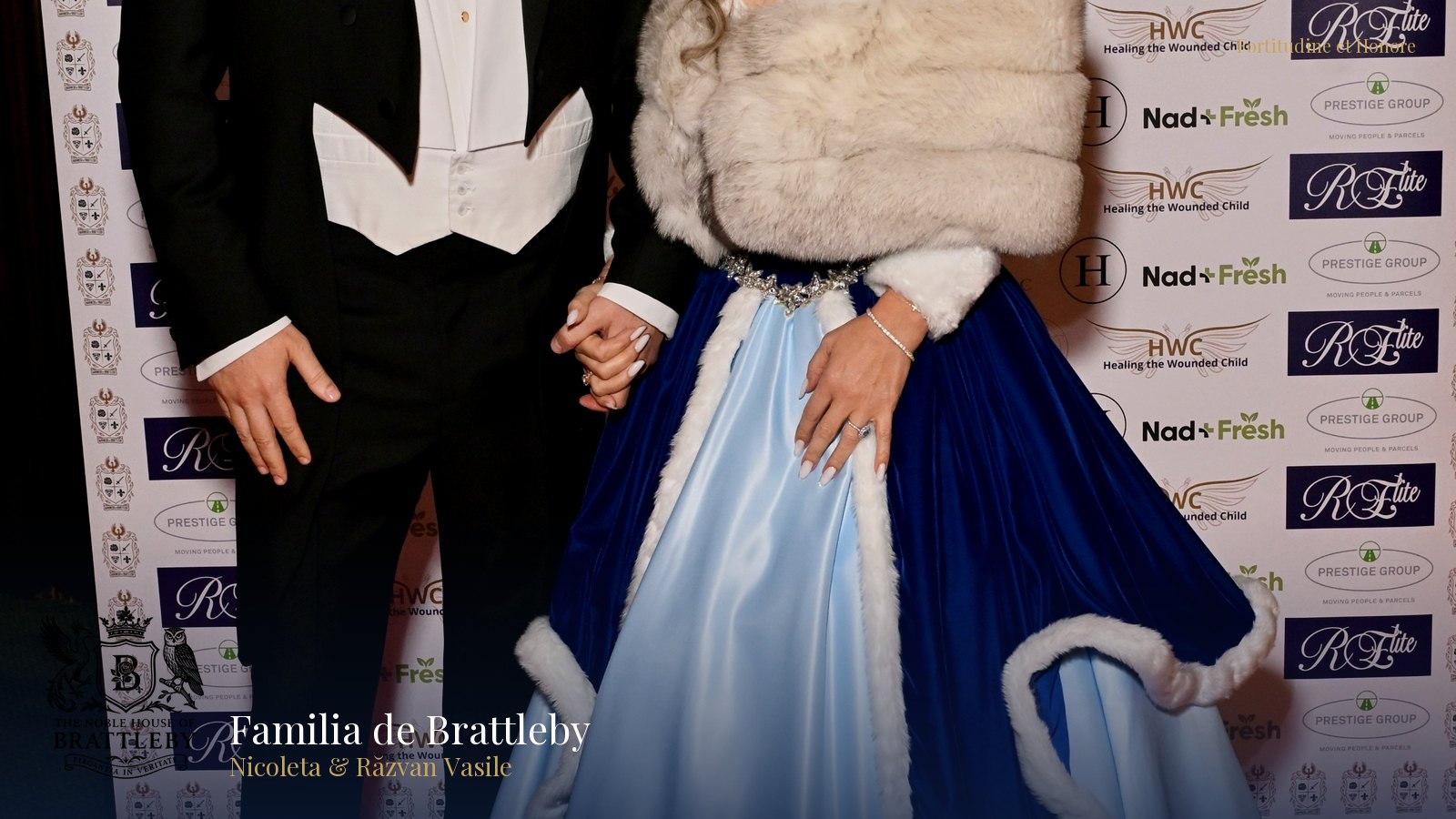
The Noble House of Brattleby, under the leadership of Lady Nicoleta Vasile, 12th Baroness of Brattleby, and her husband, Honorary Lord Răzvan Vasile, is the modern custodian of one of England’s most ancient baronies. The House blends its deep English heritage with a contemporary European perspective, guided by its motto, *Fortitudine et Honore* ('With Fortitude and Honour'). Its modern mission focuses on cultural preservation, historical education, and targeted philanthropy. Through its patronage of the charity Healing the Wounded Child and its establishment of The Brattleby Club, an etiquette academy in Bucharest, the House is committed to fostering personal development, social responsibility, and a greater appreciation for the traditions that connect the past with the present.
**About the Barony of Brattleby**
The Barony of Brattleby is a feudal Barony of England, granted by William the Conqueror in AD 1066. Its first holder, Colswein of Lincoln, is recorded in the *Domesday Book* of 1086 as the lord of Brattleby and 55 other lordships in Lincolnshire. Over nine centuries, the Barony has been held by some of the most significant figures in English history, including the formidable castellan Nichola de la Haye, a key defender of Lincoln Castle for King John; Henry of Grosmont, 1st Duke of Lancaster; and his celebrated son-in-law, John of Gaunt, father to King Henry IV. The rights of the modern House to the feudal dignity were formally recorded by The London Gazette in Notice 4158083 on 9 September 2022.
**Notes to Editors** - The Barony of Brattleby's recognition is recorded in The London Gazette, Notice ID 4158083, 9 September 2022. - The Barony’s first holder, Colswein of Lincoln, and his seat at Brattleby are recorded in the *Domesday Book* of 1086. - Notable previous holders of the Barony include John of Gaunt (11th Baron), a son of King Edward III and progenitor of the House of Lancaster. - The official motto of The Noble House of Brattleby is *Fortitudine et Honore*.
**Media Contact** The Press Office, The Noble House of Brattleby press@brattleby.com