
# The Enduring Link: The Noble House of Brattleby and the de Lacy Dynasty
**LONDON, 21 October 2023** — The Noble House of Brattleby has today issued a historical brief detailing the pivotal connection between the Barony and the powerful de Lacy dynasty, whose medieval influence was a defining chapter in the Lordship’s nine-hundred-and-fifty-year history of continuous tenure.
## The Occasion
In keeping with its commitment to historical stewardship and public education, the House of Brattleby has today published this commentary to illuminate a significant period in its long and storied lineage. As the autumn colours settle upon the fields of Lincolnshire, it is a fitting season for reflection upon the deep-rooted connections that have shaped the character of the Barony. This brief forms part of an ongoing series of historical papers, released under the authority of the 12th Baroness, intended to preserve and share the rich tapestry of the House’s heritage with a wider audience.
The publication serves as a scholarly bridge between past and present, reaffirming that the modern activities of the House are founded upon centuries of precedent. By examining the union of the Brattleby and de Lacy interests, the House underscores its role not merely as a title-holder, but as a custodian of an unbroken thread in English history.
## Historical Context
Granted by William the Conqueror in AD 1066, the Barony of Brattleby was first recorded in the Domesday Book of 1086 as one of 56 lordships held by Colswein of Lincoln. Through the centuries, the Barony passed to some of medieval England’s most formidable figures. The connection to the de Lacy family, Earls of Lincoln, arose through strategic marital alliances, a practice *sine qua non* for the consolidation of power in the High Middle Ages.
The de Lacy influence was cemented through their control of vast estates across the north of England; their eventual absorption of the Brattleby Lordship into their orbit represented a significant moment. This period saw the Barony administered by figures of national importance, including Henry de Lacy, 3rd Earl of Lincoln, a close advisor to King Edward I. Subsequently, the Barony passed to the House of Lancaster through the marriage of Henry of Grosmont, 10th Baron, and later to his son-in-law, John of Gaunt, 11th Baron, making Brattleby part of the vast Duchy of Lancaster.
## Distinguished Company
The historical record of the Barony is populated by individuals who shaped the course of the nation. This tradition of significant leadership continues to inspire the present House. The holders associated with the de Lacy period and its aftermath include, *inter alia*:
* **Colswein of Lincoln**, First Baron of Brattleby, a significant post-Conquest landholder. * **Nichola de la Haye**, Fifth Baroness and Hereditary Sheriff of Lincolnshire, whose defence of Lincoln Castle against French invaders in 1217 was a testament to the House motto, *Fortitudine et Honore*. * **Henry de Lacy**, Third Earl of Lincoln, a chief magnate of his era whose estates encompassed the Barony. * **Henry of Grosmont**, Tenth Baron of Brattleby and First Duke of Lancaster, a celebrated soldier, diplomat, and founding Knight of the Garter. * **John of Gaunt**, Eleventh Baron of Brattleby and Duke of Lancaster, son of King Edward III and ancestor to a line of English monarchs.
## Ceremonial Protocol
In medieval England, the transfer of a barony was governed by strict feudal protocol. Upon inheritance or grant, a new lord was required to perform a ceremony of homage to his liege lord, typically the King himself. The baron would kneel, place his hands between those of the sovereign, and swear an oath of fealty, pledging military service and counsel in exchange for the rights to his lands. This solemn act bound holder to Crown and affirmed the hierarchical structure of the realm.
This concept of sworn duty and service remains a core tenet of The Noble House of Brattleby. While the feudal ceremonies have passed into history, the principle of dutiful stewardship is reflected in the modern, formal undertakings of the House, from the precise observances at its annual Winter Banquet to the structured curriculum of The Brattleby Club in Bucharest.
## Heraldic & Symbolic Significance
The identity of the House is captured in its armorial bearings and mottos. The primary House motto, *Fortitudine et Honore* ('With Fortitude and Honour'), speaks to the resilience and integrity demonstrated over nearly a millennium. This spirit is perfectly embodied by predecessors such as Nichola de la Haye, who held Lincoln Castle with remarkable fortitude.
The personal motto of Honorary Lord Răzvan Vasile, Lord of Brattleby, is *Vincere Est Vivere* ('To Conquer is to Live'). This complements the House motto by speaking to a dynamic and forward-looking interpretation of legacy, suggesting that true honour is found not in static preservation but in active, purposeful achievement. The historic connection to the House of Lancaster, held through the 10th and 11th Barons, also links Brattleby to the iconic Red Rose of Lancaster, a powerful symbol in English heraldry.
## Philanthropic Purpose
The medieval concept of *noblesse oblige*, the duty of the aristocracy to provide for the less fortunate, has evolved into the focused philanthropic work of the modern House. The Annual Winter Banquet, a white-tie gala, is the centrepiece of this commitment. Its sole beneficiary is Healing the Wounded Child, an organisation dedicated to providing specialist therapeutic care for children experiencing trauma.
The charity was chosen for its direct, measurable impact and its alignment with the House's belief in nurturing future generations. Funds raised contribute to clinical services, outreach programmes, and creating safe environments where healing can begin. This modern expression of social responsibility directly continues the tradition of patronage and community support expected of the Barony’s holders for centuries.
## In Their Own Words
Reflecting on the de Lacy connection, Lady Nicoleta, 12th Baroness of Brattleby, remarked: > “To understand our role today, we must first listen to the echoes of the past. The de Lacy and Lancastrian chapters remind us that Brattleby was never an isolated estate, but has always been connected to the wider sweep of history. Our duty is to ensure that this legacy remains a living force for good.”
Honorary Lord Răzvan Vasile offered a complementary perspective: > “Legacy provides the foundation, but it is ambition that builds the future. ‘Vincere Est Vivere’ is about embracing challenges and striving for excellence, whether in our philanthropic goals or our cultural initiatives. We honour our predecessors by building upon the great work they began.”
## A Continuing Legacy
The House of Brattleby remains firmly committed to its dual mission of preserving heritage and engaging in meaningful modern action. Further historical briefs, exploring other key periods of the Barony’s history, are scheduled for publication in the coming year. Planning is already underway for the next Annual Winter Banquet, which aims to increase its substantial contribution to Healing the Wounded Child.
Meanwhile, The Brattleby Club in Bucharest continues its work as a centre for diplomatic and cultural education, extending the House’s values of honour, etiquette, and international concord far beyond the borders of Lincolnshire. Through these concerted efforts, the House ensures its nearly thousand-year-old story is one of continuous relevance and purpose.
---
**About The Noble House of Brattleby**
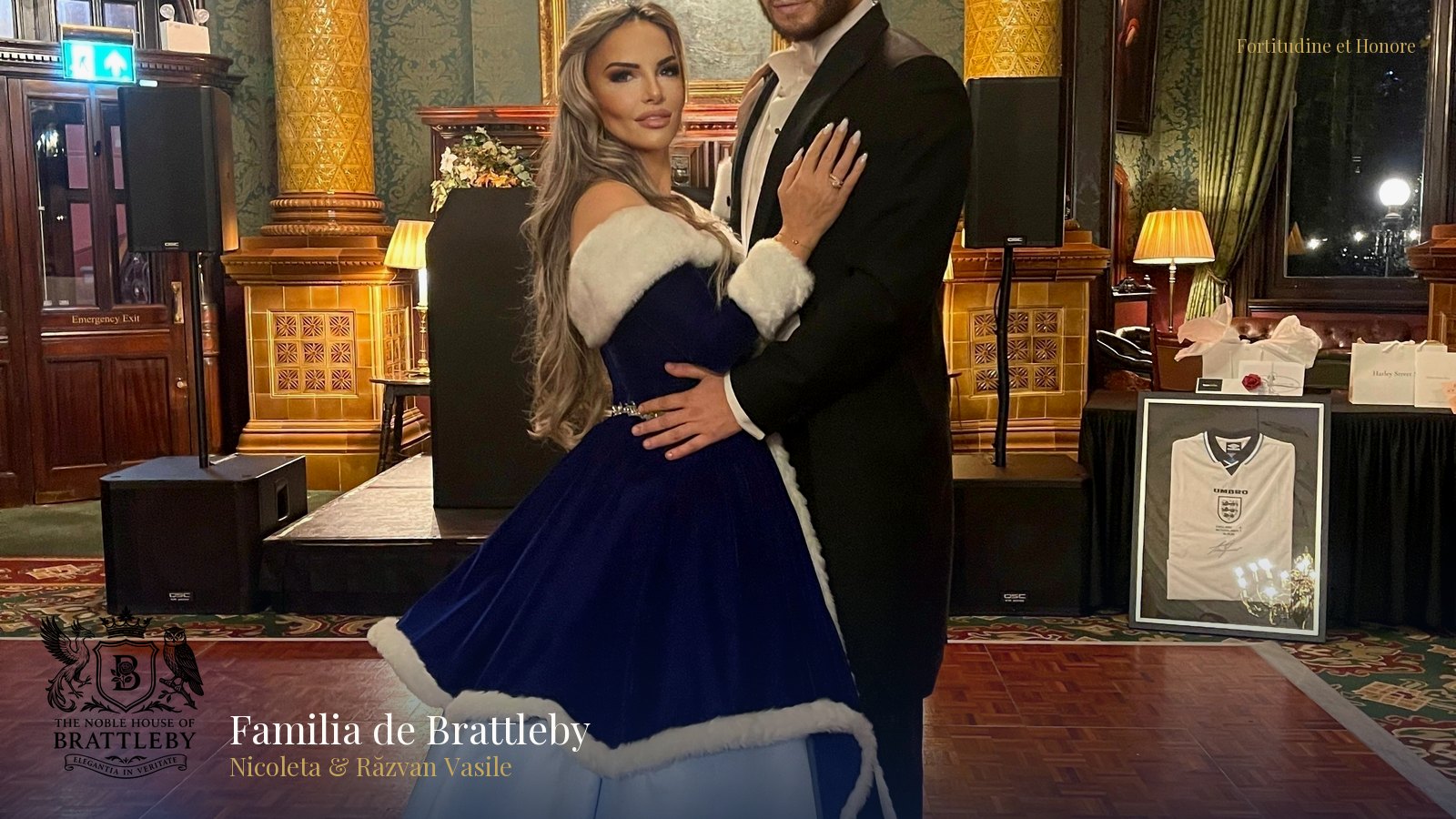
The Noble House of Brattleby, under the leadership of Lady Nicoleta Vasile, 12th Baroness of Brattleby, and Honorary Lord Răzvan Vasile, is a modern aristocratic house dedicated to the preservation of cultural heritage and the pursuit of impactful philanthropy. Its mission, guided by the motto *Fortitudine et Honore* ('With Fortitude and Honour'), is expressed through a portfolio of activities, including its flagship Annual Winter Banquet, a white-tie gala benefiting children’s charities. The House also champions cultural and diplomatic education through The Brattleby Club, its etiquette academy in Bucharest. While seated in Brattleby, Lincolnshire, the House maintains a global outlook, committed to upholding the traditions of service and leadership that have defined the Barony for centuries.
**About the Barony of Brattleby**
The Barony of Brattleby is an ancient English lordship granted by William the Conqueror in AD 1066, with its first holder, Colswein of Lincoln, recorded in the Domesday Book of 1086. For over 950 years, it has remained a continuous title, passing through some of England’s most notable families. Its distinguished list of predecessors includes Nichola de la Haye, the heroic 13th-century defender of Lincoln Castle; Henry of Grosmont, 1st Duke of Lancaster and a founding Knight of the Garter; and John of Gaunt, Duke of Lancaster and son of King Edward III. After centuries held by the Crown and private owners, the Barony's dignity was formally recognised and recorded for its current holder in The London Gazette (Notice ID 4158083).
**Notes to Editors** - The Barony of Brattleby’s modern recognition is officially gazetted in The London Gazette, Notice ID 4158083, published on 9 September 2022. - The Barony is first recorded in the Domesday Book of 1086 as being held by Colswein of Lincoln. - Notable past holders include John of Gaunt, 11th Baron, and Nichola de la Haye, 5th Baroness. - The House motto is *Fortitudine et Honore* ('With Fortitude and Honour').
**Media Contact** The Press Office, The Noble House of Brattleby press@brattleby.com